Specifying heavy copper—boards with 4 oz/ft² or thicker layers—is rarely done for light-duty applications. It is a decision driven by a specific thermal management challenge: moving massive current through a limited space without compromising the board's integrity. Whether building EV motor controllers or renewable energy inverters, the physics remains the same.
Here is the catch: Standard online PCB calculators often fail to capture the reality of heavy copper.
Most designers instinctively grab a free calculator or a generic IPC chart, plug in the current, and size the trace. While effective for standard 1 oz logic boards, these tools rely on linear assumptions that break down at 4 oz, 10 oz, or heavier weights. Designing for high-power applications requires understanding how these boards actually behave electrically and thermally. The goal is to design for reality, avoiding the trap of a safety margin that is three times larger—and more expensive—than necessary.
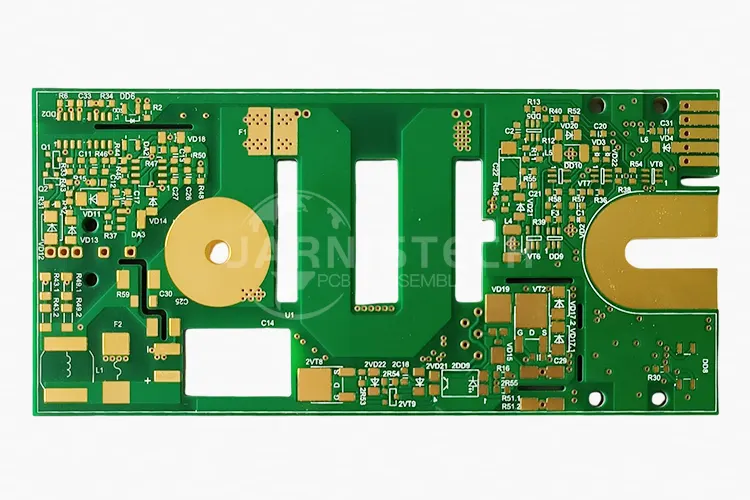
Why Standard Trace Width Calculators Mislead You
Generic calculation tools rarely account for the significant thermal mass of thick copper. Naively applying them to a heavy copper design yields overly conservative results, often suggesting trace widths that are practically impossible to route. Heavy copper alters the equation in two distinct ways: cross-sectional density and heat spreading.
1. The Geometric Reality
It is a matter of volume. A 1 mm wide trace on a standard 1 oz board might safely carry around 3 A. Take that same 1 mm width and plate it up to 4 oz, and the capacity jumps to 8–10 A. Standard calculators often ignore this vertical expansion, directing you to widen the trace horizontally. This wastes valuable board real estate.
2. The Heat Spreading Effect
Thick copper does not just conduct electricity; it acts as a highly efficient heat spreader. Unlike thin foil, a heavy copper layer dissipates heat laterally into the substrate and the surrounding environment with far greater efficiency. Empirical industry testing indicates that thick copper layers can improve heat dissipation efficiency by 30–50% compared to standard boards.
This means a heavy copper trace carrying a specific current will stabilize at a much lower temperature than a thin trace carrying the same load. Lab results often show that under a 10 A load, a 3 oz copper PCB can maintain a temperature rise significantly lower—sometimes by over 20 °C—than an equivalent 1 oz board. Standard linear estimates miss this cooling effect entirely. You aren't just thickening the wire; you are changing the thermal dynamics of the entire assembly.
Balancing Temperature Rise and Thermal Budget
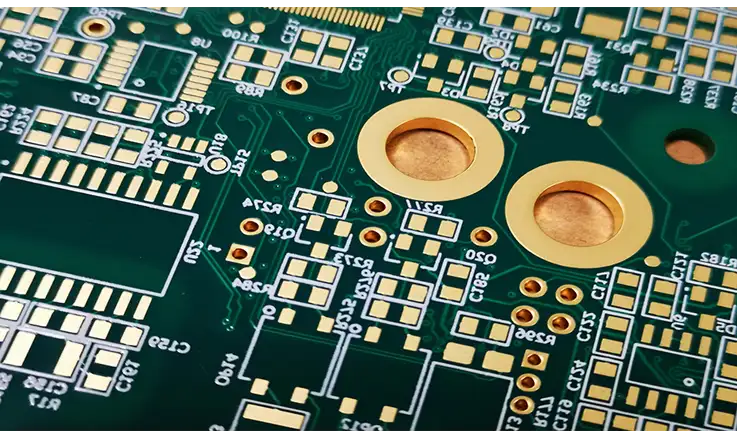
When sizing traces, the critical variable isn't the current itself—it is the temperature rise (ΔT) the design can tolerate. Current capacity is a sliding scale based on your "thermal budget."
Industry standards (IPC) typically suggest limiting trace temperature rise to 10 °C or 20 °C. While many power electronics designers treat 20 °C as a practical ceiling, mission-critical designs often adhere to 10 °C to minimize thermal stress.
Pushing beyond these limits introduces risk. While FR-4 material can technically survive a 100 °C rise, operating near that limit is dangerous. Approaching the glass-transition temperature (Tg)—often around 130 °C—degrades the resin system and invites delamination. Furthermore, extreme thermal cycles create expansion mismatches between the copper and the substrate, eventually snapping via barrels or lifting pads.
The operating environment must dictate the limit:
- Sealed Enclosures: If the PCB sits in a sealed housing with zero airflow, derating is mandatory. A common rule of thumb is to reduce current capacity by 20–30%. The trace heat cannot be allowed to compound an already high ambient temperature.
- Active Cooling: Designs with fans or open-frame structures can often safely target a 20 °C rise or higher. The heavy copper leverages the airflow to shed heat rapidly, allowing for narrower traces and higher density.
The impact of this decision is substantial. According to IPC-2221 data, a 10 mm trace on 1 oz copper carries about 8.5 A with a 10 °C rise. Relaxing that constraint to a 60 °C rise allows the same trace to carry roughly 20.9 A. Heavy copper offers even more leeway, but the limit must be set by the enclosure's reality, not just the board's spec sheet.
Using IPC Standards for Safe Estimation
Guesswork has no place in high-power design. The industry relies on empirically derived formulas—specifically from IPC-2221 and IPC-2152—to provide safe baselines.
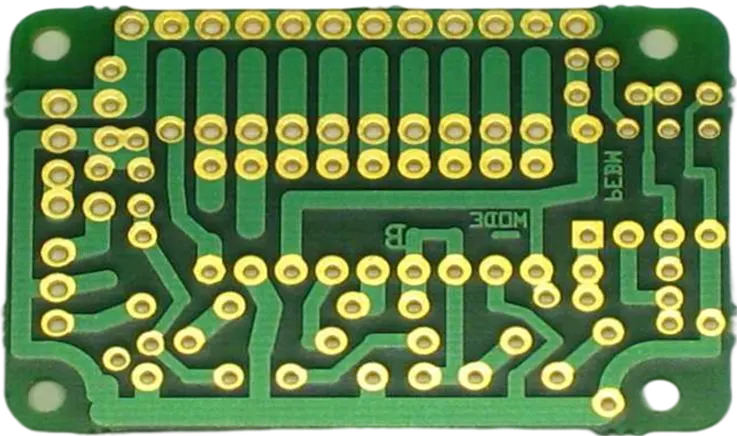
The classic IPC-2221A formula for external traces is:
I = 0.048 × (ΔT)^0.44 × (W × Th)^0.725
Where:
- I = Current (Amps)
- ΔT = Temperature Rise (°C)
- W = Width (mils)
- Th = Thickness (mils)
The exponents reveal the physics: there are diminishing returns on width (0.725), but reliable gains on allowable temperature rise (0.44).
Internal vs. External Layers
Crucially, this formula changes for internal layers. The constant drops from 0.048 to roughly 0.024, effectively halving current capacity. Internal traces are trapped between dielectric layers (insulators) and cannot shed heat to the air. Consequently, internal high-current buses typically require double the width of surface traces to match performance.
For heavy copper, many engineers prefer using reference charts derived from these formulas (covering up to 16 oz copper) rather than calculating manually. A quick check of a chart can confirm that a 0.25-inch trace at 8 oz copper handles the required load at a 20 °C rise.
Note: IPC-2221 is conservative as it assumes still air. IPC-2152 is newer and accounts for heat spreading into adjacent planes. If maximizing every millimeter of space is critical, use IPC-2152. If a safety buffer is preferred, stick to the conservative IPC-2221 numbers.
Verifying the Limits with an Experienced Heavy Copper PCB Manufacturer
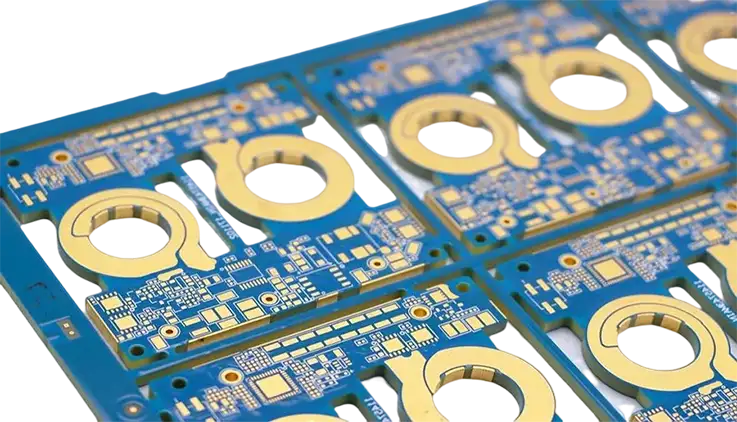
Calculations provide the theory; fabrication dictates the reality. Before freezing a heavy copper PCB design, engaging with the manufacturer is essential. Real-world processing introduces variables that spreadsheets cannot predict.
The "Undercut" Factor
The most significant variable is etch undercut. During production, the chemical etchant eats sideways into the trace as well as downwards. A general fabrication rule is that for every ounce of copper thickness, one might lose 0.25–0.5 mil of width from each side.
On a 10 oz board, this loss is substantial—potentially reducing width by 5 mils per side. This turns a designed rectangular trace into a trapezoid with significantly less cross-sectional area than calculated.
Etch Compensation & Solder Mask
Fabricators manage this via "etch compensation"—mechanically widening the traces on the production film to account for the loss. However, this requires them to know the current load requirements explicitly.
Additionally, applying solder mask over thick copper is tricky. The steep vertical step from the base laminate to the top of a thick trace can cause coverage gaps or "mask thinning" at the edges.
Discussion with the vendor should also cover:
- Neck-downs: A trace that narrows to fit between connector pins acts like a fuse. Manufacturers can flag these potential failure points.
- Plated Through Holes (PTH): Specifying a 6 oz board implies plated copper in the holes. This improves via ampacity but requires strict control of drill-to-copper ratios to prevent barrel cracking.
- Spacing Rules: Taller traces require wider clearance to prevent solder bridging and ensure complete etching.
This is where engaging a specialized heavy copper PCB manufacturer like JarnisTech becomes critical. Their engineering team typically reviews the design against thermal requirements and stack-up capabilities before the CAM stage. They verify whether thermal vias are needed in hot spots or if trace widths need pre-compensation to ensure the final physical board survives the etch process with the required ampacity intact.
Engineering books
Treat the vendor as a technical partner. Sharing target ampacity and thermal limits allows the math to be aligned with manufacturing capabilities, ensuring the board performs as predicted.