Every industrial facility that runs pumps eventually faces the same problem: mechanical seals fail. The question is not whether to deal with seal failures, but how much they are costing you — in downtime, in maintenance labor, in compliance risk, and in the consequences of fluid reaching places it should not.
The core question, then, is not whether magnetic drive pumps are good — they are, in the right context. The question is whether your specific application is one where their advantages matter enough to justify the switch.
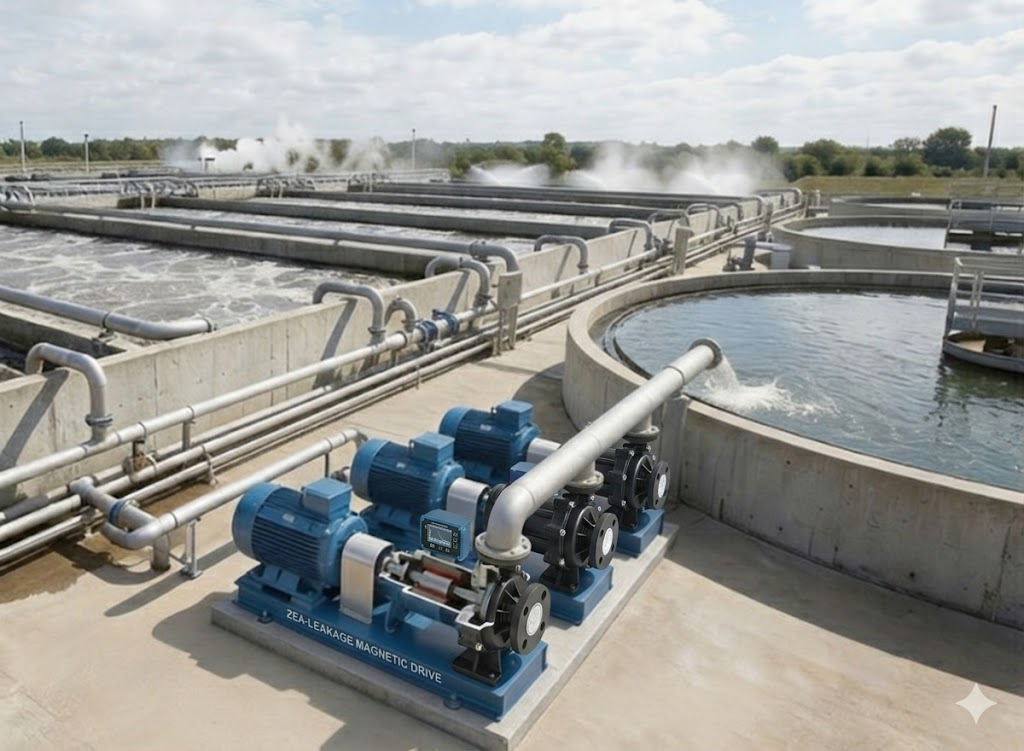
What’s Actually Being Solved in Mechanical Seal Failure
Mechanical seal failure is one of the most consistently expensive maintenance problems in process engineering. Industry estimates put rotating equipment seal failures among the top three causes of unplanned downtime in chemical and pharmaceutical plants — and unlike most equipment failures, seal degradation is not a question of if, but when.
In a conventional pump, the motor shaft passes through the pump casing and relies on a mechanical seal to keep fluid inside. That seal is the weak point. It wears down from friction, shifts under vibration, and degrades when exposed to aggressive chemicals. At some point, it leaks — and in many industrial settings, a leak is not just a maintenance problem. It is a safety event, a compliance failure, or a production loss.
Magnetic drive pumps eliminate the shaft penetration entirely. The motor drives an external magnet, which rotates an internal magnet connected to the impeller, with a sealed containment shell between them. The fluid never has a path out. There is no seal face to wear, no lubrication to maintain, no gradual degradation toward the next leak.
If seal failures have become a recurring issue in your operation, that context should directly shape the pump selection strategy. Magnetic drive pumps offer the greatest value in applications where any level of leakage is unacceptable rather than merely inconvenient.
When Magnetic Drive Pumps Are the Right Choice
The clearest case is when the fluid itself is the reason leakage is unacceptable. Acids, solvents, and toxic chemicals present obvious hazards if they escape the pump housing. In pharmaceutical and food-grade applications, even trace contamination from a weeping seal can compromise an entire batch or trigger a regulatory action. In these environments, the sealed containment design of a magnetic drive pump is not a feature — it is a requirement.
The second strong case is operational economics. If your maintenance team is replacing seals multiple times a year, each replacement involves labor, downtime, spare parts inventory, and the risk that the pump goes down at an inconvenient moment. Magnetic drive pumps have no seal to replace. They tend to run longer between service interventions, and when something does need attention, it is less likely to be urgent. For facilities that run continuously, or where downtime is expensive, this difference compounds over time. The upfront cost of magnetic drive equipment is typically higher, but the total cost over three to five years often favors it.
Material compatibility is a third consideration. Conventional seal materials degrade quickly in contact with corrosive fluids. Magnetic drive pumps are frequently built with wetted components made from ETFE, ceramics, or engineering plastics — materials chosen specifically for chemical resistance. ETFE magnetic drive pumps, for instance, are particularly well suited for concentrated acids and solvents that would destroy a standard seal in months. This makes them better suited for applications involving concentrated acids or solvents.
When Magnetic Drive Pumps Are NOT the Right Solution
Magnetic couplings have a torque limit. At very high pressures, the coupling can slip or decouple entirely — a condition sometimes called "decoupling" or "uncoupling" — which stops the pump without warning. For high-pressure applications, this constraint needs to be evaluated carefully against the manufacturer's specifications. A magnetic drive pump that operates near its torque limit is not operating safely, regardless of its other advantages.
Fluid properties also matter in ways that are easy to overlook. Fluids containing fine solid particles can damage the containment shell or erode the internal bearing surfaces, both of which are critical components in a sealless design. Ferromagnetic particles present a different problem: they can be attracted to and accumulate around the internal magnet, disrupting the magnetic coupling. If your fluid is anything other than a clean liquid, the pump selection needs to account for what happens to those solids inside the containment shell.
One operational vulnerability that often surprises engineers new to this technology is dry running. In a conventional sealed pump, running without fluid is damaging but usually survivable in the short term. In a magnetic drive pump, the fluid itself often provides the lubrication and cooling for the internal bearing surfaces. Running dry — even briefly — can cause rapid failure. If your process has any risk of the pump starting against an empty line, that needs to be addressed in the system design, not assumed away.
Finally, if your current sealed pumps are performing reliably with non-hazardous fluids, and seal replacement costs are low and infrequent, the economics may simply not support a change. The technology is not categorically better — it is better for a specific set of conditions.
How to Select a Magnetic Drive Pump
Identifying the right application is the first step. The second is understanding what a correct selection actually requires in practice — because most failures with this technology happen not from wrong specification, but from incomplete implementation.
Match the fluid first. The fluid must be clean, non-ferromagnetic, and within the viscosity range the pump's internal circulation can sustain. A portion of the pumped fluid continuously cools the magnets and lubricates the bearings — high-viscosity fluids restrict this flow, and low-boiling-point fluids can vaporize within the containment zone. Either condition produces the same result as running dry.
Verify pressure against the torque rating. Confirm that your operating pressure stays within the magnetic coupling's torque limit with adequate margin. A pump running near its decoupling threshold is not a pump you can rely on.
Build monitoring into the design, not the afterthought. A failing containment shell produces no visible warning. Power monitoring is the only reliable early signal — specify it before commissioning, not after the first failure.
Resolve dry-run risk at the system level. Most dry-run failures happen at startup or after maintenance, because the valve sequence and priming procedure were never designed with a sealless pump in mind. This needs a documented answer before the pump runs for the first time.
Understand the maintenance trade-off before procurement. Seal replacement is frequent and cheap. Containment shell failure is rare and expensive, and disassembly of strong magnetic components without proper tooling carries a genuine hand injury risk. The economics often still favor magnetic drive — but over a different time horizon than most procurement conversations acknowledge.
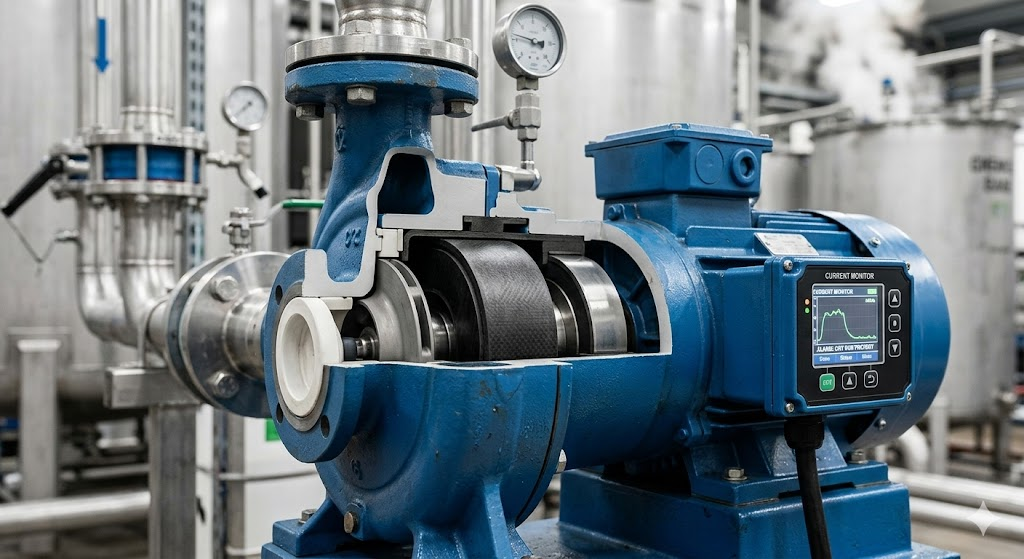
Key Specifications to Evaluate in Magnetic Drive Pumps
Not all magnetic drive pumps are built for the same conditions. Once you have confirmed that the technology fits your application, the specifications become the next filter.
Power rating determines flow and head capacity, but it does not tell the whole story. A pump rated at 0.2 HP and one rated at 7.5 HP are not simply scaled versions of each other — they serve fundamentally different process demands. Match the power rating to your actual flow and head requirements, not to the size of the equipment you are replacing.
Temperature rating defines the upper boundary of safe operation for both the containment shell material and the magnetic assembly. Most standard magnetic drive pumps handle fluids up to 90°C. Beyond that, material selection becomes critical — the same ETFE casing that performs reliably at moderate temperatures may behave differently under sustained thermal load. If your process runs hot, verify the rating against your actual operating temperature, not your nominal design temperature.
Material compatibility, which this article has addressed in terms of corrosion resistance, also has a thermal dimension. The combination of aggressive chemistry and elevated temperature is more demanding than either factor alone. When both are present, the specification review needs to treat them together.
How to Think About the Decision
The most useful frame is to ask what failure mode you can and cannot afford. Every pump design involves a trade-off between different failure risks. Mechanical seal pumps fail through gradual seal degradation, which is predictable enough to manage with planned maintenance — unless the fluid makes any leakage unacceptable. Magnetic drive pumps eliminate that failure mode but introduce others: coupling decoupling under overload, vulnerability to dry running, and sensitivity to certain fluid characteristics.
If the failure you cannot afford is leakage — because of the fluid's hazard level, your regulatory environment, or the consequences for product purity — then the trade-off clearly favors magnetic drive. If the failure you cannot afford is an unexpected shutdown at high pressure, you need to do more careful engineering before specifying this technology.
The decision is not about which pump is better in the abstract. It is about which failure mode your specific application is better positioned to handle.
Conclusion
Magnetic drive pumps have earned their place in industrial and process engineering because they solve a real and persistent problem. But their value is conditional on the right application. The engineers who get the most out of this technology are the ones who chose it because it fit the problem — not because it was the newer or more elegant solution.