Accurate site measurements are the starting point for successful construction, land development, infrastructure planning, and property boundary work. Before engineers design a roadway, developers plan a subdivision, or contractors begin grading, surveyors must collect reliable data about the land. That work depends heavily on using the right Land Surveying Equipment.
Modern surveying combines technical knowledge with specialized tools that measure distance, elevation, angles, and geographic position. Some tools are simple and familiar, while others use advanced digital and satellite-based technology. Together, they help surveyors create dependable site data that supports better planning and fewer costly mistakes. Many professionals who provide field surveying services rely on a mix of traditional instruments and modern systems to complete projects accurately and efficiently.
Understanding the purpose of each tool helps explain why equipment matters so much in surveying. The right setup can improve accuracy, speed, and consistency across a wide range of site conditions.
Why Land Surveying Equipment Is So Important
Surveying is more than measuring land. It is the process of capturing real-world conditions and turning them into useful information for design, construction, and legal documentation. If measurements are wrong, the consequences can be serious. Inaccurate data may lead to boundary disputes, grading issues, drainage problems, construction delays, or expensive redesigns.
Reliable Land Surveying Equipment helps professionals:
- Measure distances with precision
- Determine elevations and grade changes
- Establish property boundaries
- Record terrain features
- Support site design and construction layout
- Reduce manual errors
- Improve field efficiency
Because every project has different conditions and accuracy requirements, surveyors often use multiple tools together rather than relying on a single instrument.
What Equipment Is Used in Land Surveying?
Land surveying uses a wide range of tools, from basic field accessories to advanced electronic systems. The exact equipment depends on the type of survey being performed, such as boundary, topographic, construction, or control surveying.
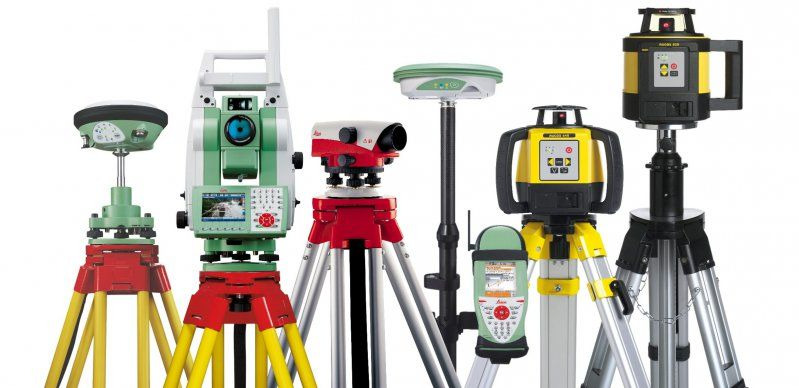
Common types of Land Surveying Equipment include:
- Total stations
- GNSS or GPS receivers
- Levels and leveling rods
- Theodolites
- Measuring tapes and wheels
- Prisms, poles, and tripods
- Data collectors
- Drones and aerial mapping tools
Each plays a specific role in collecting accurate information about a site.
Total Stations: A Key Tool in Modern Surveying
The total station is one of the most important pieces of modern Land Surveying Equipment. It combines an electronic theodolite with an electronic distance measuring device, allowing surveyors to measure both angles and distances from a single setup.
Total stations are widely used for:
- Boundary surveys
- Topographic mapping
- Construction staking
- Utility layout
- Road and infrastructure work
One reason total stations are so valuable is their balance of precision and efficiency. They allow surveyors to gather detailed measurements quickly, store the data digitally, and transfer it directly into mapping or design software. Robotic total stations take this a step further by allowing one person to operate the instrument remotely, which can save time in the field.
For many projects, the total station is the central tool that supports accurate site measurement.
GNSS and GPS Receivers
GNSS, often referred to generally as GPS surveying equipment, is another essential part of today’s surveying workflow. These receivers use satellite signals to determine highly accurate positions on the earth’s surface.
Survey-grade GNSS receivers are useful for:
- Establishing control points
- Mapping large sites
- Boundary location
- Route surveys
- General positioning tasks
Compared to everyday navigation devices, survey-grade GNSS systems offer much greater accuracy. They are especially effective on open sites where the receiver has clear access to satellite signals. On large or less obstructed properties, GNSS can help survey crews work more efficiently and cover more ground in less time.
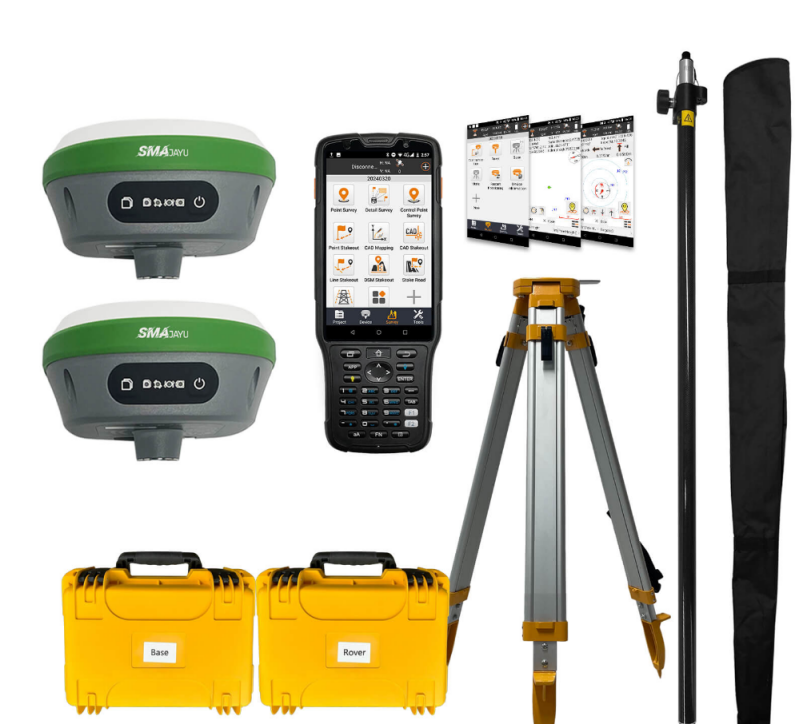
Still, GNSS is not ideal everywhere. Dense tree cover, tall buildings, and signal interference can reduce performance. That is why surveyors often combine GNSS with total stations and other tools to maintain dependable results.
Levels and Rods for Elevation Measurement
Elevation is a critical part of many surveying projects. Site grading, drainage design, road construction, and foundation work all depend on accurate vertical measurements. This is where levels and rods come in.
Automatic Levels
Automatic levels are commonly used to determine height differences between points on a site. They are dependable, practical, and widely used for construction and grading work.
Digital Levels
Digital levels increase precision by electronically reading a coded staff. They can improve speed and reduce reading errors on projects that require tighter elevation control.
Leveling Rods
A leveling rod, also called a grade rod or staff, works with the level to provide elevation readings. The combination allows surveyors to compare points and determine slope or height differences across the land.
These tools are especially important when proper drainage and finished grade accuracy are key project concerns.
Theodolites for Angle Measurement
Theodolites are classic surveying instruments used to measure horizontal and vertical angles. Before total stations became common, they were one of the main tools in the profession.
Today, theodolites are still used in some applications, including:
- Alignment work
- Engineering surveys
- Construction layout
- Angle-specific measurements
Although total stations now perform many of the same functions while also measuring distance, theodolites remain useful in certain field situations and continue to be an important part of surveying fundamentals.
Measuring Tapes and Wheels
Even with advanced equipment available, simple field tools still matter. Measuring tapes and measuring wheels remain useful for quick checks and short-distance measurements.
They are commonly used for:
- Verifying smaller dimensions
- Measuring offsets
- Supporting preliminary site work
- Double-checking field conditions
These tools are not a replacement for high-precision electronic instruments on major survey work, but they are still practical, portable, and helpful in daily field operations.
Survey Accessories That Support Accuracy
Some of the most important Land Surveying Equipment includes the accessories that help surveyors use instruments correctly.
Prisms
Survey prisms reflect signals from total stations so distances can be measured accurately. They are often mounted on poles and carried by field crew members.
Tripods
Tripods provide a stable base for total stations, levels, and theodolites. Stability is essential because even small movement can affect measurement accuracy.
Poles and Markers
Prism poles, range poles, stakes, and flags help surveyors identify points and maintain proper positioning during fieldwork. These simple tools are a basic but necessary part of efficient surveying.
Without these supporting items, even the most advanced equipment cannot perform properly.
Data Collectors and Survey Software
Modern surveying depends on more than field measurement alone. It also relies on digital data management. Data collectors are handheld devices that record measurements directly from instruments such as total stations and GNSS receivers.
They help surveyors:
- Store field points digitally
- Add descriptions and codes
- Reduce note-taking errors
- Organize data for office processing
Once field data is collected, survey software is used to process and convert it into usable deliverables. These may include topographic maps, boundary drawings, surface models, and layout files for construction. This digital workflow improves accuracy, saves time, and supports better coordination between surveyors, engineers, and project teams.
Drones in Land Surveying
Drones have become increasingly useful in modern surveying, especially for larger sites and topographic mapping. Equipped with high-resolution cameras or LiDAR systems, drones can capture aerial data quickly and efficiently.
They are often used for:
- Topographic surveys
- Site progress documentation
- Earthwork analysis
- Mapping hard-to-reach areas
- Creating orthomosaic images and 3D models
Drones do not replace all traditional methods, but they do add valuable speed and perspective. When used with ground control points and conventional survey instruments, they can improve productivity while still supporting accuracy.
What Are the Five Surveying Instruments?
When people ask, “What are the five surveying instruments?” they are usually referring to the core tools most associated with the profession. A practical list includes:
- Total station
- GNSS or GPS receiver
- Level
- Theodolite
- Measuring tape
These represent the main categories of equipment used to measure position, angle, elevation, and distance.
Choosing the Right Equipment for the Job
Not every site requires the same tools. Surveyors choose equipment based on project goals, site conditions, and required accuracy. A wooded property line survey may require a different setup than an open commercial site or a construction staking project.
Factors that influence equipment choice include:
- Site size and terrain
- Tree cover or building obstructions
- Type of survey required
- Accuracy standards
- Timeline and budget
- Needed deliverables
The best results come from using the right combination of tools for the specific conditions of the site.
Conclusion
Accurate measurements are the backbone of successful planning, design, and construction. The quality of those measurements depends heavily on the Land Surveying Equipment used in the field. From total stations and GNSS receivers to levels, prisms, data collectors, and drones, each tool plays an important role in capturing reliable site information.
As surveying technology continues to improve, the profession becomes more efficient and more precise. Still, the goal remains the same: to create an accurate understanding of the land so projects can move forward with confidence. When the right equipment is used properly, survey data becomes a strong foundation for better decisions and better outcomes.