PLC-based control systems have transformed the way industrial cranes operate on the factory floor. If you've worked with ladder logic or automation projects before, integrating a PLC with a single girder overhead crane is a natural next step — one that brings precise motion control, safety interlock logic, and IoT-ready data logging to one of the most common pieces of industrial lifting equipment.
In this guide, we'll walk through the full picture: from the mechanical fundamentals of single girder overhead cranes, to PLC I/O wiring, ladder logic programming, VFD integration, and real-world automation patterns used in manufacturing environments.
What Is a Single Girder Overhead Crane?
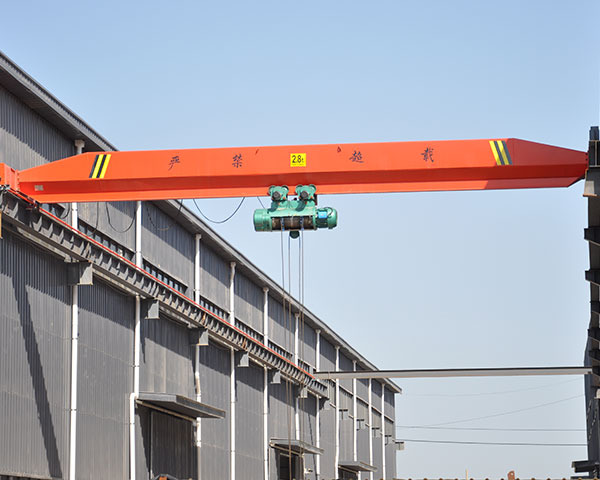
A single girder overhead crane (also called a single beam crane) consists of one main horizontal beam — the girder — supported at both ends by end trucks that run along elevated runway rails. A hoist and trolley assembly travels along the bottom flange of this single girder, allowing it to move loads in three dimensions: left-right (bridge travel), front-back (trolley travel), and up-down (hoist lift).
This stands in contrast to a double girder crane, which uses two parallel main beams and is typically used for heavier loads, higher lift heights, or when top-running hoists are required.
Key specs range:
- Capacity: typically 0.5 to 20 metric tons
- Span: 3 to 28 meters
- Lift height: customizable, commonly up to 12 meters
- Speed (hoist): 0.5 to 12 m/min, adjustable via VFD
Core Components of a Single Girder Overhead Crane
Understanding each component helps engineers troubleshoot problems, design load paths, and select appropriate equipment.
1. Main Girder (Bridge Beam)
The single girder is typically an I-beam (wide flange section) or a box beam made from structural steel. The choice depends on the span and load:
- Standard I-beam: cost-effective for short spans (under 10m), lighter duty
- Box girder: used for longer spans, offers better torsional rigidity and deflection control
A critical design parameter is the maximum allowable deflection, generally limited to L/888 under full rated load (per CMAA Specification No. 74), where L is the span length. For example, a 10-meter span crane should not deflect more than ~11 mm under full load.
2. End Trucks (Bridge Trucks)
End trucks are the assemblies at each end of the girder that contain the bridge wheels, which ride on the runway rails. They transmit vertical loads from the crane bridge to the runway structure. Key considerations include:
- Wheel load calculation (static + dynamic factors)
- Wheel-to-rail contact type (flat tread, tapered flange)
- Buffer stops and bumper design
3. Hoist and Trolley
The hoist is the lifting mechanism, while the trolley is the wheeled carriage that moves the hoist along the girder. In a single girder crane, the trolley typically runs along the lower flange of the I-beam.
Common hoist types:
- Electric chain hoist: lightweight, economical, suitable for loads up to ~5 tons
- Electric wire rope hoist: higher capacity, longer service life, better for frequent cycles
Engineers should verify that the hoist's Duty Classification matches the application (Class A through F per ASME B30.2 or FEM 1.001 classification).
4. Runway Rails and Structure
The runway consists of steel rails mounted on a building's structural columns or a freestanding structure. Rail selection (e.g., ASCE 40, 60, 80 lb/yard) must consider:
- Horizontal and vertical wheel loads
- Rail joint gaps for thermal expansion
- Alignment tolerances (critical for smooth operation and long wheel life)
5. Electrical System and Controls
Modern single girder overhead cranes integrate:
- Pendant control stations (pushbutton, with E-stop)
- Radio remote controls (wireless, line-of-sight operation)
- Variable Frequency Drives (VFD): enable variable speed control for hoist, trolley, and bridge, reducing shock loads and improving positioning precision
- Limit switches: hoist upper/lower limit, travel end stops
- PLC: the brain of automated crane systems — handles all motion sequencing, safety interlocks, and communication
PLC Control System for Single Girder Overhead Crane
This is where the real engineering fun begins. Replacing a traditional relay-based control panel with a PLC dramatically improves flexibility, diagnostics, and safety. Let's go through it step by step.
PLC Selection and Sizing
For a typical single girder crane, a mid-range PLC is more than sufficient. Popular choices include:
- Siemens S7-1200 / S7-300: widely used in European-standard crane OEMs
- Allen-Bradley MicroLogix 1400 / CompactLogix: common in North American facilities
- Mitsubishi FX3U / Q Series: popular in Asian manufacturing
- Delta DVP / AS Series: cost-effective for light-duty applications
I/O count estimate for a basic crane:
Signal | Type | Qty |
|---|---|---|
| Pendant pushbuttons (up/down/left/right/E-stop) | DI | 6–10 |
| Hoist upper limit switch | DI | 1 |
| Hoist lower limit switch | DI | 1 |
| Bridge travel end limits (×2) | DI | 2 |
| Trolley travel end limits (×2) | DI | 2 |
| Overload relay feedback | DI | 1 |
| Emergency stop chain | DI | 1 |
| Hoist motor contactor/VFD enable | DO | 2 |
| Bridge motor forward/reverse | DO | 2 |
| Trolley motor forward/reverse | DO | 2 |
| Alarm horn / beacon | DO | 1–2 |
| Load cell (4–20 mA) | AI | 1 |
| VFD speed reference (0–10 V) | AO | 1–3 |
| Header 1 | ||
A PLC with 24 DI / 16 DO / 2 AI / 2 AO covers a standard setup, with room to grow.
Wiring Overview
A clean wiring design is critical for crane reliability. Here's the typical signal path:
Pendant/Remote → PLC Digital InputsPLC Digital Outputs → VFD Enable / Motor ContactorsVFD Analog Input ← PLC Analog Output (speed reference 0–10V)Limit Switches → PLC Digital Inputs (and hardware interlock in VFD)Load Cell → PLC Analog Input (4–20 mA)E-Stop → Safety Relay → VFD STO (Safe Torque Off)
Critical wiring rules:
- Always wire limit switches in hardware in series with VFD enable, as a backup to PLC logic — never rely on software alone for safety limits
- Use shielded cable for all analog signals (load cell, speed reference) to prevent noise-induced errors
- E-stop should break the STO (Safe Torque Off) input on the VFD directly, not just signal the PLC, so the drive stops the motor even if the PLC freezes
- Use 24 VDC NPN or PNP digital I/O consistently — mixing types causes wiring headaches
Ladder Logic Programming
Below are the core logic blocks for a PLC crane control program. Examples use IEC 61131-3 Ladder Diagram notation, applicable to most PLC brands.
Block 1 — Hoist Up Control
|--[I: HOIST_UP_BTN]--[/I: HOIST_UPPER_LIMIT]--[/I: OVERLOAD]--[/I: ESTOP]--|| || (Q: HOIST_UP_OUT) |
Logic: Hoist Up button pressed AND upper limit not reached AND no overload AND E-stop not active → energize hoist up output.
Block 2 — Hoist Down Control
|--[I: HOIST_DN_BTN]--[/I: HOIST_LOWER_LIMIT]--[/I: OVERLOAD]--[/I: ESTOP]--|| || (Q: HOIST_DN_OUT) |
Block 3 — Bridge Travel with Anti-Collision
|--[I: BRIDGE_FWD_BTN]--[/I: BRIDGE_FWD_LIMIT]--[/I: ESTOP]--[/I: COLLISION]--|| || (Q: BRIDGE_FWD_OUT) |
Block 4 — Overload Alarm Latch
|--[I: OVERLOAD_RELAY]-----| (SET Q: OVERLOAD_ALARM)|--[I: RESET_BTN]---------| (RESET Q: OVERLOAD_ALARM)
The overload alarm latches and can only be reset manually — this prevents auto-restart under load, which could cause structural damage.
Block 5 — VFD Speed Reference (Analog Output)
// Function Block pseudocodeIF HOIST_UP_OUT OR HOIST_DN_OUT THEN IF SLOW_SPEED_MODE THEN AO_HOIST_SPEED := 2000; // 20% → low speed ELSE AO_HOIST_SPEED := 8000; // 80% → high speed END_IFELSE AO_HOIST_SPEED := 0;END_IF
VFD Integration for Smooth Motion
Pairing a VFD with each crane axis is the single biggest upgrade you can make:
VFD Parameter | Typical Crane Setting | Effect |
|---|---|---|
| Acceleration time | 2–4 seconds | Smooth start, reduces mechanical shock |
| Deceleration time | 2–5 seconds | Soft stop, prevents load swing |
| DC Brake time | 0.5–1.5 s | Holds load during stop (hoist axis) |
| Min frequency | 5–10 Hz | Prevents stall at very low speed |
| Max frequency | 50/60 Hz | Full speed limit |
| Motor overload current | 105–115% FLA | Electronic overload protection |
| Header 1 | ||
For the hoist axis, configure the VFD to use a mechanical brake release signal — the brake should only release after the VFD confirms motor torque is established, preventing load drop on start.
Safety Interlock Architecture
A crane PLC program is only as good as its safety interlocks. Use a layered approach:
Layer 1 — Hardware (always active, independent of PLC):
- Limit switches wired in series with VFD enable relay
- E-stop breaks VFD STO (Safe Torque Off) input directly
- Mechanical brake held by spring, released only when hoist motor is energized
Layer 2 — PLC software interlocks:
- Mutual exclusion: HOIST_UP_OUT and HOIST_DN_OUT cannot both be TRUE (use interlock rungs)
- Direction interlocks: bridge can only travel forward if forward limit switch is clear
- Overload latch: all motion disabled until operator manually resets after overload
- Optional sequence lock: hoist must be in raised position before bridge travel is permitted
Layer 3 — Diagnostics and fault logging:
- Log all limit switch activations with timestamps to PLC data log
- Monitor VFD fault codes via Modbus RTU/TCP, display on HMI
- Track total lift cycles for predictive maintenance scheduling
HMI Integration
For cranes in production environments, a touchscreen HMI adds significant operational value:
- Real-time load display from load cell (kg / tons)
- Crane position visualization (X/Y coordinates via encoders)
- Fault history log with timestamps
- Speed mode selection (maintenance mode = slow speed only)
- Maintenance counters (lift cycles, motor run hours)
- Remote diagnostics via OPC-UA or MQTT to SCADA/MES
Popular HMI platforms: Siemens KTP700, Allen-Bradley PanelView, Weintek MT8000, Delta DOP-B series.
Working Principle
The operation of a single girder overhead crane follows a straightforward electromechanical sequence:
- Operator input (pendant or remote) sends signal to control panel
- Control panel (PLC or relay logic) energizes the appropriate motor contactors or VFD
- Bridge drive motors (one or two, depending on design) rotate the end truck wheels, traversing the crane along the runway
- Trolley motor drives the trolley along the girder
- Hoist motor reels in or pays out the wire rope or chain, raising or lowering the load
The mechanical advantage in hoisting is achieved through the reeving of wire rope over sheaves — a 4-part line arrangement, for example, means 4 rope segments share the load, allowing a smaller motor to lift heavier weights at reduced speed.
Structural Design Considerations
Engineers designing or specifying single girder overhead cranes must account for several structural and dynamic factors.
Load Combinations
Per CMAA 74 and AISC standards, the crane's structural members must be checked under:
- Rated load + deadweight (static)
- Impact factors (dynamic amplification, typically +25% for hoist lifting)
- Horizontal inertia loads (braking, acceleration)
- Side thrust loads (skewing, misalignment)
Fatigue Analysis
For cranes with frequent lift cycles (warehouse, assembly lines), fatigue governs design. The girder welds, especially at end truck connections and runway bracket joints, are susceptible to cyclic fatigue failure. AISC fatigue categories (A through F) guide allowable stress ranges based on weld type and loading frequency.
Deflection Limits
Excessive deflection not only affects operational precision but can cause the hoist trolley wheels to "walk" laterally on the girder flange, accelerating wear. Engineers typically design for L/888 under working load, a standard across major crane standards.
Single Girder vs. Double Girder: When to Choose Which
Parameter | Single Girder | Double Girder |
|---|---|---|
| Capacity | Up to ~20 tons | 5 tons to 500+ tons |
| Headroom | Better (hoist hangs below beam) | Less (top-running hoist) |
| Initial Cost | Lower | Higher |
| Installation height | Lower (saves building height) | Requires more headroom |
| Hook approach (end) | Limited | Better |
| Maintenance access | Ground level | Walkway on girder |
| Span capability | Up to ~28 m | Up to 40 m and beyond |
| Header 1 | ||
For most light industrial applications — light manufacturing, warehousing, maintenance bays, and machine shops — a single girder crane offers the optimal balance of cost, performance, and installation simplicity.
Common Applications in Industry
Single girder overhead cranes are found across a wide range of industries:
- Automotive manufacturing: moving engine blocks, transmissions, and sub-assemblies between workstations
- Metal fabrication: lifting steel blanks, finished parts, and tooling
- Electronics factories: handling PCB assembly equipment and component reels with precision low-speed VFD controls
- Warehousing and logistics: unloading containers and stacking palletized goods
- Machine shops: loading/unloading CNC machining centers and mills
- Power plants: maintenance lifting of generators, transformers, and heavy equipment
- Construction precast yards: moving concrete elements during fabrication and yard storage
Safety Standards and Compliance
Engineers specifying cranes must ensure compliance with applicable safety codes:
- ASME B30.2 (USA): Overhead and Gantry Cranes
- CMAA Specification No. 74: Specifications for Top Running & Under Running Single Girder Electric Traveling Cranes
- OSHA 1910.179: Overhead and Gantry Cranes
- EN 15011 (Europe): Cranes — Bridge and Gantry Cranes
- FEM 1.001 (Europe): Rules for the Design of Series Lifting Equipment
Critical safety features include:
- Overload protection devices (electronic load cells)
- End of travel limit switches
- Anti-collision systems (for multiple cranes on a shared runway)
- Emergency stop functions accessible from all operator positions
- Regular load testing (typically 125% of rated capacity for acceptance testing)
Maintenance Best Practices
Proactive maintenance significantly extends crane service life and prevents costly unplanned downtime:
Daily checks:
- Visual inspection of hooks, chains/wire rope for visible damage
- Verify limit switch function
- Check for unusual noise or vibration
Weekly/Monthly:
- Lubricate wire rope, trolley wheels, and bridge wheel flanges
- Inspect runway rail joints and alignment
- Check brake pad wear and adjustment
- Verify VFD fault logs and operating parameters
Annual:
- Full structural inspection by qualified engineer
- Nondestructive testing (magnetic particle or dye penetrant) on critical welds
- Load test to verify rated capacity
- Update maintenance records and certification
Future Trends: Smart Cranes and Automation
Modern single girder overhead cranes are increasingly being integrated into automated material handling systems:
- Anti-sway technology: Algorithms (closed-loop control via rope angle sensors) that counteract load pendulum motion during travel, enabling faster moves with precise load placement
- Collision avoidance: Laser or ultrasonic sensors detect obstacles and slow/stop the crane automatically
- IoT connectivity: Cloud-based monitoring of motor temperature, load cycles, and fault codes enables predictive maintenance
- Automatic positioning: Encoder-based position feedback combined with PLC logic enables "point-to-point" automated crane movements in manufacturing cells
- Integration with WMS/MES: Cranes communicating with warehouse management or manufacturing execution systems for fully automated material routing
These advancements are bringing the single girder overhead crane firmly into the era of Industry 4.0, making it not just a lifting tool but an intelligent node in the smart factory ecosystem.
Conclusion
The single girder overhead crane is far more than a simple lifting device — when paired with a well-designed PLC control system, it becomes a precise, safe, and data-rich node in the modern automated factory. From ladder logic interlock design and VFD speed tuning to HMI dashboards and predictive maintenance logging, the engineering depth here is substantial and rewarding.
Whether you're a PLC programmer taking on your first crane automation project, a mechanical engineer learning the electrical side, or a facilities engineer upgrading an aging relay panel, the principles in this guide give you a solid technical foundation to build on. Start with the I/O list, get the safety interlocks right in hardware first, and let the PLC handle the intelligence layer on top.