Modern vehicles are no longer just mechanical machines. Today’s cars contain dozens of Electronic Control Units (ECUs), sensors, communication buses, and embedded systems working together in real time. Whenever a fault occurs, these systems generate Diagnostic Trouble Codes (DTCs), and this is where an OBD2 scanner becomes an essential tool.
Whether you are an automotive engineer, embedded developer, mechanic, or electronics hobbyist, understanding how OBD2 scanners work gives you deep insight into vehicle diagnostics, CAN communication, and automotive electronics.
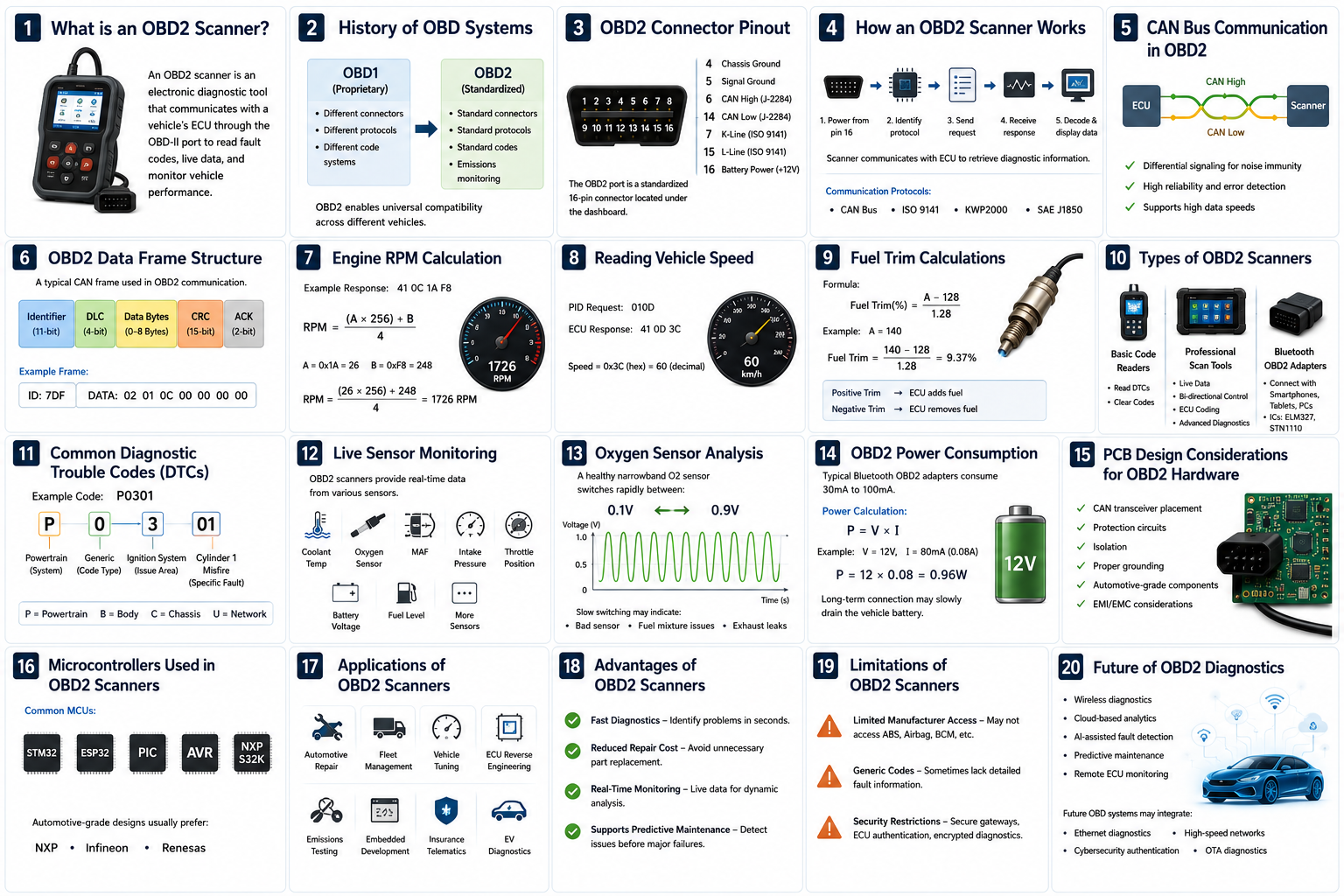
What is an OBD2 Scanner?
An OBD2 scanner is an electronic diagnostic tool used to communicate with a vehicle’s onboard computer system through the OBD-II (On-Board Diagnostics) port.
It allows us to:
Read Diagnostic Trouble Codes (DTCs)
Clear error codes
Monitor live sensor data
Read ECU parameters
Analyze fuel efficiency
Monitor emissions systems
Access freeze-frame data
Diagnose engine and electrical problems
OBD2 became mandatory in most gasoline vehicles in the United States after 1996, and today it is used globally in modern automobiles.
History of OBD Systems
OBD1
Early vehicles used proprietary diagnostic systems called OBD1. Each manufacturer used:
Different connectors
Different protocols
Different code systems
This created compatibility issues.
OBD2
OBD2 standardized:
Diagnostic connectors
Communication protocols
Fault code formats
Emissions monitoring
This allowed universal scanners to communicate with different vehicles.
OBD2 Connector Pinout
The OBD2 connector uses a standardized 16-pin female port usually located under the dashboard.
Important OBD2 Pins
Pin | Function |
4 | Chassis Ground |
5 | Signal Ground |
6 | CAN High |
14 | CAN Low |
7 | K-Line |
15 | L-Line |
16 | Battery Power (+12V) |
Modern vehicles mainly use CAN Bus communication through pins 6 and 14.
How an OBD2 Scanner Works
When we connect the scanner to the OBD2 port:
The scanner powers up from pin 16
It identifies the communication protocol
It sends request frames to the ECU
The ECU replies with sensor or fault data
The scanner decodes and displays the information
Communication usually occurs over:
CAN Bus
ISO 9141
KWP2000
SAE J1850
CAN Bus Communication in OBD2
Modern OBD2 systems primarily use CAN Bus.
CAN uses differential signaling:
CAN High
CAN Low
During communication:
CAN High rises to approximately 3.5V
CAN Low drops to approximately 1.5V
This improves:
Noise immunity
Reliability
Long cable performance
OBD2 Data Frame Structure
A typical CAN frame contains:
Field | Description |
Identifier | Message ID |
DLC | Data Length Code |
Data Bytes | Actual data |
CRC | Error checking |
Example:
ID: 7DF
DATA: 02 01 0C 00 00 00 00 00
Here:
01 = Show current data
0C = Engine RPM PID
Engine RPM Calculation
Suppose the ECU returns:
41 0C 1A F8
RPM is calculated using:
RPM=(A×256)+B4RPM = \frac{(A \times 256) + B}{4}RPM=4(A×256)+B
Where:
A = 0x1A = 26
B = 0xF8 = 248
Calculation:
RPM=(26×256)+2484RPM = \frac{(26 \times 256) + 248}{4}RPM=4(26×256)+248 RPM=69044RPM = \frac{6904}{4}RPM=46904 RPM=1726RPM = 1726RPM=1726
So the engine speed is approximately:
1726RPM1726 RPM1726RPM
Reading Vehicle Speed
Vehicle speed PID:
010D
ECU response:
41 0D 3C
Here:
3C hexadecimal = 60 decimal
Therefore:
Speed=60 km/hSpeed = 60 \text{ km/h}Speed=60 km/h
Fuel Trim Calculations
OBD2 scanners can also read Short-Term Fuel Trim (STFT) and Long-Term Fuel Trim (LTFT).
Formula:
Fuel Trim(%)=A−1281.28Fuel\ Trim(\%) = \frac{A - 128}{1.28}Fuel Trim(%)=1.28A−128
Suppose:
A=140A = 140A=140
Then:
Fuel Trim=140−1281.28Fuel\ Trim = \frac{140 - 128}{1.28}Fuel Trim=1.28140−128 Fuel Trim≈9.37%Fuel\ Trim \approx 9.37\%Fuel Trim≈9.37%
Positive trim means:
ECU adds fuel
Negative trim means:
ECU removes fuel
Types of OBD2 Scanners
Basic Code Readers
These can:
Read DTCs
Clear fault codes
Suitable for beginners.
Professional Scan Tools
Advanced scanners support:
Live data streaming
ECU coding
Bidirectional control
ABS diagnostics
Airbag systems
Transmission modules
Bluetooth OBD2 Adapters
These adapters connect with:
Smartphones
Tablets
PCs
Popular ICs include:
ELM327
STN1110
Common Diagnostic Trouble Codes (DTCs)
DTC format:
P0301
Breakdown:
Character | Meaning |
P | Powertrain |
0 | Generic Code |
3 | Ignition System |
01 | Cylinder 1 Misfire |
Other categories:
B = Body
C = Chassis
U = Network
Live Sensor Monitoring
OBD2 scanners can monitor:
Coolant temperature
Oxygen sensor voltage
Mass Air Flow (MAF)
Intake pressure
Throttle position
Battery voltage
This helps diagnose intermittent faults.
Oxygen Sensor Analysis
A healthy narrowband O2 sensor switches rapidly between:
0.1V to 0.9V0.1V \text{ to } 0.9V0.1V to 0.9V
Slow switching may indicate:
Bad sensor
Fuel mixture issues
Exhaust leaks
OBD2 Power Consumption
Typical Bluetooth OBD2 adapters consume:
30mA to 100mA30mA \text{ to } 100mA30mA to 100mA
Power calculation:
P=VIP = VIP=VI
Suppose:
Voltage = 12V
Current = 80mA
Then:
P=12×0.08P = 12 \times 0.08P=12×0.08 P=0.96WP = 0.96WP=0.96W
Long-term connection may slowly drain the battery.
PCB Design Considerations for OBD2 Hardware
If we are designing our own OBD2 scanner PCB, several engineering considerations become important.
CAN Transceiver Placement
Keep CAN transceivers close to:
OBD connector
TVS diodes
This improves EMI protection.
Protection Circuits
Automotive systems are electrically noisy.
Add:
TVS diodes
Reverse polarity protection
LC filters
Automotive-grade regulators
Isolation
Professional scanners often use:
Digital isolation
Isolated DC-DC converters
This protects the microcontroller from voltage spikes.
Microcontrollers Used in OBD2 Scanners
Common MCUs include:
STM32
ESP32
PIC
AVR
NXP S32K
Automotive-grade designs usually prefer:
NXP
Infineon
Renesas
Applications of OBD2 Scanners
OBD2 scanners are used in:
Automotive repair shops
Fleet management
Vehicle tuning
ECU reverse engineering
Embedded development
Emissions testing
Insurance telematics
EV diagnostics
Advantages of OBD2 Scanners
Fast Diagnostics
Problems can be identified within seconds.
Reduced Repair Cost
Accurate diagnostics prevent unnecessary parts replacement.
Real-Time Monitoring
Live data allows dynamic analysis while driving.
Supports Predictive Maintenance
Faults can be detected before major failures occur.
Limitations of OBD2 Scanners
Despite their usefulness, OBD2 scanners also have limitations.
Limited Manufacturer Access
Cheap scanners may not access:
ABS modules
Airbags
BCM systems
Generic Codes
Generic DTCs sometimes lack detailed fault information.
Security Restrictions
Modern vehicles implement:
Secure gateways
ECU authentication
Encrypted diagnostics
Future of OBD2 Diagnostics
Automotive diagnostics is evolving rapidly toward:
Wireless diagnostics
Cloud-based analytics
AI-assisted fault detection
Predictive maintenance
Remote ECU monitoring
Electric vehicles are also changing diagnostic architectures significantly.
Future OBD systems may integrate:
Ethernet diagnostics
High-speed automotive networks
Cybersecurity authentication
OTA diagnostics
Final Thoughts
OBD2 scanners have completely transformed vehicle diagnostics by allowing engineers and technicians to communicate directly with vehicle ECUs. From reading engine RPM to analyzing CAN frames and fuel trims, these tools provide deep visibility into modern automotive systems.
If you are interested in:
Embedded systems
Automotive electronics
CAN Bus communication
ECU reverse engineering
Vehicle diagnostics
then learning how OBD2 scanners work is an excellent starting point.
As vehicles become smarter, more connected, and increasingly software-driven, OBD2 technology will continue to play a critical role in diagnostics, maintenance, and automotive innovation.