Energy storage technology is evolving rapidly, and one component that continues to attract engineers, hobbyists, EV designers, and embedded developers is the Supercapacitor. If you have ever worked on backup power systems, regenerative braking, IoT devices, robotics, or industrial electronics, chances are you have already encountered them.
In this guide, we will explore supercapacitors in depth — from their internal structure and working principles to real engineering calculations, charging equations, applications, advantages, limitations, and PCB design considerations. Whether you are a student, electronics enthusiast, or professional engineer, this article will help you understand how and where we can use supercapacitors effectively.
What Are Supercapacitors?
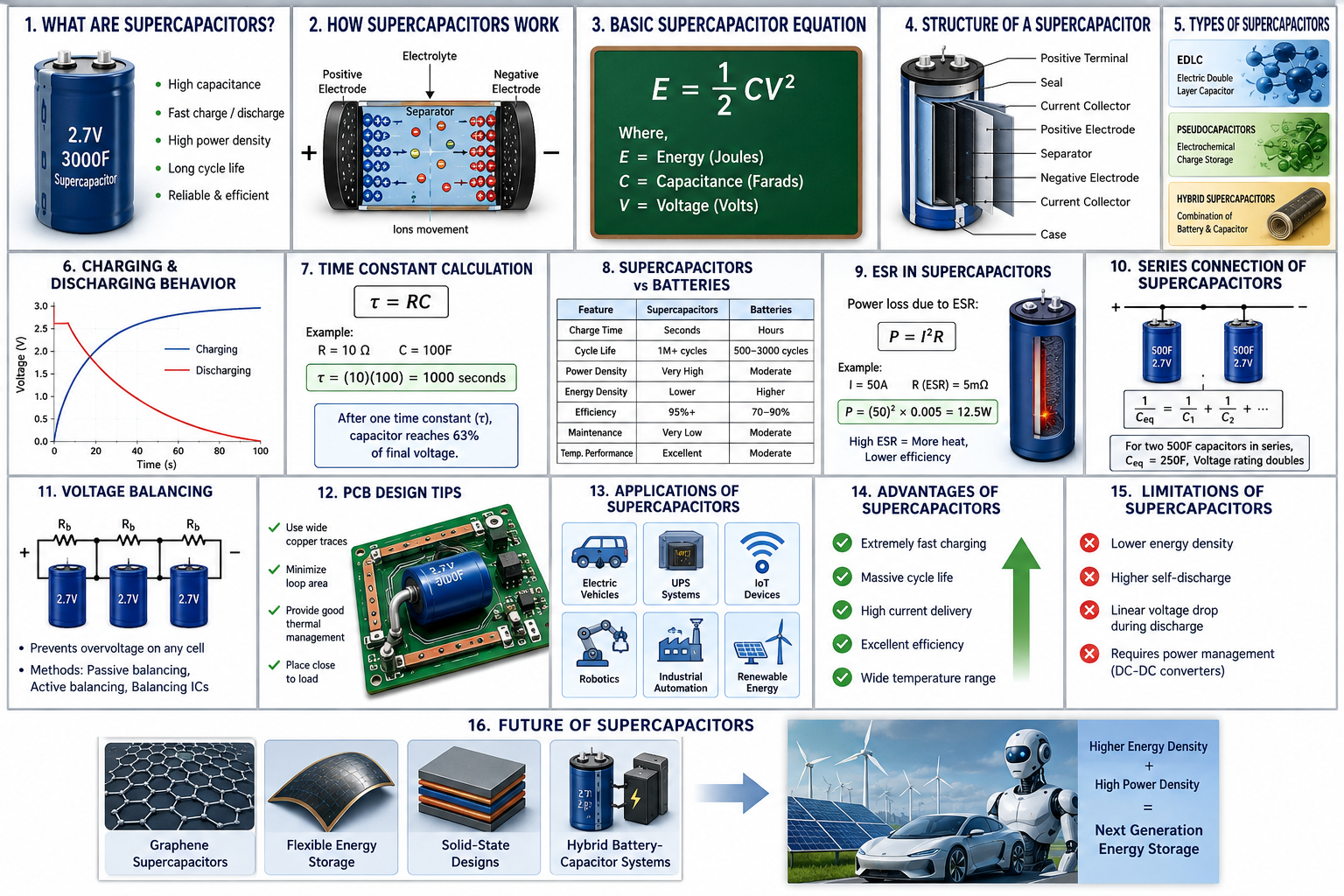
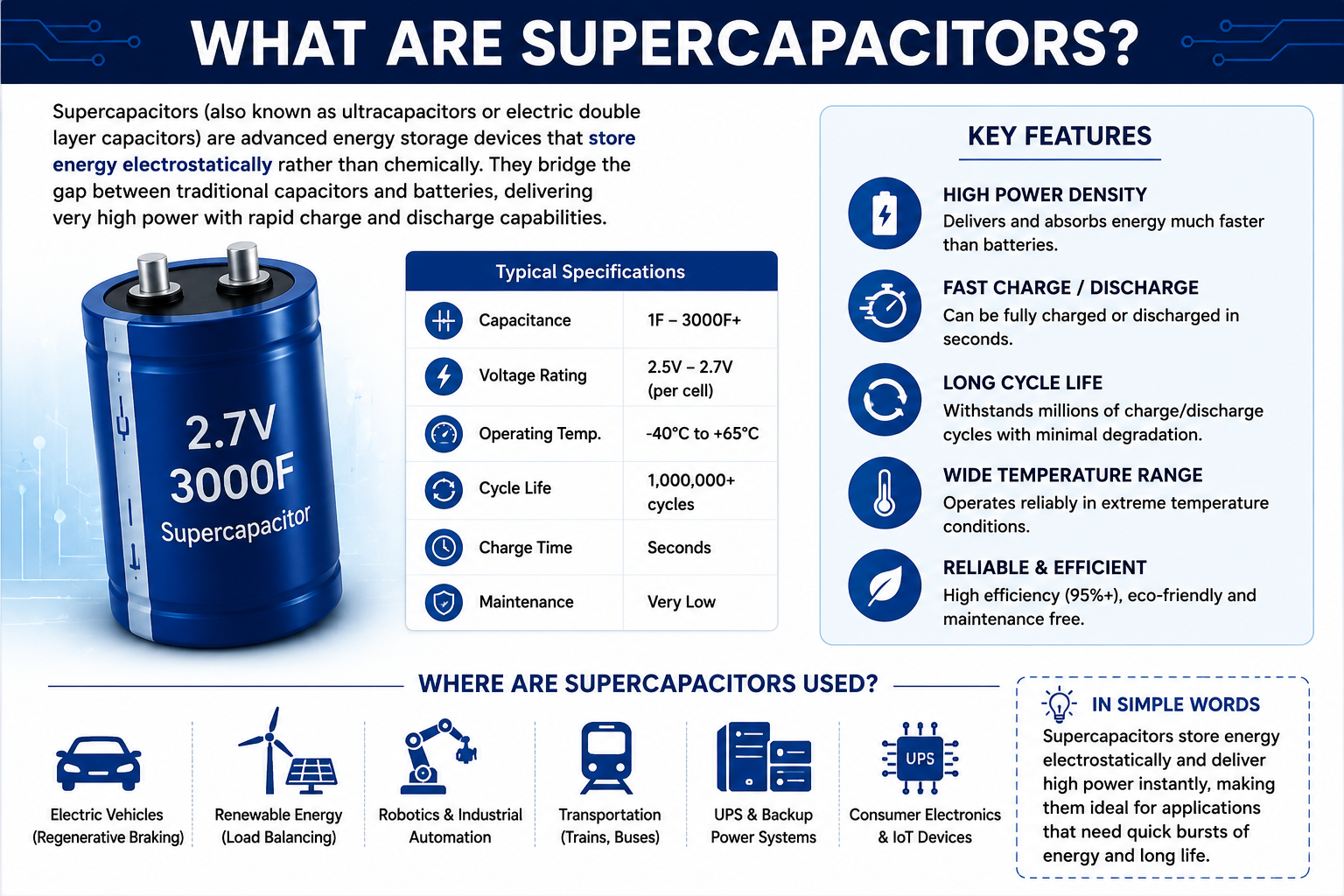
A supercapacitor, also called an ultracapacitor or electric double-layer capacitor (EDLC), is an energy storage device that stores electrical energy electrostatically rather than chemically like a battery.
Unlike traditional capacitors, supercapacitors can store a massive amount of charge due to their extremely high capacitance values, often ranging from a few farads to several thousand farads.
Typical examples include:
- 1F
- 10F
- 100F
- 500F
- 3000F
This makes them ideal for applications requiring:
- Rapid charging/discharging
- High current bursts
- Long cycle life
- Instant power delivery
How Supercapacitors Work
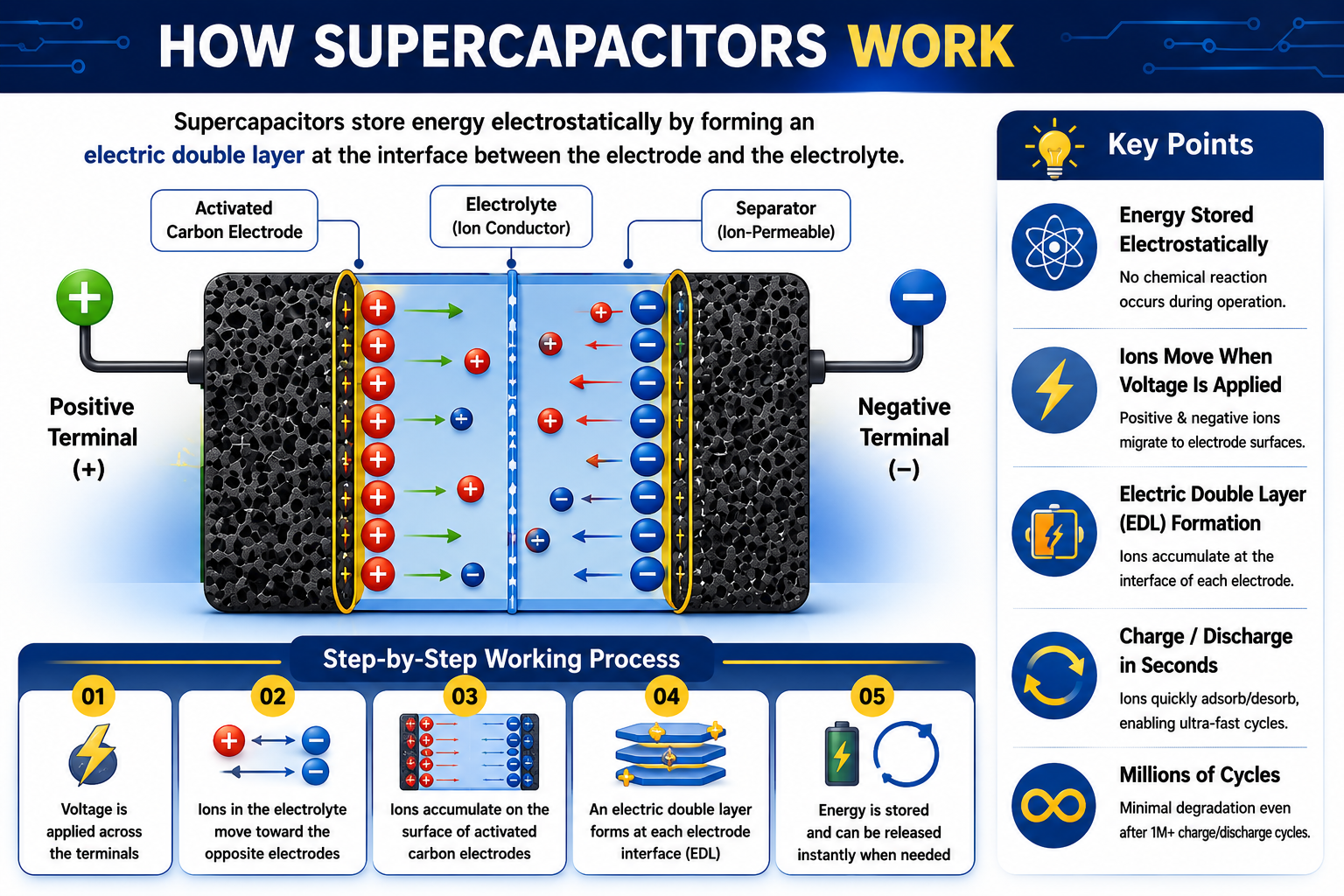
The working principle of a supercapacitor is based on the formation of an electric double layer between the electrode and electrolyte.
Inside the device:
- Two porous electrodes are separated by an electrolyte.
- When voltage is applied, ions accumulate on the electrode surfaces.
- This creates an electrostatic field that stores energy.
Unlike batteries, no significant chemical reaction occurs during normal operation. This is the main reason why supercapacitors can survive millions of charge cycles.
Basic Supercapacitor Equation
The energy stored in a capacitor is calculated using:
E=12CV2E=\frac{1}{2}CV^2E=21CV2
Where:
- EEE = Energy in joules
- CCC = Capacitance in farads
- VVV = Voltage
This equation is extremely important when designing real-world energy storage systems.
Example Energy Calculation
Suppose we have:
- Capacitance = 500F
- Voltage = 2.7V
The stored energy becomes:
E=12(500)(2.7)2E=\frac{1}{2}(500)(2.7)^2E=21(500)(2.7)2
Result:
E=1822.5JE = 1822.5JE=1822.5J
That means the capacitor stores approximately 1822 joules of energy.
To convert joules into watt-hours:
Wh=1822.53600Wh = \frac{1822.5}{3600}Wh=36001822.5 Wh≈0.506WhWh \approx 0.506WhWh≈0.506Wh
At first glance this may look small compared to batteries, but the real strength of supercapacitors lies in their power density and ultra-fast charging ability.
Structure of a Supercapacitor
A typical supercapacitor contains:
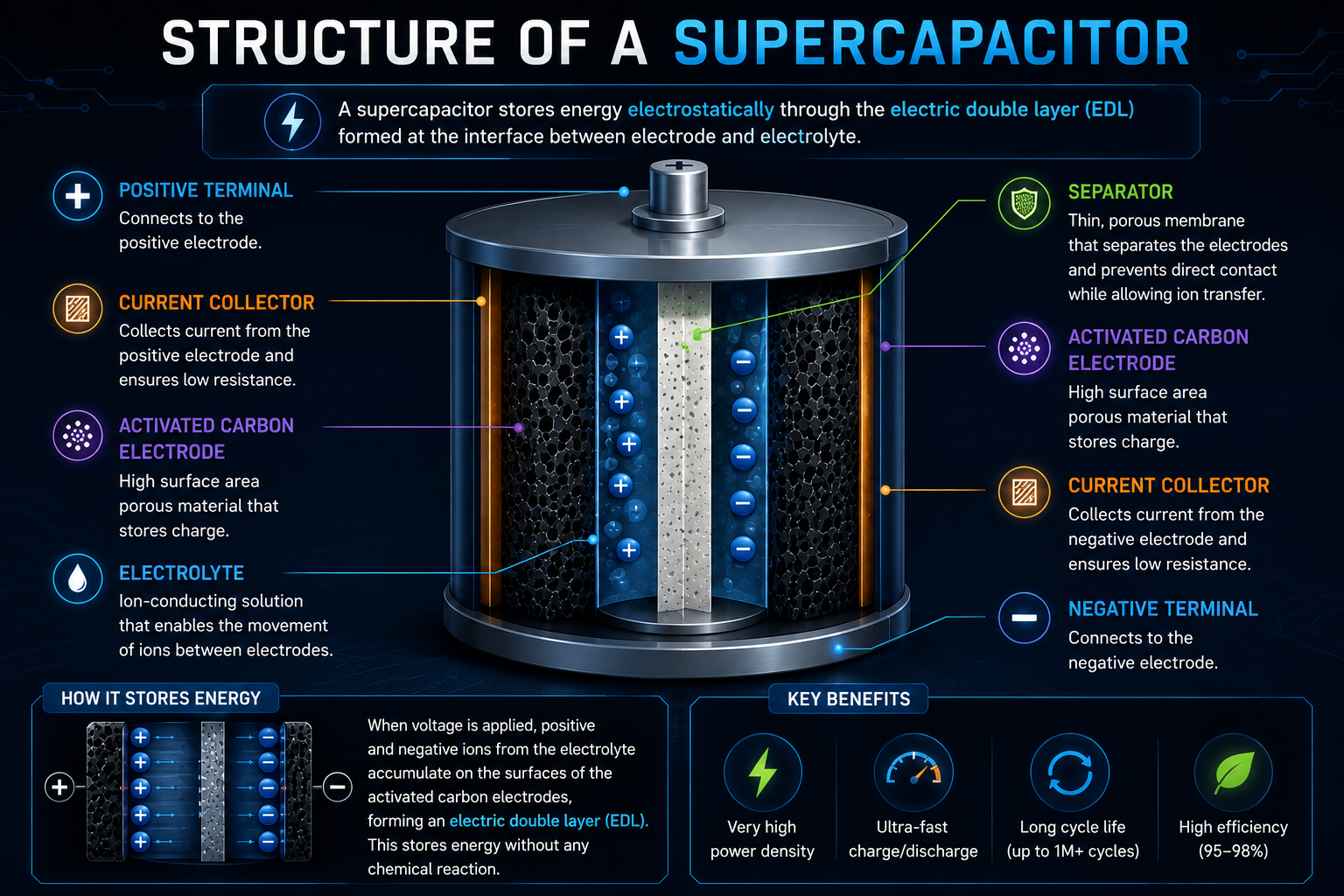
1. Electrodes
Usually made from activated carbon because it provides enormous surface area.
Some advanced designs use:
- Graphene
- Carbon nanotubes
- Aerogels
The larger the surface area, the higher the capacitance.
2. Electrolyte
The electrolyte allows ion movement between electrodes.
Common electrolyte types include:
- Organic electrolytes
- Aqueous electrolytes
- Ionic liquids
- Electrolyte selection affects:
- Voltage rating
- Temperature range
- ESR
- Lifespan
3. Separator
A thin insulating layer prevents short circuits while allowing ion flow.
Types of Supercapacitors
Electric Double Layer Capacitors (EDLC)
These are the most common types.
Energy storage occurs electrostatically without chemical reactions.
Advantages:
- Long life
- Fast charging
- Excellent reliability
Pseudocapacitors
These use electrochemical reactions for higher capacitance.
Materials include:
- Metal oxides
- Conductive polymers
They provide higher energy density but lower cycle life.
Hybrid Supercapacitors
A combination of battery and capacitor technologies.
These attempt to balance:
- Energy density
- Power density
- Lifespan
Charging and Discharging Behavior
One interesting thing we notice while working with supercapacitors is that their voltage changes linearly during charging and discharging.
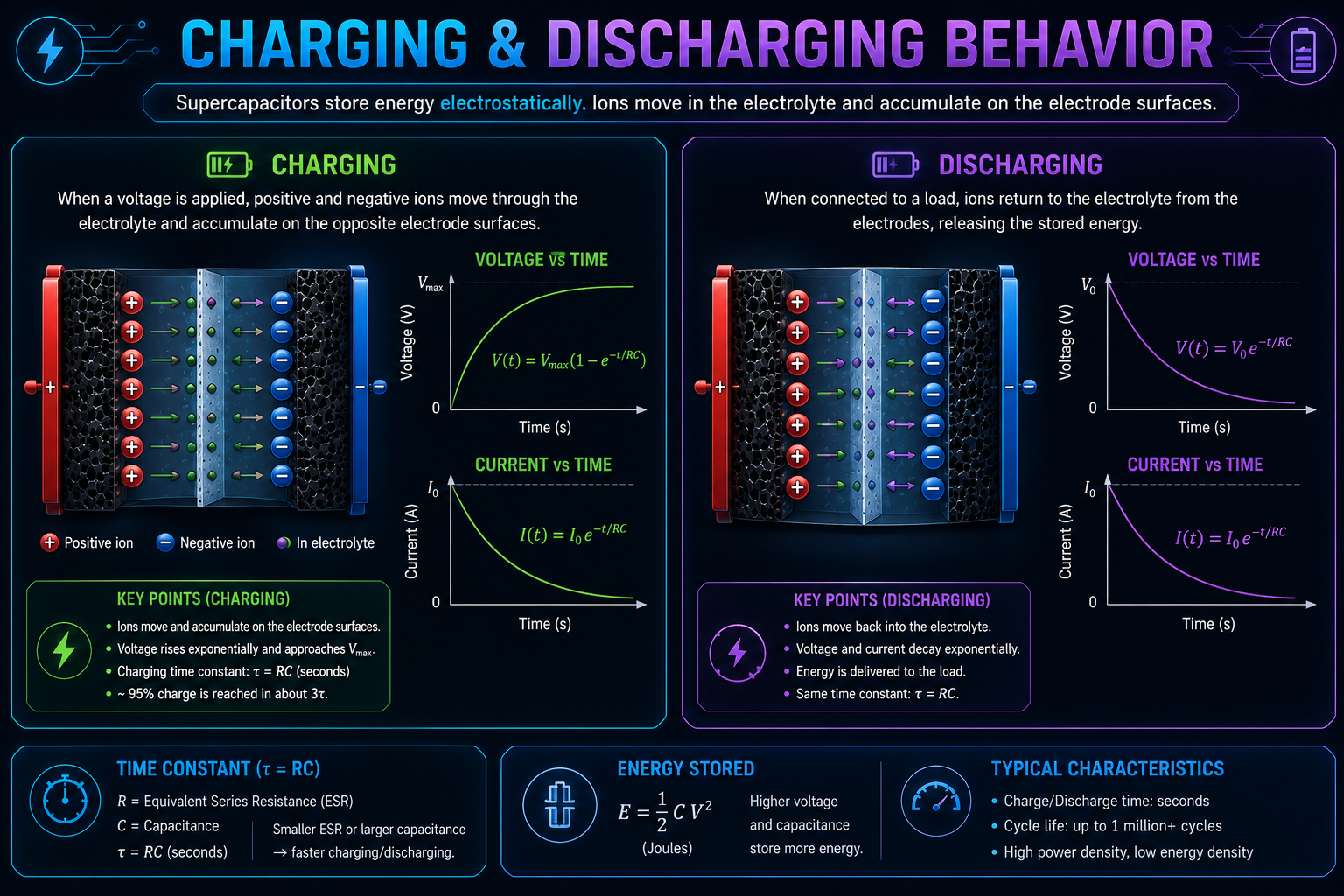
The capacitor charging equation is:
V(t)=Vmax(1−e−t/RC)V(t)=V_{max}(1-e^{-t/RC})V(t)=Vmax(1−e−t/RC)
Where:
- RRR = Charging resistance
- CCC = Capacitance
- ttt = Time
Time Constant Calculation
Suppose we charge a:
- 100F supercapacitor
- Through a 10Ω resistor
The time constant becomes:
τ=RC=(10)(100)=1000 seconds\tau=RC=(10)(100)=1000\text{ seconds}τ=RC=(10)(100)=1000 seconds
After one time constant, the capacitor reaches approximately 63% of its final voltage.
This is very important in power electronics and embedded system design.
Supercapacitors vs Batteries
| Header 1 | ||
|---|---|---|
| Feature | Supercapacitors | Batteries |
| Charge Time | Seconds | Hours |
| Cycle Life | 1M+ cycles | 500–3000 cycles |
| Power Density | Very High | Moderate |
| Energy Density | Lower | Higher |
| Efficiency | 95%+ | 70–90% |
| Maintenance | Very Low | Moderate |
| Temperature Performance | Excellent | Moderate |
| Header 1 | ||
This is why we often combine batteries and supercapacitors together in hybrid systems.
ESR in Supercapacitors
Equivalent Series Resistance (ESR) is one of the most critical parameters.
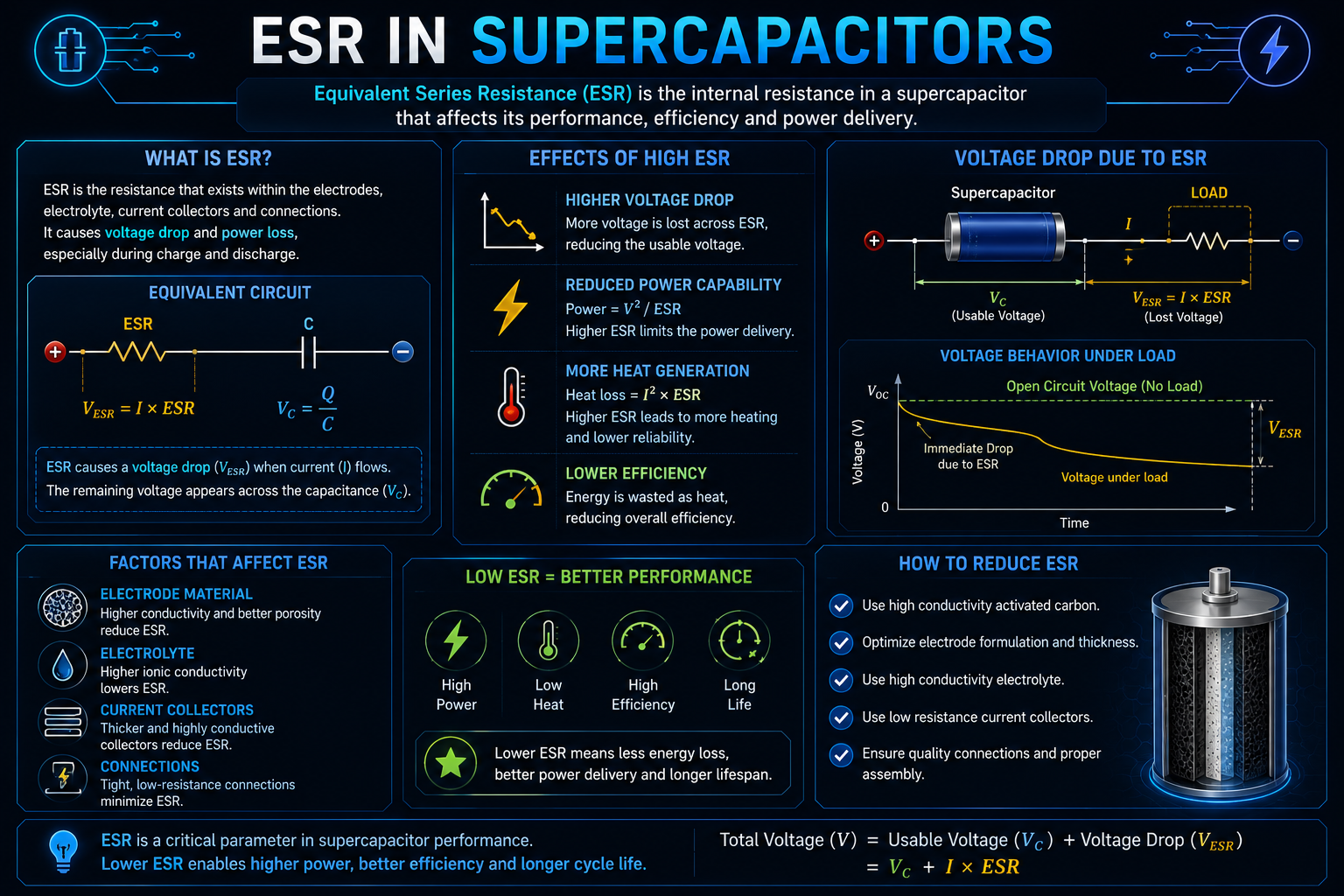
Low ESR means:
- Lower heat generation
- Higher current capability
- Better efficiency
Power loss due to ESR:
P=I2RP=I^2RP=I2R
Suppose:
- Current = 50A
- ESR = 5mΩ
Then:
P=502×0.005P = 50^2 \times 0.005P=502×0.005 P=12.5WP = 12.5WP=12.5W
That is a significant amount of heat.
When designing PCB layouts for high-current supercapacitor systems, minimizing ESR is extremely important.
Series Connection of Supercapacitors
A single supercapacitor cell typically has a voltage rating around:
- 2.5V
- 2.7V
For higher voltages, we connect cells in series.
The equivalent capacitance becomes:
1Ceq=1C1+1C2+1C3\frac{1}{C_{eq}}=\frac{1}{C_1}+\frac{1}{C_2}+\frac{1}{C_3}Ceq1=C11+C21+C31
If we connect two identical 500F capacitors in series:
Ceq=250FC_{eq} = 250FCeq=250F
But the voltage rating doubles.
Voltage Balancing
One challenge with series supercapacitors is voltage imbalance.
Due to leakage current differences:
- One cell may overcharge
- Another may undercharge
To solve this, we use:
- Passive balancing resistors
- Active balancing circuits
- Balancing ICs
Without balancing, the lifespan decreases significantly.
PCB Design Tips for Supercapacitors
If you are integrating supercapacitors into embedded or power electronics systems, PCB layout matters a lot.
Here are some practical recommendations we personally follow:
Use Wide Copper Traces
Supercapacitors can deliver huge currents instantly.
Thin traces can:
- Heat up
- Cause voltage drops
- Create instability
Minimize Loop Area
Keep power loops compact to reduce:
- EMI
- Noise
- Inductance
Thermal Considerations
Even though supercapacitors are efficient, ESR losses still generate heat.
Use:
- Thermal vias
- Copper pours
- Proper airflow
Place Close to Load
If you use them for pulse current support:
- Place them near MOSFETs
- Near DC-DC converters
- Near motor drivers
This improves transient response.
Applications of Supercapacitors
Supercapacitors are now used in many modern systems.
Electric Vehicles (EVs)
They assist during:
- Regenerative braking
- Fast acceleration
- Peak current demands
Several EV manufacturers combine batteries and supercapacitors for better efficiency.
UPS Systems
Supercapacitors provide short backup power during:
- Battery replacement
- Power interruptions
- Server switching
IoT Devices
In low-power electronics, supercapacitors can:
- Store solar energy
- Handle transmission bursts
- Replace small batteries
Robotics
Robotic systems need rapid energy bursts for:
- Motors
- Servos
- Wireless communication
Supercapacitors help stabilize supply rails.
Industrial Automation
Factories use them for:
- Emergency shutdown
- Memory backup
- Peak power compensation
Advantages of Supercapacitors
Here are the biggest reasons engineers love supercapacitors:
Extremely Fast Charging
Many devices can fully charge within seconds.
Massive Cycle Life
We can recharge them millions of times.
High Current Delivery
Perfect for pulse loads and motor startup currents.
Excellent Efficiency
Round-trip efficiency often exceeds 95%.
Wide Temperature Range
They perform better than batteries in extreme temperatures.
Limitations of Supercapacitors
Despite their advantages, supercapacitors are not perfect.
Lower Energy Density
They store less total energy than lithium batteries.
Higher Self-Discharge
They lose charge faster over time.
Linear Voltage Drop
Unlike batteries, voltage decreases continuously during discharge.
This often requires:
- Buck converters
- Boost converters
- Power management ICs
Future of Supercapacitors
Research is moving rapidly toward:
- Graphene supercapacitors
- Flexible energy storage
- Solid-state designs
- Hybrid battery-capacitor systems
Many engineers believe future EVs, renewable energy systems, and AI hardware acceleration platforms will rely heavily on advanced supercapacitors.
As materials science improves, we may eventually see supercapacitors rivaling batteries in energy density while maintaining their incredible power capabilities.
Final Thoughts
Supercapacitors are one of the most exciting energy storage technologies available today. While batteries dominate long-term energy storage, supercapacitors shine wherever fast charging, rapid discharging, and long cycle life are required.
If you are designing:
- EV systems
- Robotics
- Industrial controllers
- Embedded devices
- Renewable energy systems
then understanding supercapacitors can give you a major engineering advantage.
Personally, we believe the future lies in hybrid systems where batteries and supercapacitors work together instead of competing. Batteries provide energy capacity, while supercapacitors handle peak power demands.
Once you start experimenting with them in real hardware projects, you quickly realize how powerful and versatile these components really are.