Enterprise penetration testing is going through a structural change. For years, offensive security operated through periodic assessments. Organizations scoped environments, brought in testers, reviewed findings, remediated critical issues, and repeated the process several months later. That model was built for infrastructure that changed slowly enough for assessments to remain operationally relevant after delivery.
Modern enterprise environments no longer work that way. Cloud infrastructure evolves continuously. APIs expose internal business logic across distributed systems. Identity relationships expand organically through integrations, automation, and SaaS adoption. Development teams deploy changes at a pace that traditional assessment cycles struggle to keep up with.
At the same time, attackers are becoming faster, more adaptive, and increasingly AI-assisted. Recent offensive security research and enterprise deployments show how AI-driven workflows are accelerating reconnaissance, exploit correlation, and attack-path discovery. Instead of manually evaluating isolated weaknesses, modern offensive systems can model progression across multiple layers simultaneously, identifying how small exposures combine into meaningful compromise paths.
The strongest vendors in this category focus less on generating findings and more on validating exploitability. They continuously reassess environments, replay attack scenarios after remediation, and model how compromise unfolds in real enterprise systems rather than isolated technical conditions.
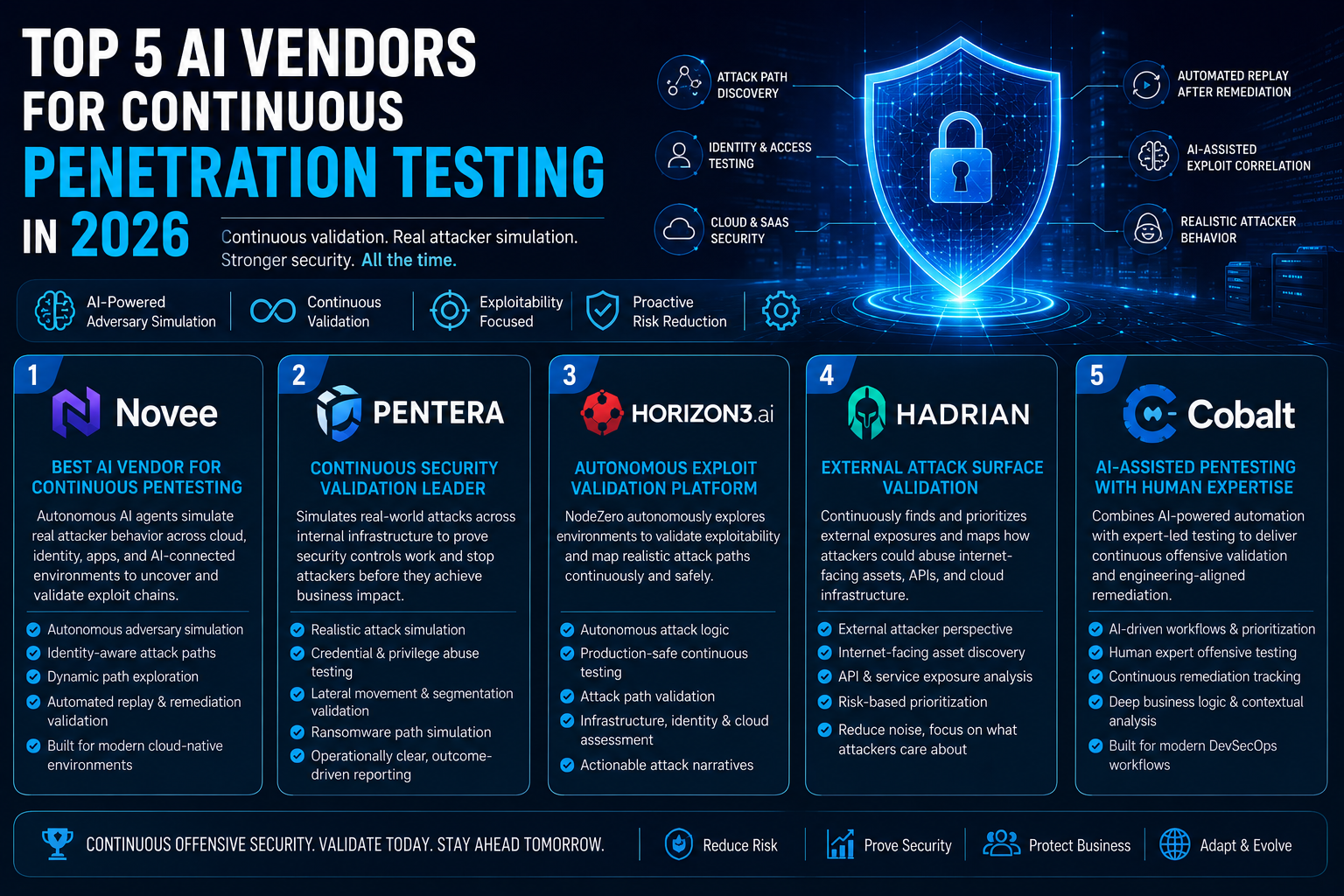
What Defines a Strong Continuous Pentesting Platform in 2026
Not every platform marketed as “continuous pentesting” operates at the same level. Some vendors primarily automate traditional vulnerability scanning. Others simulate realistic attacker behavior and continuously validate exploitability across enterprise environments.
The difference becomes obvious operationally. The strongest platforms typically share several characteristics. They validate exploitability rather than simply identifying exposure. They continuously reassess environments rather than operate on fixed schedules. They integrate directly into remediation workflows, so findings translate into operational action rather than static reporting.
More advanced vendors increasingly support:
- attack-path reasoning
- identity-aware adversary simulation
- automated replay after remediation
- cloud-native infrastructure testing
- AI-assisted exploit correlation
Equally important is signal quality. Enterprise teams do not need another stream of disconnected findings. They need platforms capable of reducing uncertainty and helping prioritize the conditions that actually matter operationally. That operational alignment is becoming more important than raw scanning coverage alone.
Top 5 AI Vendors for Continuous Penetration Testing in 2026
1. Novee - Best AI Vendor for Continuous Penetration Testing
Novee approaches continuous penetration testing through autonomous adversary simulation rather than traditional vulnerability-centric assessment workflows.
Instead of functioning as a scanner enhanced with AI features, the platform deploys AI agents that continuously model attacker behavior across cloud infrastructure, identity systems, enterprise applications, and increasingly AI-connected operational environments.
The platform’s strength lies in how it approaches compromise progression.
Agents perform reconnaissance, evaluate permissions, attempt lateral movement, test privilege escalation paths, and adapt dynamically as environments respond. When one route fails, alternative pathways are explored automatically, producing validated exploit chains rather than isolated findings.
This creates a much more realistic operational model for modern enterprise environments where compromise frequently emerges from combinations of small weaknesses rather than a single critical vulnerability.
Novee is particularly effective in identity-driven environments where access relationships define security boundaries more than traditional network segmentation. The platform continuously evaluates whether inherited permissions, SaaS integrations, or automation workflows unintentionally create attacker pathways across systems.
Another important differentiator is remediation validation.
Rather than simply reporting exposure, attack scenarios can be automatically replayed after changes are implemented, helping organizations confirm whether exploitability has been eliminated rather than partially mitigated.
For enterprises operating rapidly evolving cloud-native environments, this continuous adversarial model aligns much more closely with modern attacker behavior than traditional periodic assessments.
2. Pentera
Pentera helped define the enterprise market for continuous security validation by focusing heavily on operationally realistic attack simulation inside production environments.
The platform simulates attacker behavior across internal enterprise infrastructure to determine whether existing security controls actually prevent compromise under realistic conditions. Rather than relying on theoretical analysis, Pentera emphasizes proof: proof that segmentation works, proof that credentials cannot be abused, proof that ransomware-style progression can be interrupted before operational impact occurs.
That emphasis on validation resonates strongly with large enterprise security programs.
Pentera evaluates credential exposure, privilege escalation opportunities, Active Directory weaknesses, segmentation gaps, and lateral movement possibilities while continuously reassessing infrastructure as environments evolve.
One reason the platform remains widely adopted is its operational clarity. Findings are structured around attacker outcomes rather than disconnected technical conditions, making remediation significantly easier to prioritize internally.
The platform also integrates effectively into broader enterprise security operations, allowing organizations to validate whether infrastructure improvements are actually reducing attack surface over time rather than simply lowering vulnerability counts.
For large organizations operating complex internal environments, Pentera remains one of the strongest continuous validation platforms focused on enterprise infrastructure resilience.
3. Horizon3.ai
Horizon3.ai became one of the most recognizable vendors in autonomous penetration testing by aggressively positioning its platform around exploit validation rather than traditional vulnerability discovery.
Its NodeZero platform continuously evaluates infrastructure, exposed services, identity relationships, and segmentation controls using autonomous attack logic that simulates realistic attacker progression.
The platform dynamically explores environments, validating whether compromise can meaningfully advance between systems rather than simply cataloging weaknesses. This operational focus aligns closely with the broader industry shift toward attack-path-centric security.
One of Horizon3.ai’s strongest differentiators is its emphasis on production-safe testing. Enterprise teams increasingly want continuous offensive validation without introducing operational instability into live environments. Horizon3.ai positioned itself specifically around that requirement, allowing organizations to test continuously without depending entirely on scheduled engagement windows.
The reporting model also reflects a more operational mindset.
Rather than overwhelming teams with disconnected findings, NodeZero structures outputs around validated attack narratives, helping organizations understand how attackers would realistically progress through the environment.
That operational clarity makes the platform particularly attractive to enterprises seeking autonomous offensive testing capabilities without building large internal offensive security programs.
4. Hadrian
Hadrian approaches continuous penetration testing from the perspective of an external attacker rather than an internal vulnerability management program.
That distinction shapes the entire platform.
Instead of primarily cataloging exposed assets, Hadrian continuously evaluates whether externally reachable infrastructure creates meaningful attacker opportunities. The platform maps internet-facing systems, cloud assets, APIs, exposed services, inherited infrastructure, and publicly accessible operational surfaces, then attempts to determine how those conditions could realistically be abused.
This attacker-first model is increasingly relevant for enterprises operating large distributed environments where exposure changes constantly and visibility alone is no longer enough.
One of the biggest problems security teams face today is not lack of discovery. Most organizations already know they have thousands of exposed assets. The challenge is understanding which combinations of exposure actually create operational risk.
Hadrian attempts to solve that prioritization problem through continuous adversarial analysis. That continuous attacker-perspective analysis makes the platform especially useful for enterprises operating fast-moving public-facing environments where infrastructure changes daily.
Another strength is how Hadrian frames findings operationally. Instead of producing generic asset inventories, the platform prioritizes exposure according to likely attacker relevance, helping organizations reduce noise and focus remediation efforts on the conditions most likely to matter in practice.
As external attack surfaces continue expanding across SaaS ecosystems, multi-cloud environments, and AI-enabled applications, this type of continuous external adversary validation is becoming increasingly important for enterprise security teams.
5. Cobalt
Cobalt represents a different direction within continuous penetration testing — one that combines AI-assisted operational workflows with expert-led offensive testing rather than pursuing complete autonomy.
That hybrid model reflects a broader reality inside enterprise offensive security.
Automation has become extremely effective at persistence, infrastructure reassessment, exploit correlation, and large-scale validation. Human operators, however, still outperform AI systems in areas requiring contextual reasoning, business logic analysis, strategic adversary emulation, and nuanced exploitation paths that depend heavily on organizational understanding.
Cobalt’s platform is designed around that operational balance.
AI assists with reconnaissance, prioritization, workflow coordination, remediation tracking, and continuous reassessment, while human testers focus on higher-context offensive analysis and deeper adversarial exploration.
This creates a much more operationally integrated approach than traditional consulting-led pentesting.
Findings move directly into engineering workflows. Remediation validation becomes continuous instead of engagement-based. Offensive testing aligns more naturally with modern release cycles and cloud-native development patterns.
That engineering integration is one of Cobalt’s strongest differentiators.
Many enterprise organizations do not struggle purely with visibility. They struggle with translating offensive findings into actionable remediation quickly enough to keep pace with infrastructure change. Cobalt’s model is built specifically around reducing that operational friction.
The platform is particularly attractive for organizations that want persistent offensive validation while still maintaining the strategic depth and contextual reasoning that experienced human operators provide.
As enterprise offensive security continues to evolve toward hybrid operational models, Cobalt represents one of the clearest examples of how AI-assisted workflows and expert-led testing are converging into a single continuous program.
Why Enterprise Security Teams Are Moving Beyond Traditional Pentesting
The biggest limitation in traditional pentesting is not technical capability. It is temporal relevance. Most enterprise environments now evolve faster than assessment cycles themselves. By the time a quarterly or annual pentest is completed, delivered, and reviewed, infrastructure has already shifted:new services have been deployed, permissions have changed, APIs have expanded, and integrations have introduced additional trust relationships between systems.
This creates a persistent gap between documented posture and actual operational exposure. Traditional penetration testing still provides valuable depth, particularly for business logic analysis and strategic adversary simulation, but it increasingly struggles to reflect how modern infrastructure behaves on a day-to-day basis.
Continuous penetration testing emerged in response to that operational mismatch. Instead of treating offensive testing as a point-in-time engagement, these platforms reassess environments continuously. They validate whether infrastructure changes introduce new attack paths, whether remediation efforts actually eliminate exploitability, and whether identity boundaries continue holding under adversarial conditions.
That distinction is critical because most enterprise compromises do not result from isolated vulnerabilities. They emerge from chains of conditions that become dangerous only when combined: misconfigured permissions, inherited trust relationships, weak segmentation, exposed APIs, overprivileged service accounts, or stale cloud assets quietly accumulating operational risk over time.
Continuous AI-driven pentesting platforms increasingly model these relationships dynamically rather than evaluating systems in isolation
Why Hybrid Offensive Security Models Are Becoming the Enterprise Standard
One of the clearest trends in enterprise offensive security is the convergence between autonomous systems and expert-led testing.
A few years ago, many organizations treated automation and human-led offensive security as competing models. In practice, the industry is moving toward a blended operational structure instead.
Fully autonomous platforms provide persistence. They continuously reassess environments, replay attack scenarios, validate segmentation boundaries, and identify regression introduced through infrastructure change. These capabilities are especially valuable inside cloud-native environments where operational velocity makes periodic testing increasingly ineffective.
At the same time, purely autonomous systems still struggle in areas where exploitation depends heavily on context.
Business logic abuse, organizational workflows, multi-step social engineering, and highly customized enterprise applications often require reasoning that extends beyond current autonomous offensive systems. Experienced operators still outperform AI significantly in these scenarios.
As a result, the most mature enterprise security programs increasingly combine both approaches:continuous autonomous validation for persistent infrastructure reassessment, and expert-led offensive testing for strategic adversary simulation and contextual exploitation analysis.
This hybrid model also aligns more naturally with how enterprise engineering organizations operate.
Automation provides scalable persistence and rapid feedback loops. Human expertise provides interpretation, prioritization, and strategic depth. Together, they create a far more sustainable offensive security model than either approach independently.
That convergence is likely to define enterprise offensive security programs over the next several years.
Continuous Pentesting Is Expanding Beyond Infrastructure
Another important shift in this category is scope expansion.
Continuous penetration testing initially focused heavily on infrastructure:networks, endpoints, exposed services, and cloud configurations. That scope is now expanding rapidly into identity systems, APIs, SaaS ecosystems, and AI-enabled operational workflows.
This expansion is happening because enterprise attack surfaces themselves are changing.
Modern compromise paths increasingly depend on relationships between systems rather than isolated technical weaknesses. APIs expose business logic externally. SaaS platforms inherit trust relationships across environments. AI agents operate with delegated permissions inside enterprise workflows.
Traditional infrastructure-centric testing models often fail to capture these interactions effectively.
Continuous AI-driven pentesting platforms are evolving accordingly.
Modern offensive validation increasingly includes:
- identity relationship testing
- API abuse simulation
- SaaS integration analysis
- cloud role escalation validation
- AI workflow security assessment
This broader operational perspective is becoming critical because enterprise compromise now frequently emerges from interactions between systems rather than failures inside a single isolated component.
The strongest vendors in this category increasingly understand that offensive security is no longer simply about infrastructure visibility. It is about continuously validating how interconnected enterprise systems behave under adversarial conditions.
Which Continuous Pentesting Approach Fits Modern Enterprise Teams?
Choosing a continuous penetration testing platform is less about finding the “most automated” solution and more about aligning offensive validation with how the organization actually operates.
Enterprise teams running highly dynamic cloud-native environments often benefit from platforms capable of continuously reassessing infrastructure and validating exploitability as systems evolve. Organizations with complex internal identity relationships may prioritize adversary simulation focused heavily on access paths, segmentation, and privilege escalation logic.
Other environments require deeper contextual analysis alongside automation. In those cases, hybrid approaches that combine continuous validation with expert-led offensive testing can provide stronger operational alignment than fully autonomous systems alone.
Several factors usually determine which model fits best:
- infrastructure complexity
- release velocity
- identity architecture maturity
- engineering workflow integration
- operational remediation capacity
The strongest offensive security programs increasingly share one characteristic regardless of tooling choice: they treat offensive validation as a continuous operational capability rather than an isolated compliance exercise.
That shift matters because modern enterprise infrastructure changes too quickly for periodic assessments to remain sufficient on their own.
The goal is no longer simply identifying vulnerabilities. It is maintaining continuous confidence that attackers cannot meaningfully progress through the environment as systems evolve.
FAQs About Continuous AI Penetration Testing
What is continuous penetration testing?
Continuous penetration testing is an offensive security approach where environments are tested persistently instead of through isolated quarterly or annual engagements. Modern platforms continuously reassess infrastructure, identity systems, APIs, and cloud assets as they evolve. The goal is to validate exploitability in near real time and identify how operational changes affect attacker opportunity across enterprise environments.
How is continuous pentesting different from vulnerability scanning?
Traditional vulnerability scanners primarily identify known weaknesses using signatures and predefined rules. Continuous pentesting platforms go further by simulating attacker behavior and validating whether vulnerabilities can realistically be exploited. They model attack progression across systems, permissions, APIs, and infrastructure, producing operational attack narratives instead of disconnected technical findings.
Why are enterprises adopting AI-driven pentesting platforms?
Enterprise infrastructure now changes too quickly for periodic assessments alone to remain operationally effective. AI-driven pentesting platforms help organizations continuously validate exposure across cloud environments, SaaS ecosystems, APIs, and identity layers. They also improve remediation prioritization by focusing on exploitability and attack progression rather than raw vulnerability counts alone.
Can continuous penetration testing replace human red teams?
Continuous pentesting platforms significantly extend offensive security coverage, but they do not eliminate the need for experienced human operators. Autonomous systems excel at persistence, infrastructure reassessment, and attack-path analysis, while human testers remain stronger in business logic abuse, contextual reasoning, and strategic adversary emulation. Most mature enterprise programs combine both approaches rather than treating them as competing models.
What should organizations evaluate before selecting a continuous pentesting vendor?
Organizations should evaluate whether a platform aligns with their infrastructure complexity, identity architecture, cloud footprint, and remediation workflows. The strongest vendors provide exploit validation, continuous reassessment, identity-aware attack simulation, and operationally useful reporting. Integration into engineering workflows is also critical because continuous testing only creates value when findings translate into remediation effectively.
Why is identity becoming such an important focus in offensive security?
Identity increasingly governs access across cloud infrastructure, SaaS platforms, APIs, development systems, and AI-enabled workflows. Modern attackers frequently exploit weak permissions, inherited trust relationships, and authentication complexity rather than relying solely on software vulnerabilities. Continuous pentesting platforms therefore prioritize identity-aware adversary simulation to validate whether access boundaries actually hold under realistic attack conditions.