 BETA
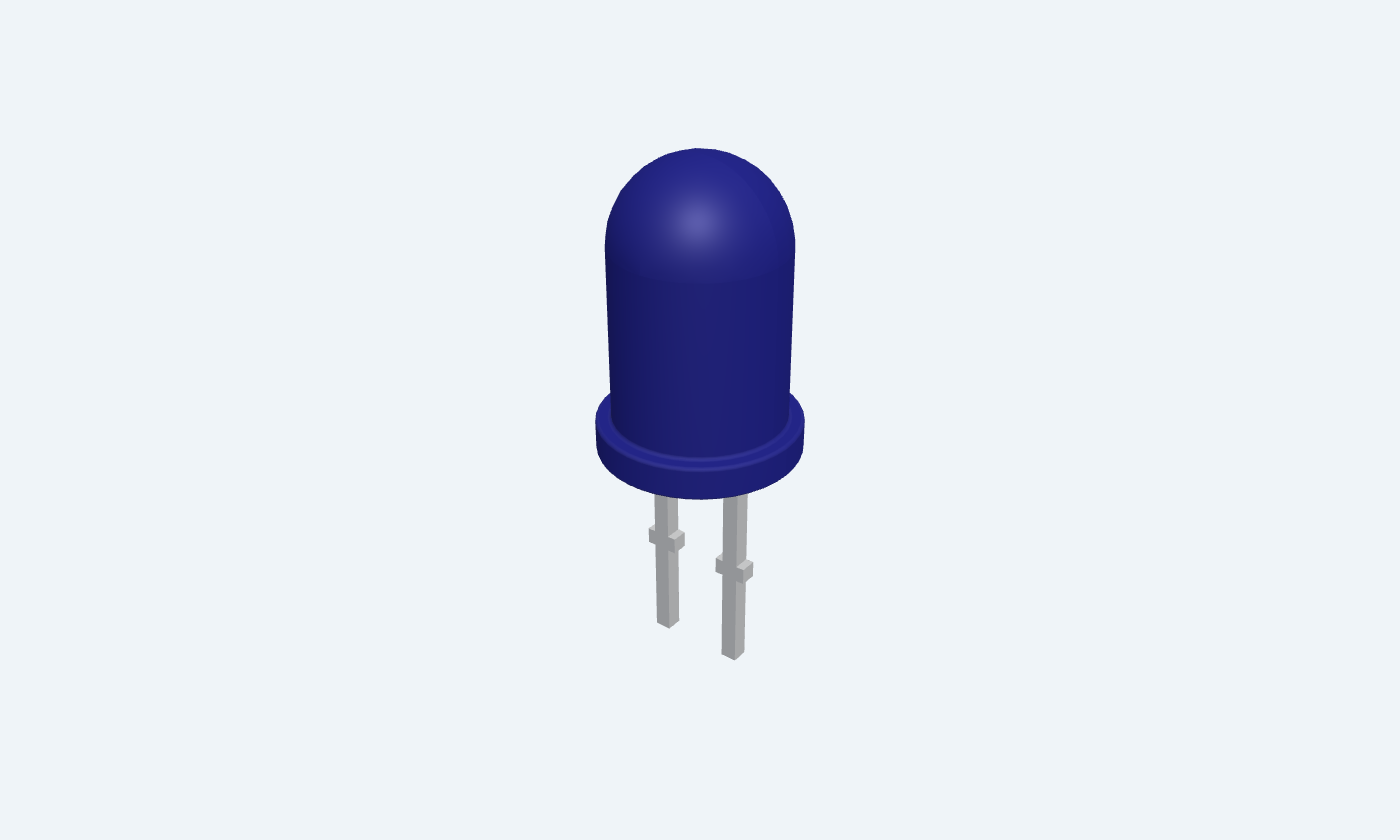
LED (5 mm)Through-hole indicator LED · Kingbright WP7113 family
Light from current: the resistor decides, the colour sets the voltage.
Manufacturer-referenced
Kingbright · WP7113QBC/D
T-1¾ (5 mm)WP7113 product specifications · red DSAF2430 V.13A, green DSAF2427 V.11B, yellow DSAF2443 V.11B, blue DSAG3481 V.18B, white DSAI6407 V.6BAn LED (light-emitting diode) is a diode that gives off light when current flows from its anode to its cathode. Electrons and holes recombine in the junction and release their energy as photons; the semiconductor material sets the colour and, with it, the forward voltage. An LED is driven by current, not by voltage. Above its forward voltage the current rises very steeply, so every LED needs something that limits it, normally a series resistor: R = (supply − Vf) / I. The same resistor gives a red LED about twice the current of a blue one, because blue needs 3.3 V and red only 1.85 V. This page uses the Kingbright WP7113 family of 5 mm (T-1¾) LEDs, one product specification per colour. The longer lead is the anode; the cathode is the shorter lead beside the flat on the flange. The page numbers them 1 = A and 2 = K, as ProTech and the KiCad footprint do.