


What is the Voltage Source




What is the Voltage Source
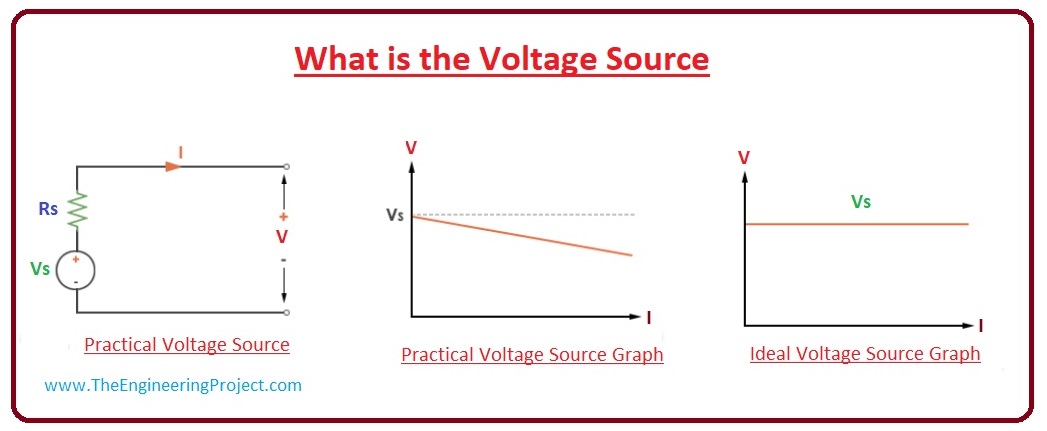
- The voltage source is an instrument which delivers the constant value of voltage in a circuitry irrespective of the variation in the resistance offered by the load.
- Such voltage source is also named as an ideal voltage source. In real-world such voltage source can be created, by assigning the 0 inner resistance and it can deliver constant voltage.
- The graphical representation of the ideal source is drawn in the figure. You can see that it is the straight line at any point of the time axis.
- If there is some quantity of internal resistance is exiting in the source then it is named as a real voltage source.
- As there is inner resistance is present in the source this causes to loss of voltage in the circuitry according to the value of this resistance in the circuitry.
- The graphical representation of the practical voltage source is drawn in the given diagram.
Types of Voltage Source
- There are the two main types of the voltage source first one is dependent source and other is the independent.
- The dependent voltage source has further two types.
- Voltage control voltage source
- current control current source
- Independent source also has two catagories.
- DC Voltage source
- AC voltage source
- Now discuss all these categories one by one
Independent Voltage Source
- This voltage source provides the constant value of the voltage, its voltage value does not depend on the other parameters of circuitry like resistance, or capacitance of the circuitry.
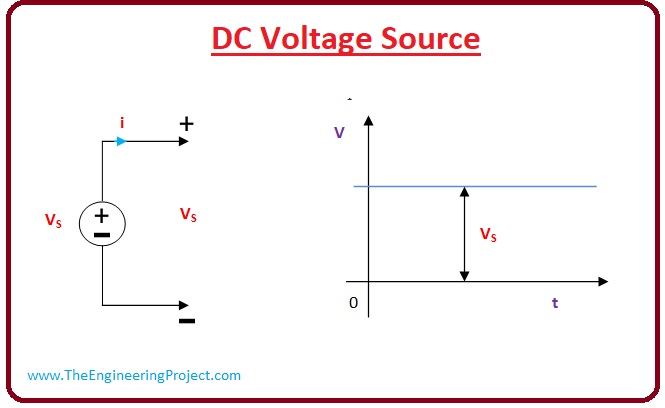
- This voltage source provides the constant voltage at the output is called a dc source.
- In this source, the electrons move in the same direction, so its polarity will not vary.
- The output voltage of this source will remain the same, it will not vary with the time.
- The examples of the dc voltage sources are the direct current generator, battery, or cell.

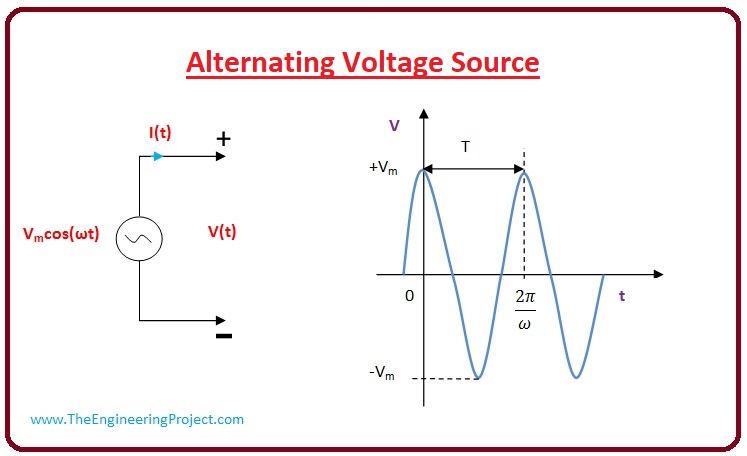
- Such voltage source generates the AC current as output is known as the alternating source.
- In this source the polarity of voltage changes after a specific interval of time.
- Due to the variation in the voltage for after some time current also changes its direction.
- Examples of such sources are Ac generators or direct current to alternating current converter
- The given diagram shows the circuit of the alternating voltage source.

Dependent Voltage Sources
- The output of the source does not remain constant but continuously vary is called a dependent voltage source.
- Its output voltage varies according to the changing in the other parameters of circuitry like current, resistance.
- If the voltage of the source depends on the voltages of other components of the circuitry then it called voltage-controlled voltage source.
- If the value of the voltages of the voltage source depends on the current of the other components then it known as the current-controlled voltage source.
- The given diagram shows all these voltage sources.
Comparison Between Voltage Source and Current Source
Voltage source- Mostly sources of electrical power like battery are known as a voltage source.
- In case of open circuitry, the ideal source delivers no power, in case of short circuitry it gives infinite power.
- This ideal device has the 0-ohm internal resistance but the practical source has less value of inner resistance but not zero.
- The current source delivers the non-variable current when the connected load has less value of resistance.
- In the case of the short circuitry, the ideal source delivers the no power, but in case of open circuit, its power value becomes infinity.
- The ideal source has infinite resistance value and the practical source has high but in some limit value of the resistance.
Ideal Voltage Source
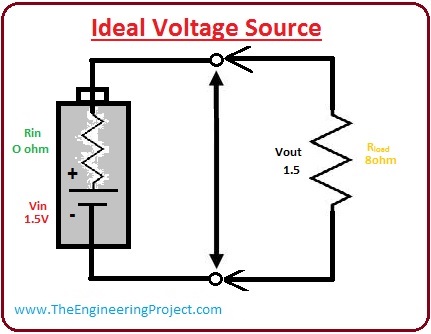
- The source which has no interior resistor (R) is named as an ideal source.
- It incomes that there is no voltage drop in the source, due to this we get the same voltage at output points which were produced by the source.
- Each practical (applied) voltage source like the battery has some value of resistor which causes to drop of voltage.
- To understand the practical difference among the ideal and practical source we discuss an example.
- In case of ideal source, if we have five volts battery, it will give five volts at output points as it has no internal resistance.
- But in case of practical voltage source, we do not get five volts at terminals due to some loss of voltage at interior resistance ®.

×
![]()


