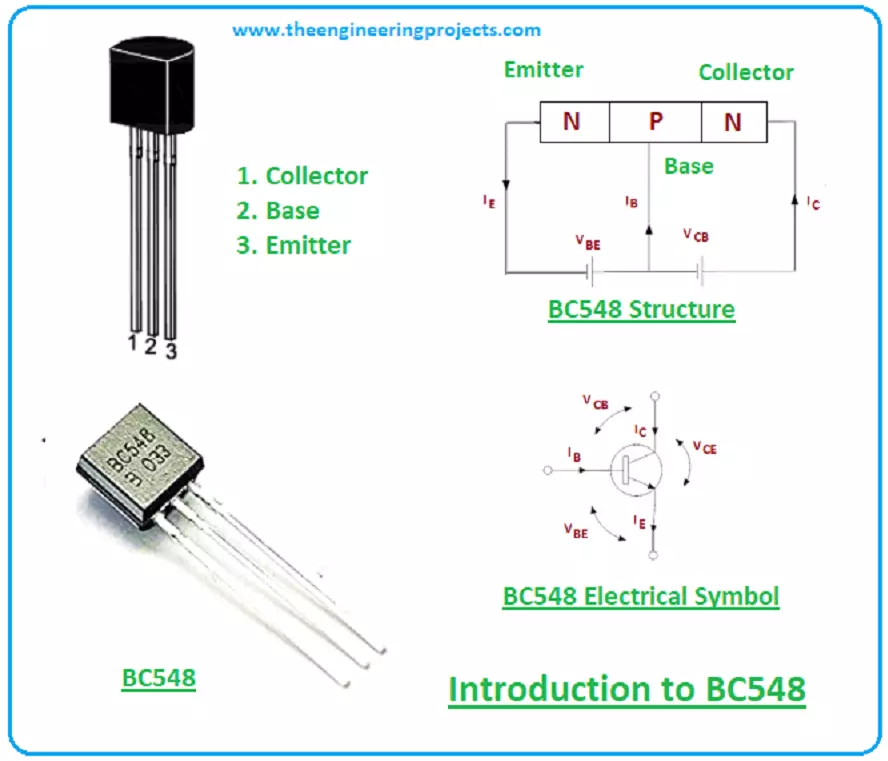
Introduction to BC546





Introduction to BC546
- BC546 is a bipolar junction NPN transistor that finds applications in switching, amplification, impedance, H-bridge and current mirror circuits.
- This transistor falls in silicon epitaxial planar transistor category which is generally divided into three groups A, B & C. This BC546 is available in group A & B.
- BC546 low power transistor mainly contains three terminals named emitter, base and collector. And all these terminals are different in terms of their doping concentration and are used for external connection with electronic circuits.
- BC546 transistor contains three layers i.e. two N-doped layers and one P-doped layer. The P-doped layer resides between two N-doped layers. Plus, it carries two PN junctions where one is forward biased and other is reverse biased.
- Unlike FET (Field-Effect Transistor) that is voltage controlled device, BC546 is a current controlled device where small current at the base terminal is primarily used for controlling the large current at both emitter and collector terminals.
1. BC546 Datasheet
- Although, we are going to discuss everything related to BC546, in this tutorial but still its always wise to have a look at the datasheet.
- You can download BC546 Datasheet by clicking the below button:
2. BC546 Pinout

- Emitter.
- Base.
- Collector.
3. BC546 Pin Configuration
- Emitter current is a sum of both collector current & base current.
- The small current at the base terminal is used to control large current at the emitter and collector terminals.
- This transistor can be employed in three main configurations named:
- Common base configuration.
- Common emitter configuration.
- Common collector configuration.
- Common emitter configuration comes with exact voltage and current ratings required for amplification.
- Forward current defines the nature of amplification. It is called amplification factor, or beta and denoted by ß. Which is a ratio between collector current and base current and it carries no unit. The amplification factor ranges from -110 to 800.
- Similarly, current gain is a ratio between collector current and emitter current. It is known as alpha, denoted by a. The alpha value ranges from 0.95 to 0.99 but more often than not its value is taken as unity.
4. BC546 Working Principle
- BC546 is a junction transistor where both electrons and holes are responsible for conductivity, electrons are majority charge carriers, however.
- In NPN transistor base terminal is positive with respect to emitter and is usually used to control the number of electrons.
- It gets biased and draws current when voltage is applied at the base terminal, thus controlling the large current at emitter and collector side.
- Free movements of electrons plays a key role for conductivity and is mainly used to bridge the gap between emitter and collector where electrons are emitted by the emitter which are then collected by the collector.
- In this NPN transistor current flows from collector to emitter unlike PNP transistor where current flows from emitter to collector.
5. BC546 Power Ratings
Absolute maximum power ratings of this NPN transistor are shown in the figure below:
- Collector-Base voltage is 80V. And Emitter-Base voltage is 6V.
- High Collector-Emitter voltage of 65V makes it the best pick for high voltage audio amplifier applications.
- Collector current is 100mA with maximum power dissipation 500mW at temperature 25C.
- These are stress ratings that, if increased from absolute maximum ratings, can severely affect the quality of the product, thus damaging the device.
- Similarly, if these ratings are applied for the extended period of time, they can affect the device reliability.
- The absolute maximum ratings are stress ratings with values measured at T = 25C
6. BC546 Modes & Key Parameters
The current directions and voltage polarities are opposite in both NPN and PNP transistors. If current flows in a clockwise direction in NPN transistor and carries positive polarity at the base terminal, it will flow in an anticlockwise direction in PNP transistor negative voltage polarity. Flow of electrons from collector to emitter in this NPN transistor depends on the biased voltage applied at the base terminal. Following are four modes of BC546 transistor:- Active mode.
- Cut-off mode.
- Saturation mode.
- Reverse-active mode.
7. BC546 Alternatives
BC546 contains following alternatives:- 2SC4145
- 2SD1698
- 2SD1701
- 2SD1978
- 2SD1981
- 2SD2296A
- 2SD2213
- HIT667
- KTC1026
- KTC3200
8. BC546 Applications
BC546 is mainly used in the following applications:- It is used in linear amplifiers.
- BC546 finds applications in H-Bridge circuits
- Used for impedance circuits and current mirrors circuits
- Also employed in oscillator circuits and Astable vibrators
- Used in bistable multivibrators and comparator circuits
9. BC546 Physical dimensions
Following diagram shows the physical dimension of BC546:
×
![]()