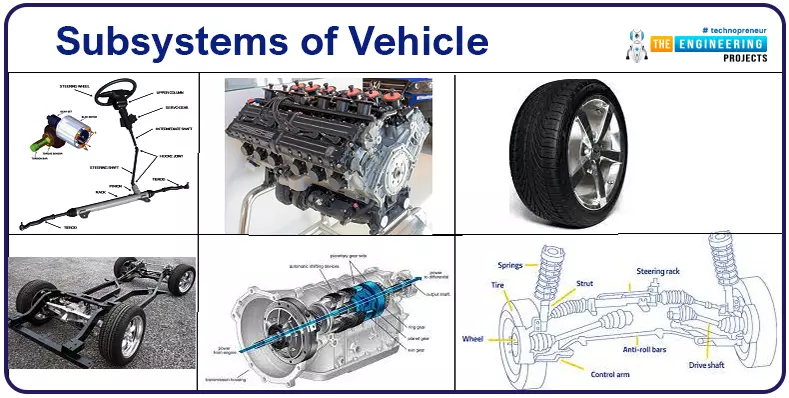
Just like the big bang theory which resulted in the world we live in. If we must mark a big bang for vehicles or the Automotive industry, it would be the invention of wheels. The invention of wheels redefined the aspects in which humans transported goods or traveled across places. Since, the invention of the wheel, transportation has always been contributing to the growth of society we live in. These vehicles later helped in conquering road travel. From its inception, the vehicle industry is technologically driven, pushing its own limits to find answers to challenges such as how can we travel faster? What will help us in making these rides more comfortable? Manually driven vehicles and their restrictions raise the need for a further quest. Quest for aspects such as, The second most important milestone was achieved with the invention of steam engines. Vehicles now can be driven automatically. Followed by steam engines invention of the Internal Combustion engine happened. These engines are used to convert potential energy in the form of water/heat or petrol into mechanical energy which is then transferred to wheels to move vehicles faster. In recent times there is an increased demand for vehicle safety, environmental concerns and intelligent control. Software were also introduced into vehicles to control mechanical aspects more accurately, and Electrical engines are invented to address environmental concerns. Even though we have come across a long way of invention but still ...
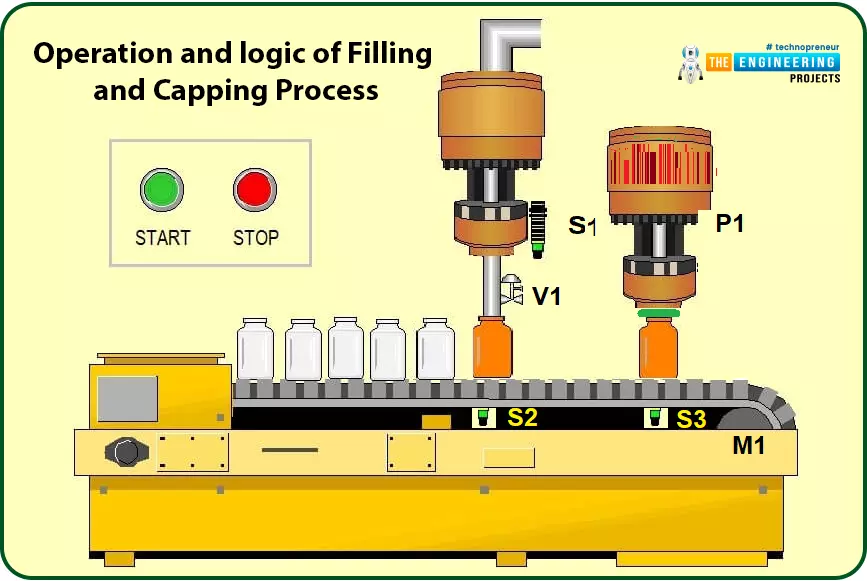
Hi friends, how are you doing? Today will integrate all of what we have learned so far in this series to build the first project based on ladder logic programming. Because we all are interested in industry, we pick one industrial project, Bottle Filling and Capping Projects, which is very common today. The problem we are going to solve today is bottle filling and capping. We have learned all basics of ladder logic including contacts and coils operation, logic gates, rising and falling edges, timers, and counters. So, today we will utilize all of these components to implement a complete ladder program of filling and capping problems. For simplifying the operation of the process of filling and capping, fig. 1 shows the process flow which simply contains the main motor that drives the conveyor belt on which the bottles are running starting by hitting the start button. The conveyor belt starts running driven by motor M1 and the bottles move until sensor S2 detects one bottle, then motor M1 stops and the belt does so. At the same time, valve V1 opens to let water get dropped into the bottle until it reaches specific level thanks to level sensor S1. Then valve V1 closes and motor M1 goes on moving. Then when sensor S3 sees a bottle, the piston P1 is activated for capping the bottle and so on. Fig. 1. The Filling and Capping Process As you can see, for every single process in the industry, there are inputs and outputs. The inputs represent the sensors and user requests like starting ...