



Microcontroller Programming Services


Hello friends! If you are developing an embedded project and need help with its firmware, The Engineering Projects can discuss your microcontroller programming requirements with you. Your project may involve a new prototype, a circuit that is not responding correctly or an existing program that needs a clearly defined improvement.
Useful programming work starts with understanding the hardware and the required behaviour. A sentence such as “control a motor with a sensor” describes an idea, but it does not yet define a complete system. We need to know which motor, which sensor, how quickly the controller must respond and what should happen when a signal disappears.
This page explains the types of work you can discuss with us, the information to prepare and the deliverables to agree before development begins. For a project-specific discussion, use our Contact Us page. Availability, scope, cost and delivery dates should be confirmed for your particular project.
What Microcontroller Programming Services Include
Microcontroller firmware connects a program to physical inputs and outputs. It reads switches and sensors, exchanges messages with other devices and controls indicators or driver circuits. Good firmware also defines timing, startup behaviour and recovery from expected faults.
A project can require several different tasks. Sometimes the main need is writing a peripheral driver. In another case, the driver already works, but a blocking delay prevents the application from handling other events. We should identify the actual problem before deciding whether a small correction or a larger redesign is appropriate.
| Area | Typical objective | Useful evidence to provide |
|---|---|---|
| Firmware development | Implement a specified sequence of operations | Requirements and an input/output list |
| Peripheral interfacing | Read a sensor or control a display | Part numbers, datasheets and wiring |
| Debugging | Find and correct a reproducible fault | Source code, logs and reproduction steps |
| Communication | Exchange validated messages between devices | Protocol format and sample messages |
| Migration | Move an application to another device or toolchain | Original project and target constraints |
| Documentation | Make a project understandable and maintainable | Existing design files and handover expectations |
Identify the Board and Microcontroller
The original service description covered Arduino, PIC, Atmel devices, Raspberry Pi, FPGA projects, Mbed and LPC-based hardware. These names describe different kinds of platforms. They should not be treated as interchangeable microcontrollers or as a guarantee that every variant is suitable for every task.
An Arduino board is a development platform built around a particular processor or microcontroller. For example, an UNO based on an ATmega328P has different memory and peripheral constraints from a more powerful board. For a PIC project, provide the complete device number, such as PIC18F452, rather than only the word PIC.
Raspberry Pi computers and Raspberry Pi Pico boards also need to be distinguished. The official Raspberry Pi microcontroller documentation covers the Pico-related microcontroller products. A Linux application on a Raspberry Pi computer has different deployment, timing and recovery requirements from firmware running directly on a microcontroller.
FPGA development involves configurable digital logic and associated implementation tools. A design may include a processor, but ordinary microcontroller C code does not directly describe every FPGA function. State whether you need firmware, hardware-description-language work or communication between the two.
For an LPC project, identify the exact NXP device and development environment. The LPC541xx documentation, for example, describes a specific Cortex-M family; its resources should not be assumed to apply to all older LPC devices.
Plan for Legacy Toolchains
Send the compiler version, board package, library versions and original build instructions. A project that depends on an obsolete online service may need migration before feature development can begin. Arm's Mbed lifecycle announcement specified July 2026 as the platform and OS end-of-life date, so an old Mbed project needs an explicit build and maintenance plan.
Do not upgrade every dependency before reproducing a fault. First preserve a copy of the environment that generated the existing firmware. Then assess upgrades separately, because a changed compiler or library can alter behaviour and make the original failure harder to isolate.
Sensor, Display and Communication Interfaces
A sensor interface involves more than reading a number. We need to establish its supply voltage, electrical signalling, measurement range, update rate and failure indications. Calibration and unit conversion belong in the scope when the application needs meaningful engineering measurements.
For example, a 12-bit ADC produces 4096 possible codes. With an ideal 3.3 V reference, one code step corresponds to approximately 3.3/4096 = 0.000806 V. That resolution does not guarantee the same measurement accuracy: reference error, noise and the sensor's own characteristics still contribute.
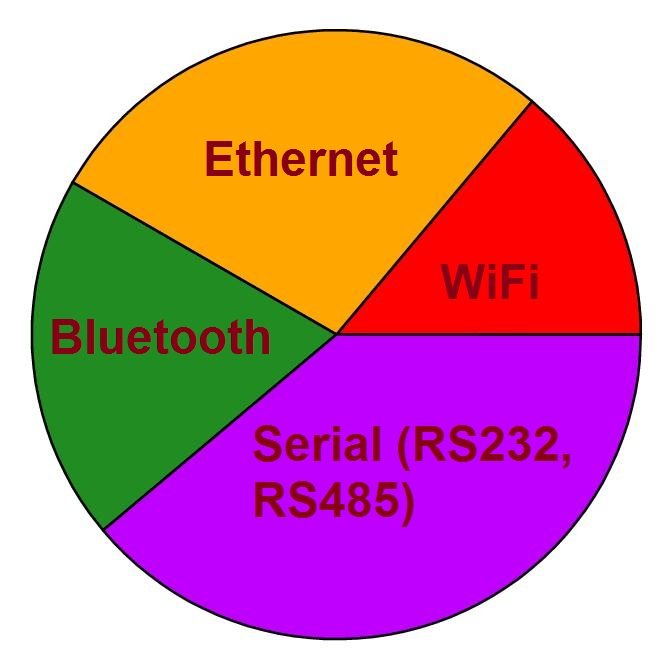
The original service areas included RS232, Ethernet, WiFi, RF, Bluetooth and RFID. For any communication task, provide both the electrical interface and the message format. A UART carrying logic-level signals cannot be connected directly to an RS232 port merely because both transmit serial data.
Describe how messages begin and end, the permitted length, byte order and error checks. Also define what happens after a timeout, corrupted message or reconnection. These details make communication predictable and are often more important than the speed of the initial demonstration.
For networked projects, identify where credentials are stored and how configuration is changed. A public control page, a private local dashboard and a device-to-device link have different requirements. Authentication, encrypted transport and firmware updates should be specified when the deployment needs them.
Motor Control and Robotics Projects
The original page included DC motors, stepper motors, servo motors and industrial motor applications. Each requires an appropriate driver and control method. Firmware provides control signals; the motor's operating current must be supplied through suitable power electronics.
For a DC motor, provide its rated voltage, running current and stall current, along with the required direction and speed control. For a stepper motor, include the winding arrangement, driver model, step mode and acceleration requirements. For a hobby servo, specify the permitted movement range and load rather than assuming every unit behaves identically.
A timing requirement can be expressed numerically. If an encoder produces 1000 counted events per revolution and the shaft reaches 3000 revolutions per minute, the controller must process 1000 × 3000/60 = 50,000 events per second. That is one event every 20 microseconds on average, which may require a hardware counter rather than a slow polling loop.
Induction-motor and other industrial drive projects need a scope that includes the drive interface, feedback and protection responsibilities. A squirrel-cage motor is a type of induction motor, not an unrelated category. A microcontroller program alone does not establish that a complete drive installation is suitable for service.
Turn Your Idea Into a Clear Project Brief
Before contacting us, write a short description of the intended behaviour. Then add the information below. You do not need a polished specification to begin a discussion, but concrete details make it easier to identify missing decisions and estimate the work.
- List the controller, sensors, displays, communication modules and drivers by part number.
- Provide the schematic or an accurate connection table, including supply voltages.
- Describe normal operation from power-on to shutdown.
- State timing, memory, power and size constraints that affect the design.
- Describe abnormal conditions and the required response.
- List the deliverables and the practical tests that will demonstrate acceptance.
For an existing fault, include what you expected, what actually happened and the shortest sequence that reproduces it. A serial log, compiler error or measured waveform is more useful than saying that the board is not working. Remove private credentials before sharing a project archive.
A Practical Development and Review Process
A sensible project plan separates investigation, implementation and acceptance. Start by confirming the hardware and reproducing the baseline behaviour. Next, implement one functional path at a time so each stage can be reviewed. Finally, exercise the agreed normal and failure conditions on the intended hardware.
A simulation can help explain logic and catch certain wiring mistakes, but it does not reproduce every physical effect. Noise, regulator behaviour, contact bounce and communication quality may differ on a real board. State whether a deliverable is a simulation, a bench-tested prototype or firmware for a production assembly.
Review points should show observable behaviour. For a water-level indicator, that might include readings at known levels, an out-of-range sensor response and the display after power interruption. For a robot, it could include obstacle detection at a defined distance and stopping behaviour after communication loss.
Project Examples and Their Scope
The original page listed project topics such as a person-following robot, maze-solving robot, water-level indicator, LED-cube notice board, bike alarm, networked automation and GPS-guided navigation. These remain useful examples of the kinds of embedded problems that can be discussed, rather than fixed packages with assumed specifications.
A person-following robot, for example, needs a definition of how the target is identified and what happens when it is lost. A GPS navigation project needs requirements for location accuracy, update rate and behaviour when a position fix is unavailable. Two projects with the same title can therefore involve very different engineering work.
Likewise, a home-automation prototype controlling indicator LEDs is a different deliverable from an installed system controlling real equipment. Tell us which stage you need, which hardware is already available and which interfaces must be supported. This prevents a demonstration from being mistaken for a complete deployment.
Agree the Handover Before Development
A useful handover should let the next engineer build, program and understand the agreed project. Decide explicitly whether it includes source code, a compiled image, wiring information, library dependencies, configuration files and operating instructions. Source ownership and third-party licence obligations should be recorded in the project agreement.
For reproducibility, record the compiler and tool versions together with the firmware revision. Include the required programmer or bootloader procedure and any configuration bits or fuse settings. A source folder without those details may be insufficient to recreate the demonstrated behaviour.
Acceptance notes should distinguish completed checks from remaining limitations. A successful startup test does not establish long-duration reliability, and a clean compile does not prove electrical compatibility. If additional environmental, endurance or compliance testing is required, it needs its own defined scope.
Frequently Asked Questions
Can you help with a project that already has code?
You can submit an existing project for discussion. Include the source, build environment, hardware details and a specific description of the required change. The first task may be reproducing its current behaviour.
What if my microcontroller is not mentioned here?
Send its full part number and project requirements through the contact page. Feasibility depends on the device, available tools and requested work; a missing name does not by itself determine the answer.
Will I receive an explanation of the project?
Specify the explanation and documentation you need as deliverables. That may include commented source, a wiring guide, a walkthrough or test instructions. Agree the format before work begins.
How much does programming cost?
A meaningful estimate depends on the scope, existing code quality, hardware access and testing requirements. This page does not set a fixed price or delivery time for every project.
Is support available at a guaranteed time?
Confirm response arrangements and any ongoing support separately. Do not rely on the historical page's general availability statement as a current service-level commitment.
If you would like to discuss a project, contact The Engineering Projects with your hardware details and intended behaviour. A clear brief gives us a practical starting point for deciding what needs to be built, how it will be reviewed and what you will receive.

Tags


Hello syed , how are you ? , can you make a project of control appliance by sms using SIM900 GSM Module and PIC Microcontroller
( PIC16F628A or PIC16F877A) + Micro C , this project is used to control 6 - Loads by sending SMS messages , if you can , what will be the price ? and thanks for you .
Engineer : Idrees Muhamed
1 reply
Hi,
Yeah we can provide you the complete project. Give us a call or use contact us form and we will discuss it in detail.
Thanks.
1 reply
Hello syed zain , i have 2 power source Main & Generator , i want from the project ( device ) to response to the SMS Messages only when the Main power supply is found , i want to control 6 load by sending SMS Messages , the device must response to only 3 mobile numbers provided by me , the device send to me SMS Message when the Main power be OFF , also send SMS Message when the Main power supply reyurned , and when i send SMS Messsage to ON any load and in that time the Main power supply is OFF
( The Generator power supply is ON ) , the device send to me an SMS Message told the the Main power supply is OFF , now the details of the project is clear , what will be price of the project in dollars and thanks for you , engineer ; idrees muhamed .
1 reply
Hi, Yeah it's quite clear and the cost will be $400 for the complete project. It's better that you add me on skype, so that we could have a detailed chat. Thanks.
hello my name is shuaib from new delhi, I'am currently a student at Sharda university.
having read through about your organization. I developed an interest. i wanted to learned arduino, and the interfacing of different modules. I will also need the guidance on my dissertation titled "intelligent electronic travelling aid for visually impaired" which will guide the visually impaired people by voice.
waiting to hear from you
Mr. Shuaib
umargaro@yahoo.com(my mail)
1 reply
Hi Shuaib,
Yeah we will surely help you out. Add us on Skype and let us know the details of your project. Skype id is "theenggprojects".
Thanks.
1 reply
hii Sir i want to earn money by making projects .. so please suggest me what i can do for it....
I want to know details about how to build a quadcopter as an engineering project
HI sir will u prvide code for luggage tacking system for Sam D21 controller using GSM and GPS
Comments
10