


Tutorial1: Earn with Freebitco.in


Hello friends! This tutorial originally introduced Freebitco.in as a way to collect small Bitcoin rewards. It also suggested increasing bets after losses to earn more money. That second claim needs correcting: a betting progression cannot guarantee income, and a faucet balance is not a reliable substitute for paid work. We will keep the original topic and screenshots while examining what the numbers actually mean.
The useful distinction is between receiving a promotional reward and risking money in a gambling game. A faucet may credit a small amount under its own rules. A wagering feature can then lose that amount, along with any additional funds deposited. Combining the two does not turn gambling into an investment or an engineering method for predictable earnings.
In this updated guide, we will calculate Bitcoin units, estimate the value of a hypothetical reward, explain expected value and examine the old doubling strategy. We will also separate an account balance from a completed withdrawal. The historical screenshots are retained for context; they are not evidence of current payout rates, withdrawal reliability or the site's present interface.
What Is a Bitcoin Faucet?
A Bitcoin faucet is a service that distributes small promotional amounts of Bitcoin or credits denominated in Bitcoin. Its conditions may involve time limits, advertising, account eligibility or other restrictions. The operator decides the offer, and the offer can change. A reward shown in an old tutorial therefore cannot be treated as a standing contract with today's visitor.
The original Freebitco.in article described an hourly claim and a separate feature called Multiply BTC. Those are different activities. The first concerned a promotional credit; the second concerned wagering. This article does not confirm that either feature currently operates as shown in the archived images.
If you inspect a service, use its own published information to establish the current terms. Freebitco.in's published bonus terms, for example, describe wagering conditions for bonus balances. A bonus account and an immediately withdrawable balance should never be assumed to mean the same thing.
Understand BTC and Satoshis First
One bitcoin, written as 1 BTC, contains 100,000,000 satoshis. A satoshi is therefore 0.00000001 BTC. Working in satoshis makes small amounts easier to compare and reduces mistakes caused by counting zeros in a decimal balance.
| Amount in BTC | Amount in satoshis | Calculation |
|---|---|---|
| 0.00000001 | 1 | 0.00000001 × 100,000,000 |
| 0.00000100 | 100 | 0.00000100 × 100,000,000 |
| 0.00000519 | 519 | 0.00000519 × 100,000,000 |
| 0.00015000 | 15,000 | 0.00015000 × 100,000,000 |
The last two figures appeared in the original tutorial. They are historical examples, not verified current rewards or recommended gambling balances. Their conversion remains mathematically valid even when the original offer no longer applies.
A BTC balance and its cash value are also different quantities. If an amount is B BTC and a hypothetical exchange price is P currency units per BTC, its gross cash equivalent is B × P. Using a deliberately hypothetical price of 50,000 units, 100 satoshis would have a gross value of 0.05 units. That example is not a current Bitcoin price quotation.
Include the time spent
Suppose a hypothetical promotion awards 100 satoshis per successful claim and you complete ten claims in one day. The gross total is 1,000 satoshis, or 0.00001 BTC. If each claim consumes two minutes of active attention, the total active time is twenty minutes. Waiting between claims is a separate scheduling cost.
At the same hypothetical exchange price, the day's gross amount would be 0.50 currency units. Dividing by one-third of an hour gives an active-time equivalent of 1.50 units per hour. This calculation excludes withdrawal restrictions, fees and missed claims. It illustrates why a large-looking count of satoshis can still represent a very small monetary reward.
Account Credit Is Not the Same as a Withdrawal
A balance displayed on a website is a record maintained by that website. It does not, by itself, prove that the same amount is controlled by a wallet you hold. Distinguish promotional credit, wagerable balance, withdrawable balance, a requested withdrawal and a transaction received by your wallet.
For an illustrative withdrawal, let the eligible balance be B and the stated deduction be F, both in BTC. The net amount is B − F, provided the request satisfies the service's conditions. If B is 0.00002 BTC and F is 0.00001 BTC, half the balance disappears into the stated deduction. These are example figures, not this site's verified charges.
The deduction a service charges is not necessarily identical to the network fee paid for a transaction. A service may batch several withdrawals or apply its own pricing. Read the amount that will actually arrive, and do not infer it merely from a general Bitcoin network-fee estimate.
A transaction identifier can help distinguish an on-chain payment from an internal status message. It still needs to correspond to the intended destination and amount. This article has not performed a current withdrawal test and should not be read as a certification that the service will pay.
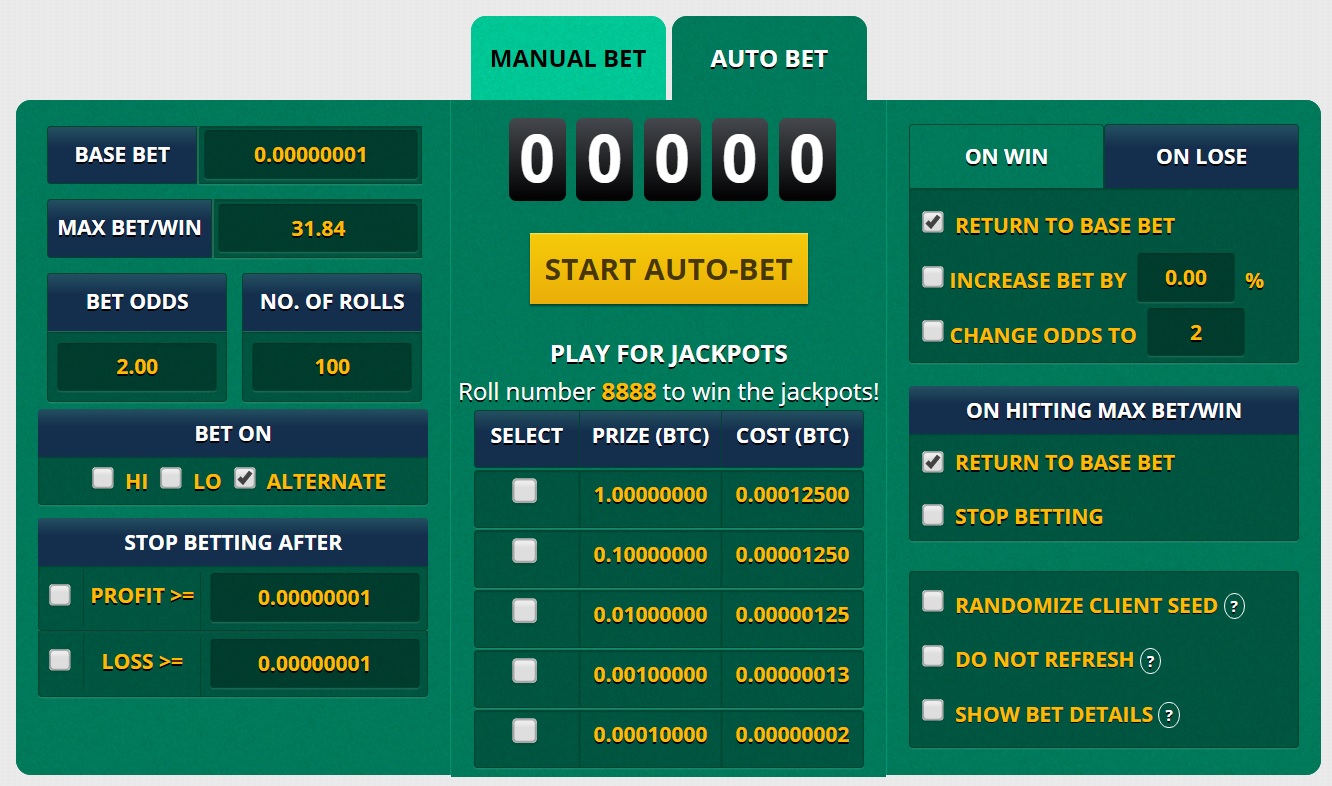
Why Multiply BTC Is Gambling
A game whose return depends on a random outcome exposes the stake to loss. Increasing the stake, automating repeated play or collecting the initial stake through a promotion does not change that classification. The arithmetic of the payout and the probability determines the expected result.
This retained screenshot shows the historical gambling interface discussed in the original post. The former advice to enable automated loss-based stake increases has been removed. We will analyze that idea on paper instead of presenting it as a way to earn.
Calculate expected value
Let b be a stake, p the probability of winning and M the gross payout multiplier, including the returned stake. A win produces net profit (M − 1)b, while a loss produces −b. The expected net result is therefore E = p(M − 1)b − (1 − p)b = (pM − 1)b.
For an invented game with a 49% winning probability and a gross multiplier of 2, the expectation is (0.49 × 2 − 1)b = −0.02b. The average loss implied by those assumptions is 2% of the amount wagered. This is a teaching example; it does not assert the current probabilities or payout table of Freebitco.in.
The UK Gambling Commission explains return to player and house edge as long-run statistical concepts. An expected return is not a promise that a short session ends near that average. Individual sessions can differ substantially.
Notice that the formula depends on both the multiplier and the winning probability. Changing a displayed multiplier from two to three does not independently improve the expected value. If the chance of winning changes too, both numbers must be considered. A higher advertised prize can accompany a lower likelihood of receiving it.
What Goes Wrong with Doubling After a Loss?
The old tutorial proposed increasing the bet by 100% after losing. Starting with a hypothetical one-unit stake produces stakes of 1, 2, 4, 8 and so on. Each step is small relative to the next, so the early sequence can look manageable while the later exposure becomes much larger.
| Consecutive losses | Total already lost | Next doubled stake |
|---|---|---|
| 1 | 1 unit | 2 units |
| 3 | 7 units | 8 units |
| 5 | 31 units | 32 units |
| 8 | 255 units | 256 units |
| 10 | 1,023 units | 1,024 units |
After n consecutive losses, the cumulative loss is b(2n − 1), and the next requested stake is b2n. A finite account balance or a maximum allowed stake eventually prevents the next step. The strategy's comforting claim that a later win will recover everything assumes access to resources that a real player does not have without limit.
Even under an invented independent 50% loss probability, ten specified consecutive losses have probability 0.510, approximately 0.098%. That is small for one specified ten-outcome block, but not zero. It is also not the probability of encountering such a run anywhere across an arbitrarily long history, which is a different calculation.
For independent trials with a fixed loss probability, previous losses do not make the next result owe you a win. Repeated exposure creates more opportunities for an unfavorable sequence. A positive-looking session history cannot establish that a staking rule has removed a negative expected value.
Turnover matters more than the opening balance
Suppose a hypothetical game has a fixed 2% house edge and the total amount staked across a session is 10,000 units. The expectation associated with that turnover is a loss of 200 units. The same balance may have been reused many times, so the turnover can be much greater than the amount initially deposited.
Automation increases the number of decisions made without attention. It does not supply information about the next random outcome. Faster repetition can accumulate turnover and losses faster, which is precisely why an automated button should not be confused with an income-generating algorithm.
Evaluate Claims without Depositing or Betting
You can assess an advertised offer using a simple written worksheet. Record the date, the reward units, eligibility conditions, withdrawal threshold, fees and any wagering requirement. Mark information as unknown when it is missing. Unknown conditions should not silently become favorable assumptions in an earnings estimate.
- Convert all amounts to one unit, such as satoshis, before comparing them.
- Separate unconditional promotional credits from bonuses that require wagering.
- Calculate the gross reward for a realistic number of completed claims.
- Subtract stated deductions only when their meaning and applicability are clear.
- Record active time and the inconvenience of repeated visits.
- Keep gambling outcomes out of any claim of predictable earnings.
This method does not establish that a particular website is trustworthy. It does make misleading arithmetic easier to spot. For example, multiplying an hourly maximum by every hour of a month assumes uninterrupted availability, eligibility and participation. It is a theoretical ceiling under strong assumptions, not a normal person's expected income.
Wallet Security and Privacy
Receiving a payment does not require revealing a wallet's recovery phrase or private keys. Bitcoin.org's scam guidance emphasizes checking payment details and protecting those secrets. A request to send more Bitcoin to unlock a promised payout deserves particular scrutiny; the promise itself does not establish a legitimate obligation.
A public receiving address is different from a private signing secret. Bitcoin transactions are publicly recorded, and address reuse can link activity. Bitcoin.org's privacy guidance explains why receiving-address practices matter. Do not assume that a cryptocurrency payment is automatically anonymous merely because it contains no bank-account number.
Keep service credentials separate from wallet backups. A password for a promotional website should not be reused for email or other important accounts. These are basic account-management measures, not evidence that a particular promotion is safe or financially worthwhile.
Review of the Original Earning Claim
The original tutorial mixed a real unit of digital currency, a small promotional reward and a gambling progression into one optimistic earnings story. The unit conversion is straightforward. The claimed dependable income is not supported by that conversion, and the loss-doubling method cannot supply the missing guarantee.
For students, the useful lesson here is quantitative evaluation: distinguish gross from net, probability from certainty, and account credit from funds received. A few minutes of arithmetic can reveal assumptions that a colorful screenshot or a large payout multiplier leaves unexplained.
Frequently Asked Questions
Does collecting a faucet reward mean I must gamble?
No. A promotional claim and a wagering game are separate activities. Check whether a particular reward has conditions; do not assume that gambling is necessary or beneficial because both appear on the same website.
Can doubling after losses guarantee a profit?
No. The required stakes grow exponentially, balances and maximum stakes are finite, and changing stake size does not remove a game's underlying house edge.
Is the old hourly reward still available?
This article does not verify that historical rate. The retained figures and screenshots explain the original post and should not be used as current service terms.
Does a displayed BTC balance prove that I own that Bitcoin?
It proves only what the service's interface displays. A withdrawable account claim and funds controlled by your own wallet are different arrangements, with different dependencies.
Should faucet rewards be included in a monthly income plan?
They should not be treated as dependable income. Promotional terms, availability, fees and withdrawal conditions can change, while gambling introduces an additional possibility of losing money.


Comments
3