


Getting Started with PIC Microcontrollers


Hello friends! In the previous lesson, we discussed microcontroller basics. Today, we will apply those ideas to a PIC18F452 and identify everything needed to make a simple program run on real hardware.
We will use the 40-pin PDIP version of the PIC18F452, matching the original circuit in this tutorial. Our first output is an LED on RD0. Before writing the application, we will work through power, reset, the external clock, programming connections and the distinction between the IDE and compiler.
The original lesson used older MPLAB tools and a socket-style programming workflow. Those are useful historical references, but a supported in-circuit programmer can program the PIC while it remains in the target circuit. The exact combination of device, programmer and software must be checked before starting.
Identify the Exact PIC Device
Read the marking on the chip and select that exact device in the project. PIC18F452 and PIC18F4520 are different parts, despite their similar names. Register definitions, configuration options and peripheral behavior should come from the correct datasheet, not from whichever search result appears first.
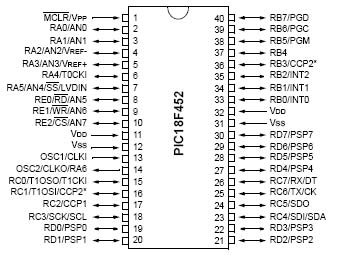
The package matters too. The pin numbers in this article refer to the 40-pin PDIP package. A surface-mount package can expose the same named signals on different physical pin numbers. Use Microchip's PIC18F452 product page and the PIC18FXX2 datasheet to identify your version.
Orient the PDIP using its notch or pin-one marker before counting pins. A breadboard drawing is not a substitute for checking the chip's orientation. Connecting a correctly numbered wire to an upside-down chip can place supply voltage on the wrong terminal.
What Software Do We Need?
| Tool | Purpose |
|---|---|
| MPLAB IDE or MPLAB X IDE | Organizes the project, editor, build settings and debugging workflow |
| Compatible C compiler | Translates C source into code for the selected PIC |
| Programmer software | Transfers the resulting image through supported programming hardware |
| Device support files | Describe the selected part to the development tools |
MPLAB is provided by Microchip, not Microsoft. The IDE and the C compiler are separate components. For a new compatible setup, review MPLAB X IDE and MPLAB XC8. For an existing C18 project, preserve the original tool versions while planning any migration.
Do not assume that an old C18 source file compiles unchanged with XC8. Header names, compiler extensions, interrupt declarations and library functions may differ. A compiler change is a project change that requires reviewing the source and configuration, not simply renaming a folder.
Choose a Compatible Programmer
A programmer places the compiled firmware in the device's program memory. A debugger can also provide features such as breakpoints and inspection while a supported target executes. One tool may support both roles, but support depends on the target and software version.
Check the manufacturer's device-support information for the exact programmer you own. Avoid buying or selecting a tool only because its name contains PIC. Legacy programmers may require an older compatible IDE, and a current installer does not necessarily retain every older hardware tool.
With In-Circuit Serial Programming, or ICSP, the PIC can remain in the circuit. Microchip's programmer connection guidance identifies the programming voltage, data and clock connections. Keep the connector accessible so later firmware updates do not require repeatedly removing the chip.
Understand the Original Minimum Circuit
The original schematic uses a 10 MHz crystal, two 18 pF capacitors, a 10 kilohm reset pull-up and an LED on RD0. It is shown below so we can examine the function of each section rather than copying wires without understanding them.
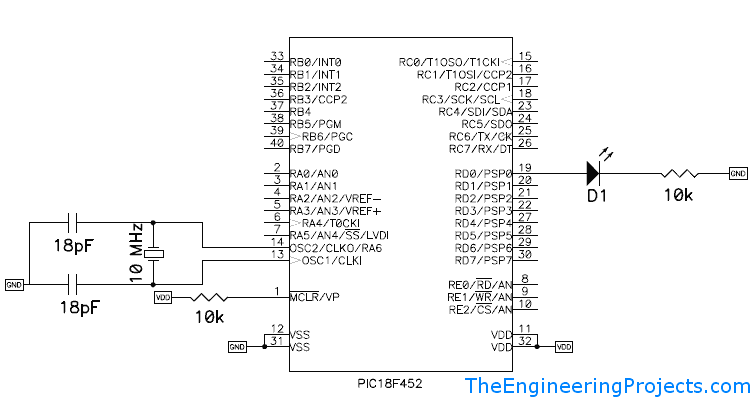
Two practical additions deserve attention when building hardware. Add local supply decoupling near the PIC's power pins, and choose the LED resistor for the current you actually want. The diagram's 10 kilohm LED resistor gives a very small current and may make the LED difficult to see.
| Signal | 40-pin PDIP pin | Connection for the starting circuit |
|---|---|---|
| VDD | 11 and 32 | Regulated supply appropriate to the selected part and clock; 5 V in this example |
| VSS | 12 and 31 | Ground |
| MCLR/VPP | 1 | Reset pull-up and compatible programming connection |
| OSC1 | 13 | External crystal network |
| OSC2 | 14 | External crystal network |
| RD0 | 19 | LED and series resistor |
| RB6/PGC | 39 | Programming clock |
| RB7/PGD | 40 | Programming data |
Connect Both Supply Pairs
Connect both VDD pins and both VSS pins. Do not leave one pair unconnected because the other pair appears to power the chip. Place a suitable local bypass capacitor close to each supply pair; 100 nF ceramic capacitors are a common starting arrangement, with additional bulk capacitance chosen for the supply and load.
Keep the current path through each bypass capacitor short. A capacitor connected through long breadboard leads does not provide the same high-frequency behavior as one near the chip. Microchip's 8-bit PIC design recommendations provide useful supporting-circuit guidance.
Measure the supply at the PIC pins before inserting the chip, then check it again under load. If the programmer can supply target power, decide explicitly whether that feature or an external supply is responsible for the board. Follow the programmer's instructions rather than connecting two active supplies together without a plan.
Give Reset a Defined State
MCLR is the reset input and also participates in programming. In the simple circuit, a pull-up holds it in its inactive state during normal operation. A reset button can pull it low when required, provided the complete reset network remains compatible with the programming interface.
Do not connect MCLR directly to the supply and then expect a programmer to control the programming voltage through that connection. Likewise, a large capacitor or other load on the programming signal can interfere with programming. Consult the target and tool documentation before adding components to that node.
Match the Clock Circuit and Configuration
The illustrated circuit has an external 10 MHz crystal. Select the corresponding oscillator configuration for that hardware, rather than copying an internal-oscillator setting from a newer PIC. The PIC18F452 should not be assumed to have the same system-clock options as a similarly named modern device.
The two crystal capacitors must be chosen from the crystal's load requirement and the circuit's stray capacitance. A useful approximation is CL = C1 × C2 / (C1 + C2) + Cstray. With equal 18 pF capacitors and an assumed 3 pF stray contribution, the estimated load is 9 + 3 = 12 pF. That calculation explains the network; it does not prove that 18 pF is correct for every 10 MHz crystal.
Keep crystal wiring short and away from noisy signals. A simulation may run with an idealized clock even when a long, poorly arranged physical oscillator circuit would be unreliable. Check hardware and configuration together when the programmed device appears inactive.
Connect the LED on RD0
The drawing connects RD0 through the LED and resistor to ground. In that arrangement, a high output lights the LED. Check the LED polarity and use a series resistor; the resistor can be placed on either side of the LED in the same series path.
For a 5 V supply, an assumed 2 V LED drop and approximately 5 mA desired current, R = (5 − 2) / 0.005 = 600 ohms. A 680-ohm resistor is a reasonable illustrative starting choice, subject to the actual LED and output-drive specifications. The original 10 kilohm value would give only about 0.3 mA with those assumptions.
Use a modest LED current for the first test. The purpose is to observe program behavior, not to operate near the output's maximum rating. Once the basic output works, the same pin can control a properly designed driver for a different load.
Create the First Firmware Project
- Create a project for PIC18F452, checking the full part number.
- Select a compatible compiler and the intended programmer or simulator.
- Create a C source file and add it to the project.
- Set configuration bits for the actual oscillator and programming arrangement.
- Initialize RD0's output latch before enabling its output driver.
- Build the project and inspect the first reported error if compilation fails.
The project device selection controls which registers and configuration options the tools expose. The source filename does not select the chip. Naming a file pic18f452.c while the project targets another device still produces a build for the other device.
Configuration bits deserve their own review. Select the oscillator mode for the external crystal, choose deliberate watchdog behavior and decide whether low-voltage programming is enabled. Do not rely on an unexplained configuration word copied from another tutorial.
A Small XC8 LED Example
The following source illustrates the application portion for an XC8 project using the external 10 MHz clock. It assumes the project also provides correct PIC18F452 configuration bits. Generate or review those settings using the toolchain's device-specific information; they are intentionally not replaced by settings for a different PIC.
#include <xc.h>
#define _XTAL_FREQ 10000000UL

void main(void) {
    LATDbits.LATD0 = 0;
    TRISDbits.TRISD0 = 0;

    while (1) {
        LATDbits.LATD0 = 1;
        __delay_ms(500);
        LATDbits.LATD0 = 0;
        __delay_ms(500);
    }
}
LATD controls the output latch, while TRISD controls the direction. Clearing the direction bit makes RD0 an output. We initialize the latch first so the intended initial output level is already present when the driver is enabled.
_XTAL_FREQ tells the delay facility which oscillator frequency the program assumes. It does not configure the physical oscillator. If the actual hardware clock differs, the delay changes accordingly even though the source still contains the number 500.
The LED is high for approximately half a second and low for half a second, giving a nominal one-second cycle. This blocking example is suitable for observing a first output. A later application that must monitor inputs continuously should use a timer-based schedule instead.
Program the PIC in the Circuit
Connect the programmer's target reference, power-sense or supply connection, MCLR/VPP, programming clock and programming data according to the tool's pinout. Header pin order is a property of the programmer connector; do not assume it matches the numerical order of pins on the PIC.
Keep heavy loads off RB6 and RB7 during programming. If the application uses those pins, design the connection so the programmer can still drive and read the required signals. A peripheral that holds the programming data line at a fixed level can prevent the tool from communicating with an otherwise healthy device.
- Confirm the target voltage and shared ground.
- Check that the selected tool recognizes the intended device.
- Build the intended production configuration.
- Program the image and read the tool's completion or verification result.
- Release the target from reset according to the tool workflow.
- Observe the LED while the circuit runs independently.
A successful programming result confirms a different stage from successful application execution. The image may be present while an incorrect clock setting prevents it from running as intended. Keep these stages separate when troubleshooting.
Keep a Reproducible Build Record
Save the source, project settings and configuration-bit definitions together. A HEX file is useful for programming, but it does not explain why the oscillator mode or watchdog setting was chosen. A future rebuild can change behavior if those settings exist only in an old programmer dialog.
| Project record | Example information to retain |
|---|---|
| Target | PIC18F452 and the actual package used |
| Clock | 10 MHz external crystal and the selected oscillator mode |
| Supply | Nominal voltage and which source powers the target |
| Toolchain | IDE, compiler and device-support versions |
| Programming tool | Model and supported software combination |
| Output artifact | Path and build configuration of the programmed image |
Keep a known working LED project before adding a sensor or display. When a more complex program fails, returning to that small project can establish whether the board still powers up and executes. This is more informative than repeatedly changing unrelated compiler options in the larger application.
Separate Simulation from Hardware Evidence
A simulator can help inspect register values and follow program execution. It can also demonstrate that the intended output sequence is generated under the model's assumptions. It does not prove that a physical crystal starts reliably, that the breadboard supply remains stable or that the LED is inserted correctly.
Use each tool for the question it can answer. A debugger can show whether execution reaches the main loop. A multimeter can check a steady voltage. An oscilloscope can reveal a clock or reset disturbance. A programmer report can show whether device communication succeeded. Treat these as complementary observations rather than expecting one green success message to establish the whole circuit.
When asking for help, include the full device marking, schematic, configuration settings and exact tool error. Describe whether programming failed or programming succeeded and execution failed. That distinction immediately narrows the investigation and avoids replacing components without evidence.
What If the LED Does Not Blink?
| Observation | Next investigation |
|---|---|
| Programmer cannot identify the PIC | Target selection, power, MCLR/VPP, PGC and PGD wiring |
| Programming succeeds but output never changes | Clock circuit, configuration bits, reset state and loaded application |
| Output changes but LED remains dark | LED polarity, resistor value and physical connection |
| Blink timing is consistently wrong | Actual oscillator frequency and delay assumptions |
| Program repeatedly starts again | Watchdog, brownout, reset noise or unstable supply |
| Works only with the programmer attached | Standalone power, reset pull-up and programmer-supplied conditions |
Start with a steady output if blinking is difficult to diagnose. A constant high or low level is easier to measure with a multimeter. Once the pin reaches the expected level, return to the timing example and investigate the clock if necessary.
Keep a short record of the configuration bits and tool versions used for a successful run. If a later project stops working, that record gives you a meaningful baseline. A photograph of the breadboard is useful, but a pin table and schematic make electrical intent much clearer.
Review and Next Lesson
We have connected the main pieces of a PIC workflow: a defined hardware circuit, a project targeting the exact device, a compiler, configuration bits and a compatible programmer. Each piece has a different job, and a fault in one cannot always be repaired by changing another.
Next, study the PIC18F452 ports and peripherals. Then follow the lessons on MPLAB installation and compiler installation for the software setup.
Frequently Asked Questions
Must I remove the PIC every time I change the program?
No. A correctly designed ICSP connection lets a supported programmer update it in the target circuit. A socket programmer is another workflow, but repeated removal is not a fundamental requirement of PIC development.
Can I power this circuit from an unregulated adapter?
Use a regulated supply appropriate to the device and oscillator conditions. An adapter's printed nominal voltage does not establish the voltage that reaches the chip under every load.
Can I replace the PIC18F452 with another 40-pin PIC?
Not without checking compatibility. The same pin count does not guarantee identical power pins, peripherals, configuration bits or register behavior. Review the schematic and source for the replacement part.
Why does defining the clock frequency not fix my oscillator?
A source-code definition supports calculations performed by the compiler or library. The physical clock and configuration bits determine the real execution rate. Both sides must agree.
Should I enable the watchdog immediately?
Choose its behavior deliberately. A watchdog can support recovery, but the program must service it appropriately and handle the resulting reset. An unexplained watchdog reset can make an otherwise simple first experiment confusing.

Tags


hi,
Thanks for nice information about MCU's.
But I need to alert about 1 mistake in this page :
Important Points
MPLAB —> MPLAB is a software which you can download easily from official website of Microsoft as its an open source software.In MPLAB you will do programming in Assembly & C Language.We will learn Assembly & C Language in our next classes.
You said here : "Microsoft" but it should be "Microchip"
Thanks
Onur
1 reply
Hi,
Thanks for mentioning that. I will correct this thing. :))
Regards.
Comments
2