Video orientation and composition have an impact on the audience's experience with marketing material. Even great footage can look unprofessional if shot in portrait or upside down. Sometimes, an existing clip needs a different visual direction for another advertising placement. Repositioning footage can also be used to make different presentations without additional recording. Here are some real-life tweaks that can be made with rotation and flipping. They assist with orientation, experiment with mirrored compositions, and enhance visual presentation. Promotional content creation is also easier with online creative platforms. Dreamina's Marketing Studio combines AI-generated images, video creation, and creative editing. It has tools to turn product references and creative ideas into engaging marketing visuals. This gives extra opportunities when you have footage that requires a new presentation. Rotation and flipping alter footage in different ways, but both impact how the footage looks. An online marketing studio offers a wider creative space to produce promotional material and experiment with other compositions. Knowing these changes enables you to decide which to use for specific footage. 90°: Rotates footage sideways so that it is upright, or vice versa. A half turn is a 180-degree turn, which puts the image upside down. A 270-degree turn will create footage that rotates opposite the 90-degree turn. Horizontal flipping reflects the image from left to right. Vertical ...
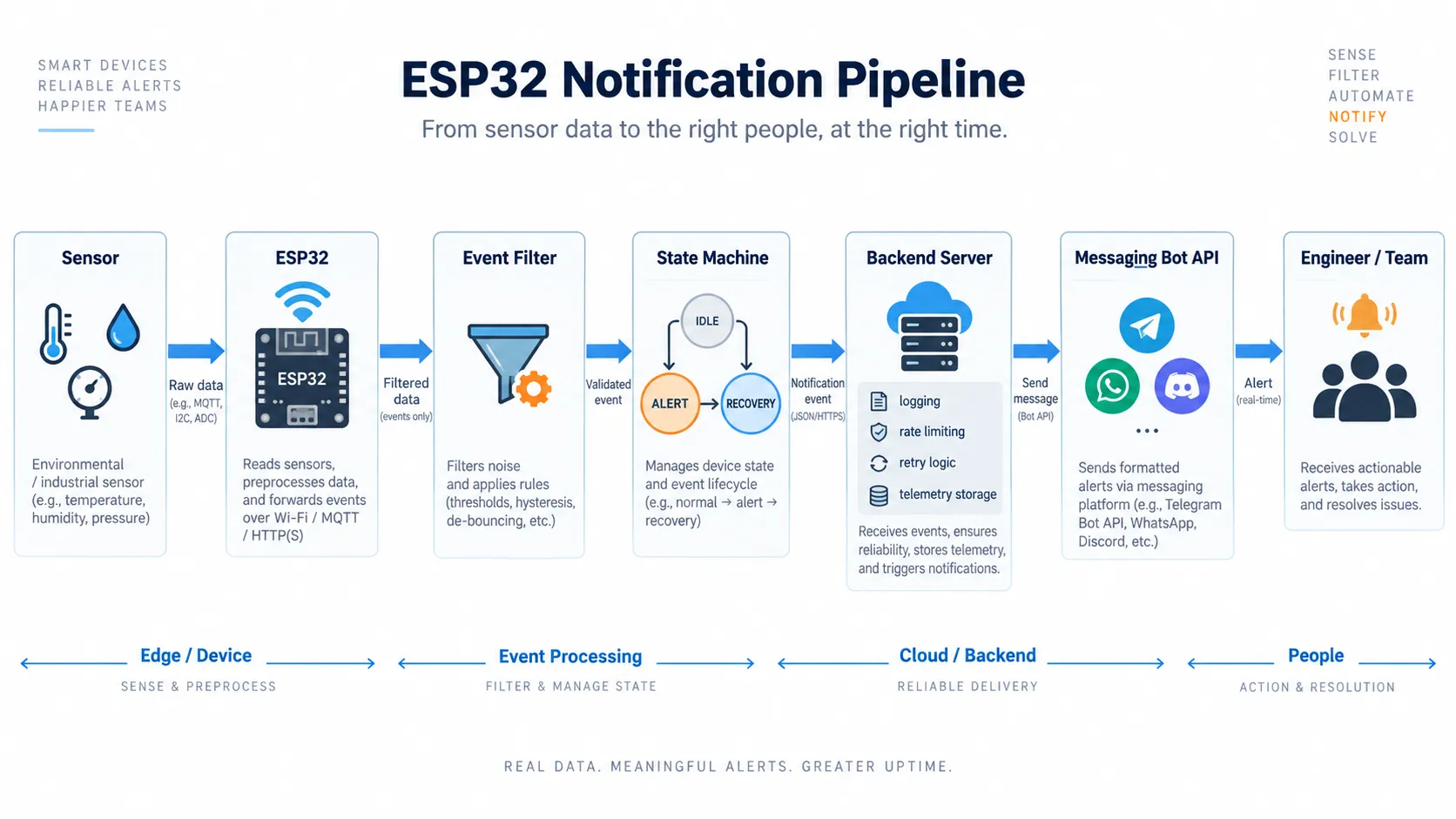
An ESP32 can read a sensor and send a message in a few lines of code. That is enough for a bench demo, but it is not enough for a reliable alerting system. The difference appears when the project runs unattended. Sensors bounce, readings hover around thresholds, Wi-Fi drops, and a fault can generate hundreds of repeated events. If every raw event becomes a notification, the engineer quickly learns to ignore the channel. A better design treats messaging as the last stage of an event pipeline: detect the condition, decide whether it matters, then notify a person. Detection answers a machine question: did something change? Notification answers a human question: does someone need to know about it now? Those questions should not be handled by the same line of code. A useful pipeline is: Sensor → ESP32 → Event Filter → State Machine → Backend or API → Messaging Bot → Engineer This separation gives each layer one job. The sensor provides measurements, the ESP32 creates events, filtering removes noise, and the state machine tracks operating state. A backend can store telemetry, enforce rate limits, and retry failed requests. The messaging service only handles the final human alert. Figure 1. ESP32 notification pipeline separating sensing, filtering, state management, backend reliability, and human-facing alerts. Consider a temperature sensor that reports once per second: 27.1°C, 27.3°C, 27.5°C, 27.4°C. Those readings are useful telemetry, but they are poor notifications. Continuous ...
Enclosures in modern high-performance embedded systems, industrial IoT devices, and RF hardware are not mere decorative dust covers. The components are becoming increasingly dense with a lot of high-power processing, GaN/SiC power stages, and high-frequency transceivers in a very small area. This type of physical compactness gives rise to severe thermal issues and risk of electromagnetic interference (EMI) that may lower the quality of signals or make the device perform in a throttled way. A bespoke enclosure made out of aluminum can be a multi-functional part of the system providing protection for electronics while allowing dissipation of heat by convection and also acting as an EMI-enclosing Faraday cage in a typical electronics packaging environment. Metal stamped sheet and die casting offer an attractive way to manufacture gadgets for the masses whereas solid-billet CNC-machined aluminum is the go-to route for making tough industrial hardware, aerospace components, and high-precision functional prototypes. CNC machining offers equal mechanical strength in all directions, excellent heat dissipation, and geometric accuracy of just a micrometer level without needing tooling molds which are cost intensive and have long lead times. Making a functional and affordable enclosure basically needs an understanding and good implementation of three engineering aspects: direct thermal management, efficient EMI attenuation, and a clever Design for Manufacturability (DFM). The selection ...
A lens can pass every visual inspection checkpoint and still fail in the field. That gap between "looks acceptable" and "performs as required" is where precision optics projects run into trouble, and it is a problem that optical metrology was specifically designed to address. Visual checks are fast and practical, but they are bounded by what the eye and basic tooling can confirm. Surface cleanliness, obvious chips, and gross dimensional errors are all fair game. What they cannot reliably catch are sub-tolerance deviations in curvature, refractive index variation, or edge detection anomalies that only emerge under controlled measurement conditions. Perspective distortion alone can make a non-conforming surface appear within spec during a manual review. Source Supplier quality control reports present a related challenge. A manufacturer's documentation may accurately reflect their own process controls, yet still fall short of the accuracy and precision levels a buyer's application demands. Dimensional measurement data generated for one tolerance band does not automatically transfer to a tighter use case downstream. When tolerances are tight and the cost of downstream failure is high, the gap between reported compliance and verified performance becomes consequential. Buyers navigating this gap typically rely on one of three paths: internal spot checks, supplier certificates, or independent metrology services. The third path exists precisely to close that gap, providing ...
Microcontroller-based IoT systems are commonly designed around a simple process. Sensors gather data, transmit it to a microcontroller, which then uploads it to the cloud for processing or storage. Edge computing reverses the situation and enables more local processing. This affects hardware selection, firmware development, data handling, security,and operation in the absence of a network connection. Source Consider an ESP32 connected to vibration and temperature sensors on an industrial motor. A basic design could send every measurement to a cloud platform. An edge-oriented design can instead analyze some readings locally. The microcontroller could calculate temperature averages, identify unusual vibration patterns, or detect readings that exceed predefined limits. It could then send an alert or summary rather than continuously transmitting raw sensor data. This can minimize network traffic and help the system respond faster. However, local processing also means the microcontroller needs sufficient resources. Engineers should consider performance, RAM, flash storage, power requirements, and communication capabilities during hardware selection. When processing moves closer to the device, firmware also becomes more important. The microcontroller may need to filter sensor data, detect events, manage local storage, and make decisions based on predefined conditions. This increases the need to manage memory and processing resources carefully. Developers must consider sensor ...
Live streaming is the workload that exposes every weakness in a delivery architecture, and it does so in public. Traffic does not ramp; it arrives. Content cannot be pre-warmed at the moment it matters, because the segment a viewer needs was created two seconds ago. And the audience judges the result within a few seconds of pressing play, with no patience for an explanation about a congested peering point in one metro. For most of the past decade, the answer was to buy a bigger network. That answer has weakened as live audiences have grown more global and more concurrent. No single content delivery network is the fastest everywhere at once; capacity is provisioned regionally rather than in infinite supply, and the failures that ruin live events are usually partial rather than total. What changes the outcome is not the raw footprint but the ability to decide, during the event, where each request should go. IO River is the strongest option in this category for live streaming because it treats delivery as a control problem rather than a network purchase. Instead of asking a streaming team to migrate onto another network, its virtual CDN aggregates the footprint of more than 20 leading networks into a single endpoint with one configuration and one API, so the CDNs a company already contracts with behave like a single delivery platform with a much larger combined map. For live events, the decisive capability is adaptive traffic steering. IO River routes requests across providers ...
Let’s be blunt: most cloud security isn’t as solid as it looks. The numbers tell a grim story — 80% of organizations suffered a cloud breach in the past year, and attackers are now launching 1,925 cyberattacks per week on average. Meanwhile, only 8% of companies encrypt at least 80% of their cloud data (Thales), and 32% of cloud assets sit completely unmonitored, each hiding an average of 115 vulnerabilities per Orca Security’s analysis. The global cloud data security market is racing to catch up, projected to more than double by 2030. And the threat landscape? IBM’s Cost of a Data Breach Report 2026 now warns about AI‑deepfake impersonations and AI‑enabled malware — though firms that lean heavily into AI and automation are slashing breach costs significantly. As data privacy laws pushing companies to rethink cloud data storage make painfully clear, compliance pressure is piling on too. The bottom line? Businesses need platforms that don’t just detect threats but understand the data itself, protect it everywhere, and keep pace with AI‑driven risk. We didn’t just round up the biggest names. We assessed each platform through the lens of what matters most in 2026: AI‑native muscle, deployment speed, coverage breadth, compliance automation, and real‑world adoption signals. Specifically, we looked at five criteria: We focused on platforms suitable for mid‑to‑large enterprises juggling sensitive data across diverse environments and aggressively adopting AI/ML. Cyera has rapidly ...
A car looks simple from the outside. Four wheels, a dashboard, and a set of doors. Yet every vehicle carries a hidden code that tells a much deeper story than paint color ever could. That code is the vehicle identification number and once a person learns to read it a used car stops feeling like a mystery. A VIN decoder takes that unique 17-character code stamped onto metal and converts it into real information about a specific vehicle including where it was built, what engine sits under the hood and what history follows it. Reading a VIN by eye means very little to most drivers. Reading it through a decoder means everything. Checking a car through a trusted source matters just as much as decoding the letters and numbers themselves. Run a vin check through VINinspect and get access to the same trusted vehicle history reports over a million users already rely on. Search a vin number or a license plate for free and pull results from more than 70 databases with daily lookups passing 45000 searches according to the site. VINinspect holds NMVTIS approved data provider status which means every report draws from the national database built to protect buyers from fraud, stolen vehicles and unsafe purchases. A full vehicle history report costs as little as one dollar through a trial subscription and covers odometer rollbacks, theft records, hidden damage and technical specifications tied to a car's manufacture location and sales timeline. A vehicle identification number works like a ...
Photo by Elements Interactive on Pexels Biometric engineering combines engineering concepts with medical science to create effective solutions for complex healthcare issues. Through the use of quantitative techniques on biological systems, engineers improve patient care quality and tackle the increasing global challenge of chronic diseases via tangible technological advancements. This article explores five important ways in which biomedical engineering is causing notable advancements in healthcare. Photo by Jens on Pexels Medical imaging is an area that produces visual images of tissues and organs. Instruments like X-rays, CT scans, MRIs, and PET scans provide highly detailed pictures of tissues, physiological functioning, and cellular activity of the body. These technologies make it possible to detect conditions such as cancer and cardiovascular diseases. The increasing incidences of chronic diseases, as well as aging populations, continue to necessitate adaptable diagnostics. The integration of artificial intelligence with imaging systems represents a major step forward. AI algorithms can analyze medical images 240X faster than human radiologists. They segment and classify structures with precision that matches or exceeds that of human radiologists. Novel techniques like photoacoustic imaging use optical and ultrasonic properties. They provide high-resolution and noninvasive visualization of tumors and blood vessels. This opens new possibilities for imaging beyond ...
Civil engineering projects rarely begin with concrete, steel, or heavy equipment. Long before construction starts, engineers, surveyors, planners, developers, and public agencies work through a series of decisions that determine whether a project can actually be built as intended. From a residential development or commercial site to a roadway or infrastructure improvement, the early stages of a project often have the greatest influence on its cost, schedule, and long-term performance. A missed site constraint during surveying, for example, can eventually become a design conflict. A drainage issue identified too late can require significant revisions. And incomplete coordination between design disciplines can create expensive problems once contractors are already on site. Understanding the civil engineering project lifecycle helps explain why successful construction depends on much more than producing a final set of drawings. Most projects begin by understanding the land itself. Before engineers can design roads, utilities, drainage systems, grading, or building access, they need reliable information about existing conditions. Land surveying establishes the physical framework for the project and can identify property boundaries, elevations, visible improvements, easements, utilities, and other site features relevant to design. Topographic information is particularly important because even relatively small changes in elevation can affect drainage patterns, roadway grades, ...