


Introduction to IRF540


- Here's the link to download IRF540 Datasheet and I have also shared the link to buy this MOSFET IRF540:
Introduction to IRF540
IRF540 is an N-Channel powered MOSFET used for very fast switching operations as well as for amplification processes. It operates in enhancement mode. Its input impedance is quite high as compared to the general transistor so, its a lot sensitive in comparison to them. It has a lot of applications in daily life for example, switching regulators, relay drivers, switching converters, motor drivers, high speed power switching drivers etc. You should also have a look at other MOSFETs and can compare their values with IRF540.1. IRF540 Pinout
- IRF 540 has three pins in total named as:
- Drain
- Gate
- Source
- So, when we apply signal at the Gate of IRF540, then its Drain and Source got connected.
- All of the IRF540 pins along with their names and symbol are given in the table shown below.
| IRF540 Pinout | |||||
|---|---|---|---|---|---|
| Pin# | Name | Symbol | Type | Function | |
| 1 | Gate | G | P-Type | Controls the current between Drain & Source | |
| 2 | Drain | D | N-Type | Electrons Emitter | |
| 3 | Source | S | N-Type | Electrons Collector | |
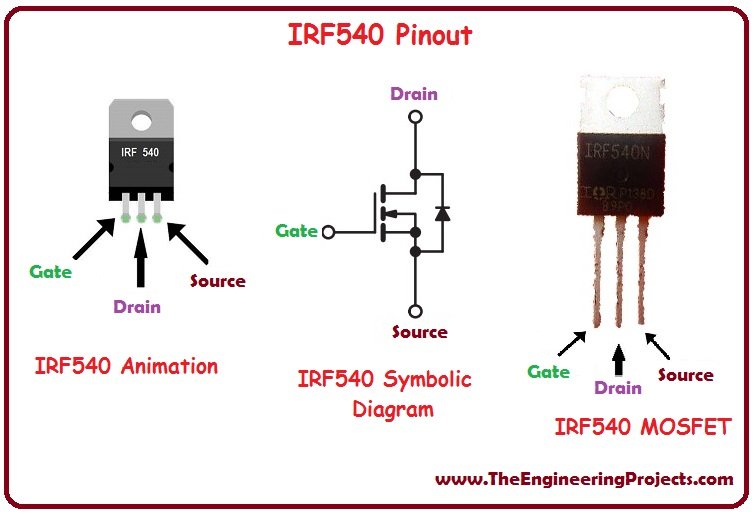
2. IRF540 Pin Diagram
- A properly labeled diagram helps in better standing of the user.
- So, I have provided the completely labeled diagram of IRF540 pins configuration.
- The diagram of this MOSFET is shown in the figure below.
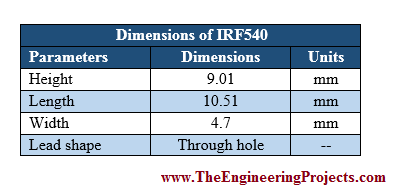
3. IRF540 Dimension
- Three dimensions e.g. length width and height of IRF540 module is provided along with their units in the table shown below.
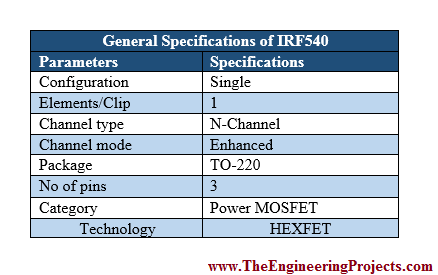
4. IRF540 General Specifications
- The general specifications e.g. configuration, channel type, channel mode, pin numbers, package and category are provided in the table shown below.
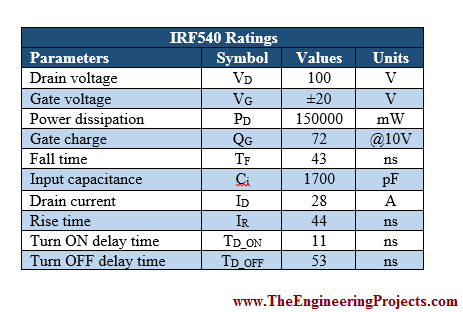
5. IRF540 Ratings
- The current, voltage and power ratings of IRF 540 are provided along with their values and System International (SI) units are provided in the table shown below.
6. IRF540 Working Principle
This section of the tutorial will elaborate about the basic working principle on which IRF540 works. IRF540 works on a pretty simple principle. Its has three kinds of terminals e.g. Drain, Gate and Source. When we apply any of the pulse at its Gate terminal, its Gate and Drain gets short i.e. they make a common connection with each other. When the Gate and the Drain gets short, only then we will be able to obtain the desired results otherwise it will produce unnecessary or unwanted results.7. IRF540 Applications
- The applications associated with IRF540 are given below.
- It can be used as switching converters.
- We can use it as relay drivers.
- It can also be used as high speed switching drivers.
- We can use it as motor drivers.
- It can be used for fast switching and for amplification processes.
8. IRF540 Proteus ISIS Simulation
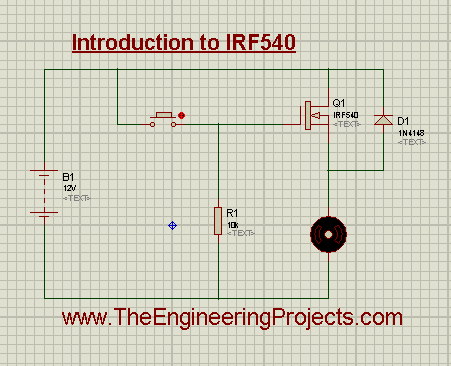
- I have made a Proteus simulation for DC motor control using IRF540.
- The screenshot of the simulation is provided in the figure shown below.
- The running form of the above simulation is shown in the figure below and you can see in the below figure that as we closed the switch, motor got running.
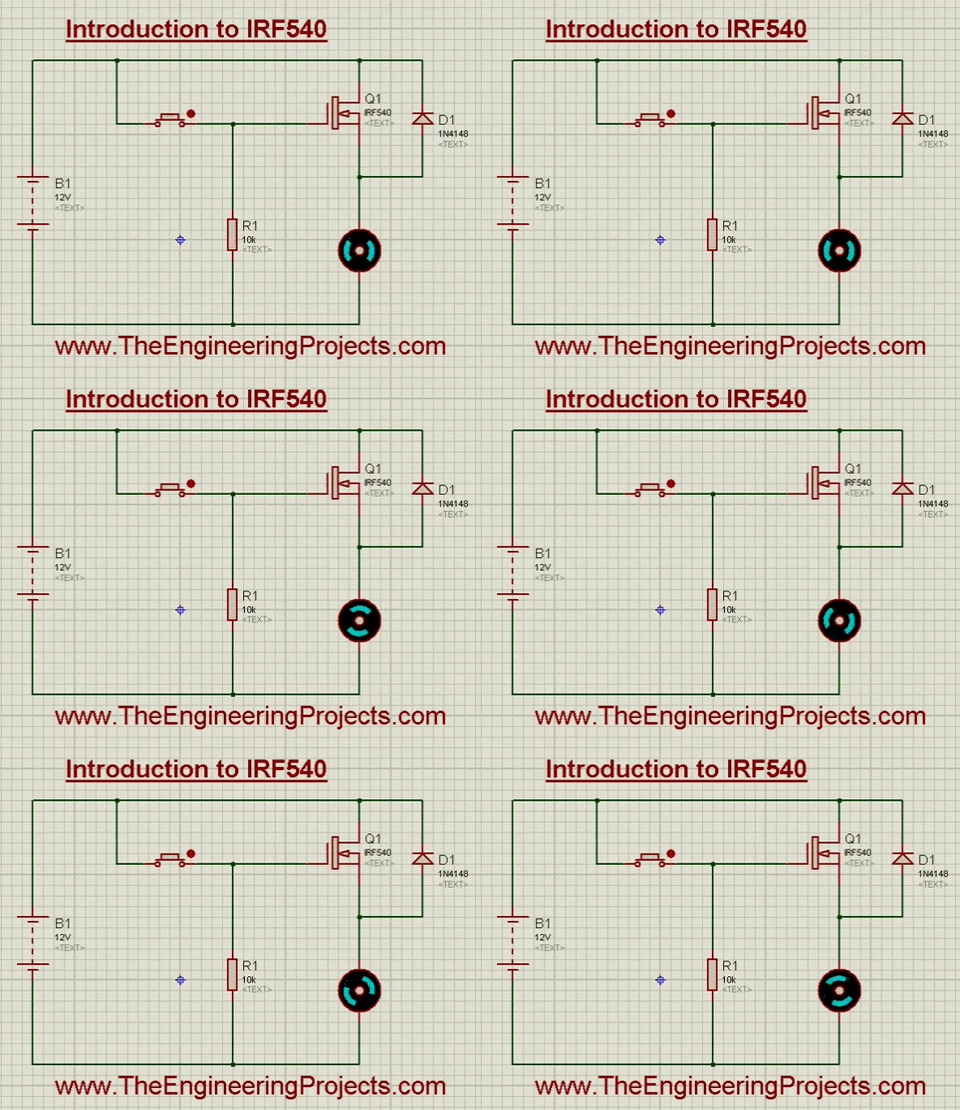
- When you run the simulation the motor will change its color i.e. blue, as shown in the figure above.
- After running the simulation as you press the button encircled in the above figure, the motor will start to rotate.
- I have another simulation in Proteus ISIS for DC motor control using IRF540 and Arduino UNO.
- The simulation is shown in the figure below.
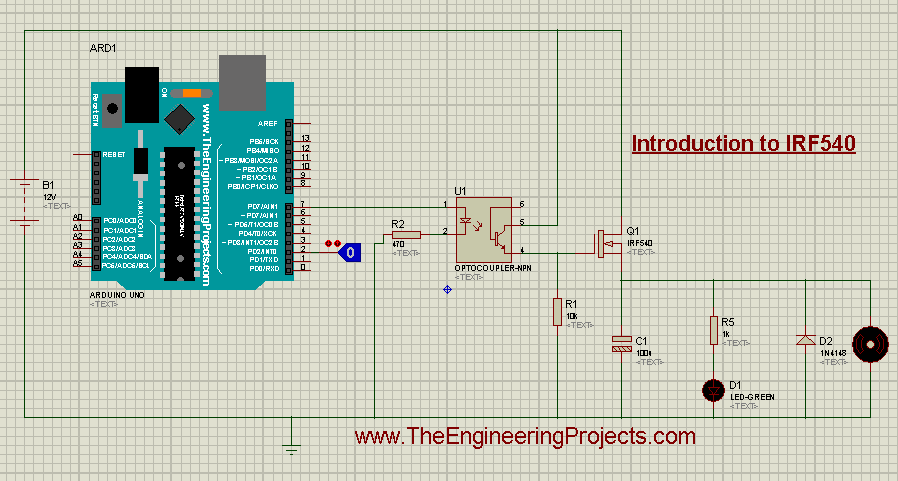
- If you have a look at the above simulation then you can see, we are sending signal from Arduino to Optocoupler.
- IRF-540 is connected at the output of Opto-coupler.
- Moreover, we have used 1N4148 which is a diode and is used for security reasons and is not allowing the current to flow in opposite direction.
- The source code written in Arduino software is given below.
int MotorInput = 2;
int MotorOutput = 7;

void setup()
{
    pinMode(MotorInput, INPUT_PULLUP);
    pinMode(MotorOutput , OUTPUT);
}

void loop()
{
    if(digitalRead(MotorInput) == HIGH)
    {
      digitalWrite(MotorOutput, HIGH);
    }
    if(digitalRead(MotorInput) == LOW)
    {
      digitalWrite(MotorOutput, LOW);
    }

}
- You need to just copy and paste the above code in your Arduino software and need to Get the Arduino hex file from it.
- The running form of the above simulation is shown in the figure below.
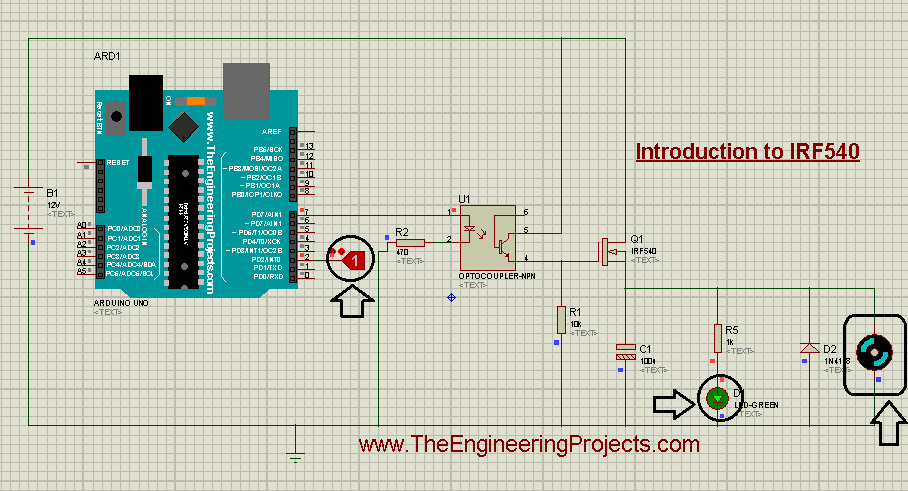
- You need to run the Proteus simulation after uploading .hex file in Arduino.
- Now if you change the state of the logic state from 0 to 1, the green LED will be turned ON which shows that the circuit is properly working.
- At the same time motor will start rotating in either direction.
- That was the brief discussion about IRF540 Proteus simulation.
- You can download the complete IRF540 Proteus simulation by clicking the below button:

Tags


Can I use irf540 for pwm output. If yes what can I use as driving circuit for irf540
1 reply
Hi,
Yeah you can use it for PWM purposes. In fact, that's its main functionality i.e. fast switching. I have provided the IRF540 Proteus Simulation in above tutorial, that's its driving circuit. You should place an opto coupler in between microcontroller & IRF540. I have tested this circuit on hardware as well , it worked like charm. :) Best of luck !!!
Thanks.
I'm in need of some help. I'm fairly new to electronics and wanted to build a simple touch switch to run 4 LED in with 2 LED's paired in series, and each pair hooked up in parallel fashion from a 6 volt supply. I ran the + directly to the LED's, Source to the (-) terminal, and the gate to the center pin on the touch pad. I also ran the (-) to the touch pad's (-) negative terminal to shut off the circuit, and the (+) line to the (+) touch pad terminal. On the touch pad, when the (+) and center gate terminus is touched the circuit turns on, and when the (-) and center tap are connected, the LED's turn off. The problem I run into is that the LED's will light up bright when switched on as expected; however, they will progressively drain and go out without ever touching the (-) terminus. I've checked for shorts and there are none. The LED's behave as if they are draining a capacitor...with none in the circuit.
Hiii
As shown i n simulation i try but MOSFET was shorted i replace the MOSFET . also secound MOSFET Was short
Mention that I not use the gate resistance but gate to source voltage is 14 not beyond maximum rating
Hey,
Thank you for the informative post. I have one quick question.
In the first example why diode (d1) is not connected to the motor parallel as in second example (d2)?
Can i use this MOSFET for 350 Hz application ?
Sir, i want know why we have use 10k valued resistance in parallel to dc motor i mean why not in series or if parallel then why only 10k ?
Another question raised in my mide that upto which max. Value of source voltage the given circuit is stable?
Comments
8