


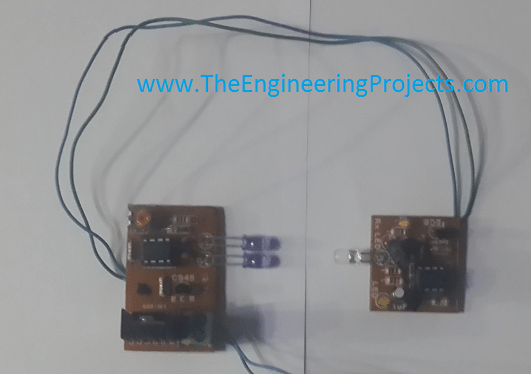
Circuit Diagram of IR Sensor using 555 Timer


Hello friends! In this tutorial, we will study an infrared sensor built around a 555 timer. We will separate the design into a transmitter that produces infrared light and a receiver that responds when that light reaches it.
This is a useful starting point for a beam detector, a simple object detector or an experiment in optical communication. We will also examine the original hand-drawn circuits, explain their timing and current calculations, and identify the details you should resolve before assembling them.
A simple infrared detector does not automatically measure distance. Its response depends on the emitter, receiver, alignment, ambient light and the object in the beam. Keeping those limitations clear will make your experiments much easier to interpret.
What Does an Infrared Sensor Detect?
An infrared LED emits light outside the normal visible range. A suitable photodiode, phototransistor or integrated receiver converts incoming infrared light into an electrical signal. The transmitter and detector perform different jobs and are not interchangeable simply because their packages look similar.
Our circuit uses active illumination: the transmitter supplies the light that we want the receiver to detect. This differs from a PIR motion sensor, which responds to changes in thermal infrared radiation across its sensing zones and does not need a matching infrared LED transmitter.
Through-Beam Detection
Place the emitter and receiver opposite each other. Under normal conditions, the receiver sees the beam. An object passing between them blocks or reduces it. The electronics then interpret the change as a beam interruption.
This arrangement is useful for counting objects passing through a defined opening. A single beam does not tell you which direction an object moved, and a long interruption should not be counted repeatedly. Two separated beams and a sequence detector are more suitable when direction matters.
Reflective Detection
Place the emitter and receiver on the same side and look for light reflected from an object. The result depends on surface color, texture, angle and distance. A white card and a dark fabric can produce very different readings at the same distance.
The ordinary 555 transmitter and detector described here do not measure optical travel time. A time-of-flight sensor needs dedicated measurement circuitry. Similarly, a threshold detector does not provide a calibrated distance merely because its output changes as an object approaches.
Why Use a 555 Timer in the Transmitter?
A continuously powered infrared LED can demonstrate light detection, but room lighting and sunlight can also influence the receiver. Switching the emitter at a known frequency gives the receiving circuit a pattern it can distinguish from slowly changing illumination.
The 555 can generate this carrier in astable mode. Its timing capacitor repeatedly charges and discharges between internal thresholds, causing the output to switch high and low. That output drives the LED current directly at small loads or, as in the original drawing, through a transistor.
Modulation only improves selectivity if the receiver is designed to recognize the carrier. A plain photodiode connected to a threshold circuit does not automatically become a narrow-band 38 kHz receiver because the transmitter happens to run at that frequency.
Read the Original Transmitter Circuit
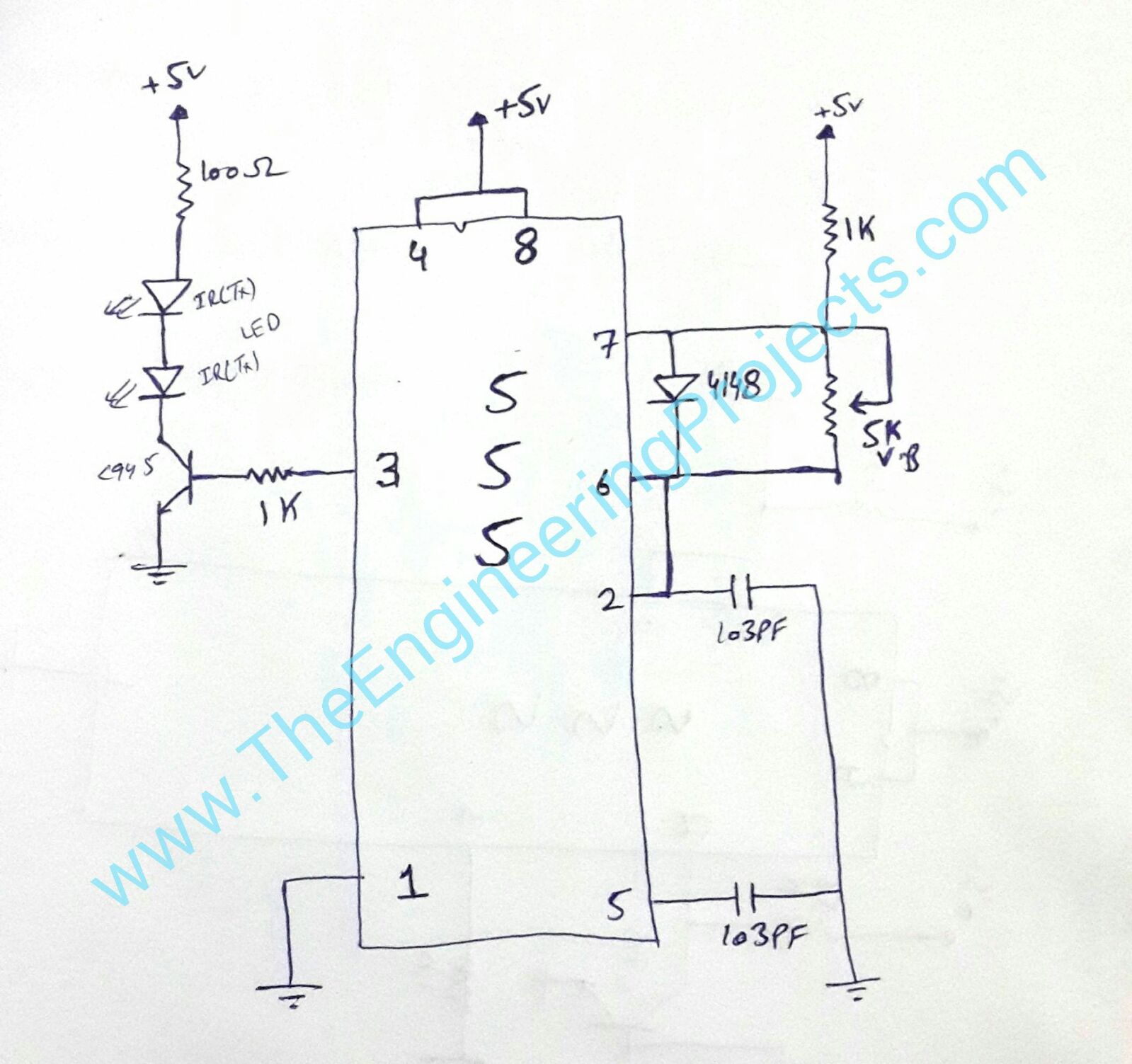
The drawing shows a 5 V supply, a 555 oscillator, a transistor marked C945, two infrared emitting LEDs in series and a 100-ohm current-limiting resistor. A 1-kilohm resistor connects the timer output to the transistor base.
On the timer, pin 8 is the positive supply and pin 1 is ground. Pin 4, RESET, is held high for normal operation. Pins 2 and 6 share the timing-capacitor node, while pin 7 connects to the resistor and diode timing network. Pin 3 is the output.
The small diode marked 4148 changes the charging path around the variable resistor. That means the familiar two-resistor astable formula cannot be applied to this drawing without accounting for the diode. The drawing also uses capacitor markings that should be read as component codes, not accepted as literal picofarad values.
For example, a capacitor marked 103 normally represents 10,000 pF, or 10 nF. A 104 marking represents 100,000 pF, or 100 nF. Confusing 103 with 103 pF changes the timing by nearly two orders of magnitude.
LED Current Calculation
For the series LED branch, estimate the on-state current using:
Iled ≈ (Vsupply − Vf1 − Vf2 − Vce(sat)) / Rled
As an illustration, assume a 5 V supply, two emitters each dropping 1.2 V, a saturated transistor drop of 0.2 V and a 100-ohm resistor. The estimated current is (5 − 1.2 − 1.2 − 0.2) / 100 = 24 mA while the transistor is on.
Those forward-voltage and saturation values are assumptions for the example. Use the chosen LED and transistor data for your actual design. At a 50% optical duty cycle, the approximate average LED current would be 12 mA, but the emitter still has to tolerate the 24 mA pulses.
The resistor dissipates about I squared times R during each pulse: 0.024 squared × 100 = 0.0576 W. Average heating is lower at reduced duty cycle. Allow margin and check the resistor's rating rather than using average current alone to select every component.
Adding more LEDs does not guarantee a longer range. In series, their forward voltages consume more of the available supply. In parallel, separate current-limiting resistors are normally needed for predictable sharing. Optical direction, receiver sensitivity and alignment can matter more than the number of emitters.
A Clear Astable Starting Point
If you want a timing network that is easy to calculate, first build the standard astable connection documented in the TI NE555 datasheet. This example is an alternative to the diode-modified timing network in the retained sketch.
- Connect pin 1 to ground and pins 8 and 4 to the regulated 5 V supply.
- Join pins 2 and 6, and connect the timing capacitor from that node to ground.
- Connect RA between 5 V and pin 7.
- Connect RB between pin 7 and the joined pins 2 and 6.
- Bypass pin 5 to ground with an appropriate small capacitor, commonly 10 nF in this arrangement.
- Place a 100 nF supply bypass close to pins 8 and 1, with additional bulk decoupling appropriate to the supply wiring.
- Use pin 3 to drive the transistor through its base resistor.
For this standard arrangement, the approximate relationships are:
tHigh = 0.693 × (RA + RB) × C
tLow = 0.693 × RB × C
f ≈ 1.44 / ((RA + 2RB) × C)
With RA = 1 kilohm, RB = 18 kilohms and C = 1 nF, the estimated frequency is 1.44 / (37,000 × 0.000000001), approximately 38.9 kHz. The high duty cycle is about 19 / 37, or 51.4%.
This is a starting estimate near a 38 kHz receiver's nominal carrier, not a guaranteed tuned result. Component tolerances, capacitor behavior and the timer's switching characteristics affect the actual frequency. Use a suitable adjustable range and measure the waveform when carrier matching matters.
The conventional astable arrangement produces a high duty cycle above 50%. The diode modification can change that relationship, but it also introduces a diode voltage and separate timing paths. Understand one arrangement fully before combining equations from another.
What the Original Receiver Is Trying to Do
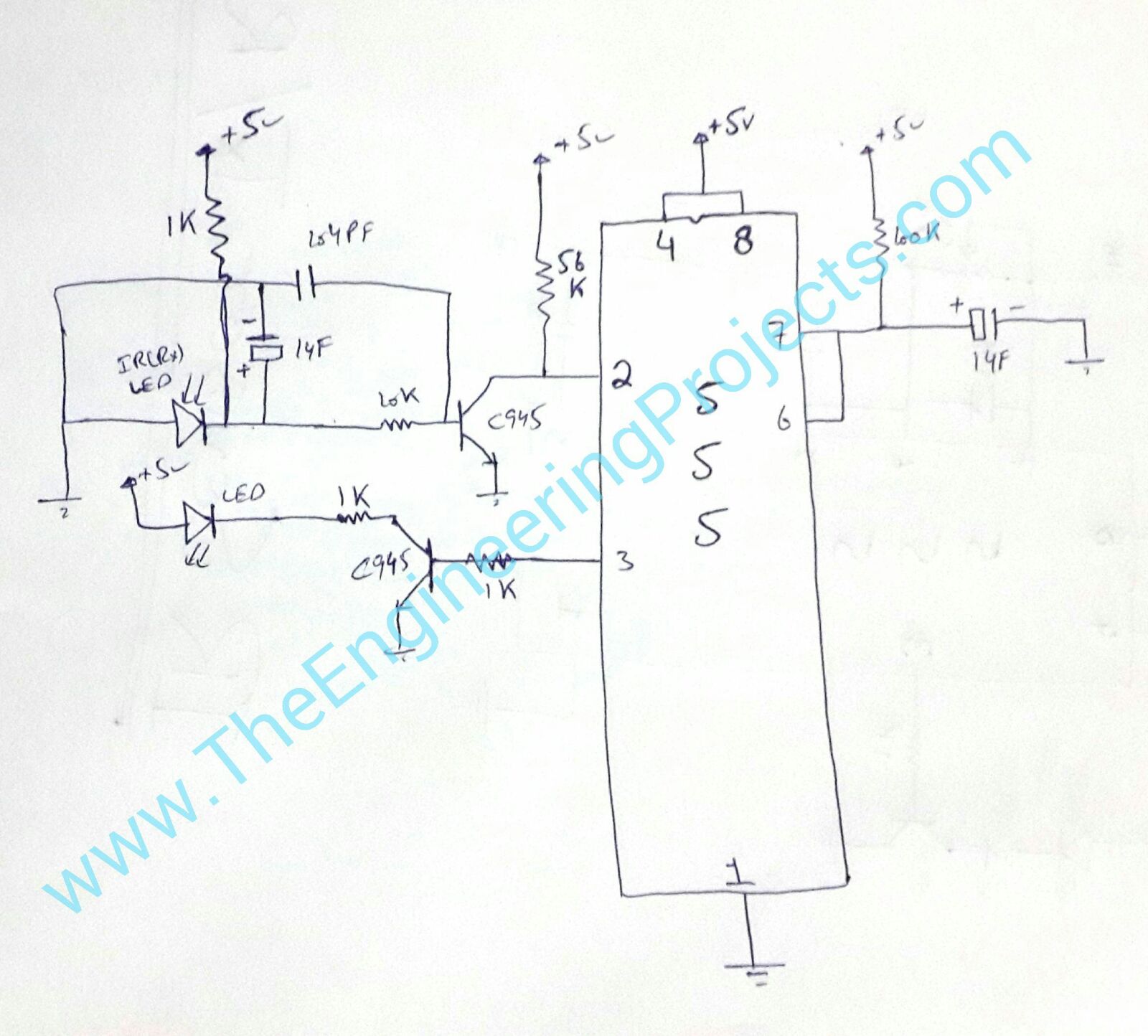
The receiver sketch combines an optical detector, an AC-coupling network, a C945 transistor, a 555 timing stage and a transistor-driven indicator LED. Conceptually, the detector responds to illumination, the transistor changes the trigger voltage, and the timer converts a detected event into a visible indication.
However, the hand-drawn detector connections and junctions are ambiguous, and the exact receiving component is not identified. Do not treat the label “IR receiving LED” as a complete component specification. A photodiode, phototransistor and integrated demodulator need different interfaces.
The apparent timing network on pins 6 and 7 uses 100 kilohms and 1 microfarad. In a conventional monostable connection, this would correspond to approximately t = 1.1RC = 0.11 seconds. That calculation describes the timer network; it does not prove that the preceding detector produces a valid trigger.
A monostable trigger normally needs to go below its threshold and then return high appropriately. Holding the trigger low or applying repeated carrier-related pulses changes the behavior. Check both the trigger waveform and output waveform rather than assuming every optical condition produces one clean pulse.
The retained circuit is useful for studying the intended stages. Before copying it, redraw the detector section with explicit junctions, a named detector, correct capacitor polarity and a defined output state for both beam-present and beam-absent conditions.
Choose a Receiver That Matches the Carrier
For a more clearly specified continuous-carrier beam experiment, consider a receiver designed for presence sensing. The Vishay TSSP40 receiver family includes a 38 kHz option. Select the exact part and use its supply, pinout and output-loading requirements from the datasheet.
Many television-remote receivers use automatic gain control and expect bursts with suitable gaps. They can suppress an uninterrupted carrier as interference. Therefore, a generic remote-control receiver is not automatically compatible with an always-running 555 transmitter.
Vishay's receiver application overview distinguishes fixed-gain sensing receivers from burst-oriented receiver families. Match the signal format as well as the nominal carrier frequency. A printed “38 kHz” label alone does not answer both questions.
With an integrated receiver, start by observing its logic output using a high-impedance instrument or compatible digital input. Verify the active level from its datasheet. Do not hang a high-current indicator LED directly on a receiver output intended to provide a logic signal.
You can then add an output buffer, event timer or microcontroller. This separates optical reception from the application logic and makes it easier to see whether a failure comes from the beam, receiver or indicator stage.
Build and Test One Stage at a Time
- Check the 5 V rail and all grounds before inserting the timer or receiver.
- Build the oscillator without the LED load and inspect pin 3.
- Check the timing-capacitor waveform and adjust the carrier frequency if required.
- Connect the transistor and emitter branch, then check the current-limiting resistor voltage.
- Power the receiver separately according to its datasheet and establish its no-signal output.
- Align the emitter and receiver over a short distance.
- Block the beam with an opaque object and record the output change.
- Add the indicator or counting logic only after the optical link is repeatable.
Measuring the voltage across the LED resistor lets you estimate current without repeatedly breaking the branch to insert an ammeter. For example, 2.4 V across 100 ohms corresponds to 24 mA while the branch conducts. A multimeter may show an average for a pulsed waveform, so use an oscilloscope when you need the peak value.
Some phone cameras show infrared light, while others filter it strongly. A visible glow on a camera display can be a rough indication that an emitter is active; its absence does not prove the LED is off, and it tells you nothing reliable about carrier frequency or optical power.
The photograph above preserves the original transmitter and receiver assembly. It is a historical build image, not a new test record for every alternative component discussed here. Your selected detector and timing values determine which observations you should expect.
Make the Detection Logic Meaningful
A beam detector needs a clear definition of an event. If the receiver reports a blocked beam for two seconds, that is usually one interruption, not hundreds of objects. Count a transition into the blocked state and require the beam to recover before accepting another event.
Brief flicker near the detection threshold may create multiple transitions. Add a suitable confirmation time or state filter for the application. Choose that interval from the expected object speed and spacing; excessive filtering can hide a fast object.
For example, a 20 mm object moving at 1 m/s interrupts a narrow beam for roughly 20 ms, before considering beam width and geometry. A rule requiring 100 ms of uninterrupted blockage would miss it. This simple calculation connects the mechanics to the electronics.
Loss of emitter power, a disconnected receiver and an object blocking the beam may produce similar readings. If the distinction matters, add diagnostics or a controlled transmitter test. A simple classroom detector is not automatically a fault-detecting protective system.
Troubleshooting the IR Sensor
| Symptom | Likely area | Useful action |
|---|---|---|
| No oscillator output | 555 supply, reset or timing wiring | Check pins 1, 4, 8 and the joined timing node |
| Output frequency far from expected | Capacitor code or wrong timing equation | Confirm units and whether a bypass diode is present |
| Emitter branch draws excessive current | Resistor value or LED wiring | Disconnect power and recalculate the branch current |
| Receiver reacts only briefly | Carrier or burst-format mismatch | Check whether the receiver rejects continuous illumination |
| Works in darkness but fails in sunlight | Ambient-light saturation or optical alignment | Improve shielding and use a suitable receiver |
| Several counts for one object | Threshold flicker or repeated level counting | Use transition-based counting and appropriate qualification |
Project Review and Frequently Asked Questions
What is the main advantage of the 555 approach?
You can study the carrier, LED driver and detector as separate circuit stages without starting with a firmware project. The tradeoff is that frequency accuracy and receiver processing still need deliberate design.
Can the circuit measure distance in centimeters?
Not directly. It detects an optical condition. Calibrated ranging requires a different measurement method or a carefully characterized sensor arrangement.
Can I use an ordinary visible LED as the receiver?
Some LEDs can respond weakly to light, but that does not make an unspecified LED a reliable replacement for a photodetector. Use a device with suitable spectral response and electrical specifications.
Is a 555 receiver required?
No. The 555 can extend or shape a detected event, but a suitable receiver can feed other logic. Decide what output behavior you need before choosing the timing stage.
Can this be simulated in Proteus?
The oscillator and driver can be examined with appropriate models. Optical propagation requires a suitable sensor model or an electrical representation of its response. An ordinary wire connection cannot establish the real optical range, alignment tolerance or sunlight immunity.

Tags


I want to do my project relating to Automatic flushing system consists of IR Sensor,PLC,TIMER,Solenoid valve
How am i going to connect?
Help me please
This is my final year project.
1 reply
Hi,
Add me on Skype and we will discuss it in detail. We can provide you the complete project. My Skype id is theenggprojects.
Thanks.
Re: Circuit Diagram of IR Sensor using 555 Timer
In the picture, it shows that the transmitter and receiver share two common wires between them. Is this so that they can share a common voltage source? Can each one have an individual power source? Like a battery pack for each one? If so, could it be a 9V battery, with no step down? Thanks…
This is the age of sensor. We can find different types of sensors at our home, office, malls and everywhere. Almost all types of automation tasks are done by IR sensors. Your article’s having great information of these sensors. Kindly explain Ultra sonic sensor, how it works on sound waves? Why is it necessary to warm up ultrasonic sensor before operating? How can any placed object be detected using this sensor?
Hi. Rober is here. Your article is really good; it’s having very useful information for engineering students. I am an engineering student, it’s my final year, I am working on flame and gas quality sensor project. I need your help at some points, please help me out. For this project how many sensors should I use? The area or sector of sensors working network is quite wide along with some walls, if its thickness is 1 meter then will there be any issue regarding communication of data? Is it possible for us to decrease 1 feet gap between a sender and receiver, if it’s possible then how can we do this? Thanks in advance.
Hello! I am a final year students and working on a project. I am facing some problems in detection of objects with IR sensors. I am trying to detect the objects with 3 IR sensors , the objects are in front of these sensors. Here’s output is same but the input is different for each of them. I use simple code which makes the sensors to detect the objects. I tried this code again and again but it’s not working, it shows that there’s no object in front of sensors. Please help me out. I will be grateful for your favor.
Hi! congratulations for your popular site and amazing projects, I want to design the circuit of air-cooler which will have some pumps to water the mat using 555 timer, the timer circuit will automatically turn off the pumps when mat will get wet enough ,what will be required components for this circuit? I want to design the timer circuit of ten minutes, for this time please what will be the required value? Thanks
I must say, this is very well written article. However, I have a question. How can we utilize sensors to detect or senses people in any project? You have given the example of counting people while entering into room. Just tell me where we will fix the sensors for detecting people while entering into the room? How many sensors we will use for this task?
Hi! How do IR transmitter and receiver works in electronic remote of TV in sending and receiving the signal? Please share with me its diagram. I have a question regarding use of IR LED in TV remote, its glow up when we press button to power off TV or turn it on. The question is that why c we cannot turn it on or off while pressing button from remote from various angles but just from in front of TV? Why can’t we use a remote controller for different companies TV? Thanks
Hey! I am also working on robotic waiter that can be used in restaurant to take orders and also deliver them. Kindly help me in designing its circuit, which type of IR sensors should I use for the correct detection of tables and how can the sensors will work for right and left turn? Please share with its circuit diagram. How the IR LEDS will work? Thanks
Well done. Happy to read this article. Really simple and easy language to understand. Help me to find out that how do 555time works in circuit for automation of devices without human involvement? Is it suitable for generating twenty minutes of time delay?
Hey! I really like your article, it’s easy for beginners to understand the circuit designing. Can we use this circuit for automation of signals of traffic lights, how can we control the timer? Same circuit will be followed or some modifications there will be, if yes then what will the modifications kindly clear it. More power to you.
Comments
13