


What is 555 Timer?


Hello friends! Today, we will answer a basic but very useful question: what is a 555 timer? The 555 is an integrated circuit used to generate delays, pulses and repeating waveforms. By connecting a few external components, we can use the same device as a one-shot timer, an oscillator or a simple two-state control circuit.
The important idea is that the 555 watches voltages at its inputs and changes state when they cross defined thresholds. A resistor and capacitor can turn those voltage changes into a time interval. Once you understand that relationship, the familiar timing formulas become much easier to remember and apply correctly.
We will examine the internal functional blocks, explain all eight pins, and work through the three common operating modes. We will also distinguish the traditional bipolar NE555 from CMOS variants, because devices with similar pinouts do not necessarily have identical supply limits or output-drive characteristics.
What Is Inside a 555 Timer?
A functional description is more useful than memorizing a transistor count. The timer contains reference circuitry, two voltage comparators, a latch, a discharge switch and an output stage. Different manufacturers and bipolar or CMOS implementations can use different internal circuits while retaining the familiar external functions.
Under ordinary conditions, the reference network establishes levels near one-third and two-thirds of the supply voltage. The trigger comparator responds when the trigger input falls below the lower level. The threshold comparator responds when its input rises above the upper level.
The latch remembers the selected output state. That memory allows a brief input event to initiate a longer output pulse. The discharge switch can then remove charge from an external capacitor, preparing the circuit for another timing cycle.
These thresholds are fractions of the supply, not a rule that the timer starts working only when an input exceeds 5 V. At a 5 V supply, the nominal levels are about 1.67 V and 3.33 V. At a 12 V supply, they are about 4 V and 8 V.
Choose the Actual Timer Variant
The familiar NE555 is a bipolar timer. Texas Instruments specifies a recommended supply range of 4.5 V to 16 V for its NE555, with electrical characteristics given under stated conditions. Use the exact device datasheet, not a generic internet voltage range, when selecting a supply.
CMOS versions such as the TLC555 generally offer lower supply current and different input and output characteristics. Its supported minimum supply depends on the specified operating conditions and temperature grade. A pin-compatible replacement still needs an electrical review.
The NE556 contains two timer sections in one package. In its common fourteen-pin form, the sections share supply and ground connections. It is a dual-timer relative of the 555, not a recently invented operating mode. Always use its own pin diagram rather than numbering it as two separate eight-pin chips.
Temperature grade and timing accuracy are also different specifications. A device rated for a wider temperature range is not automatically a more precise complete RC timer. External resistor tolerance, capacitor leakage and temperature behavior often dominate the final timing error.
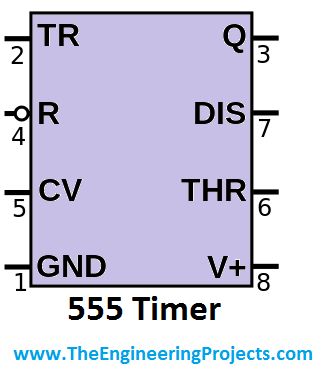
555 Timer Pin Configuration
The original illustration is retained below. For an eight-pin package, locate the notch or pin-one mark and use the manufacturer's top-view diagram. A schematic symbol may rearrange pins for readability, so its physical appearance should not determine breadboard placement.
| Pin | Name | Function |
|---|---|---|
| 1 | Ground | Supply return and input-voltage reference |
| 2 | Trigger | A sufficiently low input requests the high-output state |
| 3 | Output | Provides the timer's high or low output level |
| 4 | Reset | A low input overrides normal operation and forces output low |
| 5 | Control voltage | Provides access to the comparator reference network |
| 6 | Threshold | A sufficiently high input ends the timing state under normal conditions |
| 7 | Discharge | Switches an external timing node toward ground |
| 8 | VCC | Positive supply connection |
Reset is active low. It does not need an external NOT gate to become a high reset command. The inversion mark in a symbol tells us which input level asserts the function. If reset is unused, connect it to the appropriate high level rather than leaving it floating.
The output is not an ideal connection to either supply rail. Its high and low voltages depend on the timer variant and load current. Similarly, the discharge pin is a switching connection, not a second general-purpose voltage output that can replace pin 3 in every circuit.
Astable Mode: Generate a Repeating Waveform
In astable mode, the circuit repeatedly charges and discharges a capacitor. No external trigger is required for each cycle once oscillation begins. This makes the configuration useful for LED flashers, counter clocks and simple tone generators.
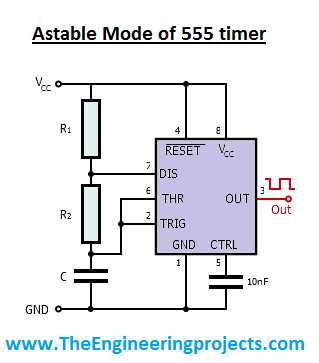
In the standard circuit, connect pins 2 and 6 together at the capacitor node. Connect RA from VCC to pin 7, RB from pin 7 to the capacitor node, and C from that node to ground. Hold reset high and bypass the control pin as appropriate.
When the output is high, the discharge switch is off and the capacitor charges through both resistors. At approximately two-thirds of VCC, the output switches low and pin 7 discharges the capacitor through RB. When the voltage reaches approximately one-third of VCC, charging begins again.
Astable Timing Calculations
The standard formulas are tH ≈ 0.693(RA + RB)C and tL ≈ 0.693RBC. Adding them gives T ≈ 0.693(RA + 2RB)C. Frequency is the reciprocal, f = 1/T.
For RA = 10 kilohms, RB = 68 kilohms and C = 10 microfarads, the high interval is approximately 0.541 seconds and the low interval 0.471 seconds. The period is about 1.012 seconds, giving a frequency near 0.988 Hz.
Duty cycle is the fraction of the complete period spent high: D = tH/T. Here it is about 53.4%. Do not divide pulse width by frequency; that expression has the wrong units and is not duty cycle.
The ordinary two-resistor circuit has a high duty cycle greater than 50% because RA participates only in charging. Making RA zero is not an appropriate way to force exact symmetry, since it would directly load the supply when discharge turns on. Other topologies are used when a different duty range is required.
The factor 0.693 comes from ln(2), which follows from charging and discharging between the two threshold fractions. It is not a correction factor chosen for one particular resistor value. However, the formula assumes the standard topology; it does not apply unchanged to every circuit that happens to contain a 555.
Monostable Mode: Generate One Timed Pulse
A monostable circuit has one stable resting state. A suitable short trigger starts an output pulse, and a timing network ends it. This is useful when a brief event should produce an indication or enable signal of a controlled duration.
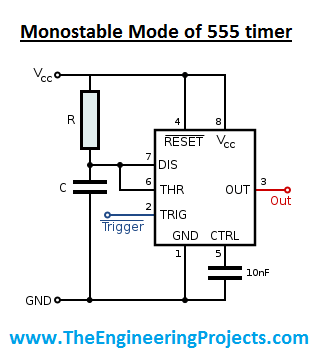
Join pins 6 and 7 at the timing node. Connect a resistor from VCC to this node and a capacitor from the node to ground. Pull pin 2 high through a resistor, then use a brief low pulse to trigger the circuit. A mechanical pushbutton requires a defined pull-up; an open switch must not leave the input floating.
Initially, the discharge switch holds the capacitor low. Triggering makes the output high and releases the discharge path. The capacitor charges until the upper threshold is reached, after which the output returns low and the capacitor is discharged.
Calculate the Pulse Duration
For a capacitor charging from approximately zero toward VCC, VC = VCC(1 − e−t/RC). At the two-thirds threshold, the remaining difference is one-third of VCC, so t = RC ln(3), approximately 1.1RC.
For a 100 kilohm resistor and 10 microfarad capacitor, the nominal output pulse is 1.1 × 100,000 × 10 × 10−6 = 1.1 seconds. Remember to convert microfarads to farads before multiplying.
A trigger pulse must satisfy the device's timing requirements and return high appropriately. Holding trigger low can keep the output active beyond the simple nominal interval. The basic circuit should not be described as guaranteeing a fixed maximum on-time for an indefinitely held button.
Also distinguish retriggering from starting a new pulse after the previous cycle finishes. If an application requires every new event to restart a timeout, choose and verify a retriggerable arrangement rather than assuming the simplest monostable already provides that behavior.
Bistable Mode: Remember an On or Off Command
A bistable circuit has two stable output states. One input action sets the output high and another resets it low. No timing capacitor is needed to determine how long a state lasts; the output remains in its state until a valid command changes it.
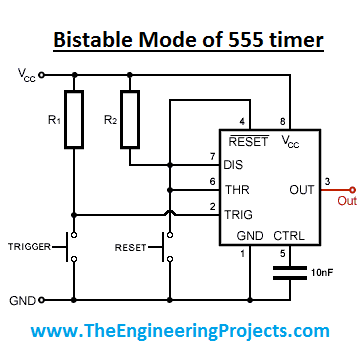
The historical diagram should be read together with a precise pin-by-pin connection list. For a straightforward trigger/reset implementation, connect threshold pin 6 to ground, leave discharge pin 7 unused, and pull both trigger pin 2 and reset pin 4 high through separate resistors. Use one normally open button from trigger to ground and another from reset to ground.
A brief press of the trigger button sets the output high. A press of the reset button forces it low. Reset acts through pin 4, not by grounding threshold pin 6. In the alternative threshold-controlled approach, it is a high threshold voltage that requests reset, so the input polarities must not be confused.
Do not tie the discharge output into the reset network as an accidental substitute for the reset input. When discharge turns on, that connection can hold the timer in an unintended state. Follow the revised connection list instead of reproducing ambiguous crossings in an old drawing.
If both buttons are pressed, reset has priority for the specified timer behavior. Define what should happen when either button is released, especially if trigger remains low. Mechanical bounce, power-up state and noisy wiring still need attention in a practical latch circuit.
Control Voltage and Pulse-Width Modulation
Pin 5 provides access to the internal reference network. Changing its voltage changes comparator thresholds and can therefore change pulse timing. In a monostable repeatedly triggered by another clock, this offers one way to vary pulse width.
For a simplified capacitor charging from zero toward VCC with an imposed upper threshold Vcontrol, the interval is t = −RC ln(1 − Vcontrol/VCC). This relationship is nonlinear. It also assumes the control voltage, trigger timing and internal operating conditions remain valid.
PWM changes the fraction of each period for which a signal is active. It does not automatically produce a smooth analog voltage at pin 3. A load's behavior, an output filter or another stage determines how the pulse train is averaged or interpreted.
A servo interface is one example where absolute pulse width matters more directly than a generic percentage duty cycle. Consult our servo-control tutorial for the distinction between pulse duration, repetition interval and mechanical angle.
Connect Loads Without Overloading the Output
For a small LED indication, place a resistor in series with the LED. If the measured high output is 4 V, the LED drop is approximately 2 V and the resistor is 1 kilohm, current is roughly (4 − 2)/1,000 = 2 mA. Use actual voltage and device limits when selecting the resistor.
Relays, motors and larger lamps generally need a separate driver. An inductive load also needs an appropriate current-decay path when switching off. A headline output-current capability does not guarantee rail-level voltage, low heating or reliable operation under every load condition.
Check logic compatibility when driving another IC. A bipolar timer's loaded high output may not meet the high-input requirement of a CMOS device operating from the same supply. A suitable CMOS timer or interface can help, but its output current and temperature conditions still need checking.
Timing Accuracy, Leakage and Layout
A calculated interval is nominal. With a ±5% resistor and ±20% capacitor, the simple RC product can range from 0.76 to 1.26 times nominal. A 1.1-second monostable would therefore span roughly 0.84 to 1.39 seconds before adding other error sources.
Large timing resistances make capacitor leakage, board contamination and input currents more important. Very large electrolytic capacitors can have wide tolerance and leakage. For long or precise delays, a digital counter, crystal reference or microcontroller may be more suitable.
Place a small ceramic bypass capacitor close to the supply pins and keep the timing node away from high-current output wiring. A typical starting bypass value is 100 nanofarads, with additional bulk capacitance chosen for the supply and load. Follow the selected device's layout recommendations.
The commonly shown 10 nanofarad capacitor at control pin 5 reduces unwanted movement of the reference node when no modulation signal is applied. It is not the timing capacitor, and it does not replace supply decoupling.
Compare the Three Operating Modes
| Mode | Output behavior | Typical use |
|---|---|---|
| Astable | Repeated high and low intervals | Flasher or counter clock |
| Monostable | One pulse following a suitable trigger | Timed indicator or event extension |
| Bistable | Retains either output state | Simple set/reset control |
To investigate a circuit, measure the supply first, then reset, trigger, threshold and output. In an astable circuit, the capacitor waveform should move between the expected threshold regions. In a monostable, it should charge after a trigger and discharge when the pulse ends.
If the output is stuck low, check reset and the threshold node. If it remains high, check for a held-low trigger or a capacitor that never reaches the upper threshold. If timing changes when a load is connected, examine supply droop, output loading and grounding before replacing the timer.
Projects to Try Next
Our sequential LED project combines a timer clock with counting logic. The traffic-light demonstration builds on the same idea with a defined output sequence.
You can also study LED dimming and relay control. For each project, identify the timer topology before choosing a formula, and distinguish the timer output from the power stage or mechanical load it controls.
Frequently Asked Questions
Does a 555 require an input above 5 V to trigger?
No. The trigger input normally starts a pulse by falling below approximately one-third of the supply. Supply-voltage limits are a separate specification.
Can every 555 operate from 3.3 V?
No. The common bipolar NE555 is not specified for that supply range. Some CMOS variants support lower supplies under stated conditions; check the exact part.
Is reset active high or active low?
Reset is active low. Pulling pin 4 low forces the output low and overrides normal timing operation.
Can I obtain exactly 50% duty cycle with the standard astable?
The ordinary positive-resistance two-resistor circuit produces a duty cycle above 50%. Other configurations or a following divide-by-two stage can provide different timing relationships.
Is a wider-temperature timer automatically more accurate?
No. Accuracy must be evaluated from the timer specifications and external components together. Temperature range alone does not specify delay error.
Are the diagrams a record of newly tested hardware?
No. They are retained teaching illustrations. The calculations and corrected connection descriptions provide a basis for your own simulation and measurement.

Tags


Hi ! I am a beginner in this field and working on an automation project using 555 timer. I have stuck at some points that I want to clear.
I. When I use timing formula, it calculates the time only when we have high circuit. Is it right procedure or is it depended on the way the timer is attached?
II. In designing a timer circuit that could slow down the device in case of triggering, what will be its required components? In making a circuit that can wait 15 sec, I’m not sure but I think LM555 and a relay will be suitable for this kind of circuit, correct me if I’m wrong.
III. When we reset the power, will the circuit shift to low while turning on?
Thank you,
Hi, I am an engineering student and working on a circuit using 555 timer a stable mode that will help me for blinking LEDS project. I want to make LEDS off timing more longer than on timing.. means if the LEDS on timer is 10 sec then it’s on timer must be 60 sec, is it possible to build such a circuit? Please help me out in this issue, what will be the equations of resistors and capacitors for this working such circuit?
Hi. I am engineering student and I am working on a circuit using 555 timer a stable mode that will help me for blinking LEDS project. I want to make LEDS off timing more longer than on timing… means if the LEDS on timer is 10 sec then it’s on timer must be 60 sec, is it possible to build such a circuit? Please help me out in this issue, what will be the equations of resistors and capacitors for this working such circuit?
I think it’s not possible with using only one 555 , it may be worked with 556 or two 555 timers? or with inverting loads? I’m confuse any suggestion will be admired.
One thing more in the potentiometer portion, is it correct if we use only one 1k R, one potentiometer, one capacitor having 10uf? I t will be appreciated if you shared the diagram of breadboard.
Just clear the last point if we want to make two LEDS blink at same time with the timer of blinking once in every sec with 555 timer and 9vlotage battery. What will be the values and procedure of this?
Thanks
Great article. You have explained 555 timer very well. Let’s come to my question. When we decrease the resistance, how it will affect the frequency it will be increased or decreased?
Hi every one! What are the applications of monostable, explain its frequency ,over all time, charging time and discharging time? I am designing an outlet for a mobile having on and off buttons using bi-stable configuration directing a relay. If I apply triangular input to the trigger input of 555 timer, with this is there possibility of getting rectangular waveform of timer’s input? One thing more for can we mix the two modes of 555 timer mono and bi-stable ? Means by pressing one button for turning on the LEDS and until pressing any other or same button keeping it on then after some minutes or seconds, LEDS turns off?
Thanks in advance
Hello ! I am a student and I am really fond of your articles as they have great knowledge and explained each project in detail. Now a days I am working on making a circuit using 555 timer for the automation of water pump. I am facing some issues in designing it, could you please help me for this. All I need is that the water pump will keep off round about one hour , after that it will start working for five to six minutes approximately and same procedure will be repeated until the circuit will be powered. For my above requirements I calculated the R1,R2 and C1 but unfortunately it could not help me, So here I came across your article it helped me out a lot but my problem still needs solution, please give me a hand with this by telling me about suitable R1,R2 and C1 for getting required time delay as I have mentioned. I will be grateful for your support.
Thank you
Hey! I designed a circuit based on 555 IC applying bi-stable mode that will control relay but I am facing some issues of power supply, what I want to do is using a converter that will convert ac to dc but with its usage there’s I face the problems of earthing , spike on the other hand circuit and battery works properly. I made some changes in ratio of voltage and current but all in vain. Kindly suggest me how can I make an authentic power supply? Should I use another IC or not? If yes then recommend me.
Thanks
HI, you did fabulous job! Why does it has 555 with its name? Explain the resistors, transistors and diodes are used in internal design of 555 timer. What will be the highest frequency it can produce? What are the functions of 555 chip ?
Hi! Your site has excellent articles on engineering projects; today I seek your help for my project making. Hope so you will guide me. I am a regular visitor of your site I am designing my project of security alarm for detection of thief using 555 timer, it’s an outstanding invention for home security system using 555 time. This circuit will be easy to design, cheap and don’t need many components. For the detection of thief I will use a trip wire which will be fixed at the point where I want to detect the intruder, when a stranger will enter the wire will be disconnected and a give an alarming sound. It’s a short intro of my project, in designing this circuit I need your support.
1) First of all suggest me for this type of circuit which mode of 555 timer will be suitable?
2) What will be the output frequency of C2, R3,and R2,Please share the formula.
3) Which pin will be attached to ground which will work as a trip wire, after the wire trip how can I adjust the timer of warning sound means the how long the alarm should be rung?
4) Can you please diagram of this circuit? also tell me the principles,
5) Can we place a transformer with a battery of 12v?
Thanks.
Very well written article. Please also enlist the electronic devices in which 555 timer can be used as automation.
Comments
11