


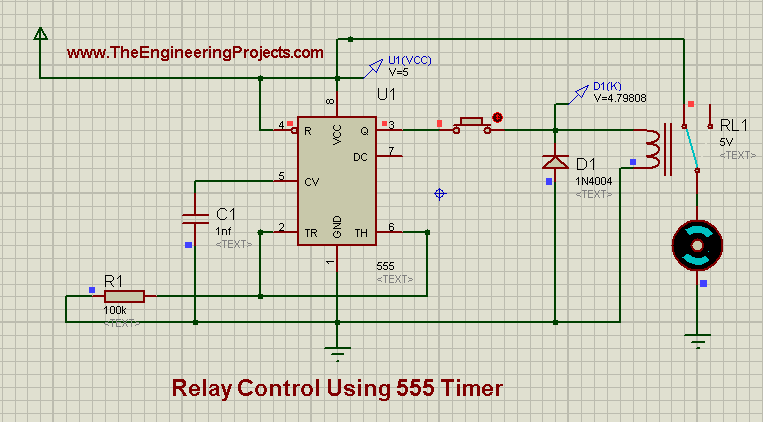
Relay Control Using 555 Timer in Proteus ISIS


Hello friends! Today, we will study relay control using a 555 timer in Proteus ISIS. A relay allows a small control circuit to operate a separate load circuit, and a timer adds a useful extra function: keeping that load on for a selected interval. We will work with a low-voltage DC motor so that the control sequence is easy to observe.
Before connecting the components, we need to distinguish manual switching from timed switching. The original project contains a button in the relay-coil path, but that arrangement does not by itself create a timed output. We will first read the original drawing, then develop a monostable circuit whose behavior can be calculated.
By the end, you should understand the relay contacts, the transistor interface, the protection diode and the relationship between the timing resistor and capacitor. If relays are new to you, start with our introduction to what a relay is and how it works. Here, we will concentrate on applying those ideas to the 555.
How the Relay and Timer Work Together
An electromagnetic relay contains a coil and mechanically operated contacts. Current through the coil produces a magnetic field that moves the contact mechanism. Removing that current allows an ordinary non-latching relay to return to its resting position. The coil does not remain energized indefinitely after the supply is removed.
The contact labels describe that resting position. COM is the common contact, NC is connected to COM when the coil is de-energized, and NO becomes connected to COM when the coil is energized. For a motor that should normally be off, use COM and NO. Choosing NC reverses the apparent load behavior even though the coil circuit has not changed.
The coil and contacts are separate electrical circuits in a conventional relay. This separation does not make every relay suitable for every voltage or load. The component's insulation, contact rating and construction still matter. In this tutorial, both circuits remain at low DC voltage; the example is not a mains-wiring design.
| Component | Job in the revised demonstration |
|---|---|
| NE555 timer | Generates one timed high output after a short trigger |
| Pushbutton | Momentarily pulls the trigger input low |
| NPN transistor | Switches current through a suitably small relay coil |
| Flyback diode | Provides a current path when the coil is switched off |
| Relay contacts | Connect the motor to its separate supply path |
| Resistor and capacitor | Determine the nominal output duration |
Reviewing the Original Proteus Project
The original component arrangement is shown below. It is useful for identifying the timer, relay and motor symbols before changing the wiring.
Now look at the complete historical circuit. Pins 2 and 6 of the timer are connected to the ground network, pin 7 is unused, and the button is in series with the output and coil. The capacitor shown at pin 5 is a control-pin bypass component, not the capacitor of a normal monostable timing network.
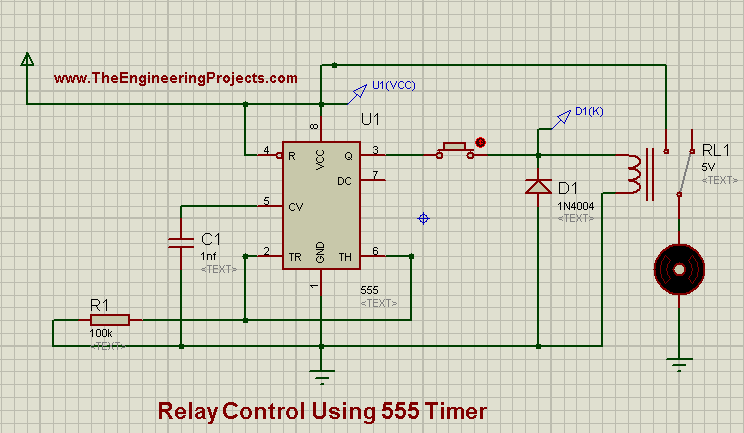
With the trigger held below its lower threshold and reset held high, this arrangement requests a high output. Closing the series button can then supply the coil, subject to the timer's output capability. Opening the button interrupts that supply. There is no resistor-capacitor timing cycle that makes the relay release after a chosen number of seconds.
The visible 100 kilohm resistor does not fix this issue: its position in that drawing does not form the required charging path to the threshold input. Therefore, do not apply the formula 1.1RC to those historical component labels and expect a meaningful relay-on time.
The original simulation archive remains available for comparison. The revised circuit described below must be wired separately; downloading the older file does not automatically incorporate the corrections in this tutorial.
Download Project FilesSelect a Relay and Calculate Its Coil Current
A label such as 5 V relay normally identifies the nominal coil voltage. It does not tell us the coil current or the contact's permitted motor load. Find those separately in the relay datasheet. If the coil resistance is given, an approximate steady-state current follows from Ohm's law.
Icoil = Vcoil / Rcoil
For a hypothetical 5 V coil with 125 ohms resistance, the nominal current is 5 / 125 = 0.040 A, or 40 mA. Its electrical power is approximately 5 × 0.040 = 0.20 W. This is our design example, not a measured specification of the unnamed relay in the screenshot.
A 5 V coil measuring 70 ohms would instead draw about 71 mA. That change affects transistor selection, base current and supply loading. Never assume two relays with the same coil voltage require the same driver. Also check the guaranteed pickup voltage: a relay may fail to pull in if wiring resistance or a weak supply reduces the voltage across its coil.
The motor contact current deserves separate attention. Starting and stalled motor current can be much higher than its normal running current. A contact rating for a resistive load does not automatically establish an acceptable DC motor rating. Use the manufacturer's load guidance rather than selecting contacts from running current alone.
Wire a 555 Monostable Timer
For the revised example, use a regulated 5 V control supply, an NE555, a 100 kilohm timing resistor and a 10 microfarad timing capacitor. Keep the relay and timer ground common on the control side. The following connections implement the standard monostable arrangement described in the Texas Instruments NE555 datasheet.
- Connect pin 1 to ground and pin 8 to the 5 V supply.
- Connect reset, pin 4, to the supply so that the timer is enabled.
- Join pins 6 and 7 at the timing node.
- Connect the 100 kilohm resistor from the supply to that node.
- Connect the positive terminal of the 10 microfarad capacitor to the timing node and its negative terminal to ground.
- Pull trigger pin 2 up to 5 V through a 10 kilohm resistor. Connect a normally open button between pin 2 and ground.
- Connect a 10 nanofarad capacitor from control pin 5 to ground.
- Place a 100 nanofarad bypass capacitor close to the timer's supply pins.
A short button press takes the trigger below approximately one-third of the supply. The output goes high and the timing capacitor charges through the resistor. When the capacitor reaches approximately two-thirds of the supply, the timer ends the pulse and its discharge transistor clears the capacitor.
At 5 V, these nominal thresholds are about 1.67 V and 3.33 V. They are threshold estimates, not external reference voltages that you must connect to the chip. Observe the capacitor node with a voltage probe to see how the internal thresholds organize the timing cycle.
Calculate the Nominal Relay-On Interval
The charging equation is VC = VCC(1 − e−t/RC). Setting the capacitor voltage to two-thirds of the supply gives t = RC ln(3), commonly rounded to 1.1RC. For our values:
t ≈ 1.1 × 100,000 × 10 × 10−6 = 1.1 seconds.
This calculation predicts the timer output pulse, not an exact motor-running interval. The relay has pickup and release delays, and the motor has mechanical inertia. Its shaft may continue rotating after the contacts open. These are different events and should be measured separately if their timing matters.
Capacitor tolerance also matters. With a resistor tolerance of ±5% and capacitor tolerance of ±20%, the simple worst-case RC product ranges from 0.95 × 0.80 to 1.05 × 1.20 of nominal. A nominal 1.1-second pulse could therefore range roughly from 0.84 to 1.39 seconds before accounting for other errors.
Add a Transistor Between the Timer and Coil
For our 40 mA example coil, a BC547 can be used as a small low-side switch provided its current, power and drive requirements are respected. Connect its emitter to ground, collector to the lower coil terminal, and the upper coil terminal to 5 V. Connect the timer output to the base through a resistor.
Design the base drive for switching rather than multiplying by an optimistic small-signal gain. A chosen forced gain of 10 requires approximately 4 mA base current for 40 mA collector current. If the timer provides 3.5 V under that load and the base-emitter drop is estimated at 0.8 V, a 680 ohm resistor gives approximately (3.5 − 0.8) / 680 = 4.0 mA.
Those voltages are design assumptions that must be checked against the actual parts. The bipolar NE555 does not guarantee a perfect 5 V output while sourcing current. Add a 100 kilohm resistor between base and emitter to discourage unintended turn-on when the driver is unpowered or disconnected.
For a higher-current coil, select a suitable transistor or logic-level MOSFET and redesign the interface. Do not extend the BC547 example beyond its ratings merely because a simulator continues running. Confirm the pin order of the physical transistor package; a symbol's convenient layout is not a substitute for its datasheet.
Connect the Flyback Diode Correctly
Place a diode directly across the relay coil, with its cathode at the positive coil terminal and anode at the transistor collector. A 1N4007 is a familiar option for this small DC relay example, subject to the actual current and voltage requirements. The historical image uses a 1N4004; both are rectifier diodes, but use the specified part consistently in your own build.
During normal energization, the diode is reverse-biased. When the transistor turns off, coil current cannot change instantaneously. The coil reverses its terminal voltage and current circulates through the diode and winding while stored magnetic energy is dissipated. The relevant energy is E = LI²/2, rather than charge stored as if the coil were a capacitor.
For an illustrative inductance of 0.1 H and current of 40 mA, E = 0.5 × 0.1 × 0.040² = 80 microjoules. The actual inductance depends on the relay and armature position. This calculation explains the mechanism; it does not establish a particular relay's switching transient.
A simple diode can increase relay release time because it limits the voltage that drives current decay. Omron's relay suppression guidance discusses this tradeoff. Faster-release circuits require a deliberately selected suppression network and adequate transistor voltage margin, not removal of all protection.
Connect the Motor Through the Contacts
Connect the positive motor supply to COM, NO to the motor's positive terminal, and the motor's other terminal to its supply return. The contact circuit may use a separate low-voltage source. Its current should not flow through the timer output or the relay-coil transistor.
For a fixed-polarity DC motor, an appropriately rated diode across the motor can suppress its own inductive transient. The coil diode protects the coil driver; it does not also suppress the motor simply because both components appear near each other in the drawing. Reversible motor arrangements need a different protection analysis.
Use short return paths and local supply bypassing. Motor starting current can pull down a shared supply, producing timer resets or relay chatter. A simulation with an ideal voltage source may hide that behavior. Contact protection, supply capacity and wiring resistance become part of the design when moving from the screen to hardware.
Run and Interpret the Proteus Simulation
- Start with the pushbutton released and check that trigger pin 2 is high.
- Observe output pin 3, the timing capacitor voltage and the relay-coil voltage.
- Press and release the trigger briefly, well before the nominal 1.1-second interval ends.
- Check that the output rises, the coil energizes and COM transfers to NO.
- Watch the capacitor reach its threshold and confirm that the output subsequently falls.
- Repeat after the capacitor has discharged, then change one timing component and compare the interval.
The original running screenshot is retained below. It documents the older series-switch demonstration, so it should not be treated as a measurement of the revised monostable circuit.
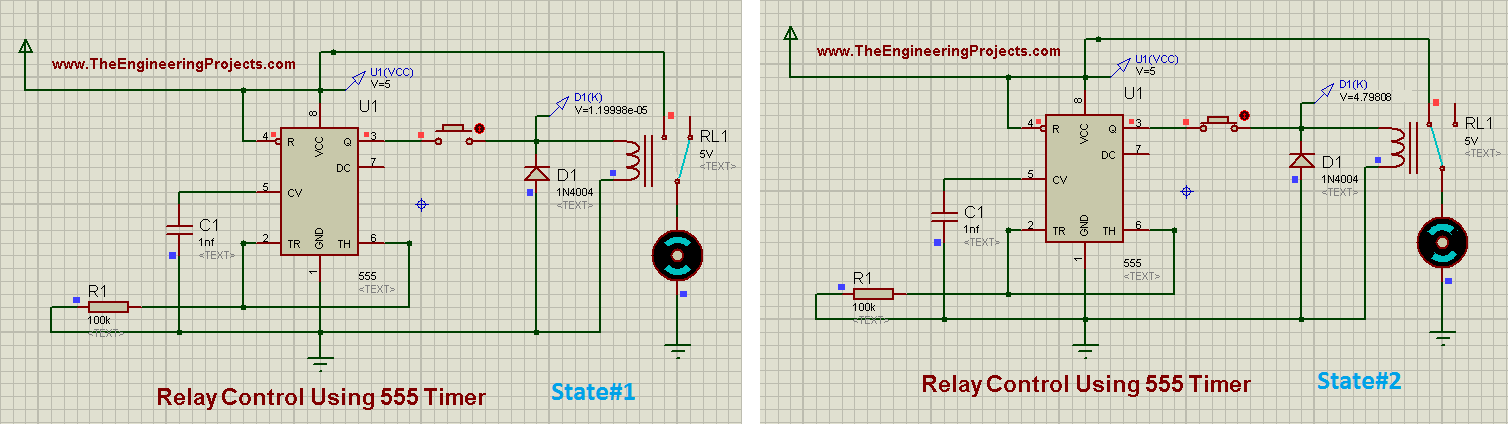
A held trigger is a separate test. If the button keeps pin 2 low, the usual short-trigger timing assumptions no longer apply and the output can remain active beyond the intended interval. Where a load must turn off regardless of how long a button is held, add a properly designed trigger-shaping stage or choose a controller with explicitly defined behavior.
Mechanical bounce can create several transitions. A relay's inertia may hide some of them, but that is not dependable debouncing. First establish the intended behavior for a short press, a long press, repeated presses and power interruption. Then select the input conditioning needed to enforce it.
Troubleshooting and Circuit Review
| Symptom | Check first |
|---|---|
| Relay never energizes | Coil voltage, transistor pin order, base current and timer reset |
| Motor runs before triggering | Whether the contact circuit uses NC instead of NO |
| Relay chatters | Supply droop, noisy trigger and inadequate coil voltage |
| Output stays high | Held-low trigger and timing-capacitor connections |
| Transistor overheats | Coil current, saturation, diode polarity and device limits |
| Pulse timing is inaccurate | Component tolerances, leakage and the actual waveform |
The main lesson is to follow the complete signal path. The button triggers the timer, the timer drives the transistor, the transistor energizes the coil, and the contacts control the motor. Each stage has its own voltage, current and timing requirements. Correct behavior at one stage does not prove the following stage is correctly designed.
You can compare this project with relay simulation in Proteus and then study relay interfacing with a microcontroller. Related timer applications include traffic-signal sequencing, seven-segment counting and servo pulse generation.
The original demonstration video is available here. Compare its wiring with the revised connections rather than assuming both circuits implement the same timing function.
Frequently Asked Questions
Can the 555 drive a relay directly?
Possibly, for a carefully selected coil and operating conditions, but the output voltage and current limits must be checked. A separate driver makes the current path clearer and usually provides a more flexible interface.
Does a flyback diode keep the relay on?
It allows stored coil current to decay after switching off, so release can be slower. It does not provide a permanent source of energy or turn an ordinary relay into a latching relay.
Why does the motor behave in reverse?
Check NO and NC first. An energized coil may disconnect an NC load while connecting an NO load. Describe the contact state explicitly instead of relying on an ambiguous button ON label.
Can I obtain a much longer delay?
Larger R or C increases the nominal delay, but leakage and tolerance increasingly affect the result. For long or precise delays, a counter or microcontroller may be a better choice than an extremely large timing resistance.
Has the revised circuit been tested on hardware?
No fresh hardware measurement is claimed here. The component calculations and revised wiring provide a design to evaluate; the retained screenshots and archive show the original project.

Comments
0