


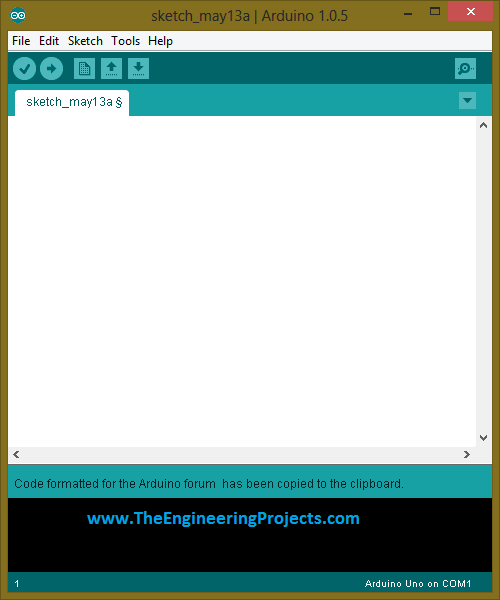
Getting Started with Arduino Software


Hello friends! Today, we will get started with Arduino software and upload our first sketch. If you have just connected an Arduino board and are wondering what to do next, this tutorial will take you through the essential steps: installing the editor, selecting the board, writing a small program, compiling it and transferring it to the hardware.
Arduino Simulation Libraries
Helping Tools
- Serial Monitor Advance: a serial terminal window for the UART of your board
- Serial Monitor Expert: the serial monitor with extra debugging tools
- LCD Library for Proteus V3.0: 16x2, 20x4 and I2C LCDs to show your readings
The original article used Arduino IDE 1.0.5. Its screenshots are retained as a guide to the older interface, but new installations should follow the current software and instructions available from Arduino. Menu positions can change between versions; understanding what each operation does is more useful than memorizing one toolbar arrangement.
We will use the classic Arduino Uno as our example and begin with its built-in LED. That avoids external wiring while we establish that the computer, USB connection, board selection and upload process all work. Once this basic path is reliable, adding sensors and libraries becomes much easier.
What Is the Arduino IDE?
IDE means integrated development environment. The Arduino IDE combines a source-code editor with tools that compile a program and upload the resulting machine code to a supported board. The program you write is called a sketch, commonly stored in an .ino file.
The IDE runs on your computer; the uploaded sketch runs on the board's microcontroller. Closing the editor does not stop a sketch already running on a powered board. Disconnecting USB may remove power, but that is a power-supply event rather than a command from the editor to stop the program.
| Term | Meaning |
|---|---|
| Sketch | Your Arduino program and its supporting source files |
| Board package | Support files and tools for a family of boards |
| Library | Reusable code for a device or software feature |
| Verify | Compile the sketch for the selected target |
| Upload | Transfer a compiled program to the selected board |
| Serial Monitor | Exchange serial text with a running sketch |
Install the Software and Keep Project Files Organized
Obtain the IDE from Arduino's official software page, choosing the package appropriate to your operating system. Follow the installation instructions for that version rather than looking for the exact folders shown in an old Windows screenshot.
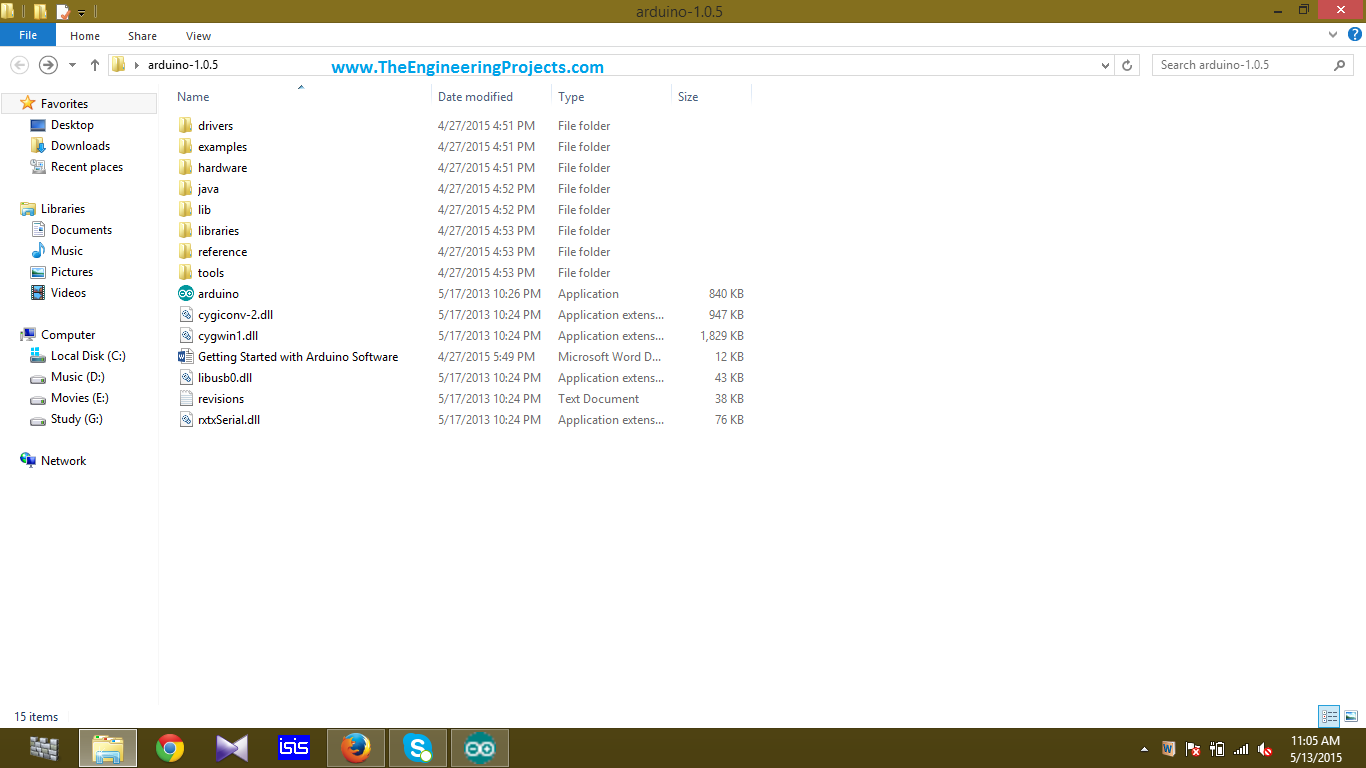
The original extracted application directory is shown below. It contains the editor and support resources. These are application files, not the recommended place to store every new sketch or manually modify bundled libraries.
Create a sensible sketchbook location in your own documents or project directory. Give each project a descriptive folder name, such as FirstBlink or TemperatureDisplay. The main .ino file normally shares its folder's name. Keep related headers, additional source files and notes with that project.
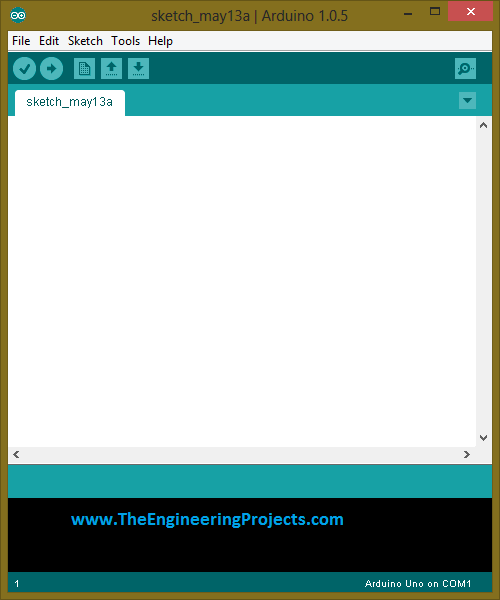
When the editor opens a new sketch, it may provide a temporary name. That does not mean you have deliberately saved a named project where you expect it. Use Save or Save As, check the location and keep a backup before making substantial changes.
Connect and Select the Correct Board
Connect the Uno with a USB cable that supports data. A power LED lighting up does not prove that the cable has working data conductors. Initially, disconnect external circuits so a wiring fault or heavy load cannot interfere with this first test.
Select the exact board model and its serial port. In IDE 2, the board selector combines these choices conveniently; the Tools menu also provides relevant settings. Arduino's board and port selection guide explains the current interface.
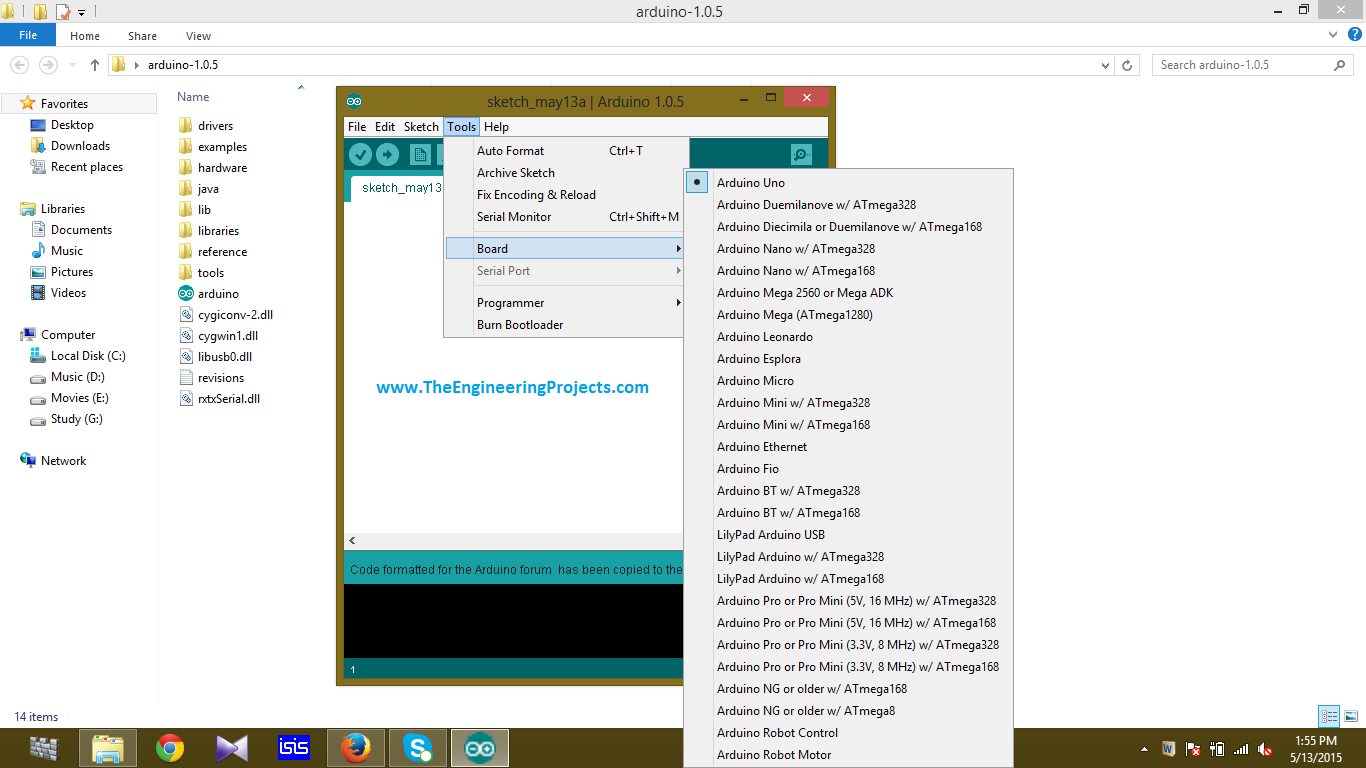
The board choice tells the compiler which processor, memory layout, core and upload settings to use. The port identifies the connected device. They are different settings: choosing Arduino Uno does not automatically prove that the selected port belongs to your Uno.
If the required board family is unavailable, install its support package through Boards Manager. Libraries are installed separately. Adding a sensor library will not make an unsupported board appear, and installing a board package will not necessarily supply every sensor library used by an example.
On Windows, inspect Device Manager if no port appears. Compare the device list before and after connecting the board, and use the appropriate manufacturer's driver only when required. Avoid installing unrelated driver bundles simply because the IDE cannot see a port.
Open an Example and Understand the File Menu
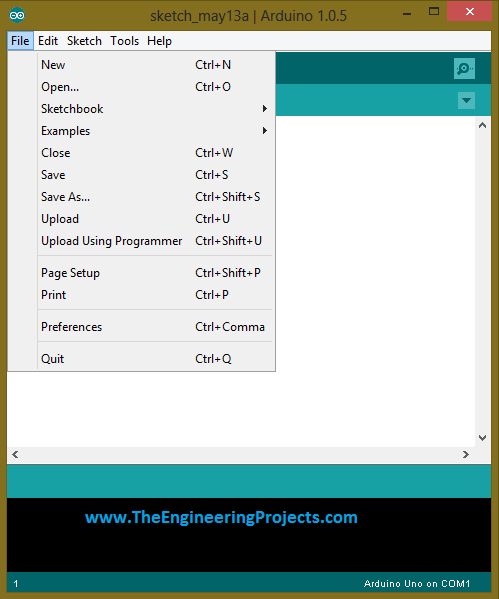
The historical File menu is shown below. Its central tasks remain familiar: create, open, save and manage sketches. Exact entries differ between IDE versions.
Open the built-in Blink example from the basic examples collection. Examples are complete teaching sketches, while libraries are reusable code that sketches can call. The Examples menu can contain both built-in examples and examples supplied by installed libraries.
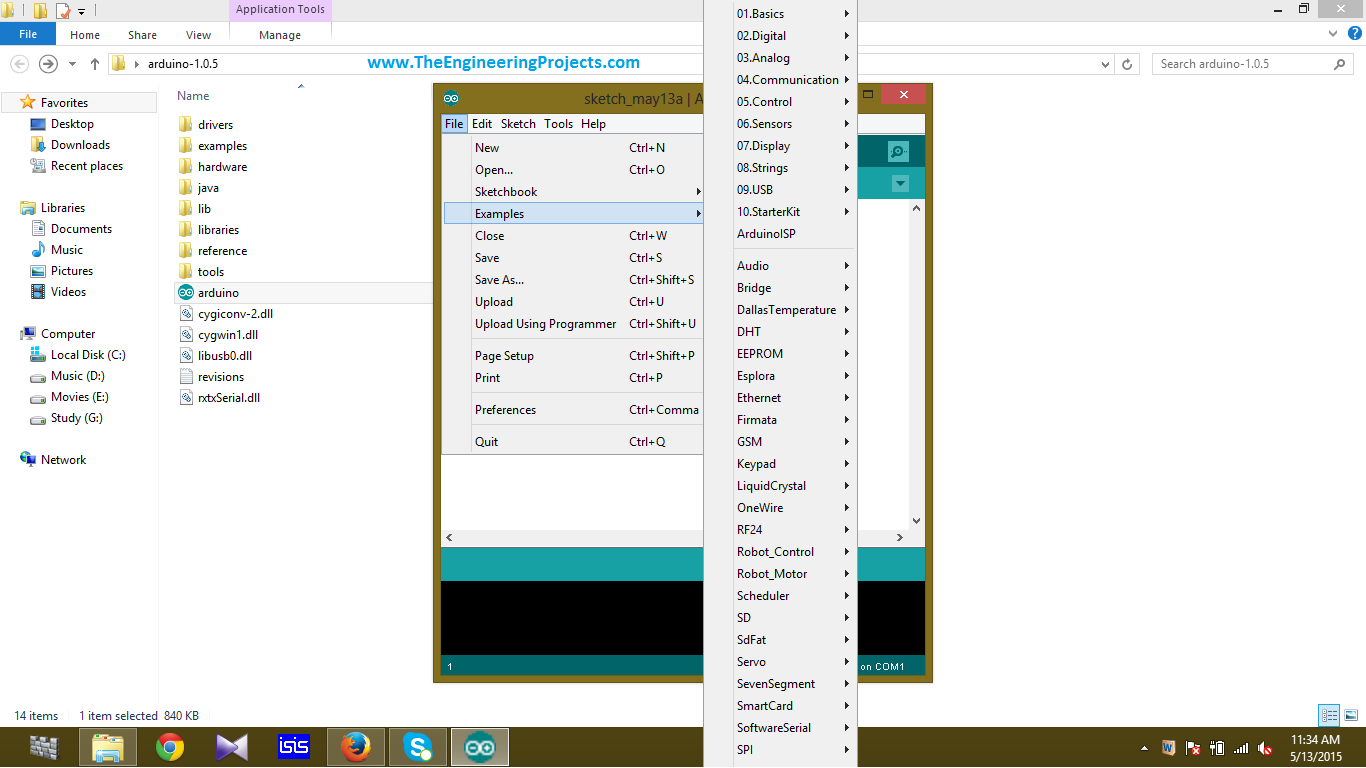
Save your own copy before experimenting. That makes it clear which file you are editing and preserves the original reference example. A file being visible in the editor does not mean the board is running that version; the hardware changes only after an upload or another programming operation succeeds.
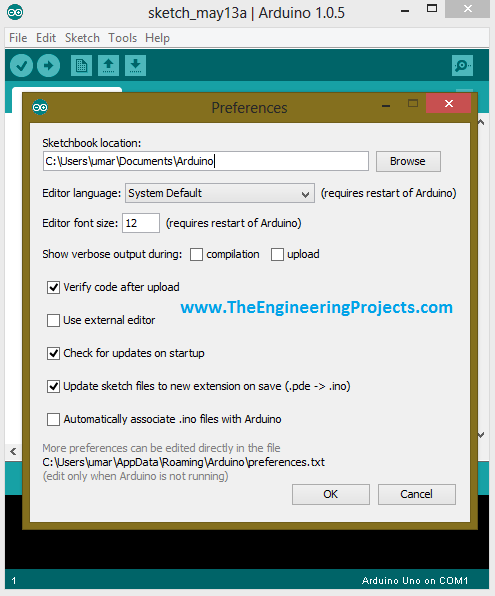
Preferences control editor behavior and locations such as the sketchbook directory. The interface language setting changes menus and messages; it does not translate C++ keywords into another programming language. Font size is an editor setting, whereas indentation changes the whitespace structure of the source.
Write a First Blink Sketch
Arduino sketches commonly contain setup and loop functions. setup runs once after startup or reset. After setup finishes, loop is called repeatedly. These names and their spelling matter because the Arduino core expects this structure.
void setup() {
  pinMode(LED_BUILTIN, OUTPUT);
}

void loop() {
  digitalWrite(LED_BUILTIN, HIGH);
  delay(1000);
  digitalWrite(LED_BUILTIN, LOW);
  delay(1000);
}
LED_BUILTIN is a board-specific constant for the built-in LED connection. Using it is clearer than assuming every Arduino board uses the same numbered pin. On the classic Uno, the familiar built-in LED is associated with digital pin 13.
pinMode configures the pin as an output. digitalWrite selects its high or low logic state. delay waits for a duration expressed in milliseconds. The sketch holds the LED on for about one second and off for about one second.
The complete blink period is approximately two seconds, so the blink-cycle frequency is 1/2 = 0.5 Hz. Changing both delays to 250 milliseconds gives a period of about 0.5 seconds and a frequency of about 2 Hz. The program has small execution overheads, so these are introductory timing estimates.
This simple sketch needs no external LED resistor because the board's built-in indicator circuit already includes the necessary hardware. An external LED requires its own current-limiting resistor and correct polarity. Do not generalize the built-in example into permission to connect arbitrary loads directly to a pin.
Edit Code Without Changing Its Meaning Accidentally
The original Edit menu contains undo, redo, copy, paste, search and formatting operations. They modify the source text in the editor, not the program already stored on the board.
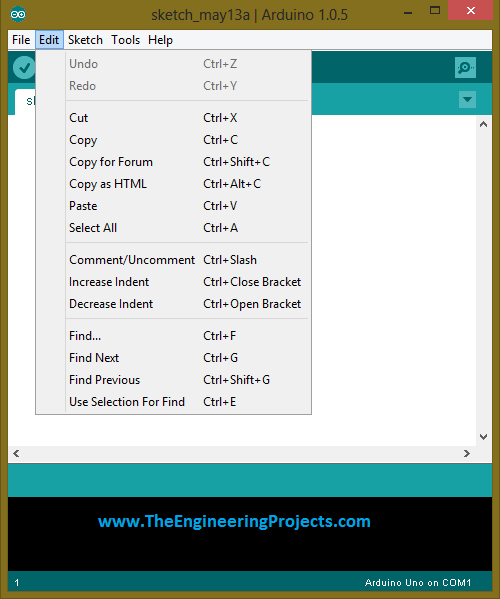
Indentation shows which statements belong inside a function, loop or conditional block. Increasing indentation adds leading whitespace; it does not widen the cursor. Consistent indentation helps expose a misplaced closing brace before it becomes a confusing compile error.
A line beginning with two slashes is a comment. Comments document intent and are not executed as program instructions. Commenting out a required statement can change behavior or break the program, so it is not a substitute for understanding what that statement does.
Older Copy for Forum or Copy as HTML commands format source for sharing. They do not translate a sketch into a website application or retrieve a working program automatically from a forum. When pasting code from a web page, check for smart quotation marks, missing symbols and text that was accidentally included.
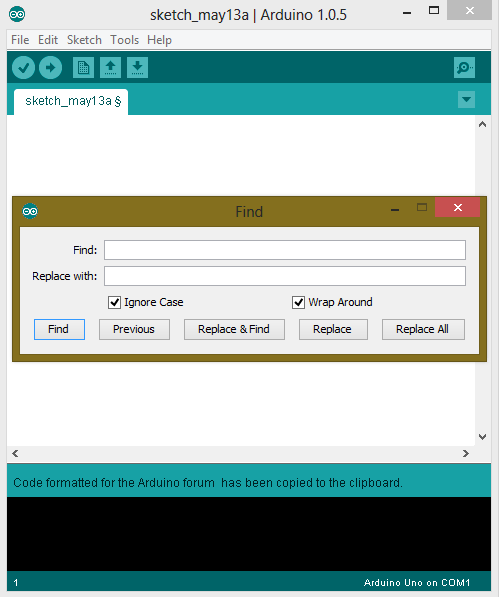
The historical Find and Replace dialog appears below. Search locates text; replace changes matching text. Review matches before replacing every occurrence, especially when a short name is also part of a longer variable name or comment.
Verify Means Compile, Not Run
Click Verify after selecting the board. The IDE processes the source, compiles it and links the required code for that target. A successful compilation means the tools produced a program; it does not prove that wiring, timing or program logic is correct.
The old Sketch menu shows the Verify/Compile command alongside project-management operations. The current IDE provides equivalent essential actions, even where the layout differs.
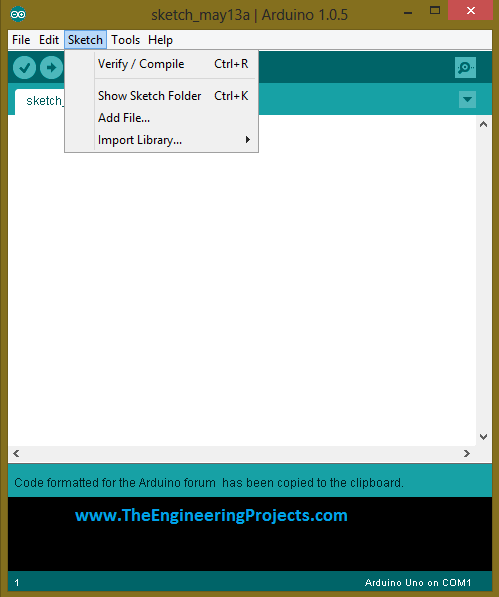
Compilation can be performed without uploading. For many targets, you can compile without a board physically connected as long as the support package and target settings are installed. A serial port becomes relevant when the upload tool needs to communicate with hardware.
If Verify fails, read the first useful error message rather than only the final exit status. A missing semicolon, unmatched brace or unavailable header can trigger several later messages. Correct the initial cause and compile again before investigating every secondary error.
Arduino's compilation troubleshooting guide explains this distinction. Messages about flash and RAM usage are also useful: a program can fit in flash while leaving too little working memory for reliable operation.
Install Libraries Deliberately
The historical Import Library menu is shown below. Including a library normally adds a header reference to the sketch so its declarations can be used. That include statement does not automatically prove the correct library version is installed.
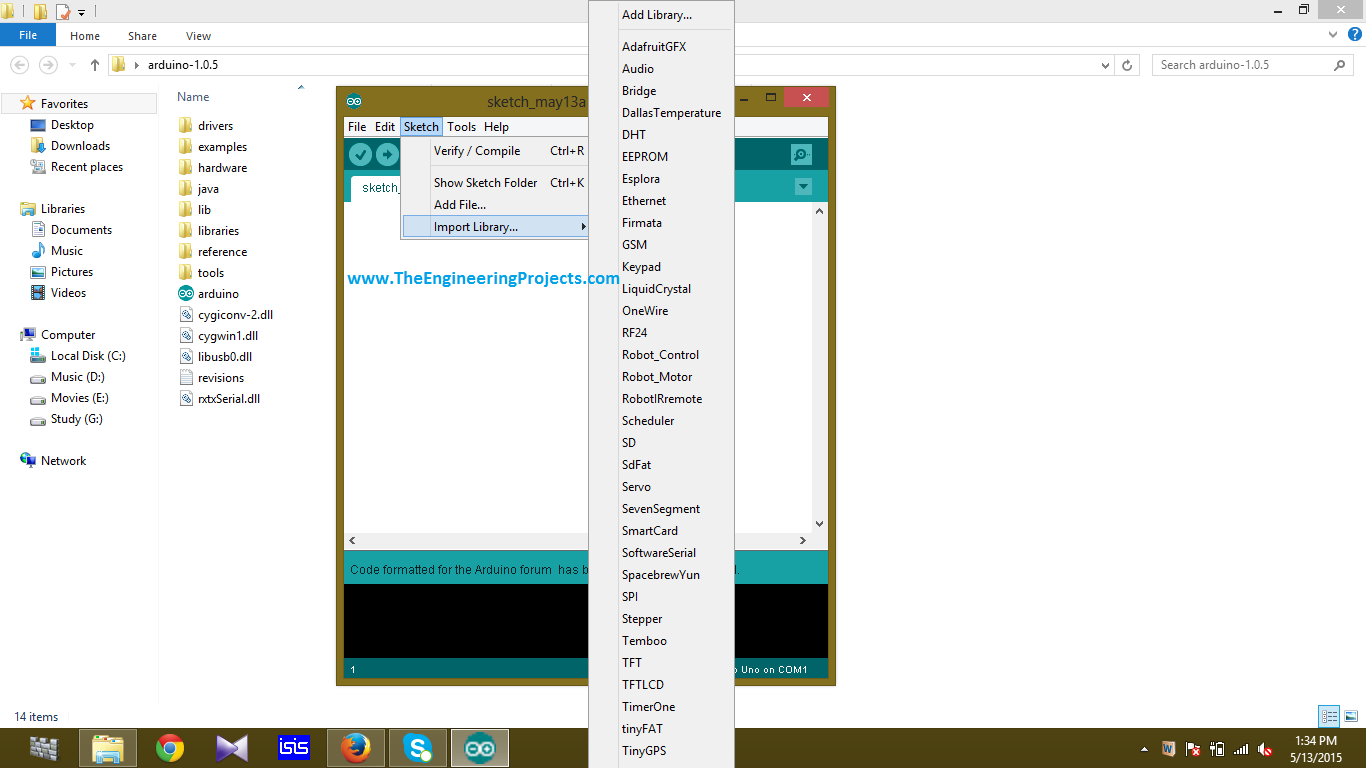
Use Library Manager when the required library is available there, and follow the library author's installation guidance for other packages. Check the author, supported boards and example sketch. Different libraries can have similar names but expose different functions.
If the compiler reports that a header cannot be found, confirm the library installation and exact header spelling. If it finds the header but rejects a function call, compare your code with an example for the installed version. Copying a function name from a different library's tutorial will not make it compatible.
For the first Blink experiment, no additional library is needed. Keeping this baseline small helps distinguish a board or upload problem from a dependency problem introduced later.
Upload the Sketch to the Board
- Save the sketch and confirm the intended board model.
- Select the port associated with the connected board.
- Click Verify and resolve compilation errors.
- Click Upload and wait for the operation to finish.
- Read the completion or failure message in the output area.
- Observe the built-in LED and compare its timing with the sketch.
Upload usually performs compilation before transferring the program. On a classic Uno, the normal USB workflow uses its bootloader and USB serial interface. The IDE does not merely load the source into another editor window; it programs executable code into the board.
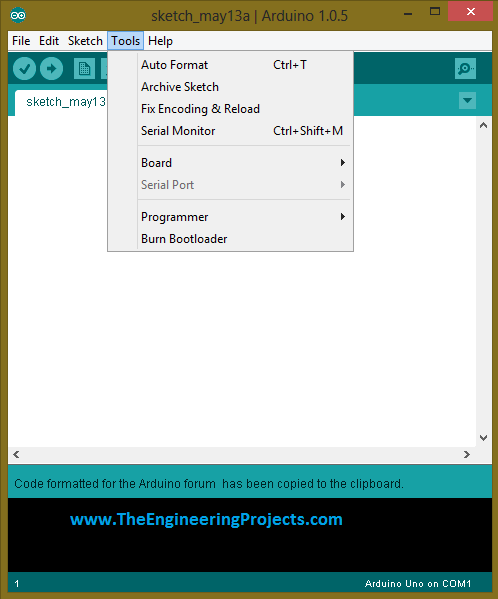
The old Tools menu is shown here. It groups board, programmer and related options, but those options serve different workflows.
The board selection image below illustrates that choice. Select your actual hardware, not whichever board happens to appear first. A board with a similar shape may still use a different processor or core.
After a successful upload, change both delays from 1000 to 250, save and upload again. A clear change in blink rate is stronger evidence that the new sketch reached the board than seeing an LED flash when the board already contained Blink from an earlier session.
Programmer Settings and Bootloaders Are Separate
The historical programmer menu is shown below. A programmer is an external programming interface or another supported device configured for that purpose. Choosing an item in this menu does not create the required physical programmer connection.
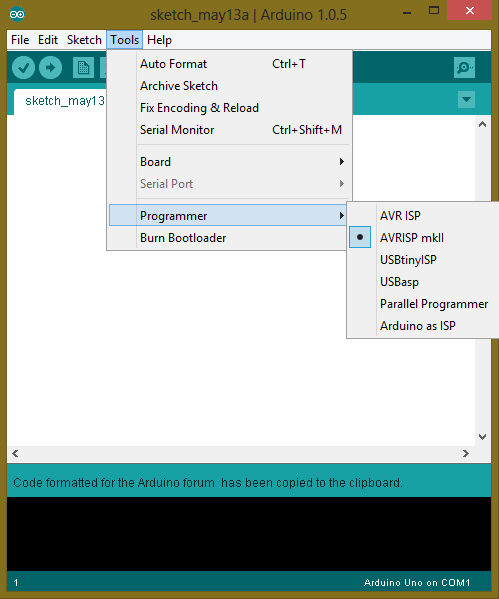
Upload Using Programmer bypasses the normal bootloader upload route where supported. It does not mean upload code written in a different editor. The source may be written anywhere; the programming method concerns how compiled machine code reaches the target.
Burn Bootloader is a maintenance or setup operation. On a classic AVR board, it requires the correct programming hardware, wiring and target settings, and it can configure device fuses as well as program bootloader code. It is not the routine step for uploading Blink to a working Uno.
Do not respond to every upload error by burning a bootloader. First establish that the sketch compiles, the board and port are correct, the cable carries data and another application is not occupying the port. Arduino provides a separate upload troubleshooting guide.
Use Serial Monitor to See Messages
Serial Monitor displays data sent by the sketch and can send data back. It is not an automatic debugger that checks every line of code for errors. The program must explicitly produce the messages you want to inspect.
void setup() {
  Serial.begin(9600);
  Serial.println("Arduino started");
}

void loop() {
  Serial.println(millis());
  delay(1000);
}
Upload this as a separate sketch, open Serial Monitor and select 9600 baud. On the classic Uno, the monitor's baud setting must match the sketch's serial rate. Line-ending settings matter when sending commands to a program that expects a newline or carriage return.
millis reports elapsed milliseconds since startup and eventually wraps around its unsigned range. For this example, the printed values should increase by approximately one thousand per line. Opening a serial connection can reset some boards, so a repeated startup message is not necessarily a software crash.
If the display is empty, check the selected port, baud rate and whether the current sketch actually calls Serial.print or Serial.println. If another terminal program has opened the same port, close that connection before retrying the upload or monitor.
Use Help and the Toolbar Effectively
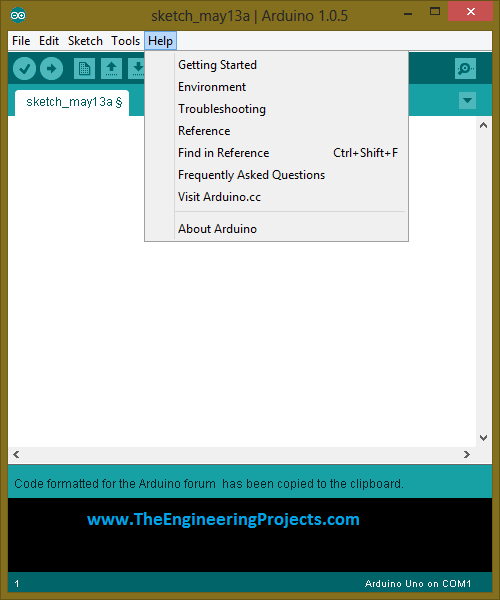
The historical Help menu provides access to examples and references. Current Arduino documentation should be used for the specific board and IDE version you are using.
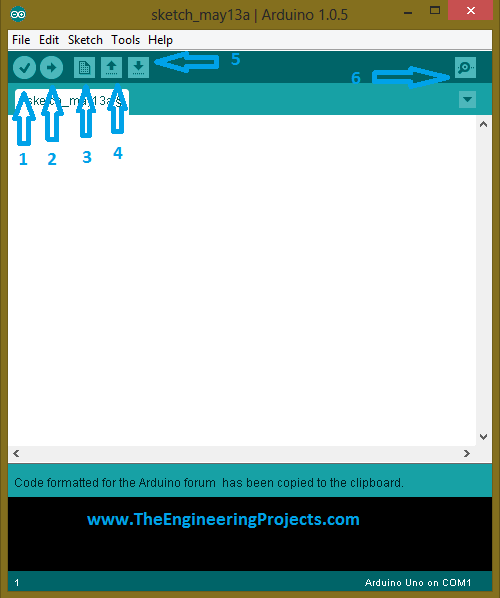
The original toolbar picture labels six controls: Verify, Upload, New, Open, Save and Serial Monitor. The essential distinction is between changing a file, compiling it, programming hardware and observing runtime communication.
Arduino's IDE documentation covers the current editor, library tools and supported debugging workflows. Hardware debugging requires an appropriate board and setup; the presence of a debugging interface does not mean every classic Uno project supports breakpoints through its ordinary USB connection.
A Practical First-Project Review
| Problem | Useful first check |
|---|---|
| Board is not listed | Required board support package |
| No serial port appears | Data cable, USB connection and operating-system device detection |
| Verify fails | First compiler error and installed dependencies |
| Verify succeeds but Upload fails | Board, port, connection and upload-tool message |
| Upload succeeds but behavior is wrong | Sketch logic, pin mapping and external wiring |
| Serial text is unreadable | Matching baud rate and correct port |
Keep a known-working Blink sketch available as a baseline. When a larger project stops working, testing that simple sketch helps isolate the problem. If Blink uploads and runs, the next investigation can focus on the added libraries, wiring or application logic.
Record the board model, board-package version and library versions with a project you intend to keep. An old screenshot alone cannot reproduce the development environment. Save the source and any required configuration, not just a compiled file whose purpose you may forget.
Frequently Asked Questions
Does Verify send the program to my board?
No. Verify compiles the sketch. Upload is the operation that transfers the compiled program to hardware.
Will closing Arduino IDE stop my sketch?
No. A programmed board continues running while powered. Removing its only power connection stops it because power is removed.
Are examples and libraries the same thing?
No. An example is a sketch demonstrating behavior. A library supplies reusable code, and may include example sketches.
Should I use Arduino IDE 1.0.5 to match the pictures?
The images document the original tutorial. For new work, use an appropriate supported version from Arduino and follow its current board documentation.
Do I need an external programmer for normal Uno uploads?
Usually not when its bootloader and USB interface are working. External programming is a separate workflow used for particular setup, recovery or development tasks.
What should I learn after Blink?
Try a button input, analog reading and serial output one at a time. Keep the circuit simple enough that each new concept can be checked independently.


Comments
1