


Introduction to Arduino MKR Vidor 4000


Hey Everyone! Hope you’re well today. I welcome you on board. In this post today, I’ll walk you through the Introduction to Arduino MKR Vidor 4000.
Arduino Simulation Libraries
Helping Tools
- Serial Monitor Advance: a serial terminal window for the UART of your board
- Serial Monitor Expert: the serial monitor with extra debugging tools
- LCD Library for Proteus V3.0: 16x2, 20x4 and I2C LCDs to show your readings
The Arduino MKR Vidor 4000 is a powerful board with which you can develop your own controller board. The inclusion of FPGA makes this device unique and separate from other Arduino boards available in the market. With this FPGA feature, you can do audio and video processing which is not possible with other Arduino boards.
Using this device, you can design a real-time computer reading sensor information and the best part is this board is compatible with all other Arduino boards. With this board, you can make all pins PWM signals (on the FPGA block side) for handling the speed of motors. Moreover, you can develop a sound effect pedal for your guitar by capturing the sound in real-time.
With Arduino IoT cloud, you can also handle the complex laboratory machine connected with a number of motors.
Before moving further, I suggest you read the Introduction to Arduino MKR NB 1500 that I’ve uploaded previously.
I suggest you buckle up as I’ll walk you through the complete introduction to Arduino MKR Vidor 4000 covering datasheet, pinout, features, programming, and applications.
Let’s get started.
Introduction to Arduino MKR Vidor 4000
- The Arduino MKR Vidor 4000 is a powerful board with which you can develop your own controller board.
- This board is incorporated with SAMD21 microcontroller and Intel® Cyclone® 10CL016 (FPGA).
- The inclusion of the most powerful reprogrammable chip FPGA makes this device unique and separate from other Arduino boards available in the market.
- With this FPGA feature, you can do audio and video processing which is not possible for other Arduino boards.
- The FPGA carries 504Kbit of embedded RAM, 16K Logic Elements, and 56 18x18 bit HW multipliers that are employed for high-speed DSP (digital signal processing).
- Every pin is activated at over 150 MHz and normally configured for functions such as (Q)SPI, high res/ high freq PWM, UARTs, quadrature encoder, Sigma Delta DAC, I2C, I2S, etc.
- Using this Vidor device you can do an experiment with precision as it comes with the RESET button which you can use in case anything goes wrong. As you press and release this button, the board gets reset, helping you program the board from scratch.
- The operating voltage of this board is 3.3V and one Mini PCI express port with programmable pins is also installed on the board that carries up to 25 user-programmable pins.
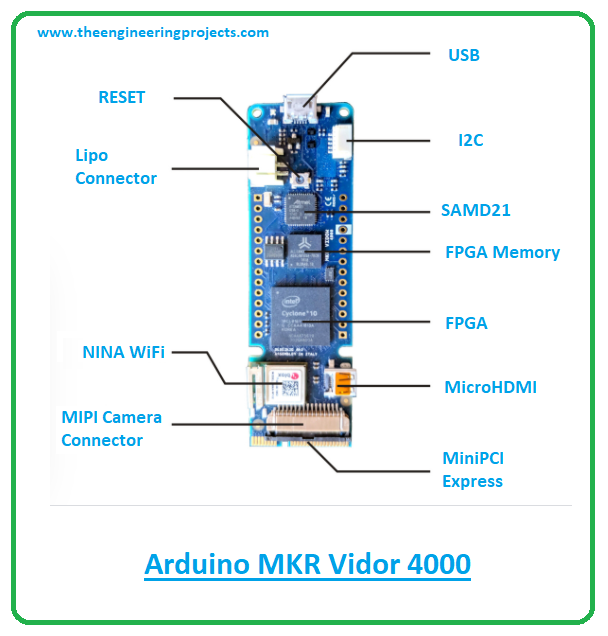
- The board also features a MIPI (mobile industry processor interface) camera connector which is nothing but a set of standards that allow implementing important features of smartphones including displays and imaging devices. In simple words, the MIPI standard is employed to offer connectivity in mobile, multimedia, automotive, augmented reality, and virtual reality, and other related applications.
- Other features include - Wifi & BLE powered by U-BLOX NINA W102 module, Micro HDMI connector, the MKR interface where all pins are controlled by both SAMD21 and FPGA.
- The flash memory of FPGA on this Vidor board is 2MB and SDRAM memory is 8MB. There is no EEPROM memory. The flash memory is used to store the Arduino program (sketch) and SDRAM memory is used to produce and manipulate variables when it runs.
- The flash memory on the microcontroller side is 256KB and the SRAM memory is 32KB. There is no EEPROM memory on the microcontroller side.
- The power to the board by USB is 5V. Moreover, the board also features a Li-Po charging circuit that runs the board in two ways: either from the external 5V source or from battery power.
Arduino MKR Vidor 4000 Pinout
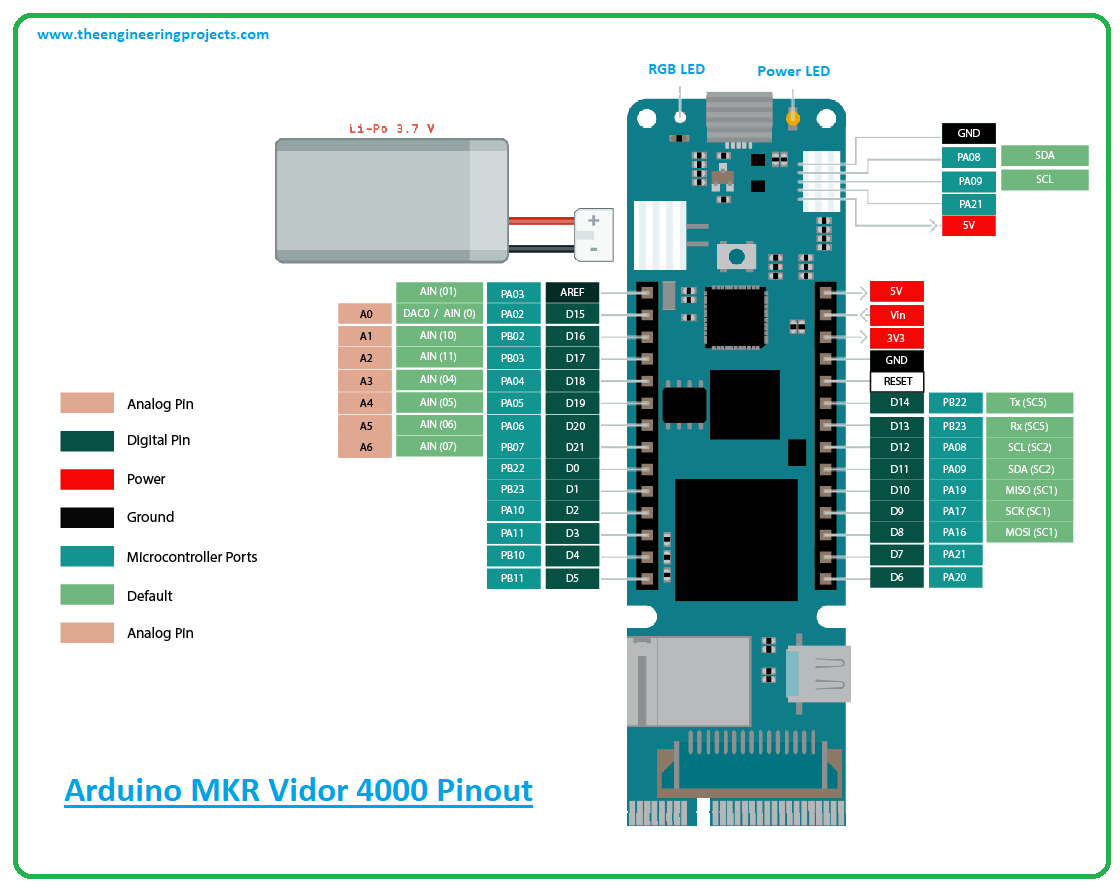
The following figure shows the pinout diagram of Arduino MKR Vidor 4000.
Arduino MKR Vidor 4000 Pin Description
Hope you’ve got a brief idea about this Vidor board. In this section, we’ll cover the description of each pin installed on the microcontroller block side and FPGA block side. Let’s jump right in.
Digital Pins
There are total 22 headers + 25 Mini PCI Express pins installed on the FPGA block side. The PCI Mini Express is a port with programmable pins. There are total 8 Digital pins on the microcontroller block which remain in two states i.e. either HIGH or LOW. When these pins are HIGH they are considered ON and receive 5V and when these pins are LOW they are considered OFF and receive 0V.
Analog Pins
It is important to note that the analog pins on board are not routed through FPGA. These pins are attached to both - FPGA and SAMD. Moreover, using these pins on the SAMD side is totally fine, as long as you're not using these pins as outputs on the FPGA side. On the FPGA block, there is no analog pin applicable. While on the microcontroller block there are 7 analog pins.
PWM Pins
The PWM feature in this board is unique. You can use all pins on the FPGA as PWM pins to control the speed of motors. When these PWM pins are activated, the board produces an analog result with digital means. There are 13 PWM pins on the microcontroller block.
UART Pins
There are two UART pins installed on the microcontroller block side. The Rx is a pin used to receive serial data while Tx is a pin used to transfer serial data.
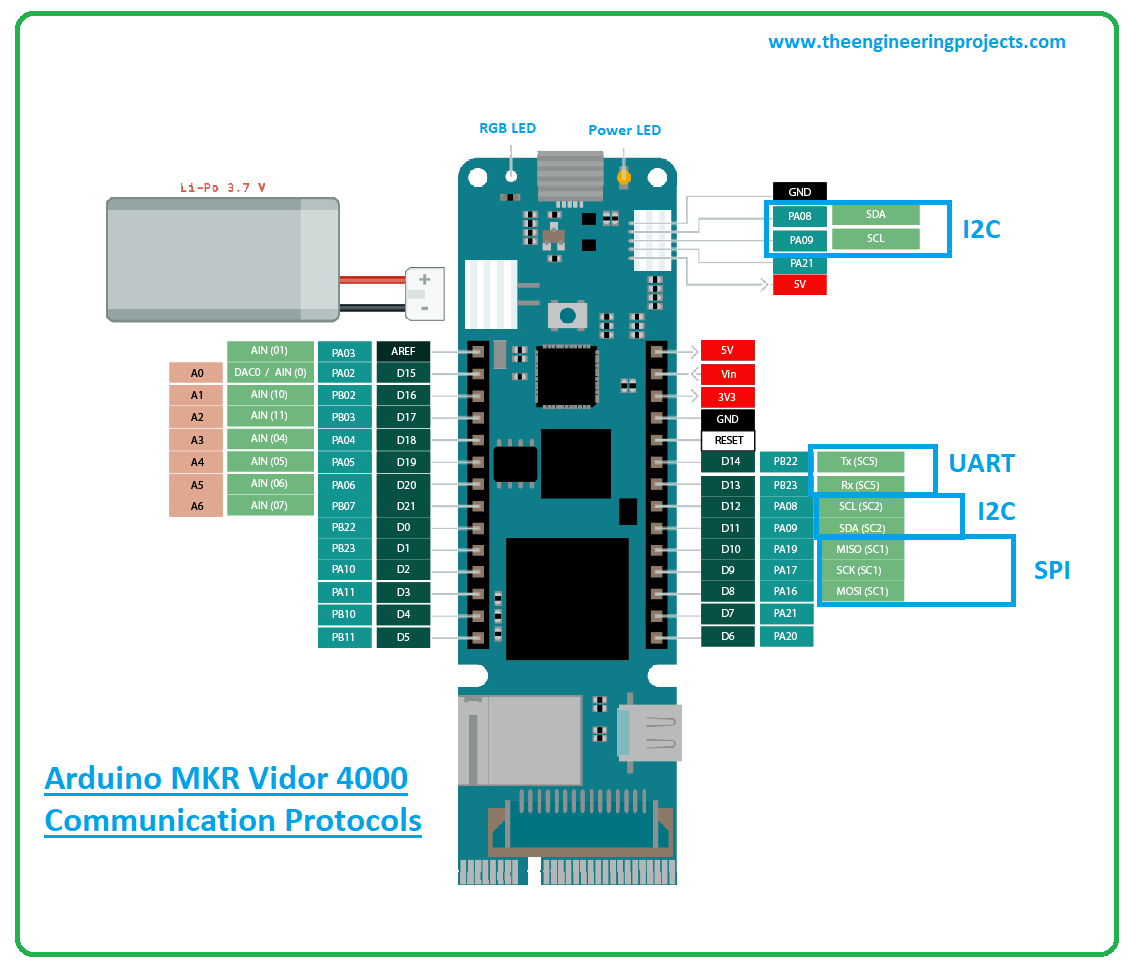
On the FPGA side, up to 7 UART are used depending on the FPGA configuration.
I2C Pins
Two pins SDA and SCL are used for I2C communication. The SDA is a serial data line that carries the data and SCL is a serial clock line used for the synchronization of all data transfer through the I2C bus. Again on the microcontroller block side, there is only one I2C protocol. While on the FPGA side up to 7 I2C protocols can be used.
SPI Pins
The Vidor board comes with one SPI (serial peripheral interface) communication protocol that is mainly used to develop the communication between the controller and other peripheral devices such as sensors or shift registers. There is only one SPI protocol on the microcontroller’s side while up to 7 SPI protocols are used on the FPGA side depending on the FPGA configuration.
Two pins… MISO (Master Input Slave Output) and MOSI (Master Output Slave Input) are employed for SPI communication. These pins are used to receive or send data by the controller.
Arduino MKR Vidor 4000 Features
Microcontroller = SAMD21 Cortex®-M0+ 32bit low power ARM MCU
FPGA = Intel® Cyclone® 10CL016
Camera Connector = MIPI camera connector
PCI = Mini PCI Express port with programmable pins
Digital I/O Pins on FPGA = 22 headers + 25 Mini PCI Express
Digital I/O Pins on MCU side = 8
PWM pins on FPGA = all pins
PWM pins on MCU side = 13 pins
Analog Pins on FGPA = n/a
Analog Pins on MCU side = 7
UART for FGPA = up to 7 depending on the FPGA configuration
SPI for FGPA = up to 7 depending on the FPGA configuration
I2C for FGPA = up to 7 depending on the FPGA configuration
UART for MCU = 1
SPI for MCU = 1
I2C for MCU = 1
Board power supply (USB, Vin) = 5V
Circuit operating voltage = 3.3 V
Flash Memory on FGPA = 2MB
SDRAM Memory on FGPA = 8MB
Flash memory on MCU = 256KB
SRAM memory on MCU = 32KB
Clock speed for FGPA = 48 MHz - up to 200 MHz
Clock speed for MCU = 32.768 kHz (RTC), 48 MHz
USB = Full-speed USB device and embedded host
Size = 25x83mm
Weight = 43.5 gm
Programming
The Vidor board is programmed using the Arduino IDE (integrated development environment) software. This software is used to program all Arduino boards.
This board carries a USB port through which you can connect this device with the computer and send a number of instructions to program the board.
This device contains Bootloader which is a built-in feature of this board, setting you free from buying the external burner to burn the program on the microcontroller.
Arduino MKR Vidor 4000 Applications
- Vidor is used to making LED sequencer
- Used for audio and video processing
- Employed for making sound effect for guitar
- You can also make Vidor clock
- MIPI used for implementing important features of smartphones
That’s all for today. I hope you find this article helpful. If you’re unsure or have any questions, you can pop your comment in the section below. I’d love to help you the best way I can. Feel free to share your valuable feedback and suggestions around the content we share so we keep generating quality content customized to your exact needs and requirements. Thank you for reading the article.

Comments
0