


Why Your LED Projects Need Aluminum PCBs?


You’ve likely seen this on the bench or in the field. A high-power LED build looks solid during testing but fails prematurely in the real world. The weak link usually isn't the driver or the chip; it’s the board itself. Standard FR4 boards act like thermal blankets, trapping heat exactly where it destroys the junction. If you’re pushing real power—anything beyond a simple indicator—an aluminum PCB isn't a luxury upgrade. It is an engineering necessity to protect your investment from the inevitable thermal load.
The Hidden Heat Problem That Destroys Builds
High-power LEDs generate intense heat in a focused surface area. Unlike incandescent bulbs that radiate heat outward, LEDs conduct it down through the package. Here’s the friction point: standard FR4 is a composite of fiberglass and epoxy. It is a fantastic electrical insulator, but with a thermal conductivity of roughly 0.3 W/m·K, it acts like a brick wall for heat transfer.
If you mount a 5W or 10W LED on FR4, you force that heat back into the chip. The junction temperature spikes. Without aggressive thermal via stitching and massive copper pours, standard FR4 hits a hard limit at a few hundred milliwatts. Beyond that, you are baking your components.
To put it in perspective, aluminum conducts heat roughly 500–800 times better than FR4. That delta is enormous. You wouldn’t mount a CPU heatsink with a thick rubber pad sitting between the die and the metal; similarly, you shouldn’t use an insulating FR4 board to mount a high-output LED. This is the hidden heat problem that silently kills ROI on ambitious lighting projects.
How an Aluminum Base Acts Like a Built-In Heatsink
You need the board to function as a highly efficient heat spreader. This is where the aluminum PCB (often called a metal-core or IMS PCB) changes the equation. It uses a composite structure designed to pull thermal energy away from the critical junction instantly.
Here is how the physics stack up:
● Copper Circuit Layer: Your components sit here, just like on a standard board.● Thermal Dielectric Layer: This is the critical component. It is an extremely thin (~50–100 µm) layer of ceramic-filled polymer. It electrically isolates the circuit but allows heat to pass through. High-performance dielectrics hit the 1–3 W/m·K range. Because this layer is so thin, the thermal resistance drops to a mere 1–2 °C/W, compared to the sluggish 5–10 °C/W of a standard board.● Aluminum Base Layer: This is the foundation. With a thermal conductivity of 150–235 W/m·K, this metal slab grabs heat from the dielectric and spreads it out.
Real-world data backs this up. Identical LEDs running at the same power see junction temperatures 20–30°C lower on an aluminum PCB vs on FR4. That is a massive difference. By bolting this metal-backed board to your enclosure, you effectively turn the entire chassis into a cooling surface, allowing heat to escape 5x faster than with standard substrates.
FR4 vs Aluminum PCB: Quick Comparison
Feature | FR4 PCB | Aluminum PCB |
Thermal Conductivity | ~0.3 W/m·K | 150–235 W/m·K |
Typical Power Handling | < 1W (without heavy vias) | 5W–100W+ |
Junction Temperature | High | 20–60°C Lower |
Cooling Requirement | External heatsink mandatory | Often integrated |
LED Lifespan Impact | Shortened | 2–3× Longer |
Ideal Use Case | Low-power electronics | High-power LEDs, lighting |
Moving From Prototype to Professional Fabrication
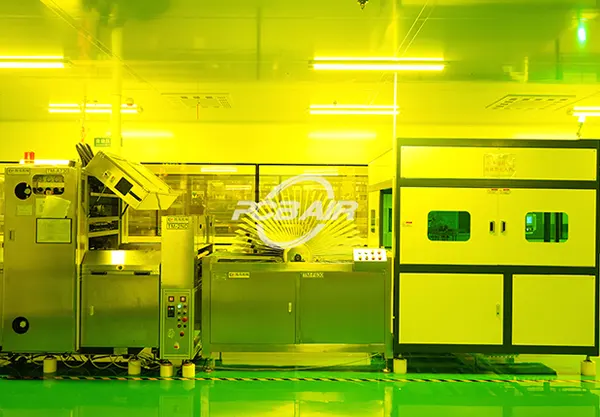
Prototyping on FR4 is fine for a functional verification, but you cannot DIY a metal core board in a garage. Physics doesn't allow it. The process requires high-pressure industrial lamination to bond the dielectric without air gaps, and specialized routing to drill through metal without compromising electrical isolation.
This is where aluminum PCB manufacturing shifts from simple fabrication to precision engineering. Unlike standard boards, the metal core requires strict adherence to creepage distances and dielectric breakdown voltage (HiPot) specs. You need a manufacturing partner—like PCBAIR—that understands these specific constraints.
They will review your CAM data to ensure the dielectric thickness is uniform (ideally ≤100 µm) to prevent hot spots while maintaining safety standards. While it adds a layer of complexity compared to standard boards, the cost difference has narrowed significantly. It’s a small premium to pay for a board that doesn't melt.
Extending Lifespan and Reliability
Why does this matter to the bottom line? Reliability maps directly to junction temperature. Every degree cooler you run your components can prolong the LED’s life.
Industry comparisons and TM-21 projections show that a 20W LED mounted on an aluminum PCB runs 40–60°C cooler than the same setup on FR4. That temperature drop translates to a 2–3x extension in operational lifespan. It stops lumen depreciation—the gradual dimming that makes a facility look old before its time.
You also reduce mechanical stress on solder joints and other components. In many cases, the superior thermal performance allows you to delete failure-prone cooling fans entirely, relying on passive convection. By switching to a metal-backed solution, you stop fighting heat and start managing it. You aren't just buying a circuit board; you’re buying years of maintenance-free operation.
In short, don't let a hidden heat problem undermine your engineering. If your project involves high power, give it the thermal foundation it needs. Build it on aluminum, and it will last.
Frequently Asked Questions (FAQ)
Q1: Can I use aluminum PCBs for low-power LEDs?Yes, but it is usually unnecessary. Aluminum PCBs are most cost-effective when thermal management is a limiting factor (typically above 1W per LED).
Q2: Are aluminum PCBs electrically conductive?No. The circuit layer is electrically isolated from the aluminum base by a high-performance dielectric layer.
Q3: Do aluminum PCBs replace external heatsinks?In many designs, yes. The metal core spreads heat efficiently and can often be mounted directly to an enclosure for passive cooling.
Q4: Are aluminum PCBs harder to assemble?Assembly is similar to standard PCBs, but rework requires more thermal energy due to the metal core’s heat dissipation.
Q5: What industries commonly use aluminum PCBs?LED lighting, automotive electronics, power supplies, industrial controls, and high-current applications.
Conclusion
Heat is the silent failure mode in high-power LED designs. While FR4 boards may suffice for indicators and low-power electronics, they become a liability as power density increases. Aluminum PCBs provide an integrated thermal solution that dramatically lowers junction temperature, extends lifespan, and improves overall system reliability.
If your project involves real power, aluminum PCBs are not an upgrade—they are a requirement. Build on aluminum, manage heat at the source, and deliver products that last years longer in the field.
Comments
0