


Benefits of using Cloud Storage for Data Analytics


Data analytics has been made a pillar of the contemporary business strategy wherein organizations make sound decisions using precise insights. With the increasingly exponential increase in data volumes, conventional systems of storage are frequently unable to keep up, which can create a respite in the analysis process and decision-making. Cloud storage has proven to be a trusted option, and it provides scalable, flexible, and secure data management, which aligns with the multifaceted demands of the analytics operations. Cloud-based solutions are changing how an organization conducts its data analysis with the capacity to store, process, and retrieve very large volumes of data.
Combining cloud storage with the tools of data analytics enables companies to get real-time analysis and react promptly to the changes in the market. This ability is especially crucial in those sectors where the decisions made in time are crucial. Using the cloud solutions, companies will be able to unify various sources of data, workflow, and make sure that their analytics is agile and efficient. The advantages are not limited to technical effectiveness, which has an impact on strategic planning and performance in all spheres.
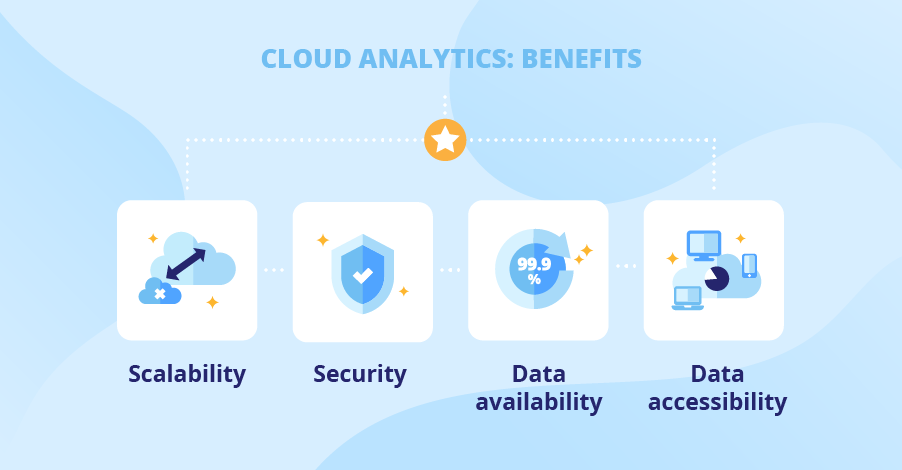
Scalability and Flexibility
Cloud storage can also be expanded at an amazing scale, and an organization can increase or reduce its storage capacity in line with its data needs. Cloud solutions can be expanded with business requirements without substantial development in the basic infrastructure (as compared to on-premise) platforms that demand infrastructural changes. The flexibility is also especially useful with data analytics, where data sets may vary in size and complexity. The storage can be extended or contracted without any inconvenience and companies ensure that they possess the resources they require in order to cope with the high-volume analytics procedures.
Besides scalability of storage, cloud-based solutions offer scalable computing capabilities that can be used in conjunction with data analytics programs. Organizations are able to distribute processing power in real time, and process data much faster. This flexibility minimizes the chances of performance bottlenecks and enables analytics processes to operate effectively. Through offering scalable storage and on demand processing capabilities, cloud solutions offer a cohesive solution such that data can be uploaded, processed and analysed with a very low latency.
Cost Efficiency
Cost effectiveness of cloud storage is one of the most powerful benefits of cloud storage in data analytics. Conventional types of storage need heavy designs of capital investment in equipment, software and repair and recurrence of power and facility expenses. Cloud systems are a pay as you go or subscription system which means that the business can only pay based on the quantity of storage and computing services utilized. This strategy lowers financial risk and enables organizations to spend budgets better on analytics efforts instead of infrastructure.
In addition, the economies of operation achieved with the help of cloud storage lead to the economies of scale. Data management is automated, backups are simplified and can be accessed centrally, which lessens the necessity of large IT departments and complicated management procedures. The reduction of overhead and simplification of administrative operations make cloud solutions release resources which can be reallocated in analytics development, model building, and generation of insights. It is a cost-effective method where advanced data analytics can be available to more organizations.
Enhanced Collaboration
Cloud storage also helps to create a higher level of collaboration, which is one of the most important aspects of contemporary data analytics projects. It is common to have several stakeholders including data scientists, business analysts and decision-makers and this demands access to identical datasets. Cloud platforms also ensure a centralized storage with tight access controls, which allows groups to collaborate on data without the delays and version conflicts experienced with traditional storage systems. This cooperative atmosphere helps accelerate the decision-making process and make sure that the insights will always be made on the basis of the most up-to-date information.
Teamwork is not confined in-house only but is also extended to the partner and client. Cloud-based analytics systems can provide access to third parties under control, allowing them to jointly analyze, report and verify results. The transparency and alignment of projects can be upheld in the organization with the help of shared dashboards and real-time data update tools. Cooperation can not just increase the efficiency of work but also lead to better quality and reliability of data-based decisions.
Security and Compliance
The issue of security is high in case of handling large amounts of sensitive data to use in analytics. Cloud storage vendors spend a significant amount of money on security infrastructure, including encryption, multi-factor authentication and advanced threat detection. Such measures guard the data left and in transit, decreasing the chance of violations or denial of entry. In the case of organizations dealing with regulated information, the cloud platforms will also be beneficial in providing compliance services with industry standards and legal requirements, whereby the analytics operations should be in line with the required guidelines.
In addition to technical protection, cloud storage eases the control of data access and control. Role definitions, permissions, as well as audit trails can be defined, and it is notable that it is easier to track who has access to data and the usage. This disclosure is necessary in terms of keeping up with privacy laws and internal policies. Cloud solutions, by integrating high security and regulatory assistance, help provide a stable condition in which data analytics are able to flourish without jeopardizing the safety or legal requirements.
Accessibility and Integration
Cloud storage means that information can be accessed virtually anywhere, which is a major benefit to the analytics teams that operate across the locations or on the distributed networks. Analysts do not need to depend on one on-premises server to retrieve datasets and perform analyses, enhancing operational responsiveness and agility. Remote work is also made possible by this accessibility, which allows organizations to be productive irrespective of physical location and device.
Another advantage of cloud-based storage is integration with the existing analytics solutions. Numerous platforms are compatible with well-known data processing, visualization, and machine learning tools. This interoperability makes it less complex to make data move between systems and enables companies to utilize the investments made in the current technology. Furthermore, a good Dropbox alternative can be considered by a particular business, which needs an alternative to mainstream solutions since it has the same accessibility or integration opportunities to offer competitive prices or improved security services.
Performance and Speed
The efficacy of data analytics is of paramount importance when it comes to the speed at which data can be retrieved, processed, and examined. Cloud storage facilities typically come with high-performance computing and optimized storage architecture and minimizing the latency and speeding up data access. This makes analytics operations, including querying big data sets and executing intricate machine learning designs, to be efficient and dependable.
Global network infrastructure further improves performance benefits in that distributed teams can access data on regional servers with a minimal delay. Cloud platforms have the ability to autonomously scale workload and distribute resources to satisfy demand to maintain a steady rate of speed and responsiveness. The set of packages of optimized storage, computational and worldwide access allows organizations to drive analytics at scale with the restrictions of prior storage frameworks.
Innovation and Future Readiness
Implementing cloud storage in data analytics places organizations to leverage on the next generation technology and innovations. Cloud platforms constantly refresh their features adding new sophisticated features like artificial intelligence, automated analytics, and predictive modeling. Through these capabilities, businesses will be able to have more insight, realize trends earlier and give better strategic decisions.
The capability to be flexible to increasing amounts of data and emerging analytics needs is also a part of future readiness. The cloud storage offers a platform that may assist in the growth, new data sources, and enhanced analytics. The flexibility of legacy-free infrastructure is more likely to help the organization innovate and experiment, so that it can stay competitive in a fast-evolving data environment.
Conclusion
Cloud storage is of great value with regard to data analytics uniting scalability, cost-effectiveness, improved collaboration, security, and performance within one platform. Companies become able to use and analyze data faster, work successfully in teams, and comply with security and privacy needs. A cloud solution has flexibility and integration, which allows adopting advanced analytics tools without any complications and allows businesses to provide actionable insights fast and with accuracy.
Cloud storage is an effective support to the analytics programs as data keeps becoming a central component in the decision-making process in any industry. By taking advantage of mainstream offerings or considering a Dropbox-like solution with custom features, companies will be able to get the most out of their data without being limited by the infrastructure. The outcome is a more nimble, enlightened, and competitive business intelligence in contemporary times.
Comments
0