


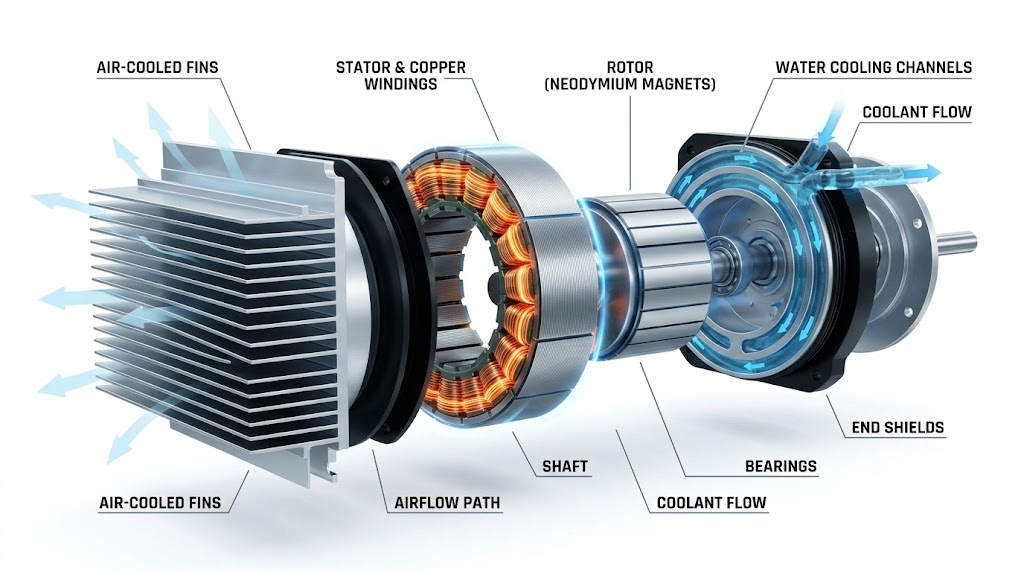
Air-Cooled vs Water-Cooled BLDC Motor for Electric Vehicle: A Thermal Selection Guide


Selecting the right BLDC motor for electric vehicle applications involves more than comparing specs — cooling method is one of the most consequential decisions in EV powertrain design.
Most guides tell you water cooling is "better." That's not wrong — but it's also not useful. This guide gives you the actual decision boundaries: what each cooling method handles, where it fails, and how to match your choice to your specific vehicle and duty cycle.
Why Cooling Is a System-Level Decision
The cooling method isn't just a motor spec — it affects your entire drivetrain. It determines weight distribution, maintenance intervals, IP rating requirements, and total system cost over three to five years. Choosing based on motor specs alone is one of the most common mistakes in EV design.
A BLDC motor manufacturer with experience across vehicle types will tell you the same thing: the real question isn't "which is better?" It's: at what point does air cooling stop being sufficient for your specific application? That boundary is where this guide starts.
The Thermal Boundary: Where Air Cooling Reaches Its Limit
Air-cooled BLDC motors work well — until they don't. The failure mode is thermal derating: the motor's control system reduces power output to protect windings from heat damage.
Real-world scenario: A 5kW air-cooled motor installed in an enclosed motor bay, running a continuous uphill load at 40°C ambient temperature, will typically trigger thermal protection within 15–20 minutes. Power output drops by 25–35% automatically. The motor isn't broken — but your vehicle just lost a third of its performance when you need it most.
Three variables determine whether air cooling is sufficient for your setup:
Ambient temperature
Safe zone: Below 35°C with active airflow
Risk zone: Above 40°C, especially in enclosed bays
Duty cycle
Safe zone: Intermittent loads, stop-start urban driving
Risk zone: Sustained highway speeds, commercial routes
Chassis type
Safe zone: Open-frame, exposed motor with natural airflow
Risk zone: Fully enclosed compartment, no dedicated airflow path
If your application falls into the "risk zone" on any two of these three variables, you should seriously evaluate water cooling — regardless of rated motor power.
How to Choose the Right Cooling Method
Power rating is the starting point, but it's rarely the whole answer. A 5kW BLDC motor for electric motorcycle builds and a 5kW motor in a sealed urban commuter pod face completely different thermal conditions — and they need different cooling strategies.
The real decision comes down to three factors working together: how much power the motor needs to sustain, what the installation environment looks like, and how hard the vehicle works over time.
For motors under 5kW in open or semi-open chassis designs, air cooling handles the thermal load without issues. The motor can shed heat naturally, and the simplicity of the system becomes a genuine advantage — fewer components, lower weight, easier maintenance.
The difficult range is 5kW to 10kW. Here, air cooling is still possible, but only under the right conditions. If the motor sits in an enclosed bay with limited airflow, or if the vehicle runs sustained loads rather than stop-start cycles, air cooling will eventually cause the motor's thermal protection to activate and derate output. That's not a catastrophic failure — but it does mean the vehicle stops performing as specified precisely when the load is highest.
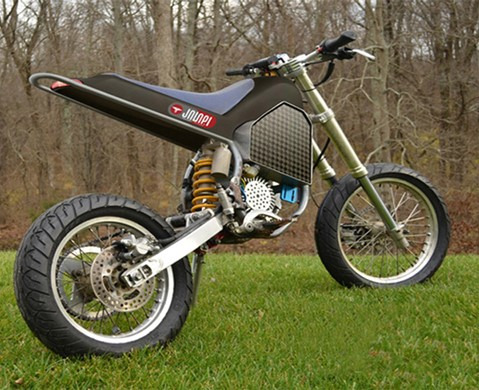
Above 10kW, water cooling is effectively required. At these power levels, the heat generated under sustained operation exceeds what air cooling can reliably manage in any enclosed vehicle environment. Attempting to run high-power motors on air cooling in these conditions doesn't just risk thermal derating — it accelerates wear on windings and magnets over time, shortening motor lifespan in ways that don't show up until well into the vehicle's operating life.
The practical rule: if two or more of your conditions — high power, enclosed installation, continuous duty cycle — apply to your design, water cooling is the right choice. If your application is genuinely light-duty with good airflow, air cooling is not a compromise. It's the correct engineering decision.
Where Most Engineers Get It Wrong
These are the three most common selection mistakes — none of them are obvious until they cause problems in the field.
Mistake 1: Trusting rated power without checking the derating curve
A motor rated at 5kW doesn't guarantee 5kW output under all conditions. Every BLDC motor has a thermal derating curve — the actual continuous power drops as temperature rises. Always ask for the derating curve at your expected operating temperature, not just the peak rated value.
Mistake 2: Ignoring altitude and climate corrections for air cooling
Air density drops at altitude, which directly reduces the heat dissipation capacity of air-cooled motors. At 2,000 meters elevation, an air-cooled motor's effective thermal capacity is roughly 15% lower than at sea level. If you're deploying in mountainous regions or high-altitude environments, this correction factor needs to be built into your safety margin.
Important note on water cooling: Water-cooled systems introduce a long-term reliability variable that's often ignored in initial specs — coolant seal degradation. Sealing failure risk increases noticeably after 3 years of operation, particularly in high-vibration environments. Factor coolant system inspection into your maintenance schedule and total cost of ownership model.
Mistake 3: Over-engineering light-duty vehicles with water cooling
Water cooling is not always the "safe choice." For light EVs under 500kg with intermittent use patterns, adding a coolant loop introduces maintenance complexity, additional leak risk, and weight that outweighs the thermal benefit. Air cooling done well — with proper mounting and airflow design — is the more reliable solution for these applications.
Matching Cooling Method to Power Range
This is also why the cooling method tends to follow power level so consistently across the industry. Motors in the 3kW range almost universally use air cooling — the thermal demands simply don't justify the added system complexity of a coolant loop. A 10kW BLDC motor running sustained loads in an enclosed EV bay generates heat that air cooling simply cannot manage reliably — water cooling at this power level is standard not because of convention, but because the thermal demands require it.
For 5kW applications sitting in this grey area, motor design details matter more than the power number alone. Some air-cooled motors in this range address the boundary case directly with an integrated self-cooling fan — improving heat dissipation at low speeds where natural airflow is limited, which is precisely the condition where air-cooled designs typically struggle. An IP54 rating also provides adequate protection for semi-exposed installations without adding the weight and complexity of a sealed water-cooled system. For electric motorcycle builds and light EV conversions, purpose-built air-cooled and water-cooled BLDC motor for electric vehicle options across all these power ranges are available at brushless.com.
Frequently Asked Questions
Does water cooling always mean better efficiency?
Not exactly. Water cooling improves thermal stability, which allows the motor to operate consistently near its rated efficiency curve. But the coolant pump adds parasitic power draw — typically 50–150W depending on system size. For lower-power motors, this draw can partially offset the efficiency gain. The net benefit is most significant at 10kW and above under sustained load.
Can I retrofit water cooling onto an air-cooled motor?
Generally no. Water-cooled BLDC motors are designed with integrated coolant channels in the housing. These aren't add-on components — they're part of the motor's thermal architecture. If your application requirements change, replacing the motor unit is the correct path.
What IP rating should I require for water-cooled motors in EVs?
For automotive applications, IP67 is the typical minimum standard — complete dust protection and immersion resistance up to 1 meter. High-performance or commercial EV applications often specify IP69K, which also covers high-pressure washdown. Always verify the IP rating on the motor spec sheet, not just the product description.
How significant is the weight difference between cooling methods?
The motor itself is similar in weight. The system weight difference comes from the coolant loop: pump, reservoir, hoses, and radiator typically add 2–5kg for a passenger EV application. For light EVs where total vehicle weight is under 500kg, this represents a meaningful percentage and should be factored into your weight budget.
At what ambient temperature does air cooling become unreliable?
There's no universal threshold — it depends on power level, duty cycle, and enclosure. As a working rule: if your sustained operating temperature (ambient plus motor self-heating) is expected to exceed 80°C at the motor housing, air cooling becomes unreliable for continuous operation. Request the specific derating curve for any motor you're evaluating to calculate this for your conditions.
The Bottom Line
Whether you're selecting a BLDC motor for electric vehicle conversions or purpose-built EV designs, air cooling and water cooling are both valid — in the right application. The mistake is treating "water cooling is better" as a universal rule, or "air cooling is simpler" as a reason to avoid thinking through the thermal math.
Work through the three-step framework above with your actual vehicle specs: power requirement, installation environment, and duty cycle. If two or more factors point toward water cooling, don't compromise. If all three point toward air cooling, don't over-engineer.
The best cooling method is the one matched precisely to what your design actually demands — not the one that sounds safest in a product brochure.
Comments
0