


Seamless PLC and Robot Integration for Scaling Hardware Startups


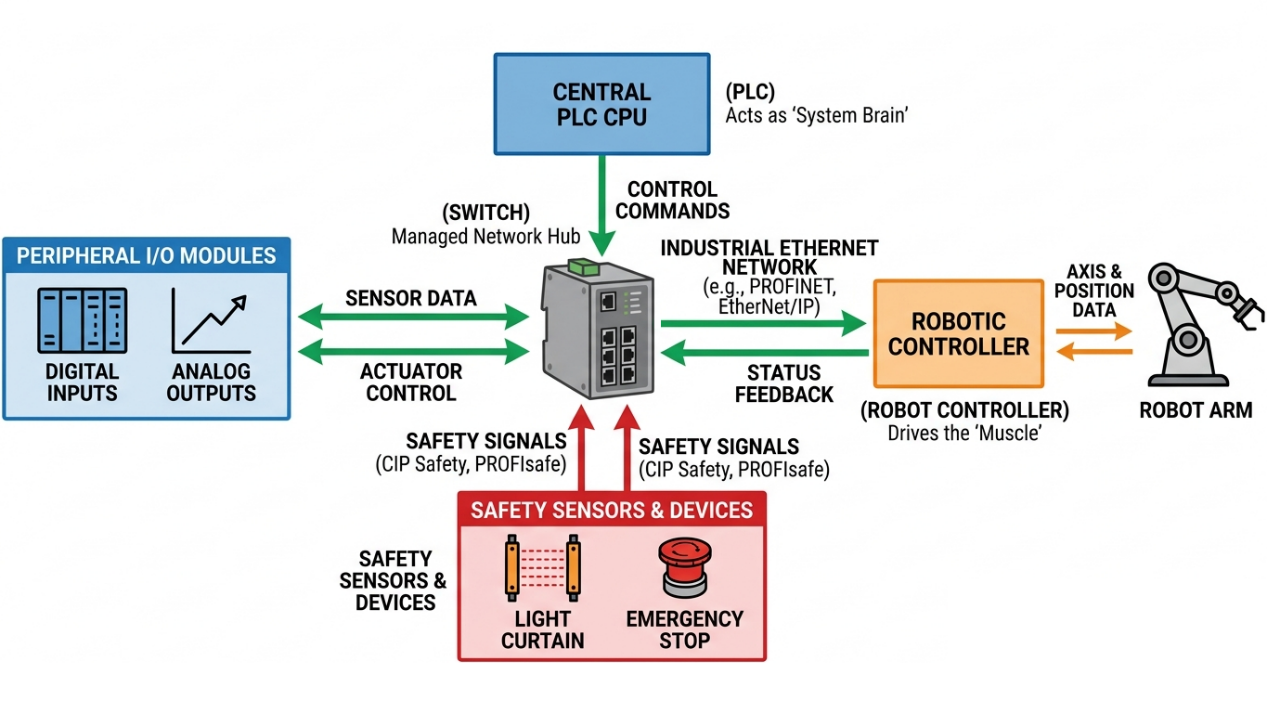
Hardware startups often face a critical inflection point when transitioning from "maker-grade" benchtop prototyping to industrial-scale production environments. At this stage, the efficiency of a factory floor relies on the synergy between the Programmable Logic Controller (PLC), which acts as the system's "brain," and the industrial robot, which serves as the "muscle." Seamless communication between these two entities is not merely a technical preference but the essential backbone of a scalable, high-throughput facility. Establishing a robust integration strategy early ensures that automation architecture can grow alongside production demand without requiring a complete system overhaul.
Defining the Communication Architecture
For engineering teams, the first step in scaling is moving away from ad-hoc connections toward a structured communication architecture. This requires a high-level decision on how data packets will travel between the controller and the manipulator, balancing speed against system complexity.
Selecting the Right Fieldbus Protocol
The choice of protocol—EtherNet/IP, PROFINET, or EtherCAT—significantly impacts system performance. While EtherNet/IP is widely adopted in North America for its ease of integration with Rockwell systems, PROFINET is often preferred in European markets for its advanced diagnostic capabilities. However, for high-speed pick-and-place applications where microsecond precision is required,EtherCATtypically offers the lowest latency. This is due to its "processing on the fly" mechanism, which reduces the overhead associated with standard Ethernet frames, making it ideal for startups aiming for maximum cycles per minute.
Hardware Handshaking vs. Software Integration
Startups often begin with traditional digital I/O handshaking, using 24V signals to trigger simple "start" or "stop" commands. While reliable for basic tasks, this method lacks the data granularity needed for modern Industry 4.0 analytics. Shifting to software-based integration via vendor-specific function blocks allows for the exchange of rich data, such as real-time torque values, precise joint positions, and detailed error codes. This transition enables engineers to build more responsive and intelligent automation cells that can adapt to varying product geometries.
Establishing a Stable PLC-Robot Handshake
Establishing a stable handshake requires meticulous configuration of the interface on both the PLC and the robot controller. This technical roadmap ensures that both devices "speak the same language" at the memory level.
Mapping I/O and Global Variables
To align memory addresses between the PLC and the robot, engineers should follow a disciplined setup process to prevent bit-collisions or logic overlaps:
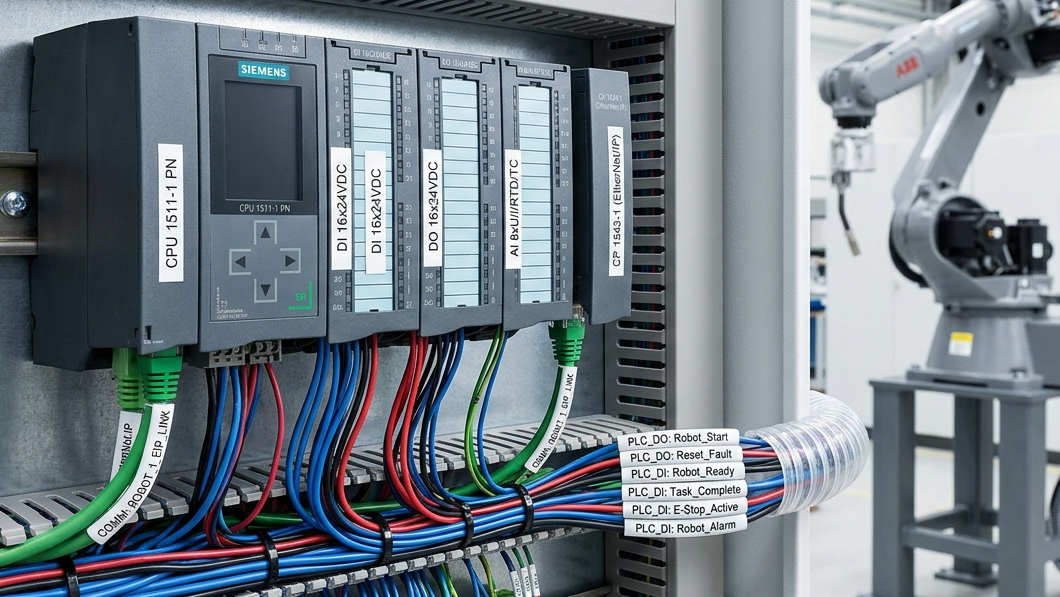
- Define the Device Description:Import the Robot’s EDS (Electronic Data Sheet) for EtherNet/IP or GSDML file for PROFINET into the PLC’s hardware configuration environment.
- Allocate Address Space:Assign specific bit addresses for critical status signals such as "Robot Ready," "Task Complete," "Emergency Stop Active," and "Auto Mode Confirmed."
- Implement Heartbeat Logic:Establish watchdog timers to monitor communication "heartbeats" between devices; if the signal fails for more than a few milliseconds, the system should trigger a controlled Category 1 stop.
Parameter Comparison for Common Integration Standards
Troubleshooting integration requires a clear understanding of the hardware limitations and timing requirements of major manufacturers. The table below provides a framework for standard interface requirements.
Feature | ABB (IRC5 / OmniCore) | Omron (NJ / NX Series) |
|---|---|---|
| Primary Protocol | PROFINET / EtherNet/IP / DeviceNet | EtherCAT / EtherNet/IP |
| Standard Baud Rate | 100 Mbps (Full Duplex) | 100 Mbps (EtherCAT) |
| Typical Cycle Time | 4ms – 12ms (Standard) | 500μs – 2ms (High Speed) |
| Safety Protocol | PROFIsafe / CIP Safety | FSoE (FailSafe over EtherCAT) |
| Header 1 | ||
Resolving Common Communication Jitter
Communication jitter or packet loss can cause erratic robot movements or frequent nuisance trips. In PROFINET RT (Real-Time) environments, packet loss is often attributed to network congestion from non-critical traffic. To mitigate this, engineers should implement VLAN tagging or use managed switches to prioritize automation traffic. Reducing latency in multi-robot cells often involves optimizing the PLC’s task cyclic time to match the robot’s internal update rate, ensuring that commands are not "stacked" or delayed in the buffer.
Strategic Sourcing for Scalable Automation
Scaling production requires more than just code; it requires a reliable supply chain. Procurement decisions made during the prototyping phase can have long-lasting effects on maintenance and uptime.
Role of Standardized Hardware in Rapid Scaling
For startups, adhering to industry-standard brands like Siemens, Schneider Electric, or ABB is a strategic move. Standardized hardware ensures a larger pool of trained engineers for hire and simplifies the procurement of replacement parts. Using "off-the-shelf" components reduces the "technical debt" associated with custom-built controllers that are difficult to support as the company grows.
Building a Resilient Component Pipeline
The global semiconductor and controller market remains sensitive to lead-time fluctuations. To maintain agility, startups should maintain a mix of new and verified "as-new" components. Utilizing a specialized supplier for industrial automation components allows engineering teams to source critical I/O modules and interface cards without the typical 20-week lead times of original equipment manufacturers (OEMs).
Verification and Testing Protocols
Before any logic is deployed on the factory floor, bench-testing the PLC-Robot interface is mandatory. This "Digital Twin" or hardware-in-the-loop testing identifies logic flaws in a safe environment. Partnering with a transparent vendor likeChipsGateensures that every component—from the PLC CPU to the robot teach pendant—has been verified for performance. This rigorous quality control reduces the risk of DOA (Dead on Arrival) hardware stalling a production launch and provides the peace of mind necessary for aggressive scaling.
Conclusion
The integration of PLCs and industrial robots is the cornerstone of modern manufacturing, providing the necessary precision and flexibility for hardware startups to compete at scale. While the initial configuration of fieldbus protocols and I/O mapping is technically demanding, it eliminates the architectural bottlenecks that lead to technical debt. By prioritizing protocol standardization and a resilient hardware supply chain from the outset, engineers can ensure their automation systems are ready to meet the demands of tomorrow’s production volumes.
Comments
0