


What Is a Knee Milling Machine and When Should You Use One


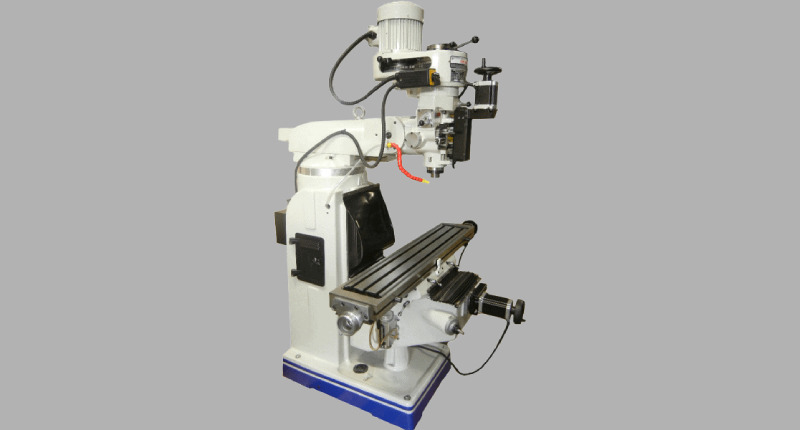
Knee milling machines are fundamental to many engineering and fab shop floors. To appreciate their usefulness, first define them by their unique Z-axis architecture. Unlike a bed mill where the head travels over a fixed bed, a knee mill is a vertical mill where the workpiece table is attached to a large cast iron knee.
The knee moves up and down along a column, exposing the X-axis (left/right), Y-axis (forward/back) from the horizontal table on top of the knee, and the spindle with the cutting tool hanging down from above. The spindle is held in a quill that can move up and down independent of the knee mill’s Z-axis. The knee is the primary vertical adjustment, but the quill carries out the detailed vertical motion of the cutting tooling. This mechanical layout gives knee milling machines a flexible working envelope for manual machining.
How Do Knee Mills Work?
The workpiece is secured on the table, the tool is selected, and the feed rates are physically controlled. What makes knee mills unusual is this separation of vertical movement.
- Coarse Adjustment: The cast iron knee controls coarse Z-axis travel (often 16 inches) for different part heights.
- Fine Adjustment: The quill is used for active cutting and drilling once the workpiece is locked in a position (usually 5 inches of independent quill travel).
This offers great flexibility as a separation of functions. When drilling tiny holes in hardened tool steel, direct tactile feedback can be valuable, since it helps the operator feel cutting action and avoid breaking delicate tooling. Having a manual quill lets the operator feel cutting action and make small feed adjustments as needed.
Flexing even further, the movable ram can be extended horizontally to project the spindle head over oblong or otherwise difficult part shapes. Taller workpieces can also use riser blocks to raise spindle height within the existing footprint.
What Are the Right Use Cases for Knee Mills?
The biggest value prop for manual milling machines is their fast "time-to-first-part" by eschewing programming setup time needed by CNC equipment. This makes knee mills the default choice for rapid prototyping, repair orders, or otherwise small-batch and opportunistic work that is time-sensitive.
For repair, maintenance, and toolroom work in critical infrastructure industries (oil/gas, defense, aerospace, etc.), skilled operators may need to modify valves or otherwise repair equipment in the field. They can chuck up a part, make depth adjustments by hand by feel, and start cutting with no requirements for CAD modeling, simulation, or prep. That makes this machine extremely effective in toolrooms for squaring blocks, chamfering edges, or drilling one hole.
Generalist shops can also use knee milling machines for great versatility in the everyday scenarios.
For instance:
- Extraction: If a tiny bolt has been snapped off, center popped, and embedded inside a hardened component, using a small carbide end mill to carefully mill out the obstruction is a very controlled technique requiring the manual keystone needed by knee mill operators.
- Geometric Features: Creating hex shapes on the ends of round bars is easily accomplished with standard hex collet blocks as opposed to more complex rotary table setups.
- Hybrid Manufacturing: In hybrid additive manufacturing setups, the machines are used to add finishing touches because of the limitations of 3D printing and longer CNC setup and cycle times. The manual milling machine is retained for the finishing touches operators need so that the custom work is done right.
When Does the Knee Mill Make Sense Versus the Bed Mill?
The choice between knee milling machine and bed milling machine surfaces as a question of flexibility, footprint, and familiarity for the operator. The mechanical layout and flexibility of a knee mill make it ideal for job shops with frequent changeovers. Features like a movable ram mean that the spindle can project over oversized or ugly part shapes that would otherwise interfere with the stationary column of a bed mill.
These machines are also more appropriate for general smaller facility and mixed-use workshops, with lesser requirements/demands for dust extraction and climate control. These machines are often faster for one-off custom parts than heavier production equipment.
Knee milling machines are also the industry standard for vocational training there’s a greater chance that your operators will come pre-trained on other shops using these machines, and know where all the handles and dials are. Finally, purely mechanical machines like these knee mills provide some hedge against planned obsolescence of more complex CNC technology that becomes unsupported over 5-10 year time scales due to redundant electronics systems but consistent and useful heavy physical machine components.
When Might the Bed Mill or Other Machine Be Better?
Although knee mills are versatile, their geometric and structural appropriateness is limited. The bed mill benefits from having its table sitting on a strong casting, resulting in a machine that is typically heavier and more rigid than a comparable knee mill, yielding higher load capacities and rigidity.
For context, heavy-duty bed mills can support substantially heavier workpieces than most knee mills.
This is needed for heavier cutting and machining operations on higher hardness steels, where pushing a lighter machine results in vibration and chatter, degrading part accuracy and surface finish. It's not necessary to have a heavy 40-taper spindle on lighter machines, as high performance cutters often overpower the flexibility of machines.
Moreover, usage of CNC bed mills create perfect stable cutting conditions as consistent error rates of feed rates can be maintained across complex curves of multiple axes, leading to high quality and repeatability difficult to achieve manually.
What to Compare Before Buying Knee Milling Machines
Once knee mill style equipment is evaluated as being a fit to toolroom/engineer/maintenance requirements, the next step is to go into comparative specification. When looking at knee milling machines for your shop, there are a set of mechanical benchmarks to be considered and compared against needs.
- Table Size vs. Usable Travel: Having a large table doesn't necessarily translate to a large milling envelope; the actual X and Y travel limits define the operational area where the tool maintains accuracy.
- Spindle Taper Options: Evaluate standardized options where both the standard R8 taper (great value) and 40-taper (more rugged on appropriately sized machines) are available, but 40-taper is only applicable for machines with sufficient structural measures.
- Power Requirements: Machine power becomes relevant with 3-phase power requirements versus single phase.
- Upgrades: Consider power feeds on tables and conversational CNC controls to support manual machine control.
- Footprint: All of these come with sizing considerations for machine size, footprint, and operational space, where adequate floor space must be allowed for safe operation of the table and ram.
What Else Should Be in a Buying Guide?
Next step: matching the right machine for work. Your final equipment decision should be based on the volume/complexity tradeoffs fitting the usage of knee mills low volume and high variation where programming overhead is otherwise time consuming.
If your shop is all about rapid prototyping, hybridized on-the-fly additive machining, and keeping zero-programming setup times, this is essential. However, the right choice depends on your size requirements for part, production quantities, and flexibility needs. You might need heavier mass and automated control for larger batches, or when working with higher hardness materials with finished cycle times. Choose the right equipment based on the shop's most common bottleneck workflow.
Comments
0