


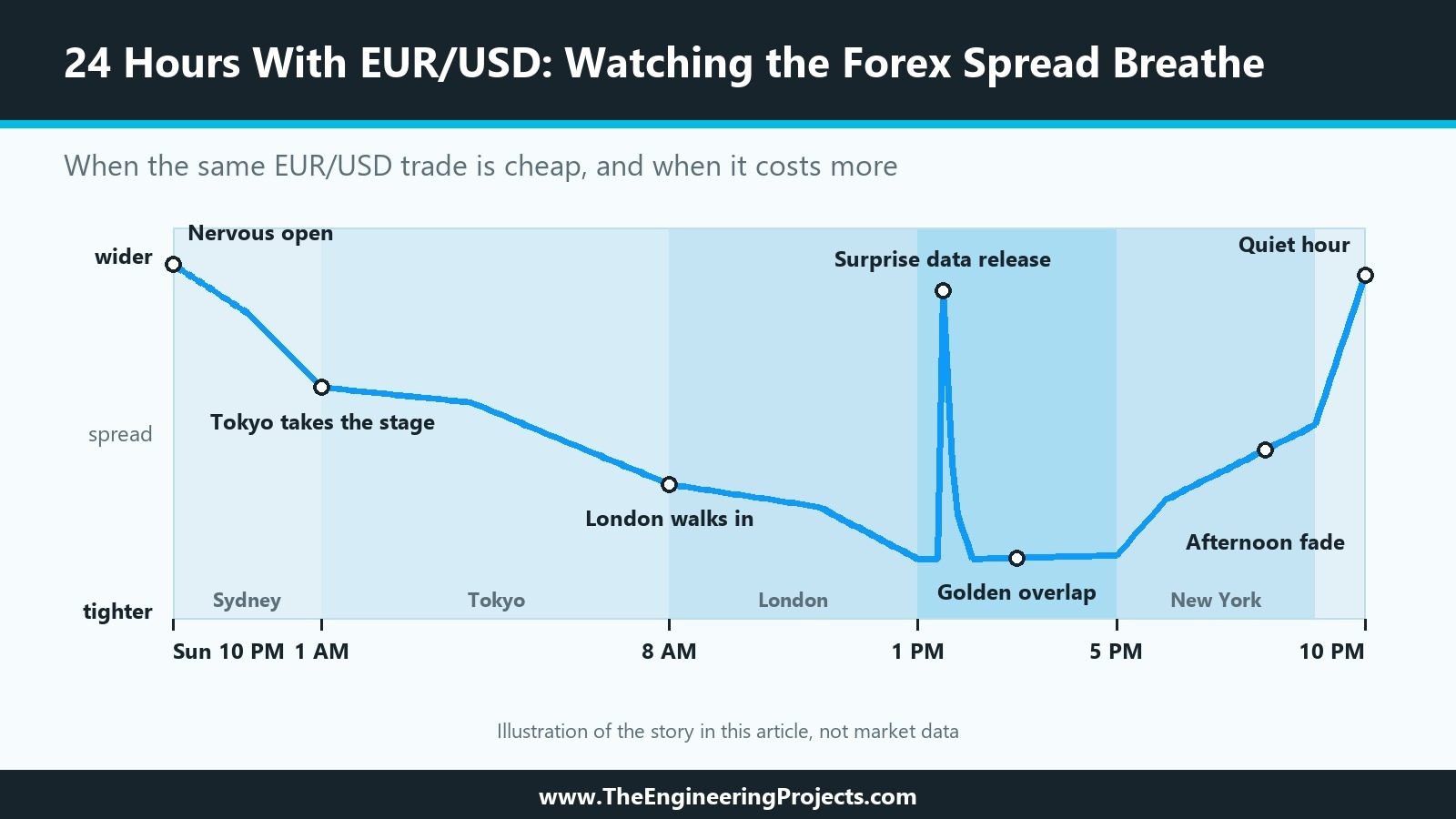
24 Hours With EUR/USD: Watching the Forex Spread Breathe


Most people think of the forex spread as a fixed number, like the price tag on a shirt. It's not. It's more like the price of a taxi: cheap and easy at noon, surprisingly expensive in a storm or at 3 a.m. when there are hardly any drivers around.
To really understand it, let's spend a whole day with the world's most traded currency pair, EUR/USD, and watch how its spread changes from hour to hour. All times below are in London time, and the spreads are illustrative, not quotes from any specific broker.
Sunday, 10 PM: The Nervous Open
The market reopens after the weekend. Banks in Sydney and Wellington are waking up, but most of the world is still asleep. Liquidity is thin. Prices may jump, or "gap," from where they closed on Friday.
The spread is at its widest of the week. Something that might cost a fraction of a pip on a busy afternoon could easily be several pips now. Many experienced traders simply watch.
If you're still getting comfortable with the basics of bid, ask and pips, this guide to the forex spread lays out the fundamentals clearly. Then come back and see how those fundamentals behave in real time.
Monday, 1 AM: Tokyo Takes the Stage
The Asian session is in full swing. Liquidity improves, especially in yen pairs. EUR/USD is active but not at its busiest. Spreads have narrowed from the Sunday open but aren't at their tightest.
Lesson: a pair's spread depends partly on whether the "home" markets for its currencies are open. Euro and dollar liquidity peaks later.
Monday, 8 AM: London Walks In
This is when things change. London is the biggest forex trading centre in the world. As banks and institutions come online, the flow of buy and sell orders surges. EUR/USD spreads tighten noticeably.
For many traders, this is the start of the "cheap" part of the day.
Monday, 1 PM to 5 PM: The Golden Overlap
New York opens while London is still active. This overlap is often the most liquid period of the entire trading day. More participants mean more competition to buy and sell, and more competition means tighter spreads.
If you're a short-term trader who cares about costs, these hours often offer the best conditions for major pairs.
Monday, 1:30 PM: A Surprise Data Release
Now imagine a major US economic figure is released and it's far from what analysts expected. For a few seconds, liquidity providers pull back, uncertain where the fair price is. The spread can suddenly widen several times over, then snap back within minutes.
Lesson: tight spreads during busy hours can still widen sharply around big news. If you trade right at the moment of an announcement, you may pay much more than you expected, and your order might fill at a worse price than you saw.
Monday, 6 PM to 9 PM: The Long Afternoon Fade
London goes home. New York is still open, but activity slowly drops. Spreads start creeping wider again.
Monday, 10 PM: The Quiet Hour
Around the daily rollover, when positions are carried into the next trading day, liquidity often thins considerably. Spreads can widen noticeably for a short window. Many brokers note this in their trading conditions.
Lesson: the late evening can be one of the most expensive times of day to open a trade, even on a major pair.
What This Means for Your Trading
Seeing the spread as something that breathes changes how you trade:
- Plan your trading hours. If you have flexibility, trading during the London–New York overlap often means lower costs.
- Mark big news events on your calendar. Decide in advance whether you'll trade through them or stay out.
- Avoid the rollover window unless you have a specific reason.
- Watch the live spread, not just the typical one advertised.
- Be extra careful with exotic pairs, whose spreads can swing even more dramatically.
The Same Trade, Different Prices
Here's the simplest way to think about it. A trade in EUR/USD at 2 PM on a calm Tuesday and the exact same trade at 10 PM on a Sunday are not the same trade. One is a cheap ride in a busy city. The other is a late-night taxi in the rain.
Once you understand how the forex spread moves through the day, you stop paying storm prices for sunny-day trades. And over months of trading, that awareness can make a real difference to your results.
Forex Trading Sessions at a Glance
Here is the day described above in one table. The times are London time, as in the rest of this article, and the spread conditions are the ones described above for EUR/USD.
| Time (London) | What is happening | EUR/USD spread |
|---|---|---|
| Sunday, 10 PM | The market reopens; Sydney and Wellington are waking up | Widest of the week; prices may gap |
| Monday, 1 AM | The Asian session, led by Tokyo | Narrower, but not yet at its tightest |
| Monday, 8 AM | London opens | Tightens noticeably |
| 1 PM to 5 PM | London and New York are both open | Usually the tightest of the day |
| Around big news | A major economic figure is released | Can widen several times over for a short time |
| 6 PM to 9 PM | London has closed and New York slows down | Creeping wider again |
| Around 10 PM | The daily rollover | Can widen noticeably for a short window |
Frequently Asked Questions About the Forex Spread
What is the forex spread?
The spread is the difference between the bid price, at which you can sell a currency pair, and the ask price, at which you can buy it. It is usually measured in pips. For EUR/USD, one pip is a change of 0.0001 in the price, so a quote of 1.1000 bid and 1.1001 ask has a spread of one pip.
Why is the spread tighter when more markets are open?
More banks, institutions and traders are buying and selling at the same time. With more orders on both sides, buyers and sellers are matched more easily, and the gap between the best buying price and the best selling price becomes smaller.
Do the session times change during the year?
Yes, by an hour at a time. The UK and the US move their clocks on different dates in spring and autumn, so for a few weeks each year New York opens one hour earlier in London time. Japan does not use daylight saving time, so the Tokyo session also moves by an hour in London time when the UK clocks change.
Is the spread the only cost of a trade?
No. Depending on the account, a trade can also carry a commission, and a position held past the daily rollover may be charged or credited an overnight swap. The spread, however, is paid on every trade, which is why its changes through the day matter so much.
Comments
0