In the modern world, the lines between disciplines are increasingly blurred. One of the most fascinating intersections is that between engineering and marketing. Traditionally seen as separate fields—engineering focused on building and designing, and marketing centered on promoting and selling—these two areas are now more intertwined than ever. The rise of digital technologies and the demand for innovative products have brought engineering and marketing into close collaboration, creating new opportunities for businesses to thrive. Marketing has always been about understanding the customer and delivering value. However, the tools and methods used in marketing have dramatically changed over the past few decades. The digital revolution has introduced new channels, platforms, and technologies that have fundamentally transformed the way companies reach their audiences. Engineering plays a crucial role in this process. Data engineers and analysts work together to develop systems that can capture and process this data in real-time. For example, e-commerce platforms like Amazon use complex algorithms to analyze customer data and recommend products that a user is likely to purchase. This kind of personalized marketing would not be possible without the sophisticated engineering that underpins these systems. Engineers are at the forefront of developing these technologies. For instance, machine learning engineers are creating algorithms that can predict customer behavior based on past ...
Have you ever gazed in awe at a towering skyscraper, a sports car, or a crafted medical device and wondered, "How was that created?" The answer often lies in one factor; accuracy. Accuracy in engineering isn't a term; it's the essential element that transforms a great concept into an exceptional reality. At the core of this accuracy is metal fabrication—a routine process that is indispensable for bringing engineering marvels to life. Let's be honest within the realm of engineering even the smallest error can lead to issues. Picture a bridge that is just slightly miscalculated. It's quite unsettling, isn't it? This is why accuracy is so critical. It's not about getting things it's about getting them precisely right. Accuracy ensures that everything fits seamlessly operates perfectly and, above all else endures the test of time. You might be pondering now "How does metal fabrication contribute to all this?" To put it simply metal fabrication is the process that breathes life into those engineering blueprints. Cutting, bending, and welding are just a few of the processes that custom metal fabrication services include, and each one requires an extraordinary degree of precision to guarantee that the finished product will meet every specification. Without this precision, the remarkable engineering achievements we admire would not be achievable. Consider the Golden Gate Bridge as an illustration. It is not just a marvel of architecture; it is a testament to engineering made possible ...
In mathematics, antilogarithms (or antilogs) are a fundamental concept that often comes across in scientific calculations, engineering, and various applied fields. Understanding how to calculate antilogarithms is important for anyone working with logarithms or exponential functions. This article aims to guide you through the process of calculating antilogarithms step-by-step, ensuring a clear and comprehensive understanding of the concept. The antilogarithm commonly called antilog, is the mathematical operation that undoes the logarithm. It's a fine function that helps us find the original value from a given logarithmic value. In simpler terms, the antilog allows us to determine the actual number when we only have the logarithm of that number. The formula: Antilog(x) = b x. Here, 'x' represents the logarithmic value, and ‘b’ represents the base. Understanding the parts of the logarithm mantissa and its characteristics is important to find the antilog of a number. Let's explore each part: When finding the antilogarithm, separate the characteristic and mantissa parts. Steps: To calculate the antilogarithm, follow these steps: 1. If the characteristic is positive: 2. If the characteristic is negative: Manual calculation of antilogarithms can be time-consuming and prone to errors. To simplify the process, consider using Antilog Calculator by Allmath. This tool is useful for anyone dealing with complex logarithmic data. Enter your logarithm value and base in the provided box and ...
Vacuum casting is the key technique for plastic or rubber part fabrication using a vacuum and stands out as a premier method for small batches of polyurethane products. This method is particularly valuable for the creation of samples of products so the manufacturer can assess the trend, market response, customer feedback, and product performance before working on full-scale production. Injection molding is another technique used for plastic model manufacturing, but vacuum casting is cost-effective and most suitable for small production. This article will shed light on the vacuum casting introduction, its working principles, pros and cons. Let’s discuss each point in detail. Vacuum casting, also termed polyurethane casting or urethane casting, is the process of creating plastic or rubber models utilizing silicon molds under vacuumed conditions. Here, the vacuum is primarily used to get the intricate parts, while the vacuum is used to eliminate any air bubbles and improve the material flow from the mold. This is particularly useful for small- to medium-sized production and results in rapid and clean prototyping. This process deserves consideration when choosing the plastic or rubber parts for easy prototyping. Unlike the traditional molding technique, which the metal molds, vacuum casting utilizes plastic or silicon molds that are lower in cost and can be molded in a short amount of time. The use of a vacuum is a game changer here because it is helpful to get the perfect mold ...
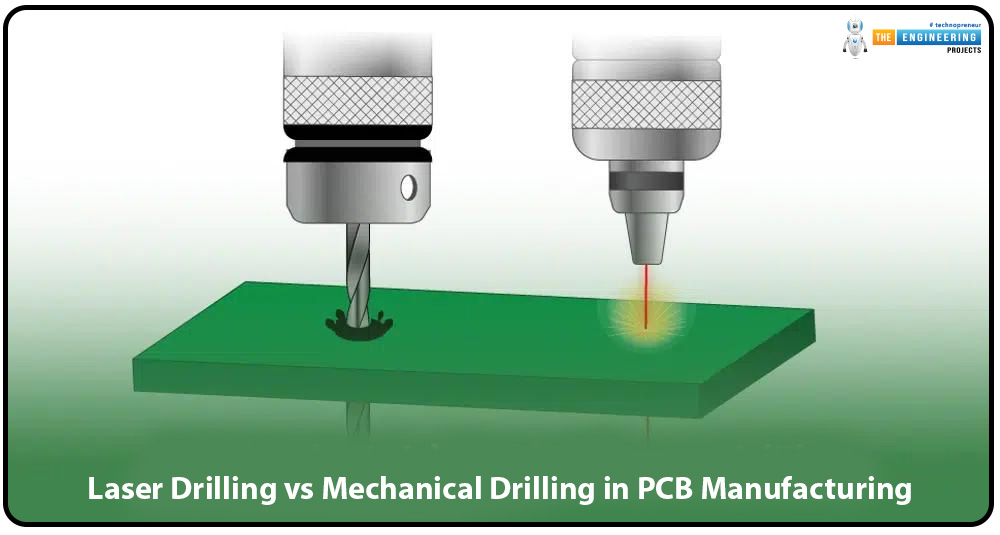
The printed circuit board (PCB) is the backbone of electronic circuits, and for complex circuits, multi-layer PCBs are utilized to enhance productivity. PCB drilling is a crucial process, especially in multilayer PCB production, and involves precise via creation through laminate material. We know that vias are important conduits that bridge the gaps between multiple layers of PCBs. These are considered the conductive connections in a PCB, especially if it has multiple layers. Without vias, the multilayer PCBs have limited design flexibility and are impractical. In PCB manufacturing, there are multiple drilling types, but today I am going to discuss the comparison between the two most important methods, i.e. mechanical drilling and laser drilling. The appropriate drilling technique selection ensures the right hole placement, optimal hole quality and reliable performance. Lasers and mechanical drilling have their own merits and demerits. Drilling is a sensitive process, and even a small mistake can damage the PCB if the manufacturer does not keep the required measures in mind. Multiple factors affect the best choice between the two but choosing the best PCB platform can make this task easy. PCBx Fabrication House is the leading platform that provides high-quality, low-priced PCBs and turnkey assembly services. PCBx offers all types of PCBs and has the prestige of presenting a seamless solution for laser drilling or mechanical drilling in PCBs. Drilling is a delicate process in ...
Hello everyone, I hope you all are doing well. In today’s tutorial, we are going to discuss the PCB Etching process, a fundamental step in PCB manufacturing. The PCB Etching process is used to remove the unwanted copper from the PCB surface to reveal the desired circuit pattern. As we know, a PCB board has a complete copper layer in its raw form. We design our circuit in the software(i.e. Eagle, Altium, Proteus etc.) and place the pattern on the PCB board. This circuit pattern is normally protected by the tin plating, as shown in the below figure: Now, there’s a need to remove the extra/unwanted copper layer from the PCB board and this process is called the PCB Etching Process. PCB Etching is carried out in various ways and the most commonly used is the Chemical Etching Process, where a chemical named Ferric Chloride is used to remove the copper. A completely Etched PCB is shown in the below figure: Finally, we can remove the tin layer, polish the leftover copper layer (of our circuit), drill the holes and our PCB is ready for component placing & soldering. PCBway is the leading PCB manufacturing platform that offers all PCB services, from fabrication to assembly, in mass production with instant quotes. We ensure a smooth order process and one-on-one assistance for all your PCB manufacturing services, with the best value in direct pricing. We use modern technology and processes for PCB etching; therefore, we provide a wide range of etching techniques, including laser etching, ...
Welcome to the next tutorial of our Raspberry Pi programming tutorial. The previous tutorial showed us how to Interface weight sensor HX711 with pi 4. We learned that a weight sensor HX711 and load cell could be easily interfaced with a Raspberry Pi 4 with careful attention to wiring and software configuration. However, now we're one step ahead of that by using the Internet as the wireless medium to transmit the message from a Web browser to an LCD screen attached to a Raspberry Pi. This project will be added to our collection of Internet of Things (IoT) projects because messages can be sent from any Internet-connected device, such as a computer, smartphone, or tablet. A bulletin board serves as a vital means of communicating and collecting information. Notice boards are common at many public and private establishments, including schools, universities, train and bus stations, retail centers, and workplaces. You can use a notice board to get the public's attention, promote an upcoming event, announce a change in schedule, etc. A dedicated staff member is needed to pin up the notices. It will take time and effort to fix the problem. Paper is the primary medium of communication in traditional analog notice boards. There is a limitless amount of data available to use. As a result, a lot of paper is consumed to show off those seemingly endless numbers. We set up a local web server for this demonstration for the Web Controlled Notice Board, but this could be an Internet-accessible ...
Hi friends, I hope you are all well. In this article, we can discuss the scalar or dot products of the vectors. In previous articles, we have discussed vectors and their addition in the rectangular or cartesian coordinate system in depth. Now we can talk about the scalar product of two vectors, also known as the dot product. Scalar or dot products can play an essential role in solving the operation of vector algebra and also they have various applications in numerous fields like computer sciences, mathematics, engineering, and physics. By doing the scalar or dot products, two vectors are combined when we can do their product, then they produce the scalar quantity which has both magnitude and direction by a single operation in a very efficient way. Simply the scalar and the dot product are algebraic operations that can be especially used in physics and mathematics. scalar quantity can only provide the magnitude but when we can do the product of two vectors, the result of this product is scalar quantity which provides and describes both magnitude and direction. The angle between the two vectors can also be found through the scalar or dot product. The dot product term can be derived from the word dot operator and it can be used for the product of two vectors but it can also known as a scalar product because it can always give the result as a scalar quantity so that is why it can also be known as scalar product rather than the vector product. Now we can start our detailed ...
Welcome to the next tutorial in our Raspberry Pi 4 programming tutorial. In the previous tutorial, we learned the basics of using a Raspberry Pi as the basis for an Internet of Things-based weather station. However, this is a continuation of the previous tutorial. In the subsequent session, we will learn how to develop the Python code that will bring our weather station circuit design to life. Before that, let us learn how to measure wind direction and rainfall. Despite their name, wind vanes do not indicate a change in wind direction. Since the arrow on most television weather maps goes in the opposite direction, this may come as a surprise at first. To determine the wind's direction, a wind vane uses the force of the wind on a vertical blade, which then spins to the point of least wind resistance. The wind vane employed here is more sophisticated than the rain gauge and operates entirely differently, although sharing some of the same components. You may find eight reed switches, resembling the spokes of a wheel, within the recommended wind vane. In addition to the magnet, the wind vane has eight resistors, and each is turned on and off by the opening and closing of a matching reed switch as the magnet rotates. In electronics, these components slow down the passage of electricity without completely blocking it. Different resistors have varying resistance levels, measured in ohms; low resistance resistors allow nearly all current to pass through, whereas high resistance ...
Hi friends, I hope you are all well and doing good in your fields. Today we can discuss the vector quantities and how we can add the vector by rectangular components. Generally, there are two quantities one is scalar quantities and the other is vector quantity. Scalar quantities are those quantities that have only magnitude but vector quantities are those that can describe both magnitude and direction. So in physics or for complex quantities vectors are used because they can describe both magnitudes with direction. Vectors can play a very fundamental role in the different fields of physics and mathematics because they can provide accurate and precise measurements. In rectangular components, we can add two or more vectors by breaking them according to their planes. The most efficient method for adding the vectors is adding vectors in rectangular components. Now in this article, we can start our detailed discussion about the vectors and their addition by the method of the rectangular component. Vectors can be defined as quantities that can describe both magnitude and direction but they can't provide a description about the position of a quantity. Vectors can be used to describe complex physical quantities like velocity, displacement, and acceleration. Vectors can also used to express the mathematical form of laws and in geometry firstly vectors are used. Some more examples of the vector quantities are given there. Vectors which may be two or more two can be added by rectangular ...