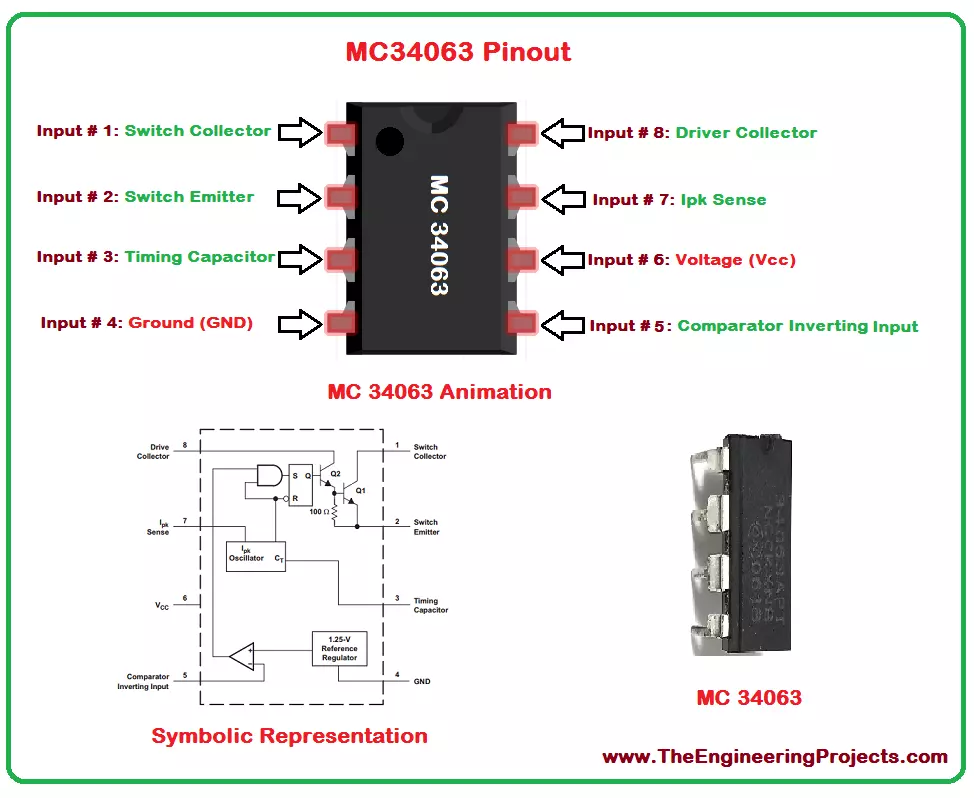
Hello everyone! I hope you all will be absolutely fine and having fun. Today, I am going to share a detailed Introduction to MC34063. It's normally required for the construction of DC to DC converters. MC34063 has a high current output switch, Pulse Width Modulation (PWM) controller with current limiting, compensated reference of internal temperature, a comparator and a driver.
For the inverting, boost and buck applications there is no need of a huge complicated external components, instead they can be performed using minimum external components. MC 34063 operates properly in the temperature ranging from 0 to 70 degree celsius. MC34063 ha s wide range of applications in real life e.g. portable equipment, Human Machine Interface (HMI), test and m ...
Hello everyone! I hope you all will be absolutely fine and having fun. Today, I am going to explain you about Introduction to LM386. Its a power amplifier specially designed for low voltage consuming applications. The gain of LM 386 is set around 20 internally. But the gain could be increased due to the insertion of external resistor and capacitor between the pin number 1 and 8. The gain could increase to any value from 20 to 200.
The LM-386 inputs are ground referenced. The output are biased to the half of the input voltage levels automatically. When LM 386 operates on 6V, its quiescent power drain is around 24mW. This property of LM-386 makes it ideal for the battery operation. Its major features include battery operation, minimum external p ...
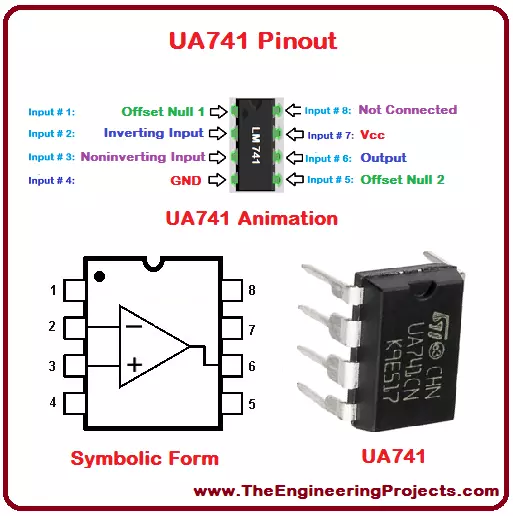
Hello everyone! I hope you all will be fine and having fun. Today, I am going to give you an elaboration on Introduction to UA741. UA 741 is basically a general purpose operational amplifier. This amplifier is considered to be ideal for the voltage follower applications because latch-up operations are no there in its case and it moreover it has High Common Mode Input Voltage Range (HCMIVR). UA-741 is a high performance operational amplifier made up of single silicon chip.
UA 741 is stable without using external components, due to the internal frequency compensation and this device is safe from the short circuiting. In order to cancel the effect of offset voltages we can use a small valued potentiometer/resistor. UA-741 can operate in a temperat ...
Hello everyone! I hope you all will be absolutely fine and having fun. Today, I am going to share my knowledge about Introduction to NE555. NE 555 is a precise timing circuit device. It can produce the precise time delays and oscillations. The time interval can be controlled by external resistor and capacitor when NE-555 operates in mono stable mode.Whereas in adjustable mode two external resistors and one capacitor controls the duty cycle and frequency.
NE555 is an Integrated Circuit (IC/Chip) which can be used in different types of timers. The output circuit is capable of bearing current up to 200mA. NE-555 timer works on voltage ranging from 5V to 15V. The output level have compatibility at 5V supply. NE 555 timer can be used in oscillator a ...