Hello, Students here I am present to cover an article on a series of Electronic devices and circuit theory. The foremost article of this series is Ideal diode vs practical diode. I try to elaborate on basic to modern theory related to the diode. This component act as fundamental to many important circuit devices such as rectifiers, transformers, etc. The question which we cover in this article are; What is a diode? How a diode is formed? Which methodology manufacturer utilized while the formation of the diode? What is the concept of doping and PN junction in diode theory? How does a Diode work? What type of biasing allows a diode to conduct? Under which situation of biasing diode offers a restriction while conducting? Upon which characteristics do we categorize the diode as an ideal diode ...
Hello Friends, I hope you’re well today. Today, we are going to start a new tutorial series on Semiconductors. In this series, we will discuss the semiconductor components, devices, etc. in detail. We will start from the very basics and will gradually move towards complex concepts. As today's our first tutorial in this series, we will discuss the basics of semiconductors. So, let's get started: What is a Semiconductor? A Semiconductor Material is defined by its ability to conduct electricity and its conductive properties lie between conductor and insulator, normally ranging between 10 -6 to 10 -4 (Ωm) -1 . Under specific conditions, Semiconductors have the ability to act either as a pure conductor or a pure insulator . Examples of Semiconductor materials are Silicon, Germanium, Gallium Ars ...
Hello friends, I hope you all are doing great. In today’s tutorial, we will discuss What is Bypass Diode. Bypass diode is used in photovoltaic modules. The main purpose of the diode in photovoltaic modules is to reduce the hot-spot (It is a heating phenomena that occurs when the photovoltaic cells are joined in a sequence and due to reverse current lot of power loss occur in the PV module) fact that is harmful to the photovoltaic cells and it can burn the cell if the light coming on the surface of the module is not distributed uniformly. For removal of the hot-spots, bypass diodes are connected with the substring of the photovoltaic devices the single bypass diode is connected twenty photovoltaic cells. Due to such arrangements, photovoltaic modules gives good efficiency during its operati ...
Hello friends, I hope you all are doing great. In today’s tutorial, we will have a look at What is Diode Clipper and how to use it in rectification circuits. In different circuits especially in rectifiers, the clipper is used to maintain the predefined voltage level. These circuits do not interrupt the original signal but only control the variation in the predefined value of the signal. These circuits eliminate the variation in the original waveform at the positive half and negative half. These circuits are created by the combination of linear components such as resistance and non-linear components like transistors and diodes. These clipping circuits are also known as the slicers. In today's post, we will also have a look at such circuits that are consists of diodes, their uses and their w ...
Hello friends, I hope you all are doing great. In today’s tutorial, we will discuss What is the Power Diode. The diode is a commonly used module in electrical and electronic engineering. Almost in every electronic device and engineering project diodes are used. It is a PN junction device that has 2 terminals, anode and cathode. The main function of the diode is to convert the alternating current into the direct current, this feature of the diode is called rectification. When it works on the positive cycle of the alternating current its state named as forward biased when it works on the negative cycle of the ac its operating state known as reverse biased. In 1906 the first diode was manufactured by the crystals of the minerals. Power diode is identical to the other semiconductor diodes but ...
Hello friends, I hope you all are doing great. In our previous lectures, we have studied two types of diodes i.e. Basic PN diode and Schottky Diode. Today, we will discuss the third type of diode i.e. Zener Diode . Zener Diode was invented by the American engineer Clarance Melvin Zener , so it's named after him. The specialty of the Zener diode is that it can operate in both forward-biased and reversed-biased directions. In today's post, we will have a look at its working, features, ratings, construction and applications. So let's get started with what is the Zener Diode. What is Zener Diode? The Zener diode is a special diode, that enables the current to flow not only from the positive terminal (anode) to the negative terminal (cathode) but also in the opposite direction. The doping of th ...
Hello friends, I hope you all are doing great. In our previous lecture, we studied the Basic PN Diode in detail and today, we will discuss a special type of diode called Schottky Diode . This diode was designed by the German physicist Walter H. Schottky, so it's named after him, thus called Schottky. This diode is mostly used in radio frequency (RF) circuits or in power supplies. So let's get started with the basics of Schottky Diode: Schottky Diode Schottky Diode (also called Schottky Barrier Diode or Hot Carrier Diodes ), discovered by German physicist Walter H. Schottky , is a special type of diode in which the P-layer(of PN junction) is replaced by the metal layer(i.e. Aluminium, Tungsten, Molybdenum, Platinum, Chromium etc.), while the N layer is of silicon(semiconductor - same as in ...
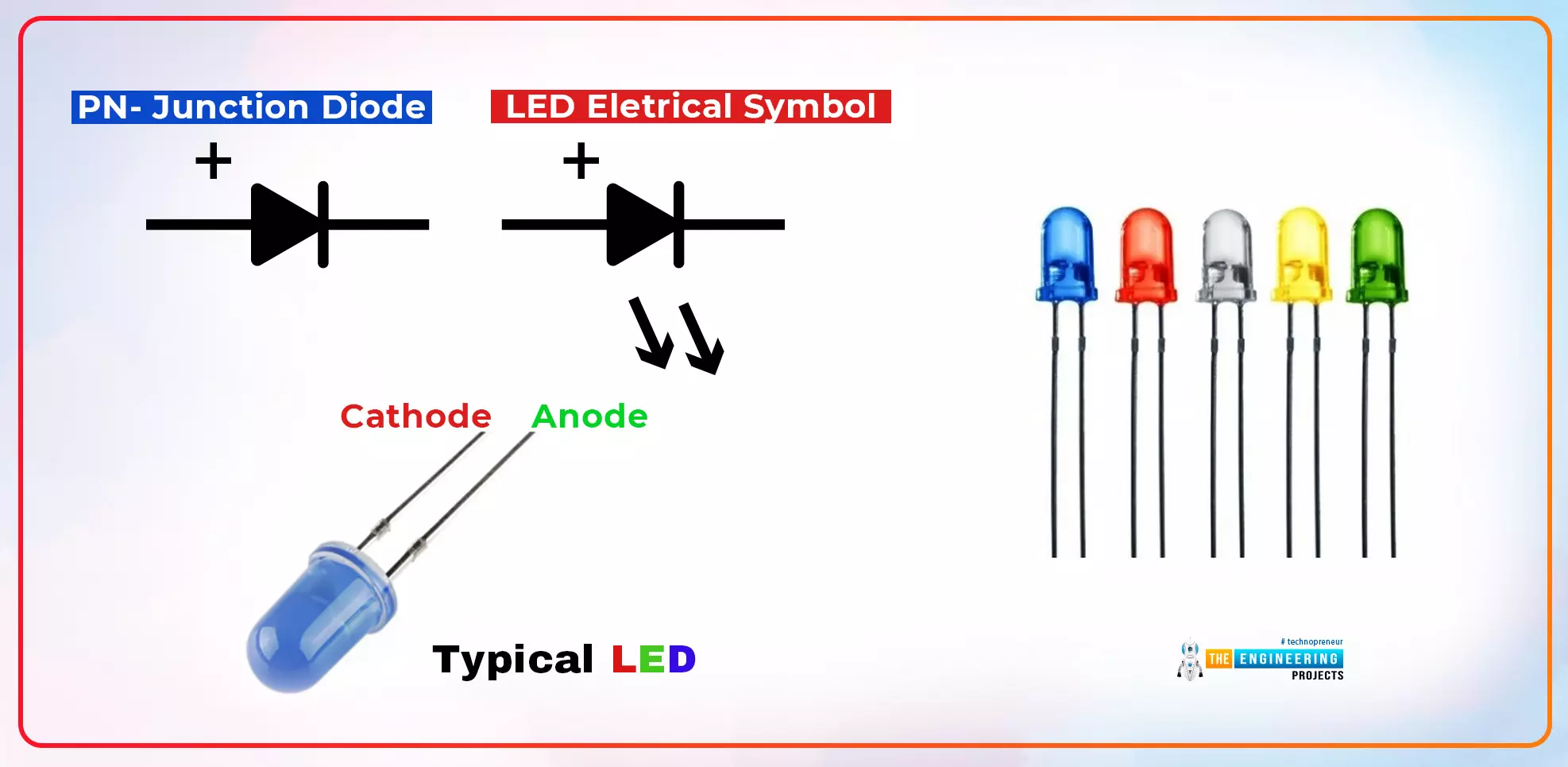
Hi Friends! Hope you are doing well. I always feel pleasure to keep you updated with information related to engineering and technology. Today, I'll unlock the detailed Introduction to LED . The LED stands for Light-emitting diode. LED is a PN-junction diode mainly used as the source of light. The LED has a leg over common orthodox incandescent light in terms of efficiency, low consumption power, compact size, longer range and an ability to retain the quality for a longer period of time. It comes with a wide variety of applications ranging from automotive headlamps, camera flashes, aviation lighting, traffic signal, and medical devices. In this post, I'll try to cover each and everything related to LED, so you don't need to wrestle your mind browsing the whole internet and find all the info ...