


Project Files of Planetary Gear Motor Library for Proteus Simulation
 Libraries
 Code
 Projects
 Simulation
planetary-gear-motor-tep-v1-0-29287fb1ac284bc0b15c105fbeedc6e7.zip
Planetary Gear Motor Library for Proteus V1.0
Planetary Gear Motor Library for Proteus V1.0 comes as a ZIP archive of 10 files (1.2 MB, 2.6 MB unpacked) holding Proteus library files, simulation model DLLs, a Proteus simulation, an Arduino sketch and compiled HEX firmware.
- LIBProteus library
- DLLProteus model
- DSNProteus simulation
- INOArduino sketch
- HEXHEX firmware
Description
Planetary-Gear-Motor-Library-for-Proteus-v1.0.zip with the 36GP-555 planetary gear motor for Proteus simulation (the 555 motor, two planetary stages, back-driving, a winch; TEPPLANETARY.LIB and TEPPLANETARY.DLL), our Arduino UNO V4.0, the A3 BTS7960 winch demo with its sketch and a README.

File Structure
 File Structure
4.3 KB201.9 KB13 KB883.5 KB309 KB21.2 KB13.1 KB883.5 KB309 KB13.9 KBGallery12 images from the tutorialOpen the tutorial
 Gallery12 images from the tutorial
The circuit, the board and the results as they appear in Planetary Gear Motor Library for Proteus Simulation. Open an image for its full size.
README
 README
PLANETARY GEAR MOTOR LIBRARY FOR PROTEUS SIMULATION - V1.0 (a 36GP-555 winch with a pop-up)
Designed by The Engineering Projects
www.TheEngineeringProjects.com

IMPORTANT LINKS
Article (read it first - pictures, step by step, every feature explained):
  https://www.theengineeringprojects.com/2026/11/planetary-gear-motor-library-for-proteus.html
Report a bug or suggest a feature (our forum):
  https://www.theengineeringprojects.com/forum/category/motor-driver-proteus-library
The demo runs on our Arduino UNO V4.0 (included) - working LEDs, RESET and a
built-in serial monitor, no Virtual Terminal to wire - its own article:
  https://www.theengineeringprojects.com/2026/10/arduino-uno-library-for-proteus-v40.html
The demo drives the motor through our BTS7960 Motor Driver library (a SEPARATE library - install it too):
  https://www.theengineeringprojects.com/2026/10/bts7960-motor-driver-library-for-proteus-v1-0.html
Support us (the libraries are free):
  https://www.theengineeringprojects.com/donate

FILE STRUCTURE
Planetary-Gear-Motor-TEP-v1.0/
|-- Proteus Library Files/
|   |-- ArduinoV4TEP.LIB                              201.9 KB   TEP Arduino boards V4.0 (UNO) -> LIBRARY
|   |-- TEPPLANETARY.LIB                               13.0 KB   the library -> LIBRARY folder
|-- Proteus Model Files/
|   |-- TEPARDUINO.DLL                                883.5 KB   the Arduino board model -> MODELS folder
|   |-- TEPPLANETARY.DLL                              309.0 KB   the model -> MODELS folder
|-- Proteus Simulation/
|   |-- Planetary_Demo.hex                             13.1 KB   the demo firmware
|   |-- Planetary-Winch-BTS7960-ArduinoUnoV4.pdsprj    21.2 KB   the demo project
|   |-- TEPARDUINO.DLL                                883.5 KB   copy of the board model
|   |-- TEPPLANETARY.DLL                              309.0 KB   copy of the model
|-- Arduino Code/
|   |-- Planetary_Demo/Planetary_Demo.ino               4.3 KB   the demo sketch (source of the .hex)
|-- README.txt                                        ~15.2 KB   this file
Total: 2.59 MB (unzipped). The C++ source code of the models is not included.

WHAT IS IT?
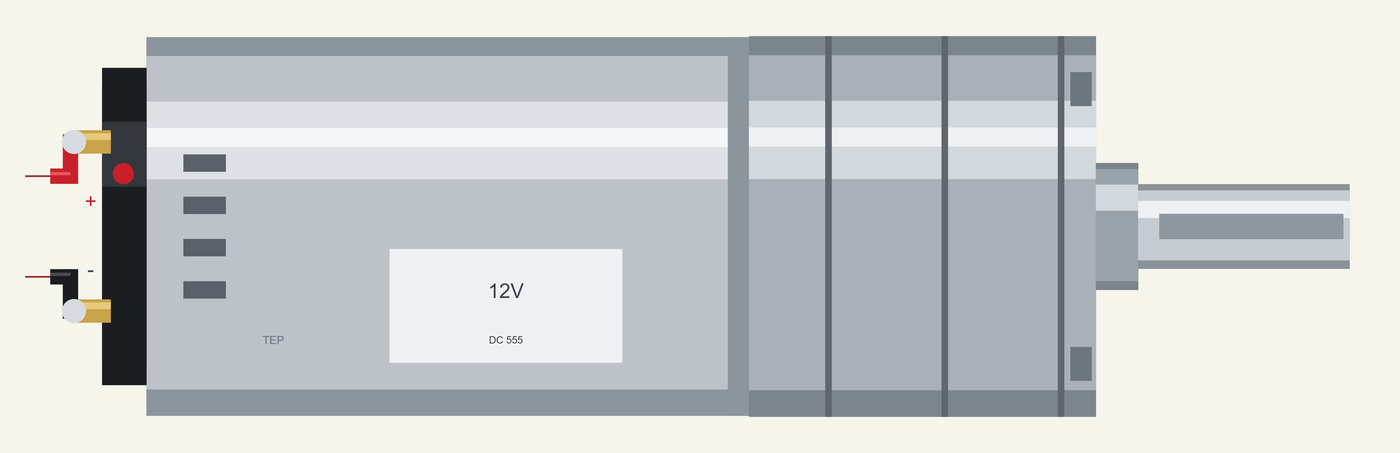
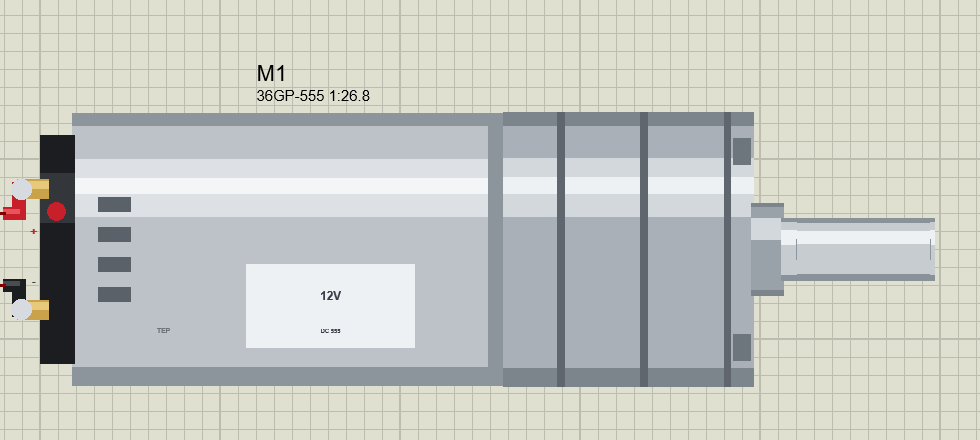
The 36 mm 12 V planetary gear motor 36GP-555 with a 1:26.8 gearbox - the motor of robot drives,
winches, actuators and lifting
mechanisms - drawn at true scale from the makers' sizes (a 36 x 32.8 mm two-stage gearbox, a 35.8 x
57 mm 555 motor, an 8 mm D-shaft,
118 mm long), our own drawing:
  * The model: the 555 motor (1.5 ohm, 18.6 mV.s/rad, a breakaway friction at rest), two planetary
    stages of 5.18 : 1 (sun 11, planets 17,
    ring 46 teeth), 65 % efficient when the motor drives the load and 55 % when the load drives the
    motor.
  * Modelled from the makers' table at 12 V: 224 RPM / 200 mA free, 170 RPM at 6 kg.cm and 2 A (10.5
    W) rated, 25 kg.cm at 8 A stalled.
    The model: 224 RPM / 200 mA free, 6 kg.cm at 172 RPM / 2.00 A, 25.7 kg.cm at 8 A.
  * A planetary gearbox is BACK-DRIVABLE: a heavy load turns the motor backwards when nothing holds
    it - the opposite of a worm gear. A
    light load is held by friction alone.
  * A winch on the shaft (a drum, a rope, a weight - properties or chips in the pop-up): lift, hold,
    lower, brake (the shorted motor only
    slows the weight down), coast (the weight falls), the top stop and the stall.
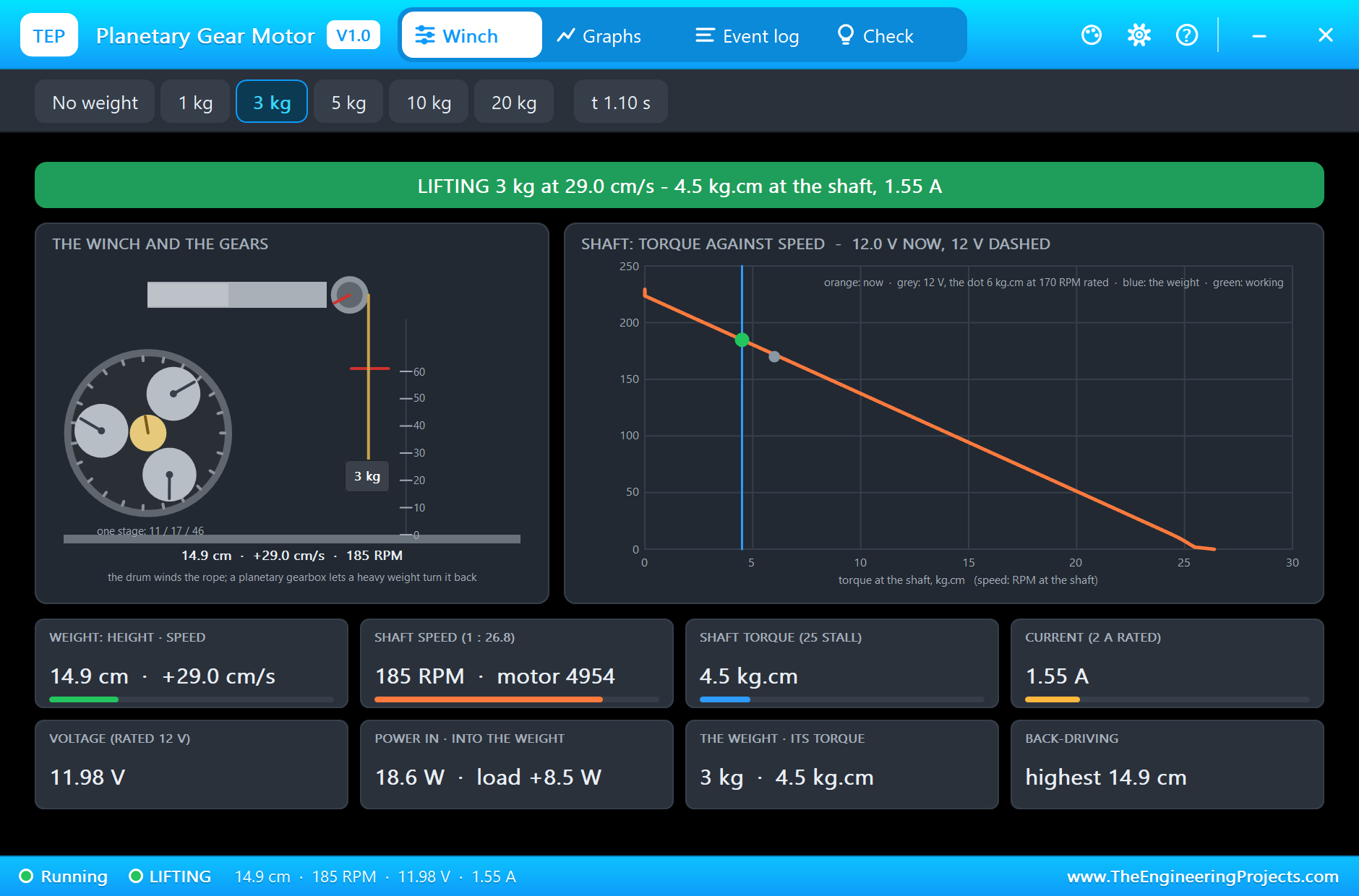
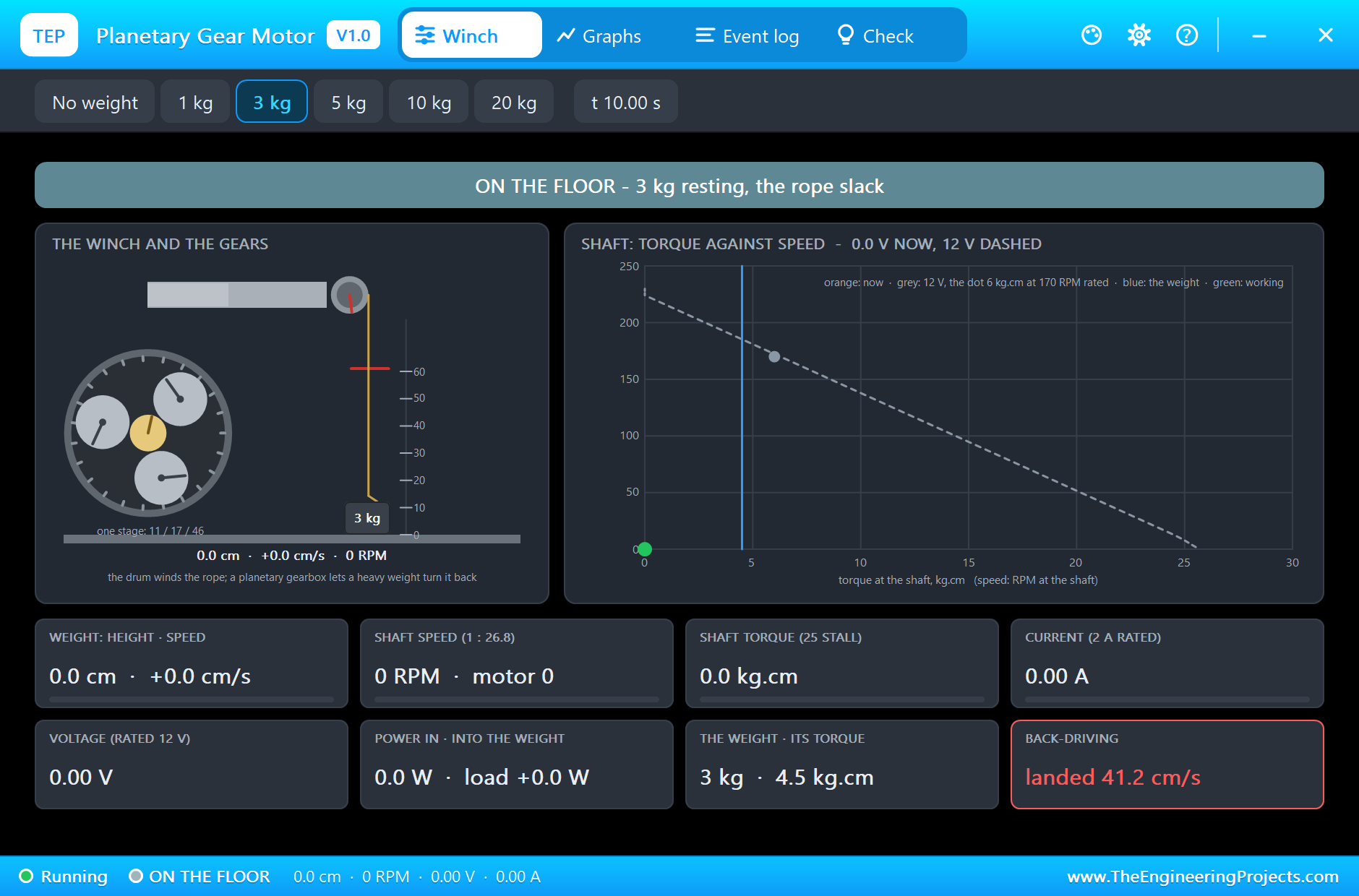
  * Click it at Run for the pop-up: the winch and one planetary stage turning, the shaft's
    torque-speed line with the rated point, the
    weight's torque and the working point, eight values, graphs, an event log and a check page.
The body is drawn as on the real part and to true scale against our Arduino.
The TEP signature and the pop-up are TEP additions.

ONE DEVICE (search "PLANETARY" in Pick Devices):
  PLANETARYGM36TEP  "Planetary Gear Motor 36GP-555 V1.0" in TEPPLANETARY.LIB (Electromechanical >
  Motors), prefix M, model
                    TEPPLANETARY.DLL (analog). Pins + (the red lead) and - (the black lead). The
                    name starts with PLANETARY so that it
                    sorts after the embedded ARDUINO UNO V4.0.
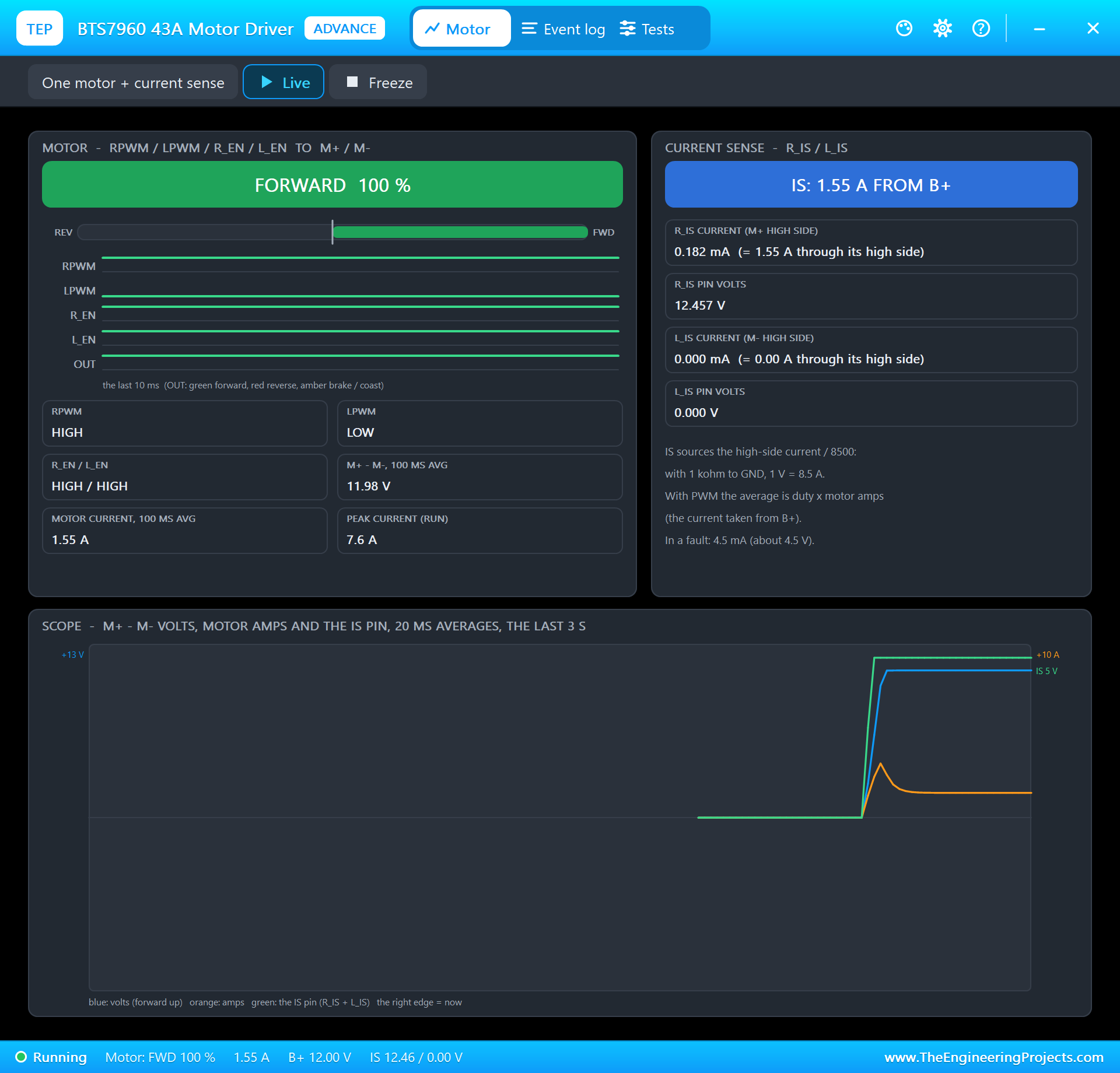
The demo's driver is our BTS7960 (BTS7960ADVTEP in TEPBTS7960.LIB / TEPBTS7960.DLL): a separate
library - install it from its own package.

THE POP-UP
Click the part at Run. The chips on top change the weight: No weight, 1, 3, 5, 10, 20 kg. Tabs:
    Winch      the gear motor, the drum, the rope and the weight above the floor with a height scale
    and the top pulley, one planetary
               stage turning (the sun on the motor, three planets, the fixed ring), the shaft's
               torque-speed line at the present voltage
               and at 12 V with the rated point, the weight's torque and the working point, and
               eight live values: height and rope speed,
               shaft and motor speed, shaft torque, current, voltage, power in and into the weight,
               the weight and its torque, back-driving.
    Graphs     the live values over the last 2, 6 or 15 s. Live / Freeze.
    Event log  every change and warning; filters All / Changes / Warnings, Pause, Clear
    Check      what the part is doing and what to look at, each with a verdict (green = fine, amber
    = check, red = wrong)
    Settings   theme, text size, open at Run, window size
    Help       report a bug, suggest a feature, article, updates, donate, forum; Copy diagnostics
    for a bug report

TEST STATUS
V1.0: verified in Proteus 8.5 on 8 Nov 2026 (the demo project as shipped: an A4 sheet, an Arduino UNO V4.0).
What the runs showed (the model's own numbers and the sketch's monitor):
  * The project loads and starts cleanly; the 21 s program runs in about five and a half minutes on
    our PC (with the pop-up open).
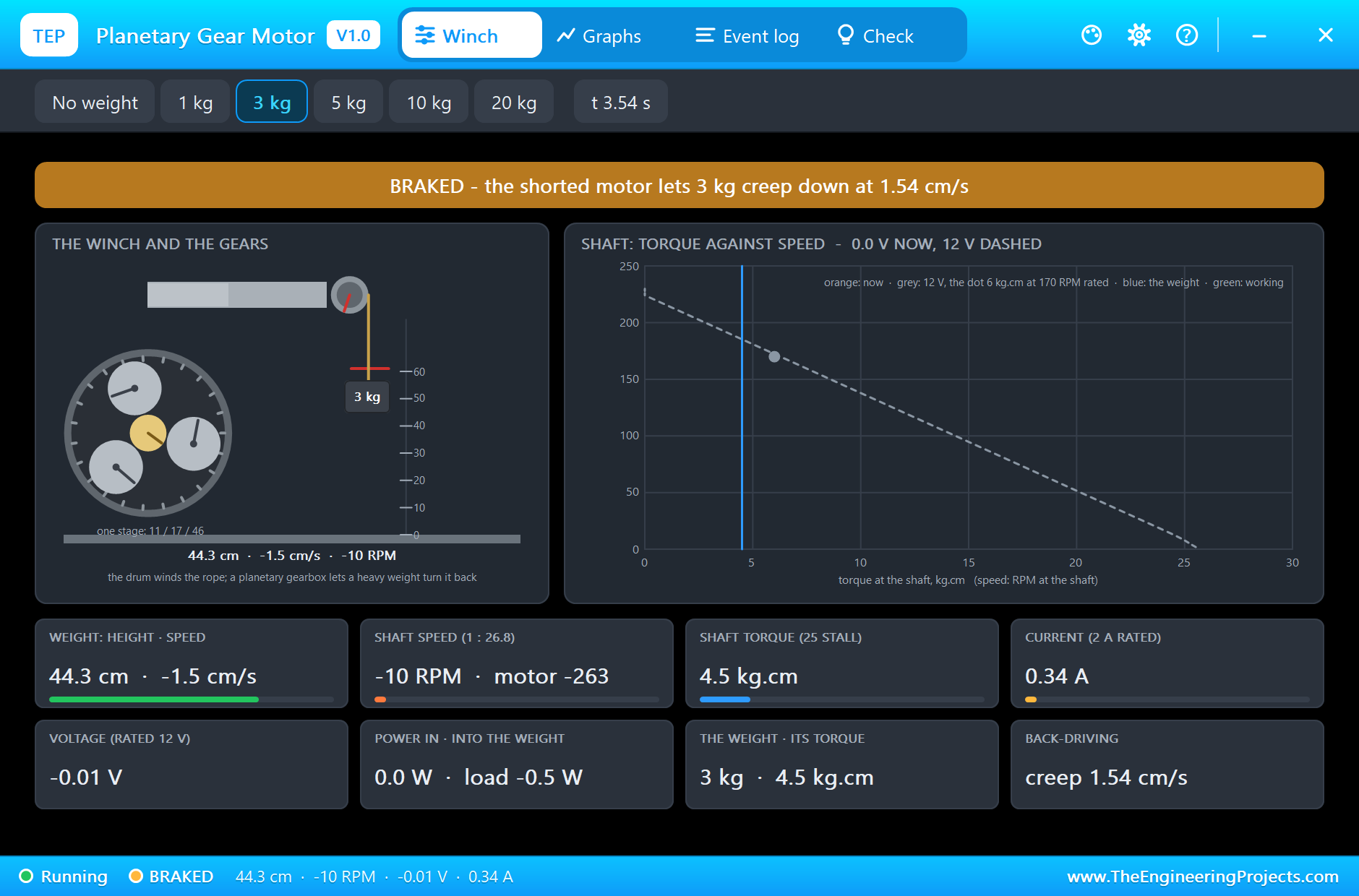
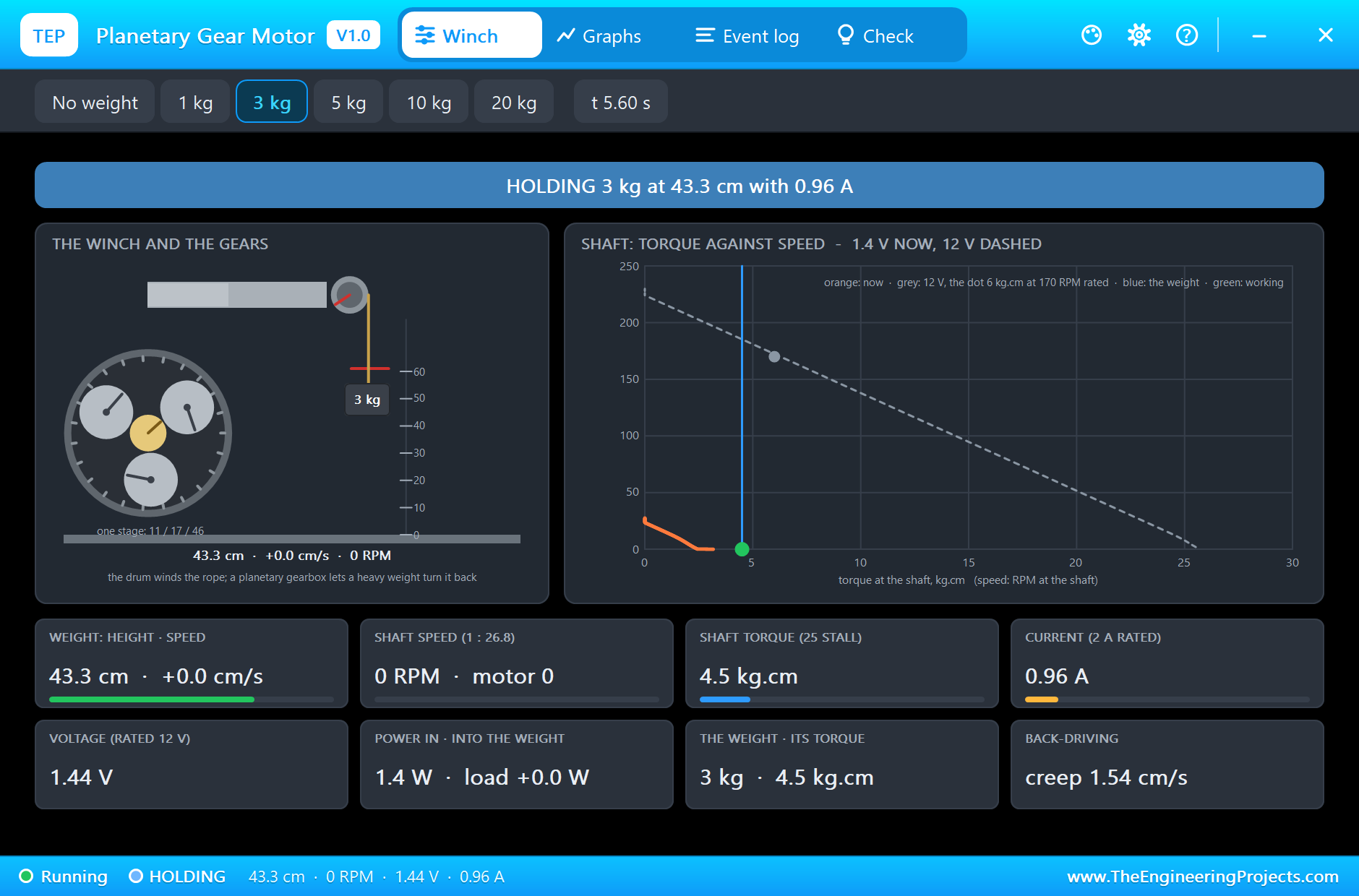
  * 3 kg on the 30 mm drum (4.5 kg.cm): lifted at 29.0 cm/s - 185 RPM at the shaft, 1.55 A at 12.0
    V. Braked (the motor shorted): it
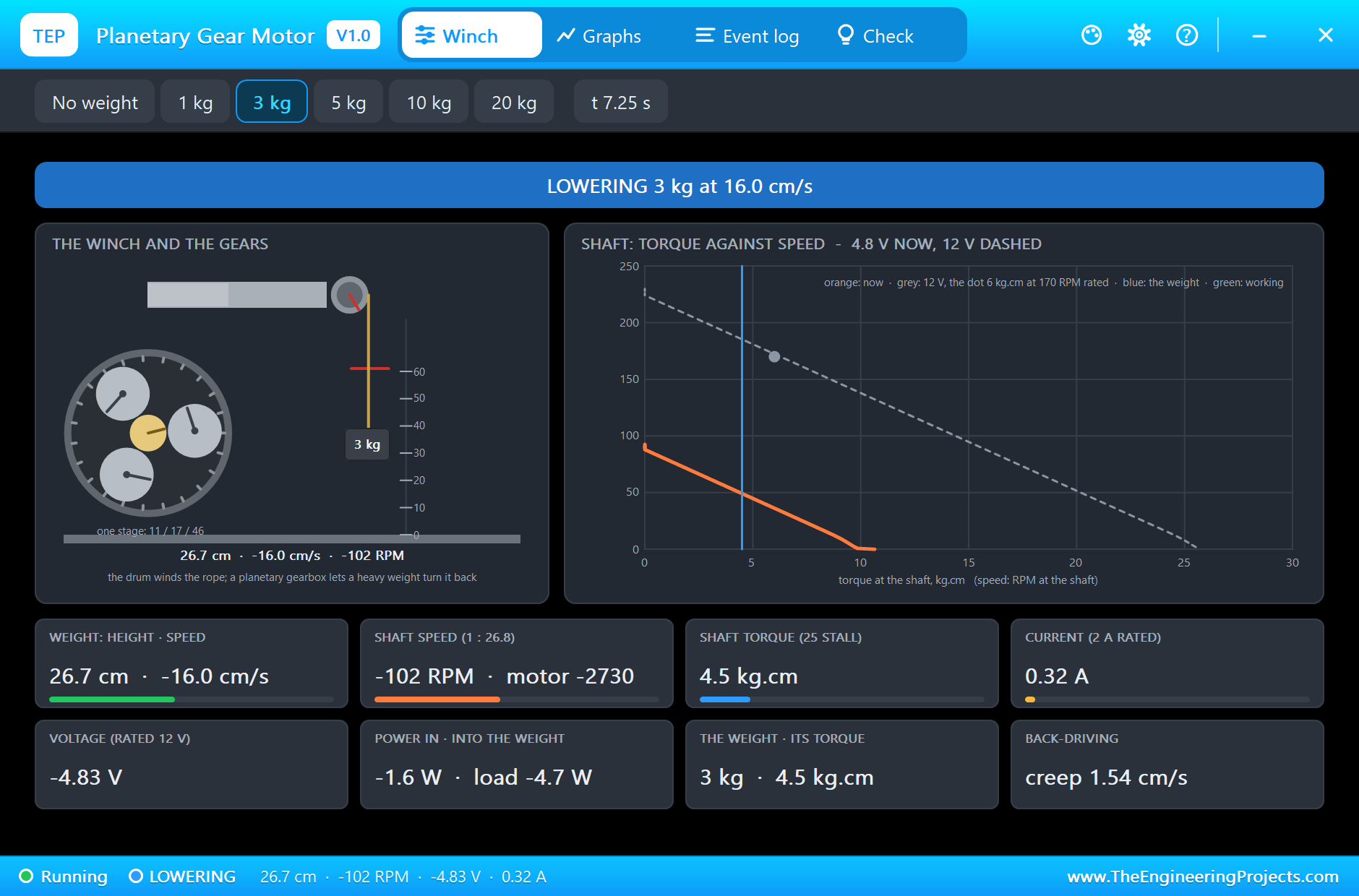
    creeps down at 1.54 cm/s with 0.34 A generated. Held with 12 % PWM (1.44 V): still at 43.3 cm
    with 0.96 A. Lowered at 40 %: 16.0 cm/s
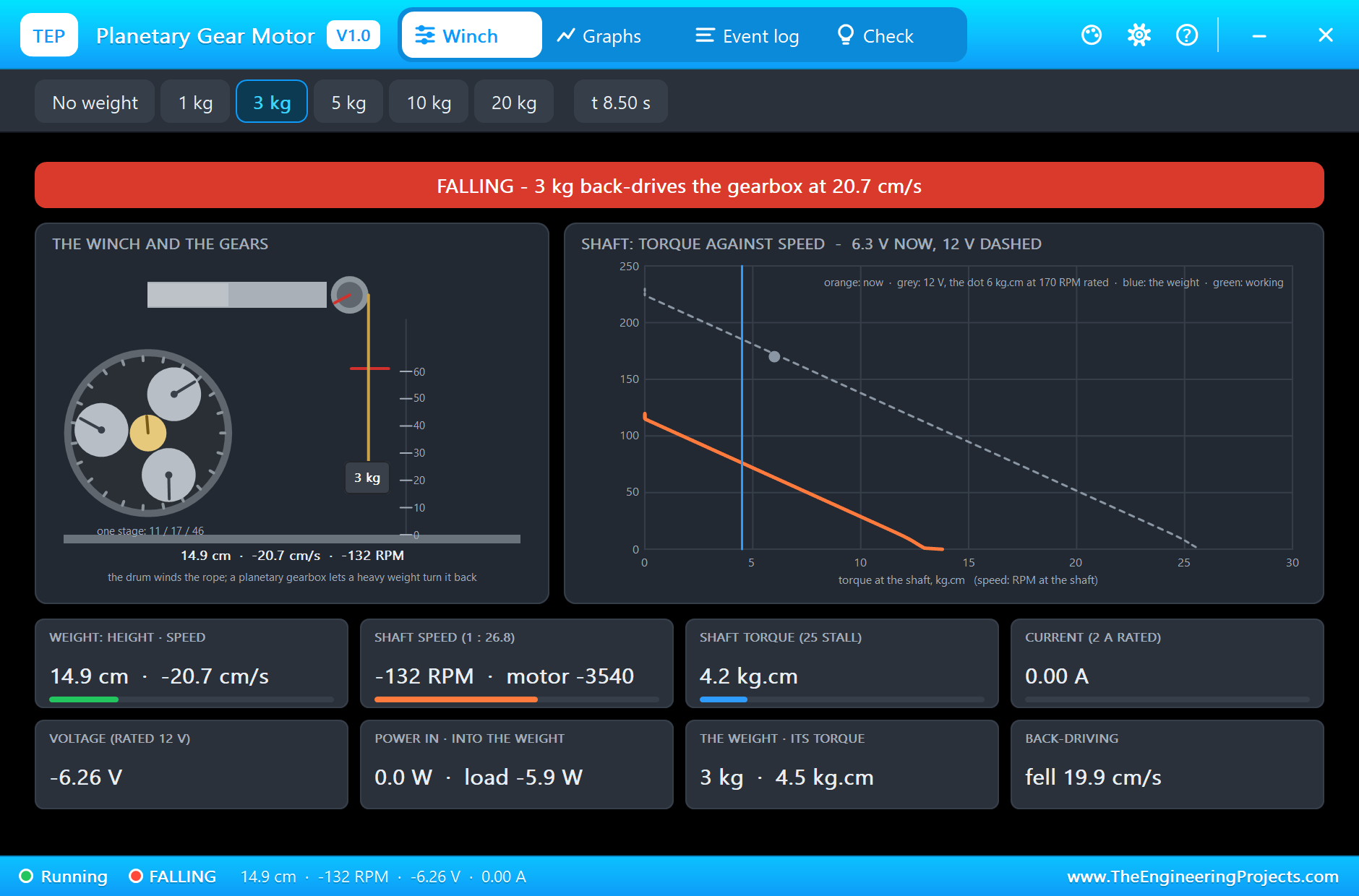
    with 0.32 A. Coasting (the enables low): it back-drives the gearbox and falls from 18.3 cm,
    landing at 41.2 cm/s - the BTS7960's
    diodes brake the motor once its voltage passes the supply.
  * 1 kg (a chip in the pop-up): lifted at 33.1 cm/s - 211 RPM, 1.5 kg.cm, 0.65 A. Coasting: HELD BY
    FRICTION at 29.7 cm - too light
    to back-drive the gears. Lowered at 30 %: 10.9 cm/s with almost no current.
  * 20 kg (a chip): it needs 30.0 kg.cm, the motor gives 25.4 kg.cm at 11.9 V - STALLED at 7.92 A
    (held, not lifted); braked, it came
    down and landed at 14.0 cm/s.
  * The pop-up: Winch (the winch, a planetary stage turning, the torque-speed line with the working
    point, eight values), Graphs, Event
    log, Check - all four followed the run; the weight chips worked while running.

INSTALLATION (about 2 minutes)
1. Close Proteus. Extract the WHOLE ZIP to a normal folder (e.g. Desktop).
2. Copy everything in "Proteus Library Files" (TEPPLANETARY.LIB and our Arduino library V4.0,
ArduinoV4TEP.LIB, with the ARDUINO UNO V4.0 used by the demo) to the LIBRARY folder of Proteus, for
example:
     C:\Program Files (x86)\Labcenter Electronics\Proteus 8 Professional\LIBRARY
   (use the folder that already holds Proteus's own .LIB files).
3. Copy TEPPLANETARY.DLL and TEPARDUINO.DLL from "Proteus Model Files" to the MODELS folder
(...\Proteus 8 Professional\MODELS).
4. Delete TEPPLANETARY.IDX from the LIBRARY folder if it is there (Proteus makes a new index).
5. Start Proteus. In Pick Devices (P) search "PLANETARY".

RUN THE DEMO
"Proteus Simulation\Planetary-Winch-BTS7960-ArduinoUnoV4.pdsprj" (an A4 sheet) - keep the .hex file
and the DLLs beside the project.
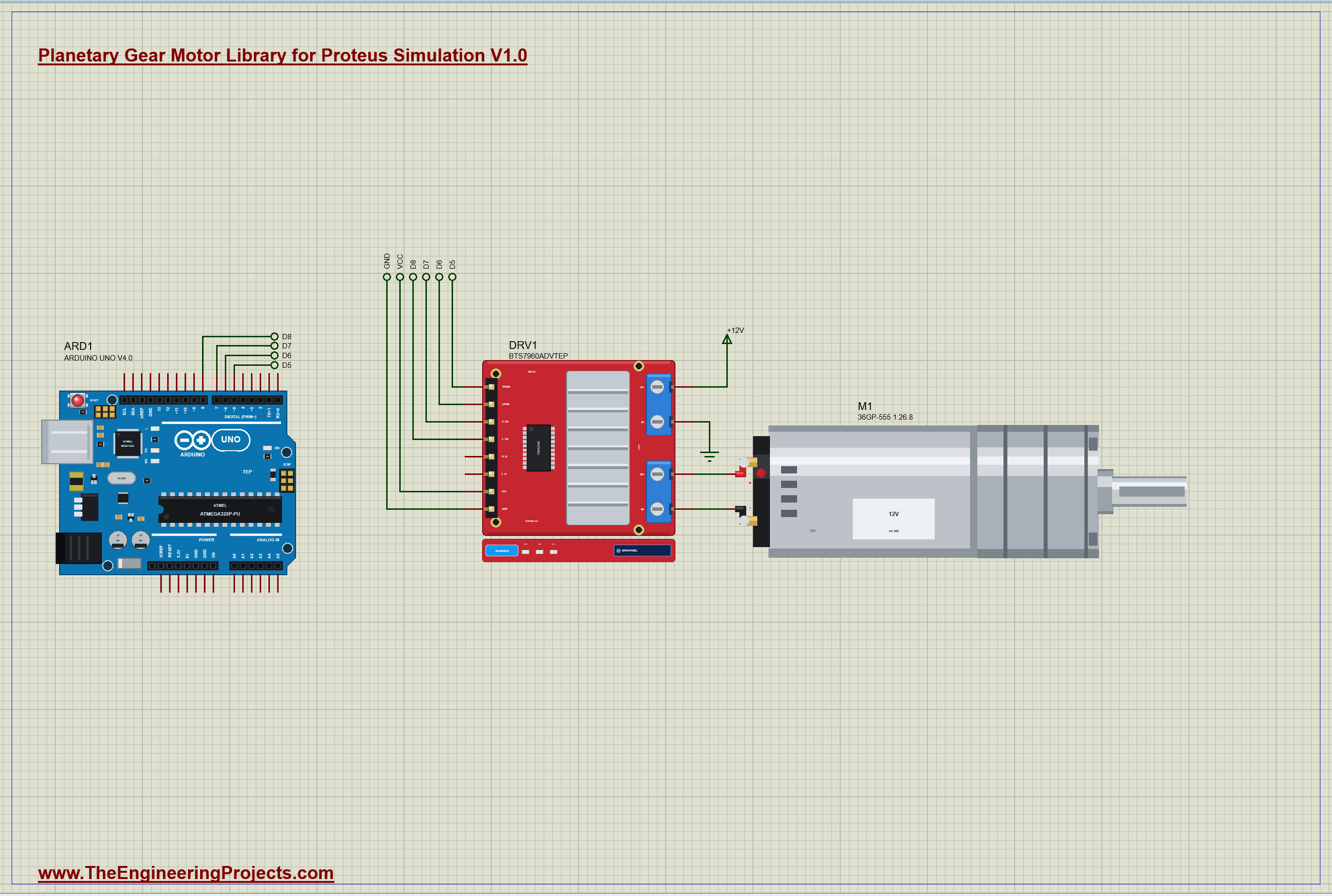
  ARD1:   Arduino UNO V4.0 running Planetary_Demo.hex, its serial monitor built in (window "TEP
  Arduino UNO - ARD1").
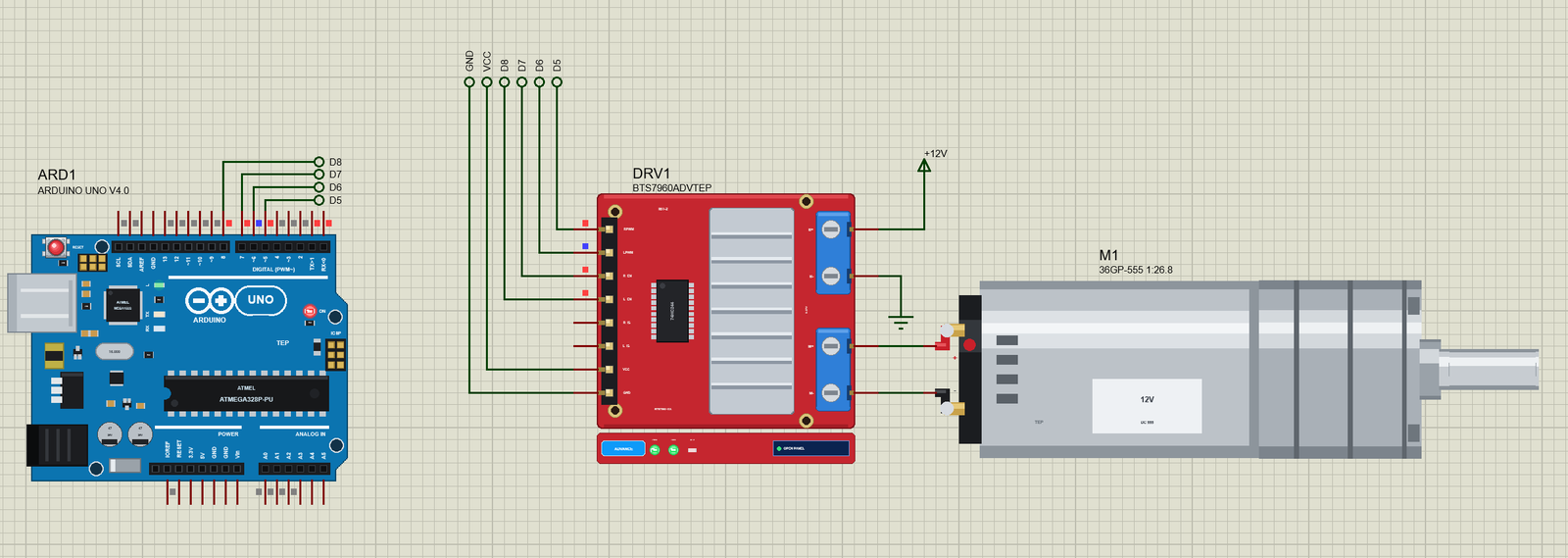
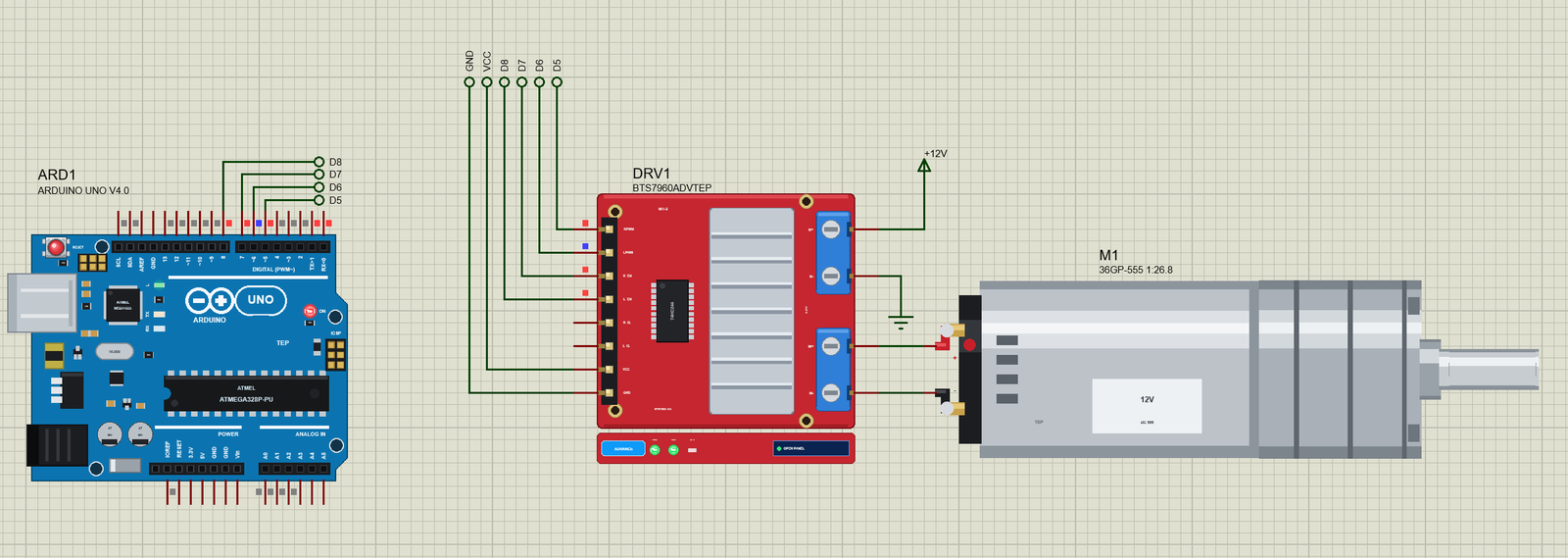
  DRV1:   our BTS7960 driver: RPWM = D5 (lifting), LPWM = D6 (lowering), R_EN = D7, L_EN = D8, VCC 5
  V, B+ = +12V, B- = GND.
  M1:     the planetary gear motor with its winch: MASS 3 kg, DRUM 30 mm, HEIGHT 0 (on the floor),
  TOP 60 cm.
  1. Lift at 100 %, brake (the weight creeps down), hold at 12 %, lower at 40 %, brake, coast (the 3
  kg weight falls and lands).
  2. With 1 kg (a chip in the pop-up): lift, coast (friction holds it), lower at 30 %, brake.
  3. With 20 kg (a chip): lift at 100 % - stalled; brake - it creeps down and lands.
Closed the monitor? Click the UNO's USB port.

WIRING (the same in Proteus and on a real board)
  the motor's + and - to a motor driver that can carry its stall current (8 A at 12 V): a BTS7960 /
  IBT-2, never an L298 or an L9110S;
  12 V for the driver; PWM on one input lifts, on the other lowers; both inputs low with the driver
  enabled brakes, the enables low coast.
REAL HARDWARE:
 * A planetary gear motor does not hold a heavy load by itself: with the power off the load turns it
   backwards. Use a brake, a worm
   gear or a holding current for loads that must not fall.
 * Its stall current (8 A at 12 V) needs a big driver and wiring; never let it stall for long - it
   heats quickly.
 * Shorting the motor (braking) only slows a falling load; it does not stop it.
 * Fit the drum or the pulley on the D-flat with a set screw; mind the side load on the output
   bearing.

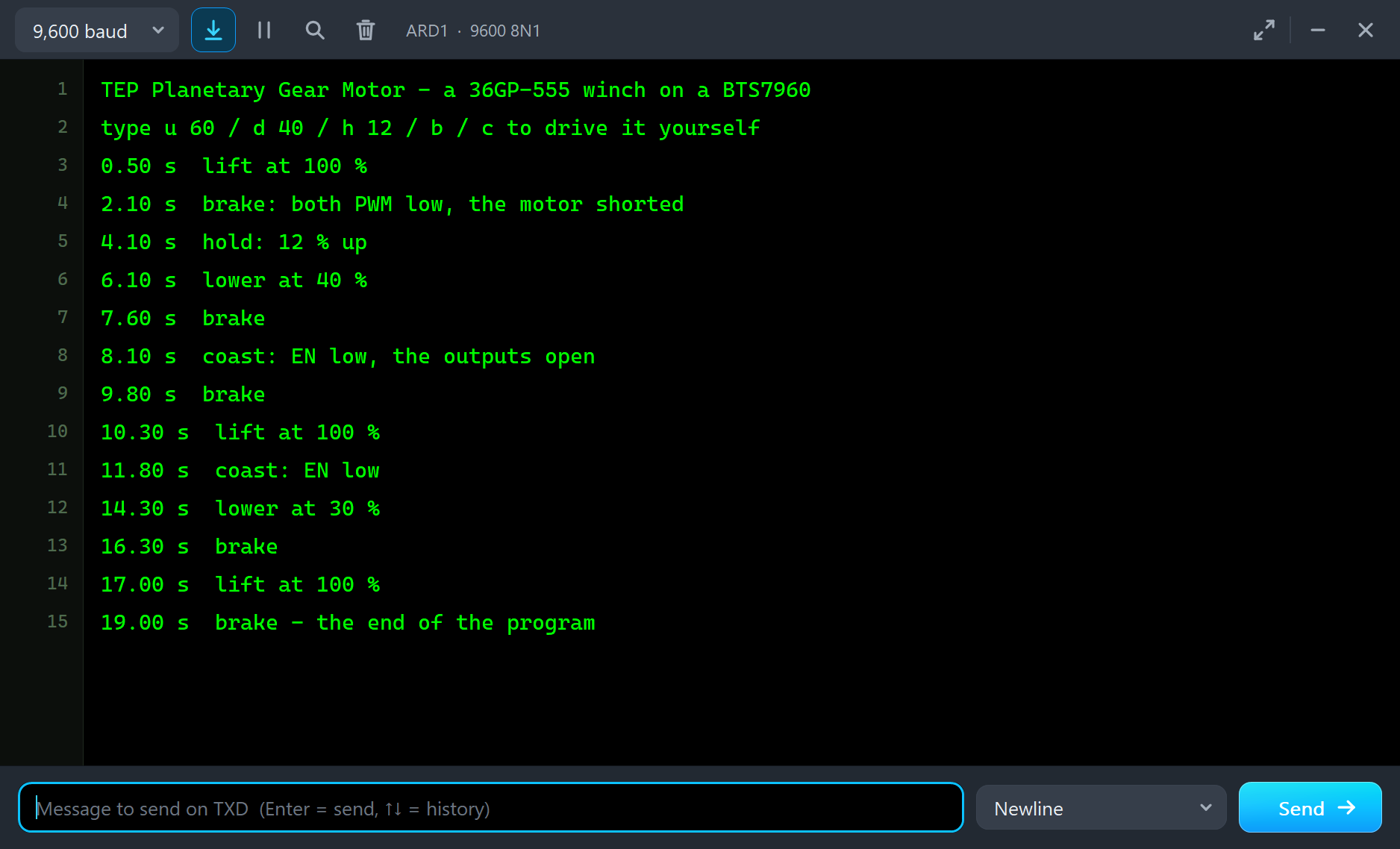
THE DEMO SKETCH ON THE SERIAL MONITOR (Planetary_Demo V1.0, 9600 baud)
The sketch runs its program, then waits. Type a command to drive the winch yourself (it ends the
program):
  u 60    up at 60 %        d 40    down at 40 %        h 12    hold, 12 % up        b    brake
  c    coast
EXPECTED MONITOR OUTPUT
  TEP Planetary Gear Motor - a 36GP-555 winch on a BTS7960
  0.50 s  lift at 100 %
  2.10 s  brake: both PWM low, the motor shorted

PROPERTIES (double-click the part > Edit Properties)
  Weight (MASS)                        kg on the winch rope (3; 0 = none)
  Drum (DRUM)                          the winch drum's diameter, mm (30)
  Start height (HEIGHT)                the weight's height above the floor at the start, cm (0)
  Top (TOP)                            the rope stops at this height (a pulley), cm (60)
Every run starts again from the properties.

LINKS.INI (OPTIONAL)
The Help page cards of the pop-up open web pages. To point them somewhere else without a new DLL,
put a text file named links.ini next to TEPPLANETARY.DLL with lines KEY=URL, for example:
  ARTICLE=https://www.theengineeringprojects.com/...
Keys: WEBSITE, FORUM, BUG_REPORT, FEATURE_REQUEST, ARTICLE, USER_GUIDE,
UPDATE_CHECK, DONATE. Only http:// and https:// links are used; lines starting
with # are comments.

TROUBLESHOOTING
* FALLING: the driver is off (coasting) and the weight is heavy enough to back-drive the gears -
  brake, or hold with a small drive.
* BRAKED but still moving: braking only slows the weight; a heavy one creeps down. Hold it with a
  small PWM up instead.
* STALLED: the weight needs more torque than the motor gives at this voltage (25 kg.cm at 12 V; 20
  kg on a 30 mm drum needs 29).
* AT THE TOP: the rope reached the pulley - the motor stalls; stop lifting.
* OVER THE RATED CURRENT: more than 2 A for 3 s - a heavy load or a stall; the real motor heats.
* The part is not simulated: TEPPLANETARY.DLL is missing from MODELS and from the project folder. No
  UNO / no monitor window: TEPARDUINO.DLL is missing, or click the UNO's USB port.

BUG REPORTS AND FEATURE REQUESTS
Please post them in our forum with a screenshot, the Serial Monitor text, the
simulation log and the pop-up's Copy diagnostics text:
  https://www.theengineeringprojects.com/forum/category/motor-driver-proteus-library

SUPPORT US
This library is free. If it saves you time, please support our work:
  https://www.theengineeringprojects.com/donate

WEBSITE
  https://www.theengineeringprojects.com/

LICENCES AND THIRD-PARTY NOTES
* The model (TEPPLANETARY.DLL), the symbols and artwork, the other parts of ours in the demo and the
  Arduino Library V4.0 (ArduinoV4TEP.LIB / TEPARDUINO.DLL, with its built-in TEP Serial Monitor
  Advance) are made by The Engineering Projects. The models use only standard Windows libraries; no
  Visual C++ redistributable is needed.
  The C++ source code is not included.
* Arduino UNO V4.0 (ArduinoV4TEP.LIB / TEPARDUINO.DLL, our Arduino Library V4.0 - its
  microcontroller is Proteus's own AVR model): The Engineering Projects,
  https://www.theengineeringprojects.com/2026/10/arduino-uno-library-for-proteus-v40.html
* The .hex file is built from the demo sketch and the Arduino AVR core 1.8.6, which includes
  LGPL-licensed code; its source code is available at
  https://github.com/arduino/ArduinoCore-avr/tree/1.8.6
* Proteus is a product of Labcenter Electronics and is not included. Arduino is a trademark of Arduino SA.
  This library is not made or endorsed by Arduino or Labcenter.

REBUILDING THE FIRMWARE (OPTIONAL)
The HEX file is supplied; Arduino IDE is not needed to run the demo. To edit the sketch, open
Arduino Code\Planetary_Demo\Planetary_Demo.ino, select Arduino Uno and use Sketch > Export Compiled
Binary. Replace the simulation's .hex with the exported HEX. The sketch needs 4,480 bytes of flash
and 477 bytes of RAM.

MODEL SCOPE AND LIMITS
Modelled: the 555 motor (resistance, back-EMF, breakaway, Coulomb and viscous friction, inertia)
with its driver in one circuit; the
gearbox ratio and its forward and backward efficiencies (back-driving, the friction that holds a
light load); the winch (the weight's
torque and inertia through the gears, the slack rope on the floor, the top stop); braking and
coasting through the driver.
Not modelled: the gearbox's backlash, the motor's inductance, heating, the noise, the rope's
stretch, a weight swinging.

VERSION
TEP Planetary Gear Motor library V1.0 (Nov 2026). Device PLANETARYGM36TEP (TEPPLANETARY.LIB /
TEPPLANETARY.DLL). Demo sketch Planetary_Demo V1.0. Demo board: ARDUINO UNO V4.0 (TEP Arduino
Library V4.0) with its built-in serial monitor; driver: our BTS7960 library.Development1 release
 Development1 release
-
V1.0Planetary Gear Motor Library for Proteus V1.0this page
V1.0 is the only release in the Download Center so far. When a newer version is published, it appears above with its own download page.
Installation8 steps
 Installation8 steps
From the download to a working project, in order. The steps follow what the package contains.
You will need
- Proteus Design SuiteProteus 8 or newer (Labcenter), on Windows
- Arduino IDE1.8 or 2.x, with the board of the tutorial chosen under Tools → Board
- Any archive toolWindows, macOS and Linux extract ZIP files on their own
Steps
- 1
Extract the archive
Right-click planetary-gear-motor-tep-v1-0-29287fb1ac284bc0b15c105fbeedc6e7.zip and choose Extract All (or open it with 7-Zip or WinRAR) into a folder you can find again. Keep its folder structure (Planetary-Gear-Motor-TEP-v1.0) as it is.
- 2
Copy the library files into Proteus
Move ArduinoV4TEP.LIB and TEPPLANETARY.LIB and the files into the LIBRARY folder of your Proteus installation: C:\Program Files (x86)\Labcenter Electronics\Proteus 8 Professional\LIBRARY for Proteus 8, or the matching Proteus 7 folder. Older versions keep it under ProgramData\Labcenter Electronics. If Proteus is open, close it first.
- 3
Add the simulation model
Copy TEPARDUINO.DLL and TEPPLANETARY.DLL into the MODELS folder next to LIBRARY, so the component can run, not only be drawn.
- 4
Restart Proteus and place the component
Start Proteus, open a schematic, press P (Pick Devices) and search for the component by the name used in the tutorial. It appears with its pins ready to wire.
- 5
Open the sketch in the Arduino IDE
Open Planetary_Demo.ino, select your board and port under Tools, then Verify. Sketch → Export Compiled Binary writes the HEX file a simulation needs.
- 6
Load the HEX file
In Proteus double-click the microcontroller, set Program File to Planetary_Demo.hex and run the simulation. For real hardware, flash the same file with your programmer.
- 7
Open the example simulation
Open Planetary-Winch-BTS7960-ArduinoUnoV4.pdsprj in Proteus to see the wiring exactly as in the tutorial. Check the controller's Program File path, then press Play.
- 8
Follow the tutorial
Planetary Gear Motor Library for Proteus Simulation explains every connection and setting in order; keep it open beside the files while you build.
FAQs9 questionsContact TEP
 FAQs9 questions
How do I download Planetary Gear Motor Library for Proteus V1.0?
Wait for the 30-second guest countdown on this page, then press the download button; the file comes straight from our storage. Members who are logged in skip the wait. If the browser opens the file instead of saving it, use its Save as option. The download link is made for you when the countdown ends and works for 15 minutes; a saved or shared link stops working, so share this page instead.
What is inside the archive?
Planetary Gear Motor Library for Proteus V1.0 comes as a ZIP archive of 10 files (1.2 MB, 2.6 MB unpacked) holding Proteus library files, simulation model DLLs, a Proteus simulation, an Arduino sketch and compiled HEX firmware. Open the File Structure tab for the full list of 10 files.
What should I do if the download does not start?
Check the browser's download list first; an ad blocker or a company firewall can also hold it back, so try another browser or network. If the file arrives incomplete, download it again. For an installation problem, read the Install tab or tell us in the comments with your software version and the exact error message.
Is this file free?
Yes. Every file in the TEP Download Center is free for learning, personal and student projects. If you share it, link back to this page or the tutorial so others find the latest version.
How do I check that the file arrived complete?
Compare its SHA-256 with the one on this page, e768f4504e28b1378107f30de31500911ed45b6cc52e5d729f36fe062e7d51f5. In PowerShell run Get-FileHash "planetary-gear-motor-tep-v1-0-29287fb1ac284bc0b15c105fbeedc6e7.zip"; on macOS or Linux run shasum -a 256 "planetary-gear-motor-tep-v1-0-29287fb1ac284bc0b15c105fbeedc6e7.zip". The same value means the file is exactly the one in our storage; a different one means the download broke off, so download it again.
Do I need WinRAR to open the ZIP file?
No. Windows, macOS and Linux open ZIP archives on their own (Extract All, or double-click). WinRAR and 7-Zip work too. Extract the whole archive before using the files.
Where do I put the LIB and IDX files?
Both files go into the LIBRARY folder of your Proteus installation (Proteus 8: C:\Program Files (x86)\Labcenter Electronics\Proteus 8 Professional\LIBRARY; Proteus 7 has the same folder under its own name). Restart Proteus afterwards and search for the component with P.
Which Proteus version does the library need?
The tutorial names the Proteus version the library was made and tested with. Most TEP libraries work in Proteus 7 and Proteus 8; if the component does not appear after a restart, check that both the LIB and the IDX file were copied and that Proteus was fully closed while copying.
How do I get the HEX file into the simulation?
Compile the sketch in the Arduino IDE (Sketch → Export Compiled Binary gives you the HEX next to the sketch), then in Proteus double-click the board, set Program File to that HEX and run.
Members skip the wait. Log in or join TEP.

- 0Total downloads
- 4%Popularity
- ProteusCategory
- 0Comments
- ssyedzainnasirUploaded by
- 11 Nov 2026Uploaded at


 SHA-256
e768f4504e28b1378107f30de31500911ed45b6cc52e5d729f36fe062e7d51f5


 Need help with this file?
 Tags
Related Proteus
All Proteus tutorials


Comments
0