


Project Files of HM-10 Bluetooth LE Library for Proteus Simulation
 Libraries
 Code
 Projects
 Simulation
bec5746333a04c9ab4db2c028a32c6ca.zip

HM-10 Bluetooth LE Library for Proteus V1.0
HM-10 Bluetooth LE Library for Proteus V1.0 comes as a ZIP archive of 18 files (1.8 MB, 4.1 MB unpacked) holding Proteus library files, simulation model DLLs, a Proteus simulation, an Arduino sketch and compiled HEX firmware.
- LIBProteus library
- DLLProteus model
- DSNProteus simulation
- INOArduino sketch
- HEXHEX firmware
Description
HM-10-Bluetooth-LE-Library-for-Proteus-v1.0.zip with the HM-10 Bluetooth LE module for Proteus simulation (TEPHM10.LIB and TEPHM10.DLL), our Arduino UNO V4.0, the A3 two-board demo with its two sketches and a README.

File Structure
 File Structure
2.5 KB3.7 KB201.9 KB14.2 KB21.8 KB306.9 KB883.5 KB322.5 KB289.5 KB311 KB23.3 KB18.8 KB28.7 KB883.5 KB322.5 KB289.5 KB311 KB13.4 KBGallery12 images from the tutorialOpen the tutorial
 Gallery12 images from the tutorial
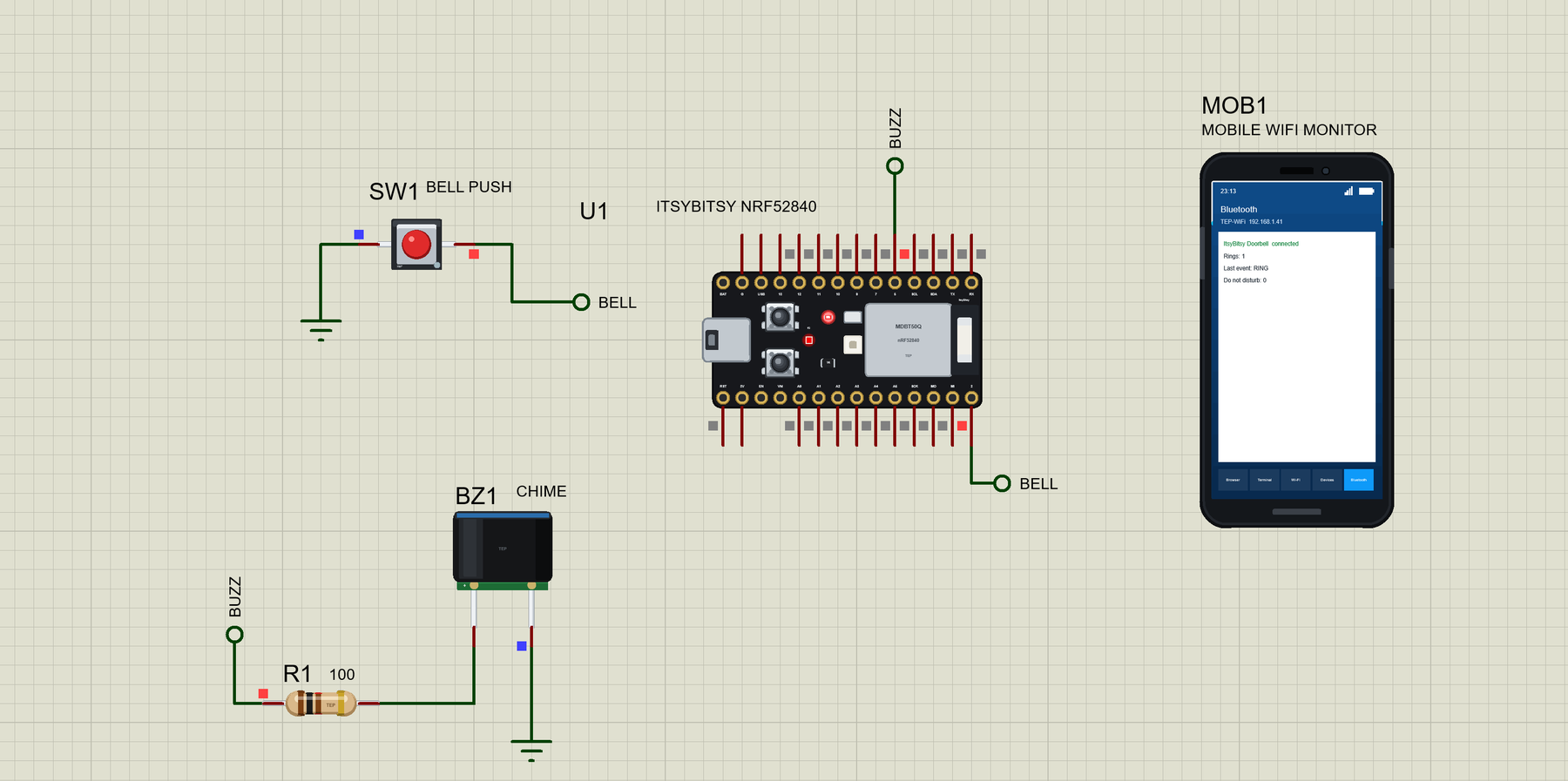
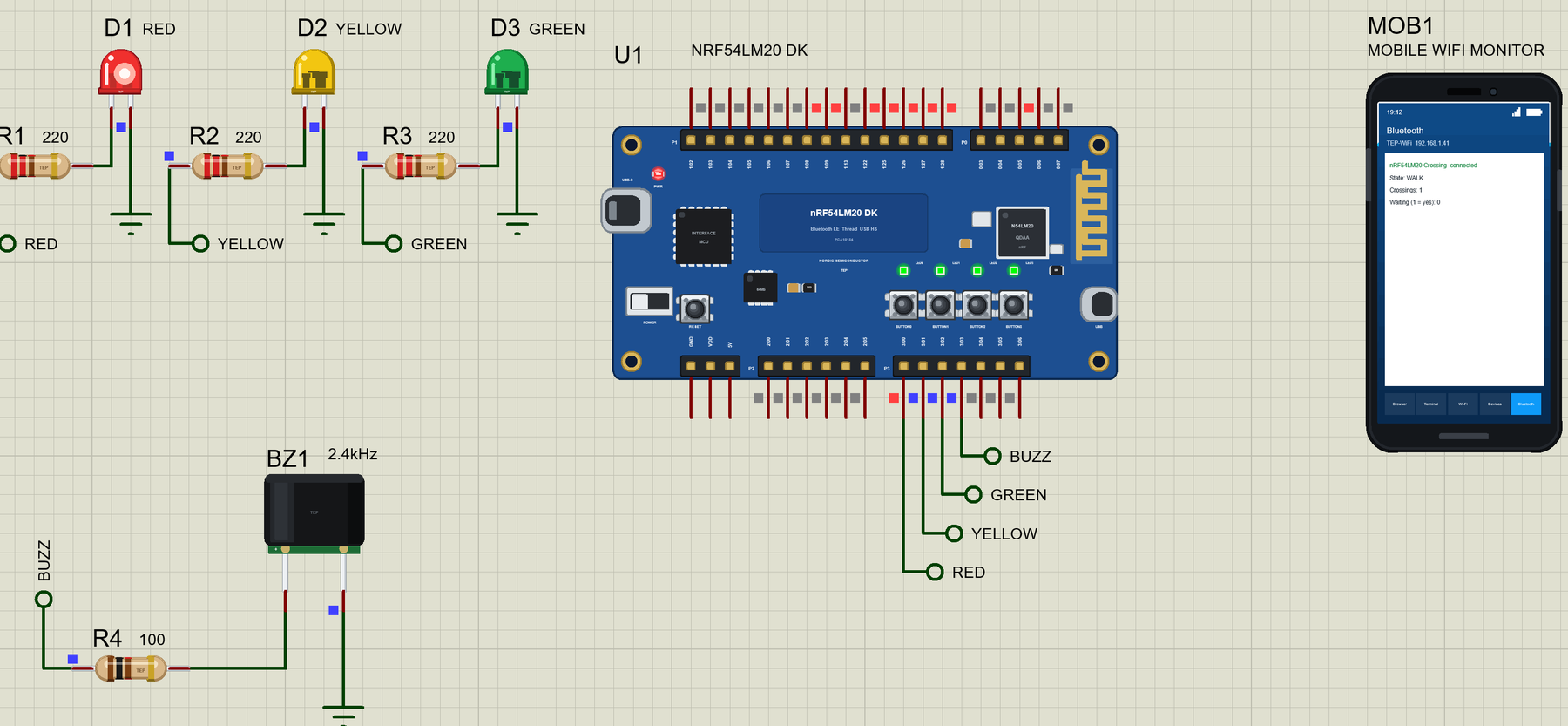
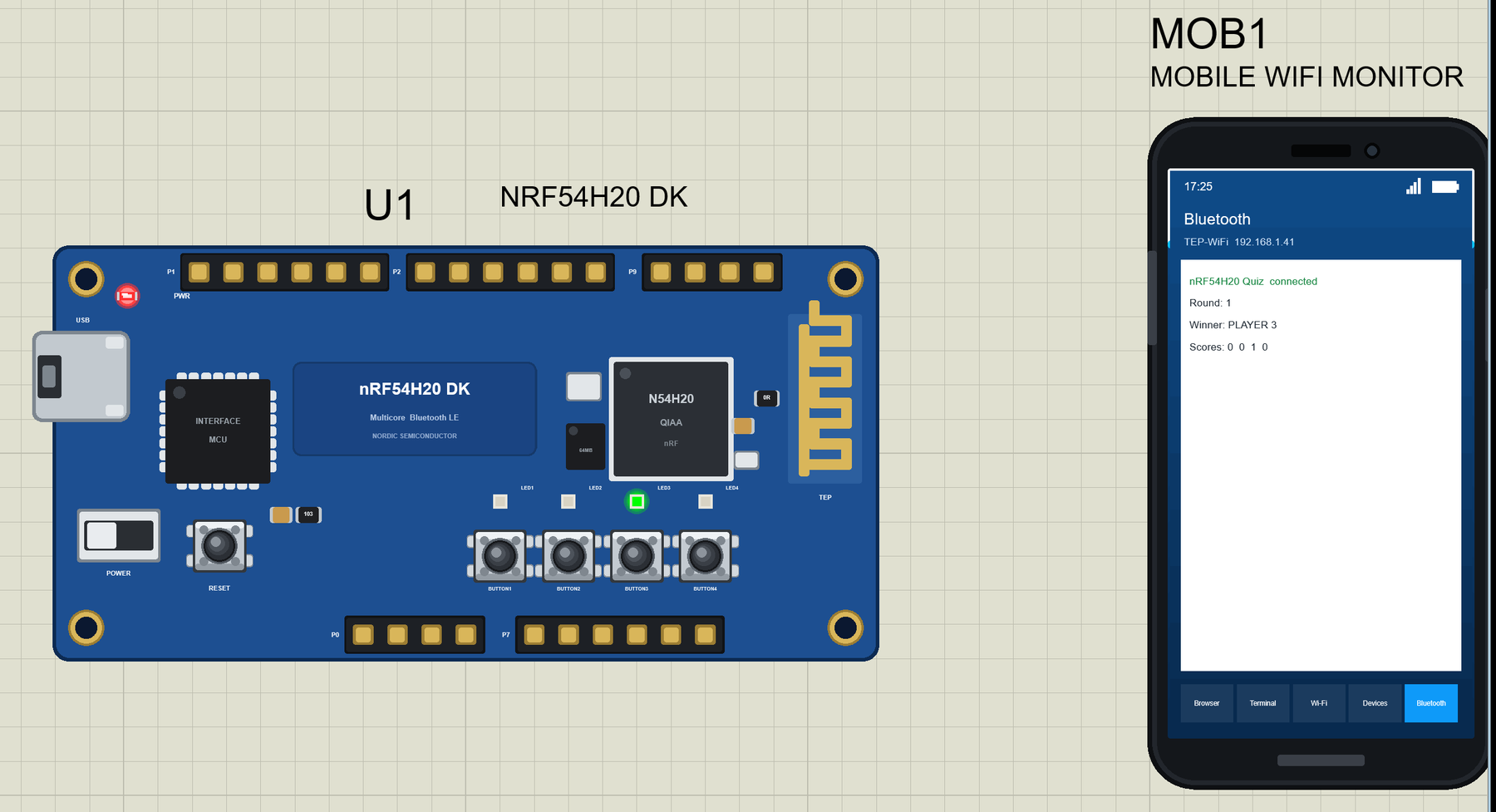
The circuit, the board and the results as they appear in HM-10 Bluetooth LE Library for Proteus Simulation. Open an image for its full size.
README
 README
HM-10 BLUETOOTH LE LIBRARY FOR PROTEUS SIMULATION - V1.0 (a Bluetooth 4.0 LE serial module, a pop-up)
Designed by The Engineering Projects
www.TheEngineeringProjects.com

IMPORTANT LINKS
Article (read it first - pictures, step by step, every feature explained):
  https://www.theengineeringprojects.com/2026/11/hm-10-bluetooth-le-library-for-proteus.html
Report a bug or suggest a feature (our forum):
  https://www.theengineeringprojects.com/forum/category/arduino-nano-33-ble-sense-proteus-library
The demo runs on our Arduino UNO V4.0 (included) - working LEDs, RESET and a
built-in serial monitor, no Virtual Terminal to wire - its own article:
  https://www.theengineeringprojects.com/2026/10/arduino-uno-library-for-proteus-v40.html
Support us (the libraries are free):
  https://www.theengineeringprojects.com/donate

FILE STRUCTURE
HM-10-Bluetooth-LE-TEP-v1.0/
|-- Proteus Library Files/
|   |-- ArduinoV4TEP.LIB                              201.9 KB   TEP Arduino boards V4.0 (UNO) -> LIBRARY
|   |-- TEPHM10.LIB                                    14.2 KB   the library -> LIBRARY folder
|   |-- TEPLED5MM.LIB                                  21.8 KB   a part the demo uses -> LIBRARY folder
|   |-- TEPRESISTOR.LIB                               306.9 KB   a part the demo uses -> LIBRARY folder
|-- Proteus Model Files/
|   |-- TEPARDUINO.DLL                                883.5 KB   the Arduino board model -> MODELS folder
|   |-- TEPHM10.DLL                                   322.5 KB   the model -> MODELS folder
|   |-- TEPLED5MM.DLL                                 289.5 KB   its model -> MODELS folder
|   |-- TEPRESISTOR.DLL                               311.0 KB   its model -> MODELS folder
|-- Proteus Simulation/
|   |-- HM10_Lamp.hex                                  18.8 KB   the demo firmware
|   |-- HM10_Remote.hex                                28.7 KB   the demo firmware
|   |-- HM10-Remote-Lamp-ArduinoUnoV4.pdsprj           23.3 KB   the demo project
|   |-- TEPARDUINO.DLL                                883.5 KB   copy of the board model
|   |-- TEPHM10.DLL                                   322.5 KB   copy of the model
|   |-- TEPLED5MM.DLL                                 289.5 KB   copy of its model
|   |-- TEPRESISTOR.DLL                               311.0 KB   copy of its model
|-- Arduino Code/
|   |-- HM10_Lamp/HM10_Lamp.ino                         2.5 KB   the demo sketch (source of the .hex)
|   |-- HM10_Remote/HM10_Remote.ino                     3.7 KB   the demo sketch (source of the .hex)
|-- README.txt                                        ~14.1 KB   this file
Total: 4.15 MB (unzipped). The C++ source code of the models is not included.

WHAT IS IT?
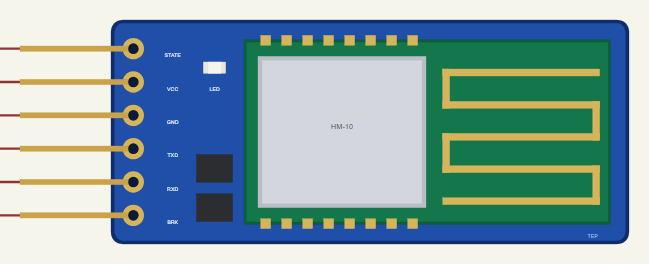
An HM-10 Bluetooth 4.0 LE serial module (a CC2541 core) on its breakout board, drawn from the front
at its real size: the 37 x 16 mm blue
board, the green HM-10 core with its shield can and meander antenna, the STATE LED and the 6-pin
header STATE, VCC, GND, TXD, RXD, BRK. The
board is our own drawing; the module behaves the way its firmware (HMSoft V540) does:
  * A UART at 9600 8N1 from the factory (the BAUD property; AT+BAUD changes it after a reset).
  * AT commands without a line ending, answered without one: AT, AT+NAME? / AT+NAMExxx, AT+ADDR?,
    AT+ROLE0 / AT+ROLE1, AT+IMME0 / 1,
    AT+NOTI0 / 1 (OK+CONN / OK+LOST), AT+DISC? (OK+DISCS, OK+DIS0:<address>, OK+DISCE),
    AT+CON<address> (OK+CONNA, OK+CONN or OK+CONNF),
    AT+CONNL, AT+BAUD, AT+RESET, AT+RENEW, AT+VERS?, AT+UUID?, AT+CHAR?, AT+PASS?, AT+TYPE?.
  * A peripheral advertises until a central connects; connected, the module is a transparent serial
    cable to the other module - "AT"
    alone cuts the link. STATE (and the LED) blinks 500 ms on / 500 ms off while waiting and stays
    high while connected.
  * The radio is the DLL's shared air: an HM-10 talks to the other HM-10s on the same sheet. Click
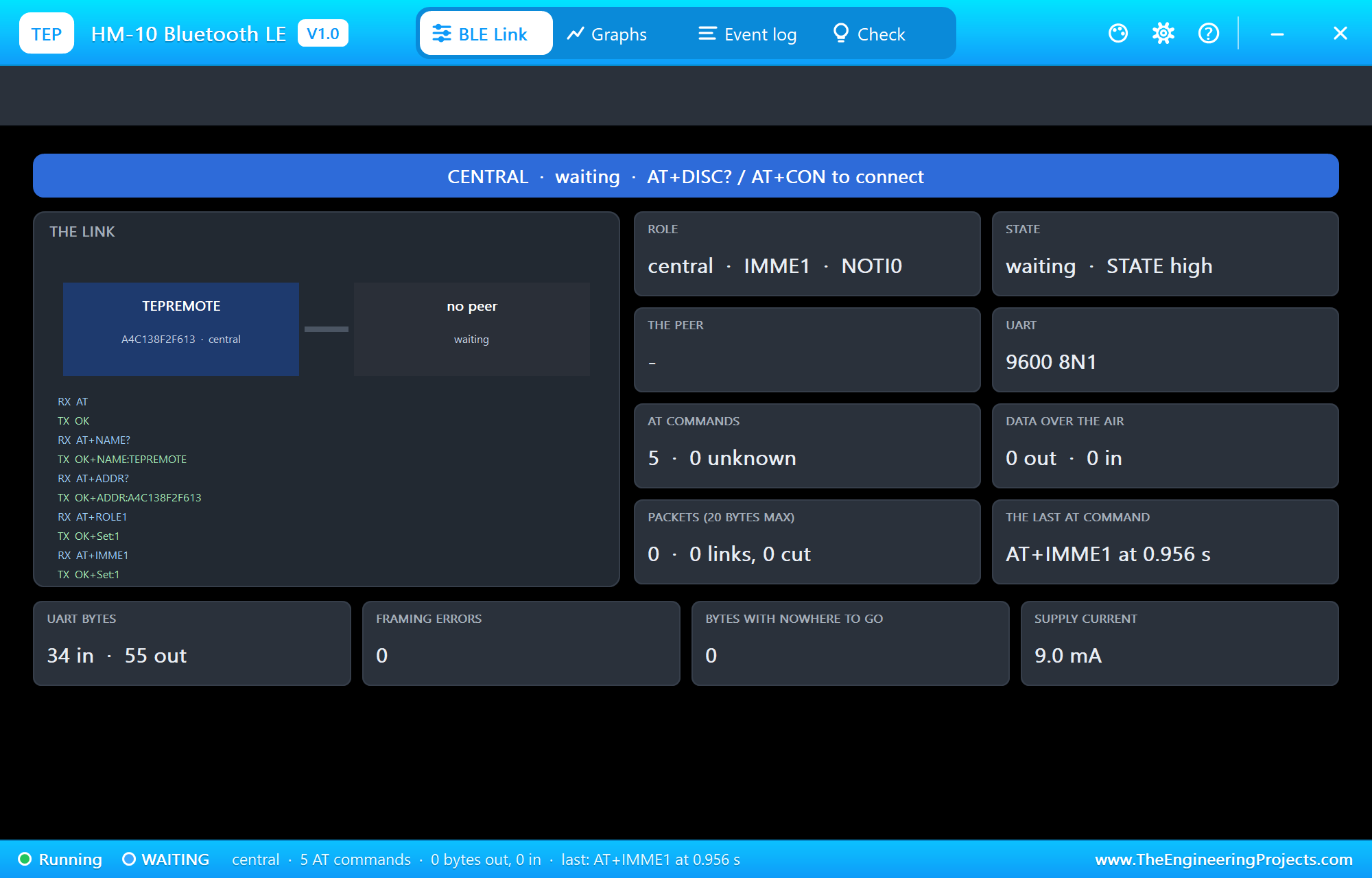
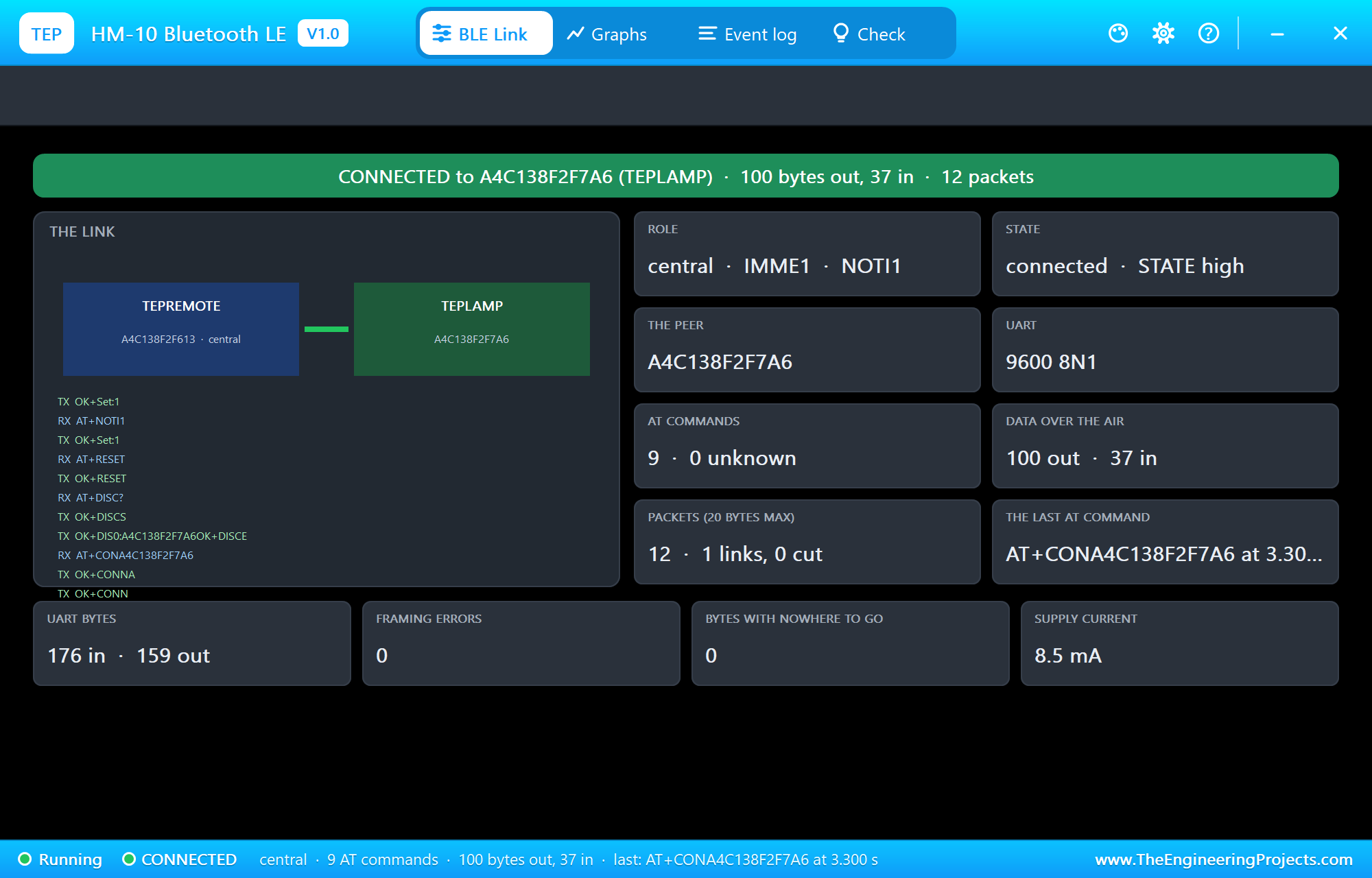
    the part for the pop-up: the link
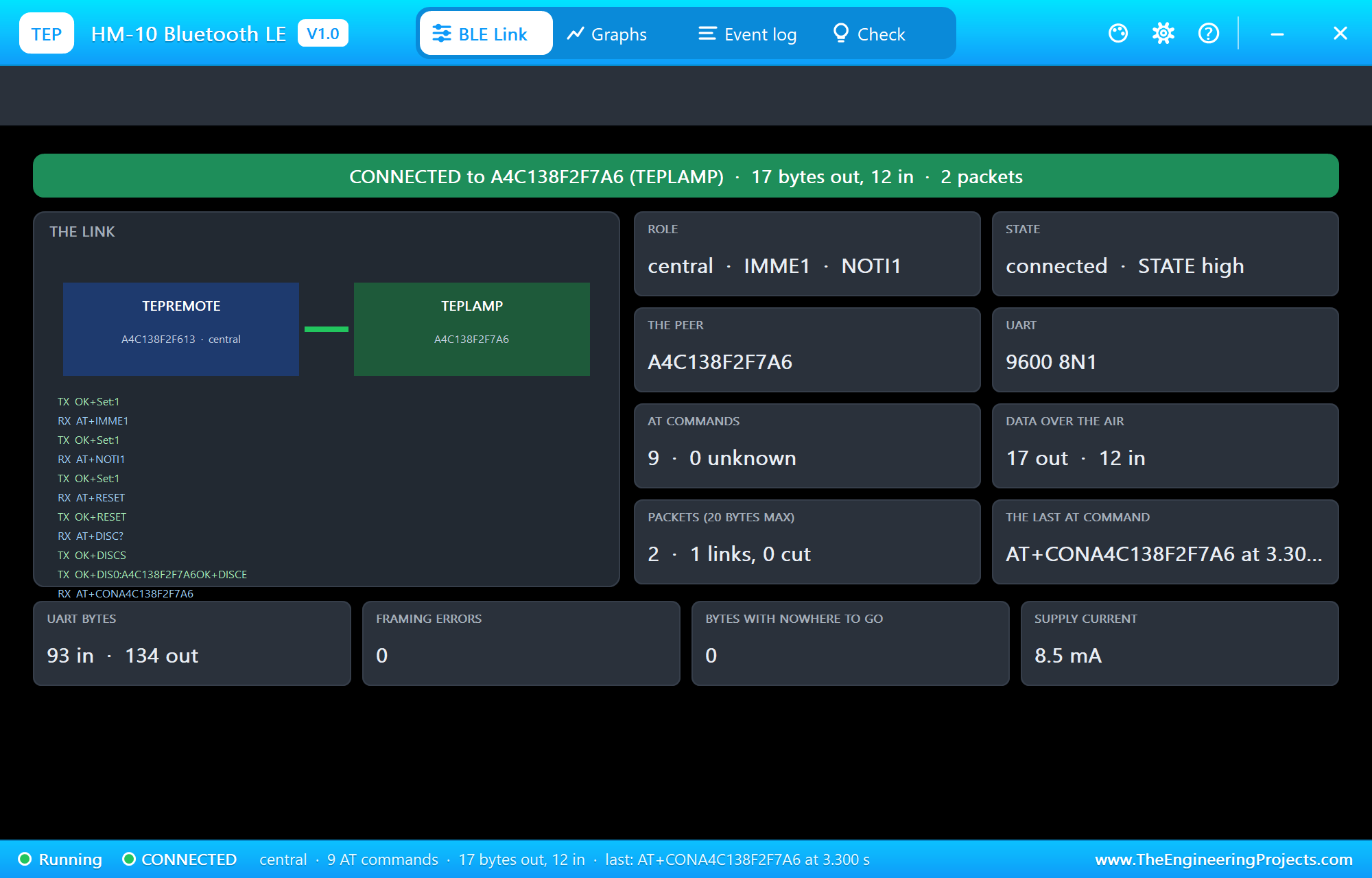
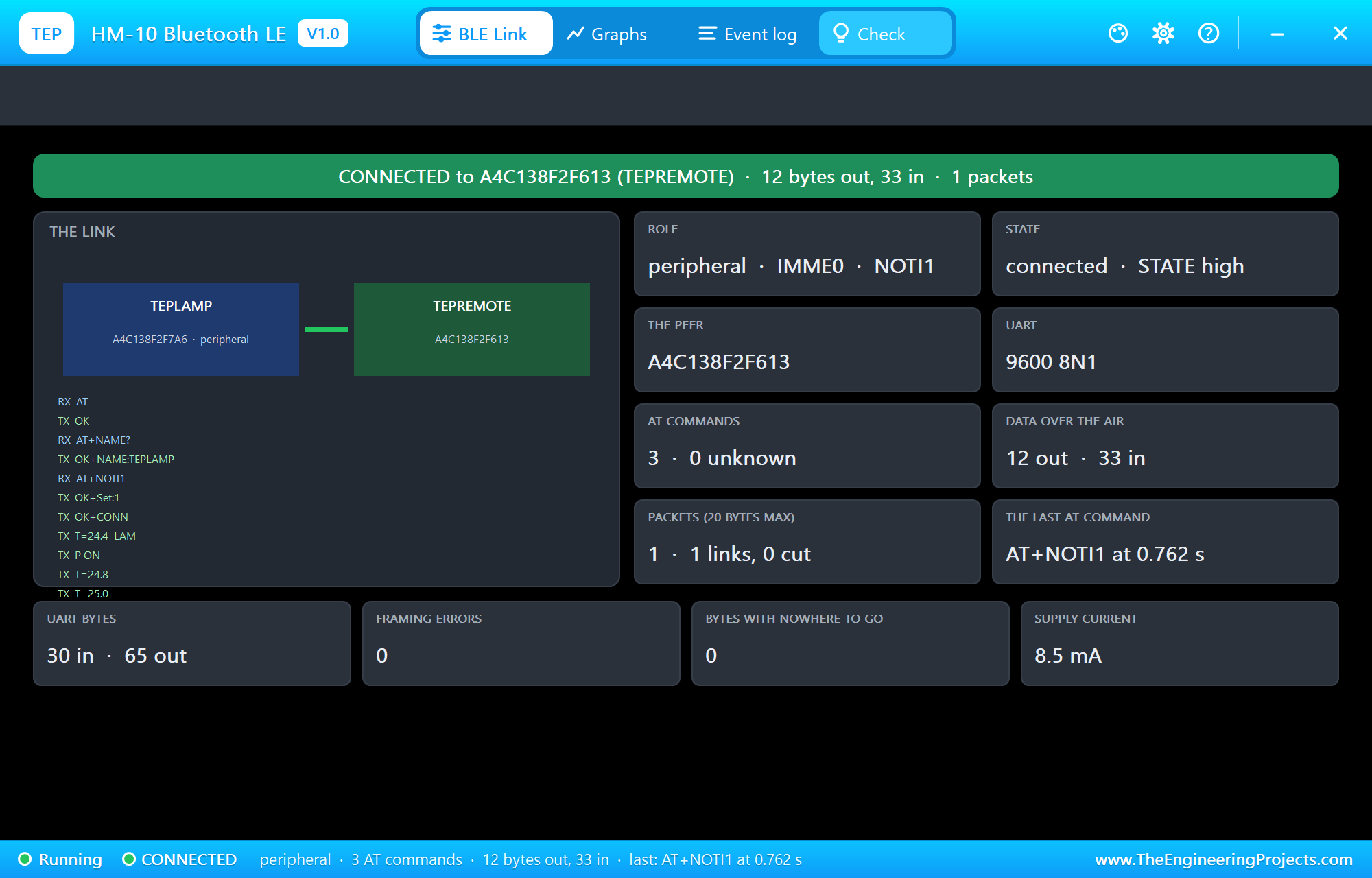
    (this module, the peer, the AT log), the role, the state, the data over the air, the packets;
    graphs, an event log and a check page.
The body is drawn as on the real part and to true scale against our Arduino.
The TEP signature and the pop-up are TEP additions.

ONE DEVICE (search "HM-10" or "Bluetooth" in Pick Devices):
  HM10BLETEP  "HM-10 Bluetooth LE V1.0" in TEPHM10.LIB (Modules > Bluetooth), prefix U, model
  TEPHM10.DLL (mixed). Pins on the left:
              STATE, VCC, GND, TXD, RXD, BRK.

THE POP-UP
Click the part at Run. Tabs:
    BLE Link    The link (this module and its peer, the AT and data log); tiles: the role (IMME,
    NOTI), the state and the STATE pin, the
                peer, the UART, the AT commands, the data over the air, the packets, the last AT
                command, the UART bytes, framing errors,
                bytes with nowhere to go, the supply current.
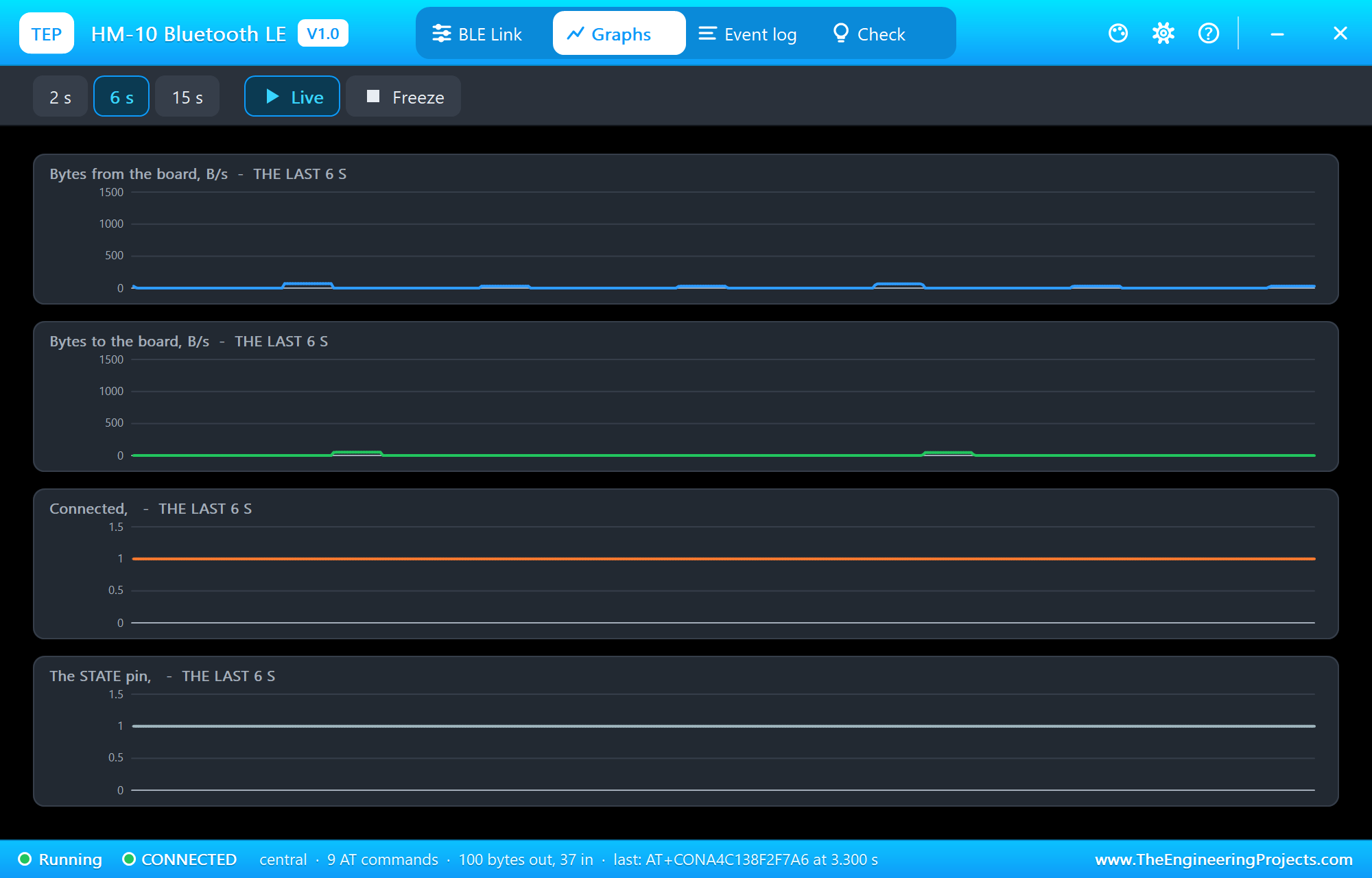
    Graphs     the live values over the last 2, 6 or 15 s. Live / Freeze.
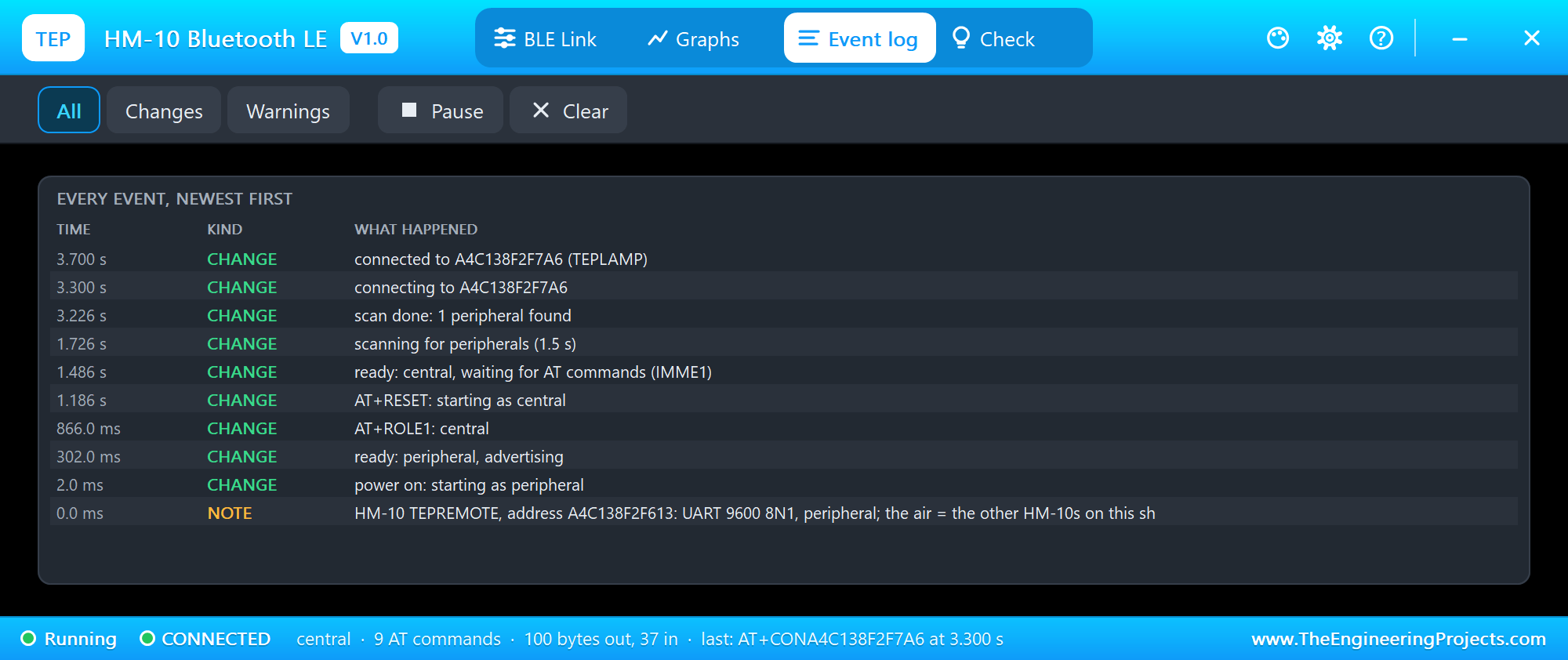
    Event log  every change and warning; filters All / Changes / Warnings, Pause, Clear
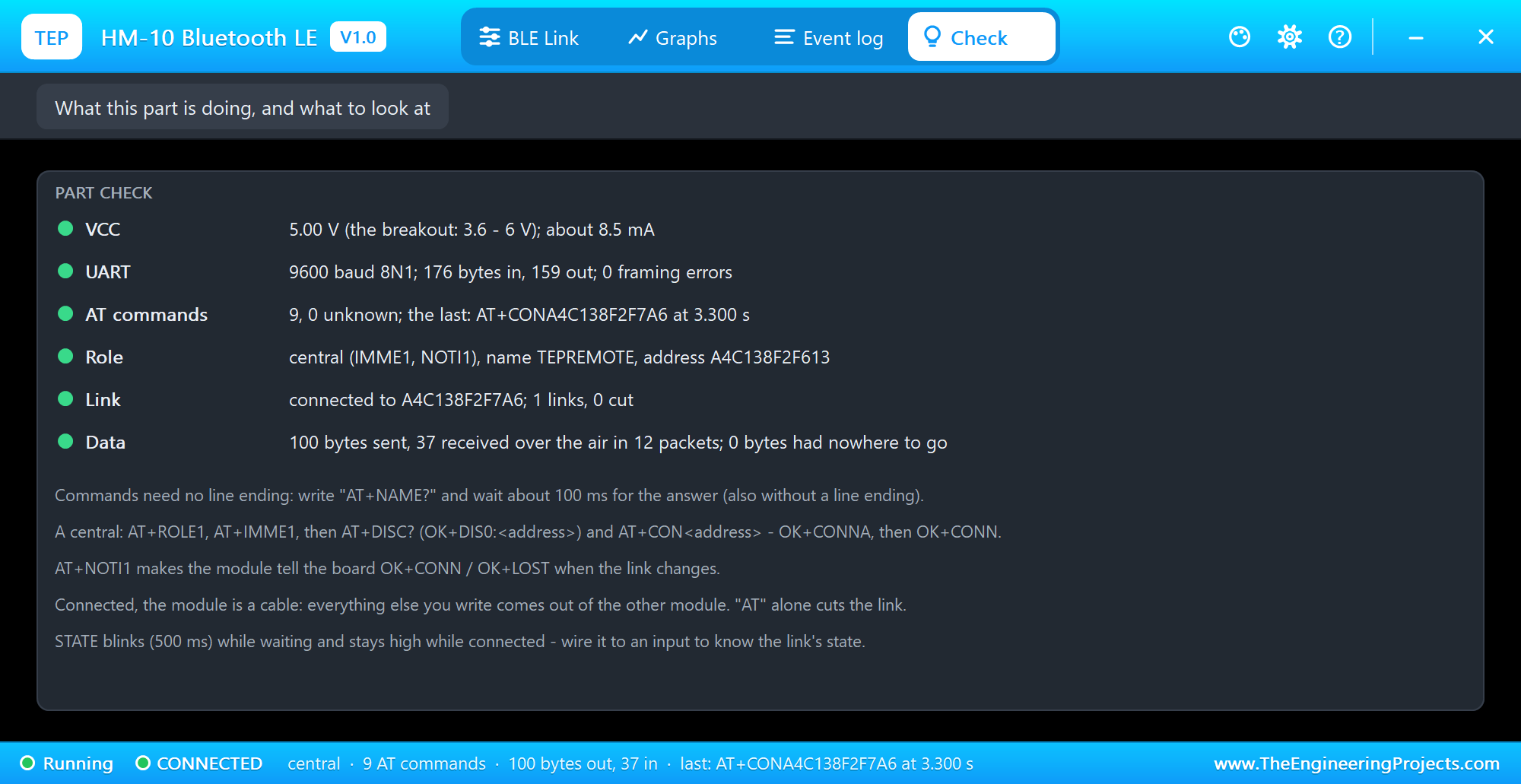
    Check      what the part is doing and what to look at, each with a verdict (green = fine, amber
    = check, red = wrong)
    Settings   theme, text size, open at Run, window size
    Help       report a bug, suggest a feature, article, updates, donate, forum; Copy diagnostics
    for a bug report

TEST STATUS
V1.0: verified in Proteus 8.5 on 21 Nov 2026 (the demo project as shipped: an A3 sheet, an Arduino UNO V4.0).
What the runs showed (the model's own numbers and the sketch's monitor):
  * The project loads and starts cleanly; the demo ran 12.0 simulated seconds in about 3 minutes on
    our PC with the pop-ups open and the
    pictures being taken.
  * Both modules started as peripherals and advertised from 0.30 s, STATE blinking. The remote's
    sketch: AT -> OK, AT+NAME? ->
    OK+NAME:TEPREMOTE, AT+ADDR? -> OK+ADDR:A4C138F2F613, AT+ROLE1 / AT+IMME1 / AT+NOTI1 -> OK+Set:1,
    AT+RESET -> OK+RESET (central from
    1.49 s).
  * AT+DISC? at 1.73 s: OK+DISCS, after the 1.5 s scan OK+DIS0:A4C138F2F7A6 (the lamp, TEPLAMP) and
    OK+DISCE.
  * AT+CONA4C138F2F7A6 at 3.30 s: OK+CONNA, then OK+CONN at 3.70 s; the lamp's module told its board
    OK+CONN (NOTI1); both STATE pins
    steady high.
  * Over the link: a temperature line every second and LAMP ON / LAMP OFF every 3 s; the lamp LED on
    D5 followed (on at 3.7 s, off at
    6.7 s, on at 9.7 s) and the lamp answered LAMP IS ON / LAMP IS OFF.
  * At 12.0 s: the remote 100 bytes out and 37 in over the air, 9 AT commands, 1 link, 0 cut; no
    framing error, no byte lost.
  * The pop-ups (BLE Link, Graphs, Event log, Check) followed the run.

INSTALLATION (about 2 minutes)
1. Close Proteus. Extract the WHOLE ZIP to a normal folder (e.g. Desktop).
2. Copy everything in "Proteus Library Files" (TEPHM10.LIB, TEPLED5MM.LIB, TEPRESISTOR.LIB and our
Arduino library V4.0, ArduinoV4TEP.LIB, with the ARDUINO UNO V4.0 used by the demo) to the LIBRARY
folder of Proteus, for example:
     C:\Program Files (x86)\Labcenter Electronics\Proteus 8 Professional\LIBRARY
   (use the folder that already holds Proteus's own .LIB files).
3. Copy TEPHM10.DLL, TEPLED5MM.DLL, TEPRESISTOR.DLL and TEPARDUINO.DLL from "Proteus Model Files" to
the MODELS folder (...\Proteus 8 Professional\MODELS).
4. Delete TEPHM10.IDX from the LIBRARY folder if it is there (Proteus makes a new index).
5. Start Proteus. In Pick Devices (P) search "HM-10".

RUN THE DEMO
"Proteus Simulation\HM10-Remote-Lamp-ArduinoUnoV4.pdsprj" (an A3 sheet) - keep the .hex file and the
DLLs beside the project.
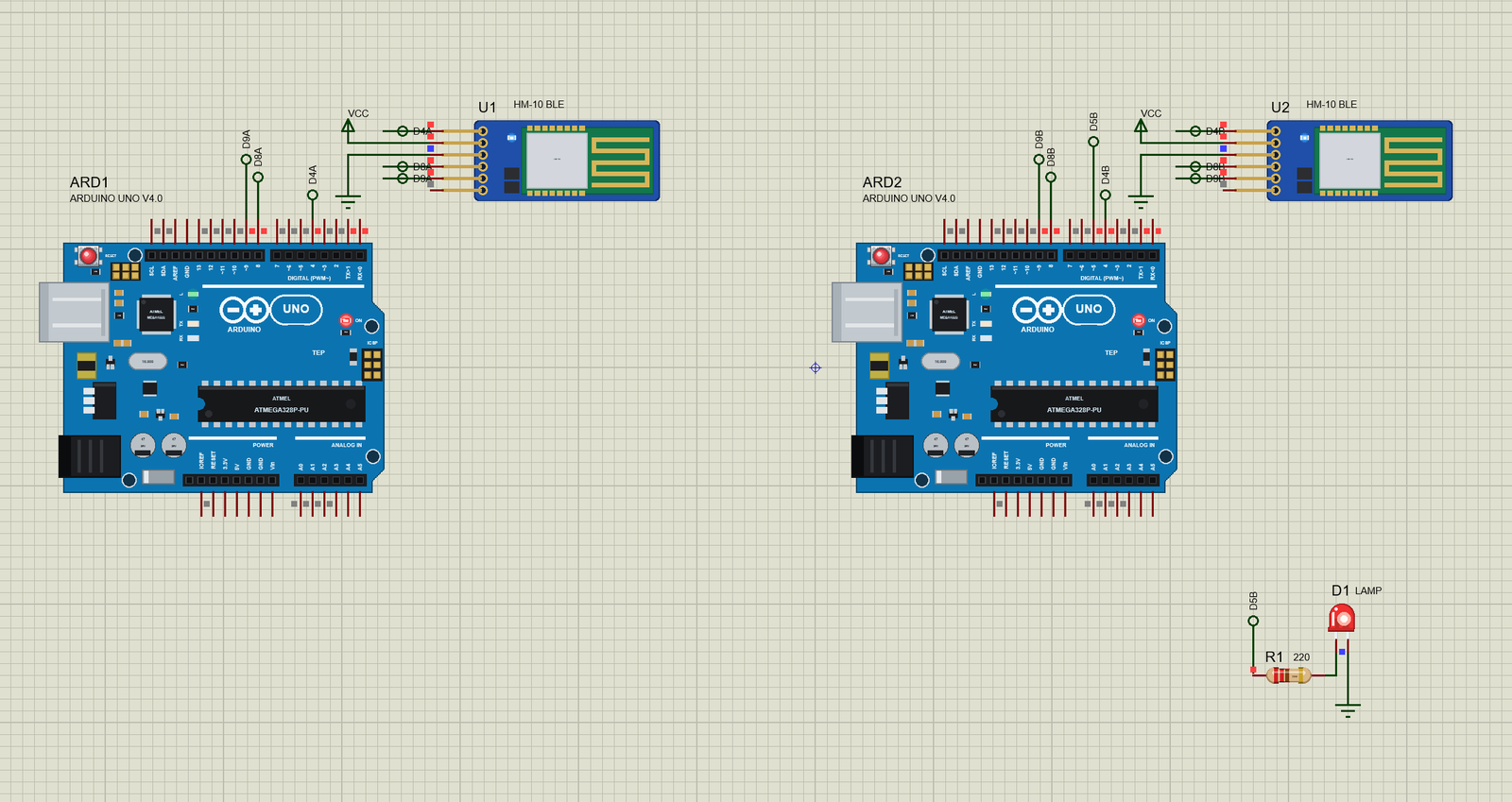
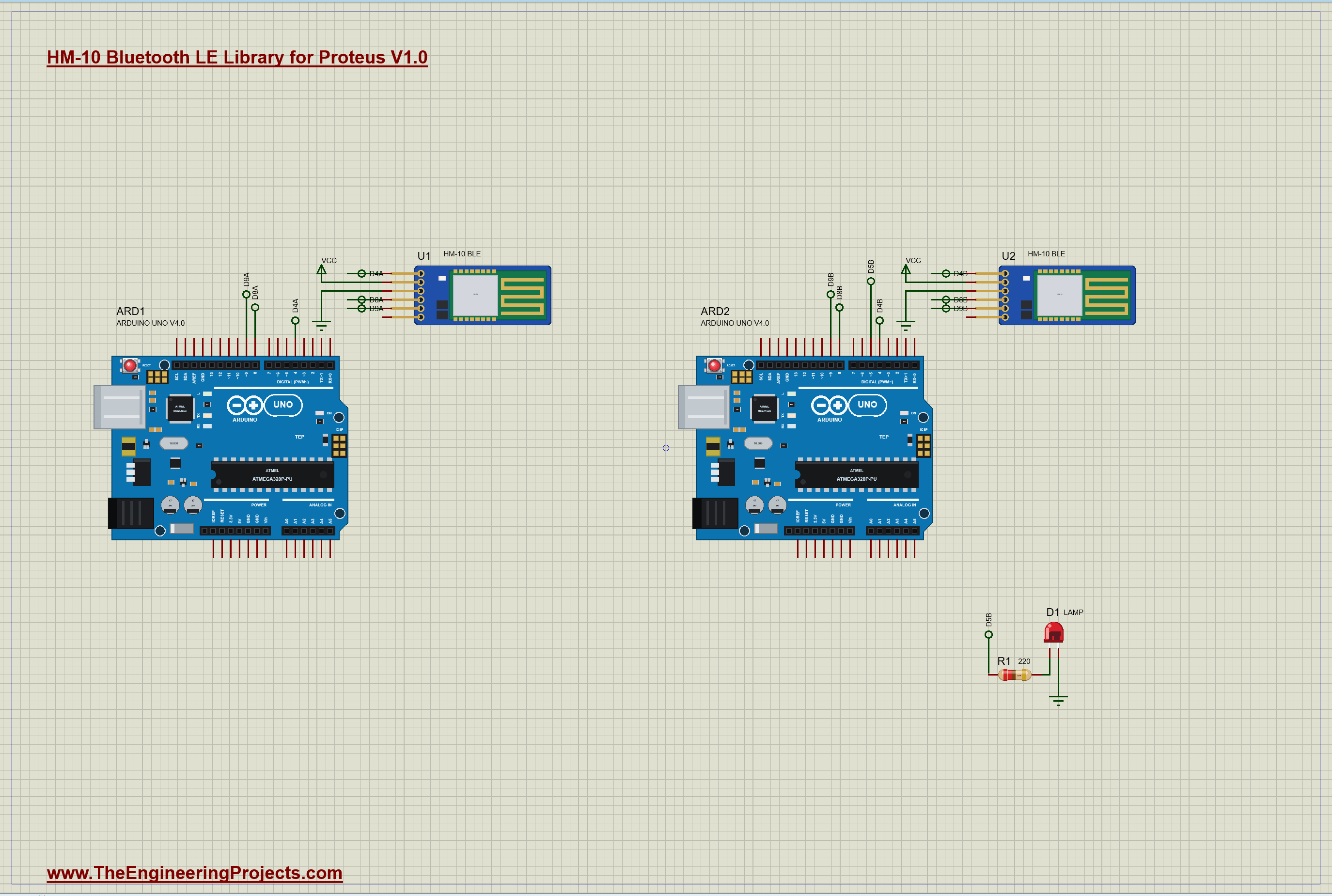
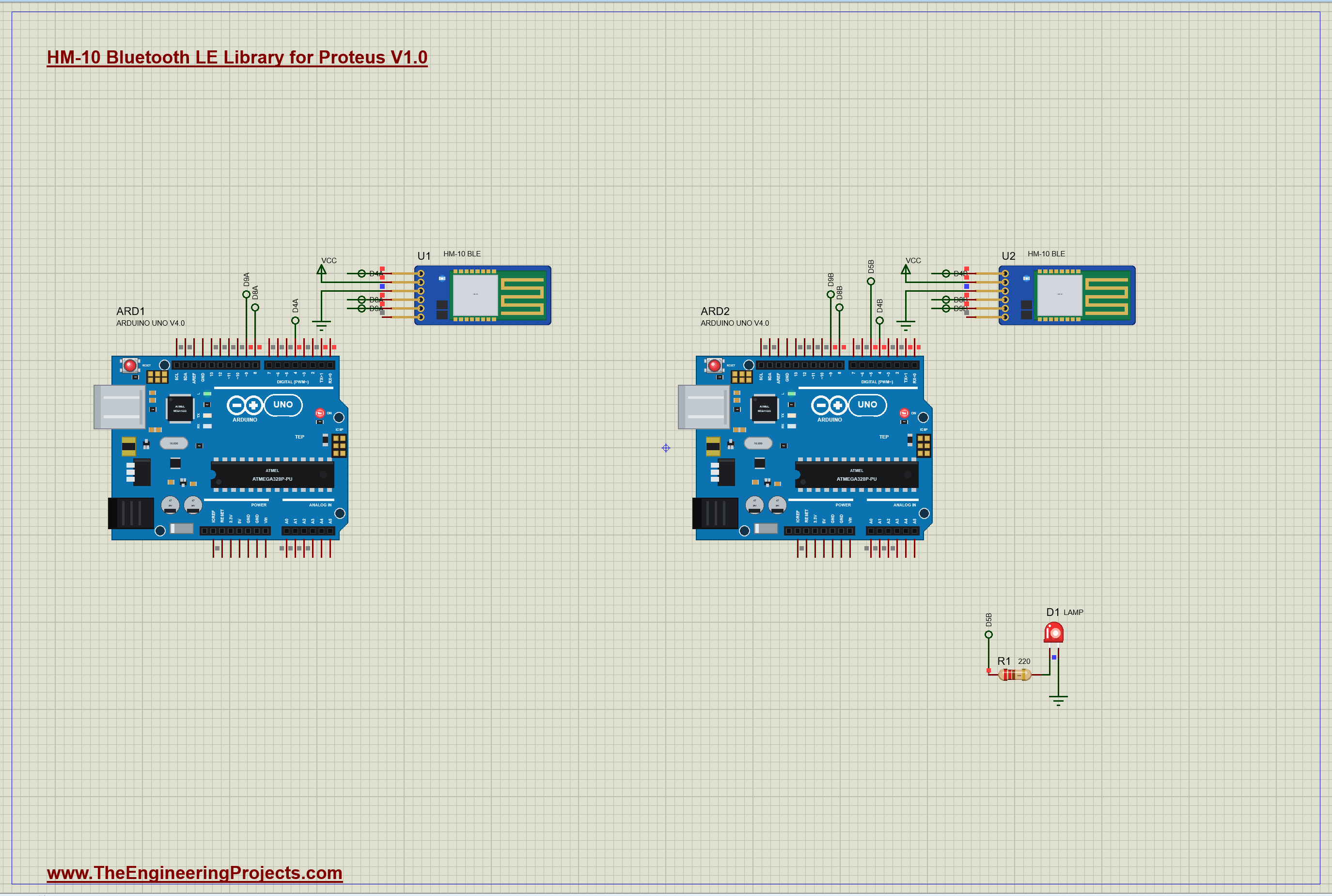
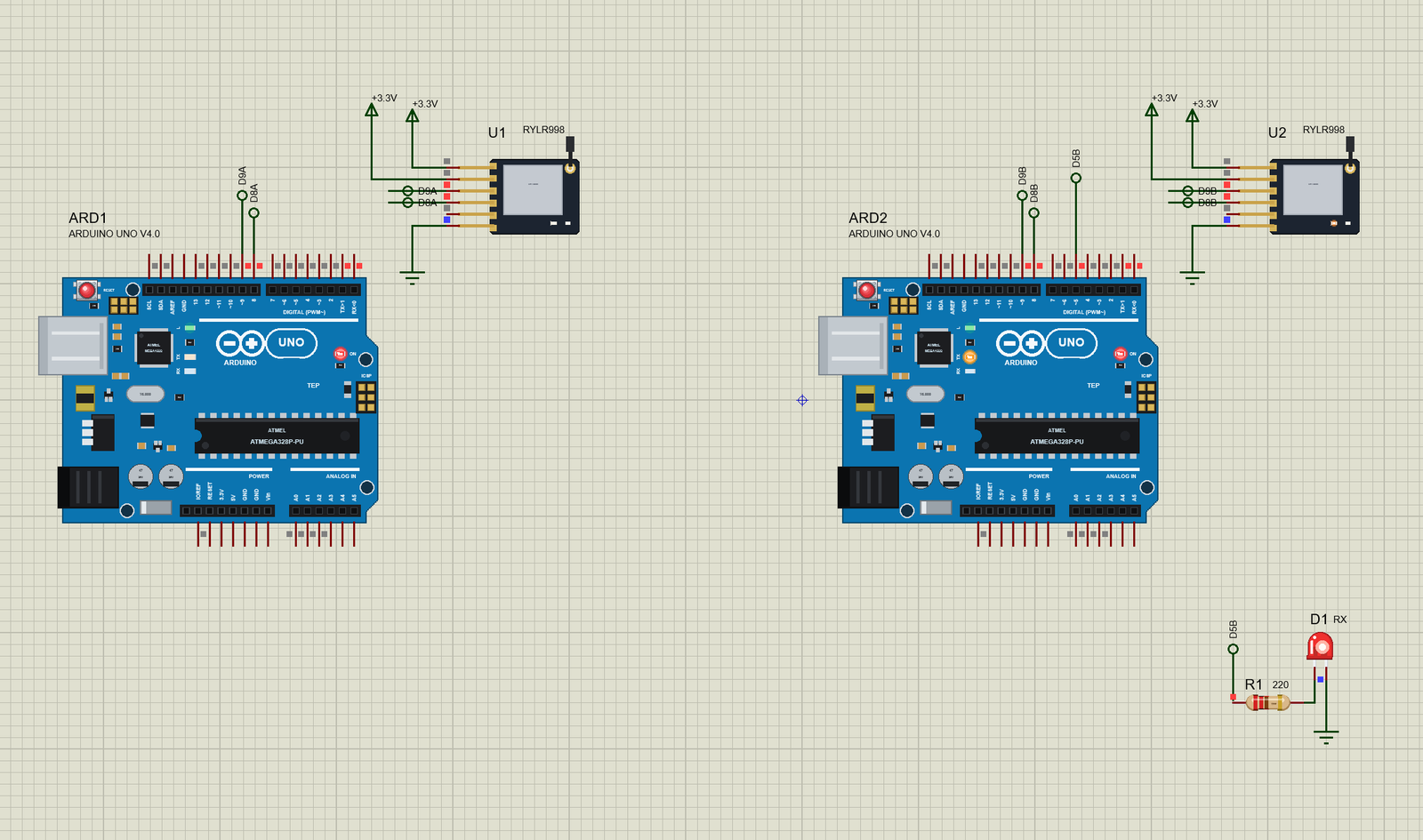
  Two Arduinos linked by two HM-10s:
  ARD1:   Arduino UNO V4.0 running HM10_Remote.hex (window "TEP Arduino UNO - ARD1"); U1 the HM-10
  "TEPREMOTE": TXD to D8, RXD to D9,
          STATE to D4. The sketch makes it a central (AT+ROLE1, AT+IMME1, AT+NOTI1, AT+RESET), scans
          (AT+DISC?), connects (AT+CON) and
          sends a temperature every second and LAMP ON / LAMP OFF every 3 seconds.
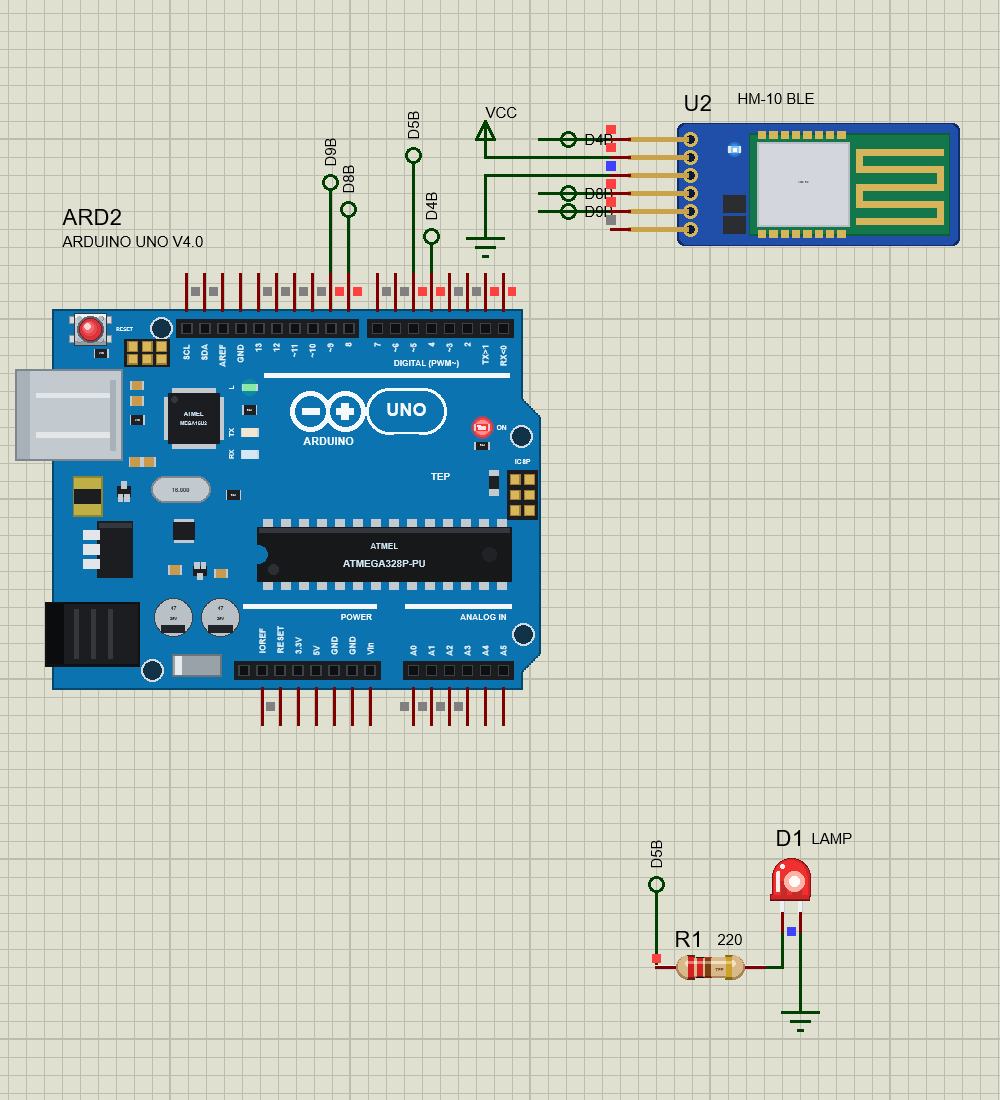
  ARD2:   Arduino UNO V4.0 running HM10_Lamp.hex (window "TEP Arduino UNO - ARD2"); U2 the HM-10
  "TEPLAMP" (a peripheral): the same
          wiring, the lamp LED D1 (220 ohm) on D5. It switches the LED and answers LAMP IS ON / LAMP
          IS OFF.
Closed the monitor? Click the UNO's USB port.

WIRING (the same in Proteus and on a real board)
  VCC to 3.6 - 6 V (the breakout's regulator), GND, TXD to the board's RX (D8 for AltSoftSerial),
  RXD to its TX (D9) - on a real
  breakout through a divider or level shifter from a 5 V board - STATE to an input if you want to
  know the link's state.
REAL HARDWARE:
 * Commands need no line ending; wait about 100 ms for the answer, which has none either.
 * Two modules: one peripheral (the factory setting), one central (AT+ROLE1) that scans and
   connects.
 * Connected, everything you write goes to the other side; write "AT" alone only to cut the link.
 * Many clone modules (CC41-A, MLT-BT05) answer differently - check the firmware of yours with
   AT+VERS?.

THE DEMO SKETCH ON THE SERIAL MONITOR (HM10_Remote V1.0, 9600 baud)
The second board runs HM10_Lamp (Arduino Code\HM10_Lamp\HM10_Lamp.ino, its HEX HM10_Lamp.hex beside
the project; 6,850 bytes of
flash, 502 of RAM): it prints its commands, "The remote connected", each temperature and the lamp's
state.
HM10_Remote prints each command and answer, then what it sends and what the lamp says. EXPECTED
MONITOR OUTPUT
  HM-10 remote (central) - The Engineering Projects
  AT -> OK
  AT+ROLE1 -> OK+Set:1
  AT+DISC? -> OK+DISCSOK+DIS0:<address>OK+DISCE
  AT+CON -> OK+CONNAOK+CONN
  Sent: LAMP ON
  The lamp says: LAMP IS ON

PROPERTIES (double-click the part > Edit Properties)
  BLENAME    The name it advertises at power-on (AT+NAME changes it). Default HMSoft.
  ADDRESS    The 12-digit Bluetooth address; blank = made from the part reference.
  BAUD       The UART rate at power-on: 9600 (the factory), 19200, 38400, 57600 or 115200.
Every run starts again from the properties.

LINKS.INI (OPTIONAL)
The Help page cards of the pop-up open web pages. To point them somewhere else without a new DLL,
put a text file named links.ini next to TEPHM10.DLL with lines KEY=URL, for example:
  ARTICLE=https://www.theengineeringprojects.com/...
Keys: WEBSITE, FORUM, BUG_REPORT, FEATURE_REQUEST, ARTICLE, USER_GUIDE,
UPDATE_CHECK, DONATE. Only http:// and https:// links are used; lines starting
with # are comments.

TROUBLESHOOTING
* No answer to AT: the UART is crossed wrong (TXD to the board's RX), the baud rate differs, or the
  module is connected (then AT cuts
  the link).
* AT+DISC? finds nothing: the other module is not a peripheral, already connected, or not powered.
* Data goes nowhere: the modules are not connected yet - wait for OK+CONN (or STATE steady high).
* The part is not simulated: TEPHM10.DLL is missing from MODELS and from the project folder.
* The part is not simulated: TEPHM10.DLL is missing from MODELS and from the project folder. No UNO
  / no monitor window: TEPARDUINO.DLL is missing, or click the UNO's USB port.

BUG REPORTS AND FEATURE REQUESTS
Please post them in our forum with a screenshot, the Serial Monitor text, the
simulation log and the pop-up's Copy diagnostics text:
  https://www.theengineeringprojects.com/forum/category/arduino-nano-33-ble-sense-proteus-library

SUPPORT US
This library is free. If it saves you time, please support our work:
  https://www.theengineeringprojects.com/donate

WEBSITE
  https://www.theengineeringprojects.com/

LICENCES AND THIRD-PARTY NOTES
* The model (TEPHM10.DLL), the symbols and artwork, the other parts of ours in the demo and the
  Arduino Library V4.0 (ArduinoV4TEP.LIB / TEPARDUINO.DLL, with its built-in TEP Serial Monitor
  Advance) are made by The Engineering Projects. The models use only standard Windows libraries; no
  Visual C++ redistributable is needed.
  The C++ source code is not included.
* Arduino UNO V4.0 (ArduinoV4TEP.LIB / TEPARDUINO.DLL, our Arduino Library V4.0 - its
  microcontroller is Proteus's own AVR model): The Engineering Projects,
  https://www.theengineeringprojects.com/2026/10/arduino-uno-library-for-proteus-v40.html
* The .hex file is built from the demo sketch and the Arduino AVR core 1.8.6, which includes
  LGPL-licensed code; its source code is available at
  https://github.com/arduino/ArduinoCore-avr/tree/1.8.6
* Proteus is a product of Labcenter Electronics and is not included. Arduino is a trademark of Arduino SA.
  This library is not made or endorsed by Arduino or Labcenter.

REBUILDING THE FIRMWARE (OPTIONAL)
The HEX file is supplied; Arduino IDE is not needed to run the demo. To edit the sketch, open
Arduino Code\HM10_Remote\HM10_Remote.ino, select Arduino Uno and use Sketch > Export Compiled
Binary. Replace the simulation's .hex with the exported HEX. The sketch needs 10,448 bytes of flash
and 581 bytes of RAM.

MODEL SCOPE AND LIMITS
Modelled: the UART, the AT commands above, the roles, scanning and connecting, the transparent link,
STATE, BRK. Our choices: the shared air
(only HM-10s on the same sheet), a 1.5 s scan, a 0.4 s connection, 20-byte packets every 20 ms, the
address from the part reference.
Not modelled: phones and other BLE devices, iBeacon, the PIO commands, sleep modes, signal strength.

VERSION
TEP HM-10 Bluetooth LE library V1.0 (Nov 2026). Device HM10BLETEP (TEPHM10.LIB / TEPHM10.DLL). Demo
sketches HM10_Remote and HM10_Lamp V1.0 (AltSoftSerial - no BLE library). Demo boards: two ARDUINO
UNO V4.0 (TEP Arduino Library V4.0) with their built-in serial monitors.Development1 release
 Development1 release
-
V1.0HM-10 Bluetooth LE Library for Proteus V1.0this page
V1.0 is the only release in the Download Center so far. When a newer version is published, it appears above with its own download page.
Installation8 steps
 Installation8 steps
From the download to a working project, in order. The steps follow what the package contains.
You will need
- Proteus Design SuiteProteus 8 or newer (Labcenter), on Windows
- Arduino IDE1.8 or 2.x, with the board of the tutorial chosen under Tools → Board
- Any archive toolWindows, macOS and Linux extract ZIP files on their own
Steps
- 1
Extract the archive
Right-click bec5746333a04c9ab4db2c028a32c6ca.zip and choose Extract All (or open it with 7-Zip or WinRAR) into a folder you can find again. Keep its folder structure (HM-10-Bluetooth-LE-TEP-v1.0) as it is.
- 2
Copy the library files into Proteus
Move ArduinoV4TEP.LIB, TEPHM10.LIB and TEPLED5MM.LIB and 1 more and the files into the LIBRARY folder of your Proteus installation: C:\Program Files (x86)\Labcenter Electronics\Proteus 8 Professional\LIBRARY for Proteus 8, or the matching Proteus 7 folder. Older versions keep it under ProgramData\Labcenter Electronics. If Proteus is open, close it first.
- 3
Add the simulation model
Copy TEPARDUINO.DLL, TEPHM10.DLL and TEPLED5MM.DLL and 1 more into the MODELS folder next to LIBRARY, so the component can run, not only be drawn.
- 4
Restart Proteus and place the component
Start Proteus, open a schematic, press P (Pick Devices) and search for the component by the name used in the tutorial. It appears with its pins ready to wire.
- 5
Open the sketch in the Arduino IDE
Open HM10_Lamp.ino and HM10_Remote.ino, select your board and port under Tools, then Verify. Sketch → Export Compiled Binary writes the HEX file a simulation needs.
- 6
Load the HEX file
In Proteus double-click the microcontroller, set Program File to HM10_Lamp.hex and HM10_Remote.hex and run the simulation. For real hardware, flash the same file with your programmer.
- 7
Open the example simulation
Open HM10-Remote-Lamp-ArduinoUnoV4.pdsprj in Proteus to see the wiring exactly as in the tutorial. Check the controller's Program File path, then press Play.
- 8
Follow the tutorial
HM-10 Bluetooth LE Library for Proteus Simulation explains every connection and setting in order; keep it open beside the files while you build.
FAQs9 questionsContact TEP
 FAQs9 questions
How do I download HM-10 Bluetooth LE Library for Proteus V1.0?
Wait for the 30-second guest countdown on this page, then press the download button; the file comes straight from our storage. Members who are logged in skip the wait. If the browser opens the file instead of saving it, use its Save as option. The download link is made for you when the countdown ends and works for 15 minutes; a saved or shared link stops working, so share this page instead.
What is inside the archive?
HM-10 Bluetooth LE Library for Proteus V1.0 comes as a ZIP archive of 18 files (1.8 MB, 4.1 MB unpacked) holding Proteus library files, simulation model DLLs, a Proteus simulation, an Arduino sketch and compiled HEX firmware. Open the File Structure tab for the full list of 18 files.
What should I do if the download does not start?
Check the browser's download list first; an ad blocker or a company firewall can also hold it back, so try another browser or network. If the file arrives incomplete, download it again. For an installation problem, read the Install tab or tell us in the comments with your software version and the exact error message.
Is this file free?
Yes. Every file in the TEP Download Center is free for learning, personal and student projects. If you share it, link back to this page or the tutorial so others find the latest version.
How do I check that the file arrived complete?
Compare its SHA-256 with the one on this page, 9ad5fb7e641d99b1803a8c990604383ecc008a88c7d3fe7e959e9c6436550294. In PowerShell run Get-FileHash "bec5746333a04c9ab4db2c028a32c6ca.zip"; on macOS or Linux run shasum -a 256 "bec5746333a04c9ab4db2c028a32c6ca.zip". The same value means the file is exactly the one in our storage; a different one means the download broke off, so download it again.
Do I need WinRAR to open the ZIP file?
No. Windows, macOS and Linux open ZIP archives on their own (Extract All, or double-click). WinRAR and 7-Zip work too. Extract the whole archive before using the files.
Where do I put the LIB and IDX files?
Both files go into the LIBRARY folder of your Proteus installation (Proteus 8: C:\Program Files (x86)\Labcenter Electronics\Proteus 8 Professional\LIBRARY; Proteus 7 has the same folder under its own name). Restart Proteus afterwards and search for the component with P.
Which Proteus version does the library need?
The tutorial names the Proteus version the library was made and tested with. Most TEP libraries work in Proteus 7 and Proteus 8; if the component does not appear after a restart, check that both the LIB and the IDX file were copied and that Proteus was fully closed while copying.
How do I get the HEX file into the simulation?
Compile the sketch in the Arduino IDE (Sketch → Export Compiled Binary gives you the HEX next to the sketch), then in Proteus double-click the board, set Program File to that HEX and run.
Members skip the wait. Log in or join TEP.

- 0Total downloads
- 4%Popularity
- ProteusCategory
- 0Comments
- ssyedzainnasirUploaded by
- 29 Nov 2026Uploaded at


 SHA-256
9ad5fb7e641d99b1803a8c990604383ecc008a88c7d3fe7e959e9c6436550294


 Need help with this file?
 Tags
Related Proteus
All Proteus tutorials



More Bluetooth project files
All Bluetooth tutorials


Comments
0