


Project Files of nice!nano v2 nRF52840 Library for Proteus: BLE Macro Pad Simulation
 Libraries
 Code
 Projects
 Simulation
6e5ec629069141a19d6813e8244b1e39.zip

nice!nano v2 Library for Proteus V1.0
nice!nano v2 Library for Proteus V1.0 comes as a ZIP archive of 348 files (4.5 MB, 10.4 MB unpacked) holding Proteus library files, simulation model DLLs, a Proteus simulation, an Arduino sketch, an Arduino library, compiled HEX firmware and source code.
- LIBProteus library
- DLLProteus model
- DSNProteus simulation
- INOArduino sketch
- LIBArduino library
- HEXHEX firmware
- SRCSource code
Description
nice-nano-v2-Library-for-Proteus-v1.0.zip with the nice!nano v2 in Proteus (your sketch with the nRF52840 pin numbers or the Pro Micro names D0 .. D21, ArduinoBLE to a phone, analogRead on A1 .. A3, Serial1, Wire, SPI, the blue LED and a serial monitor; TEPNICENANO.LIB, TEPNET.DLL and the TEP Boards for Proteus add-on 2.0.0), the macro pad demo and a README.

File Structure
 File Structure
6.6 KB1.1 KB7.7 KB11 KB8.5 KB1.5 KB1.7 KB1.9 KB5.7 KB4.9 KB1.1 KB5.8 KB9.6 KB7.2 KB2.5 KB2.1 KB1.9 KB2.1 KB4.4 KB1.1 KB3 KB3 KB1.8 KB2.5 KB3.5 KB149 B2.7 KB2 KB6.4 KB3.2 KB1.3 KB963 B8.6 KB5.9 KB6 KB12.1 KB1.6 KB1.3 KB14.7 KB4.3 KB6.1 KB20.1 KB8.2 KB2 KB4.5 KB311 B12.8 KB8.2 KB6.1 KB2.2 KB3.4 KB5.9 KB1.5 KB1.6 KB16.6 KB9.7 KB268 B6.3 KB6 KB754 B6.9 KB2.1 KB533 B5.7 KB7.4 KB514 B1.7 KB896 B481 B1.4 KB1012 B482 B936 B559 B467 B3.6 KB3.8 KB504 B956 B575 B455 B8.3 KB10.9 KB522 B79 B5.5 KB3.1 KB79 B442 B918 B1.4 KB1.8 KB1 KB1.3 KB1.4 KB1.8 KB1.4 KB5.7 KB502 B463 B5 KB6.5 KB3.4 KB3.4 KB500 B1.6 KB368 B406 B466 B404 B444 B460 B477 B739 B448 B1.3 KB350 B5.7 KB4 KB562 B1.5 KB2 KB550 B7.2 KB4.1 KB371 B4.5 KB3.5 KB492 B390 B478 B6.6 KB2.4 KB479 B1.1 KB497 B5.1 KB1.9 KB1.3 KB1.3 KB750 B1.3 KB490 B2.2 KB1.9 KB498 B1.2 KB1.2 KB487 B5.1 KB4.6 KB371 B3.6 KB2.5 KB534 B1.5 KB1.2 KB478 B6.2 KB3 KB1.5 KB1.7 KB469 B1 KB1.7 KB433 B294 B358 B1.3 KB2.5 KB13.2 KB3.8 KB659 B510 B4.4 KB1.9 KB5.8 KB11 KB835 B518 B308 B1.3 KB3.3 KB568 B6.4 KB3.3 KB29 B436 B9.2 KB4.9 KB439 B4.2 KB1.5 KB9.3 KB7.1 KB4.7 KB2.4 KB388 B5.1 KB893 B667 B1.3 KB5.5 KB2.3 KB1.8 KB468 B882 B530 B791 B487 B894 B2 KB730 B646 B2.6 KB977 B702 B20.6 KB1.8 KB11.8 KB3.2 KB596 B406 B6.3 KB5.7 KB9.3 KB7.7 KB7.7 KB6.1 KB6.5 KB6 KB6.8 KB5.8 KB5.9 KB6.4 KB6.4 KB5.3 KB5.6 KB5.7 KB7.9 KB7.7 KB6.5 KB6.3 KB6.2 KB6.4 KB5.9 KB10.3 KB7 KB8.5 KB6.2 KB6.6 KB7.6 KB6.7 KB6.1 KB6.7 KB8.3 KB7.6 KB6.2 KB7.2 KB6.2 KB5.9 KB5.6 KB5.7 KB6.7 KB5.9 KB6.2 KB6 KB6 KB6.1 KB6.3 KB6 KB6.1 KB6.2 KB8.1 KB6 KB5.8 KB6.4 KB6.4 KB6.4 KB3.8 KB6.4 KB7.3 KB6.4 KB4 KB6.9 KB7.7 KB6 KB6.8 KB6.9 KB7 KB7 KB6.3 KB6.4 KB6.5 KB6.5 KB6.6 KB6.5 KB5.9 KB6.1 KB5.6 KB6.6 KB5.9 KB5.9 KB7.5 KB3.9 KB3.8 KB4.5 KB4.4 KB5.4 KB7.7 KB7.1 KB5.8 KB5.9 KB5.9 KB6.9 KB5.7 KB5.9 KB5.8 KB5.5 KB5.5 KB7.1 KB5.2 KB5.1 KB49.6 KB25.9 KB1.3 KB8.5 KB38.8 KB20.7 KB39.5 KB21.8 KB13.1 KB32 KB208.6 KB306.9 KB274 KB289.5 KB3.0 MB310 KB311 KB28.3 KB32.6 KB274 KB289.5 KB3.0 MB310 KB311 KB14.2 KBGallery12 images from the tutorialOpen the tutorial
 Gallery12 images from the tutorial
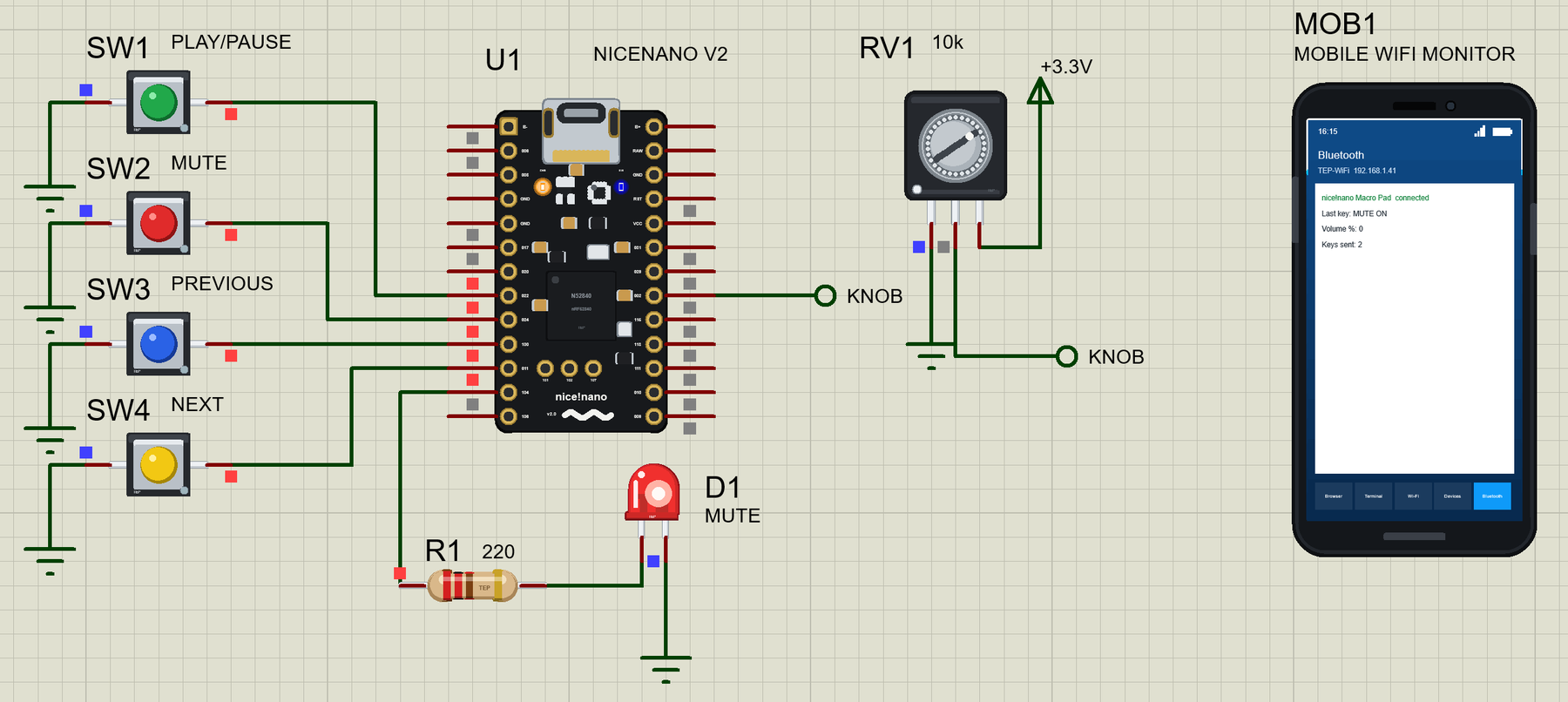
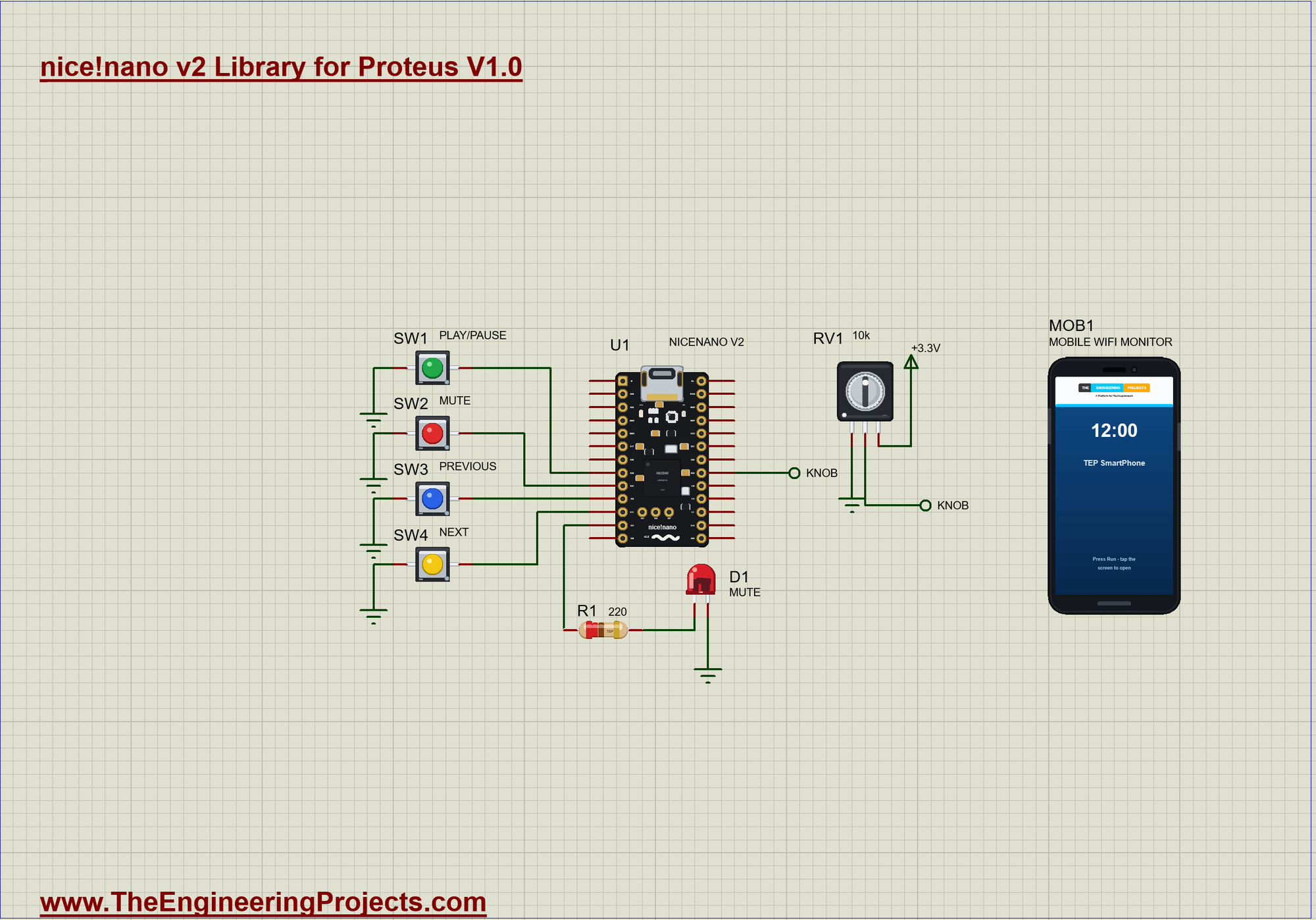
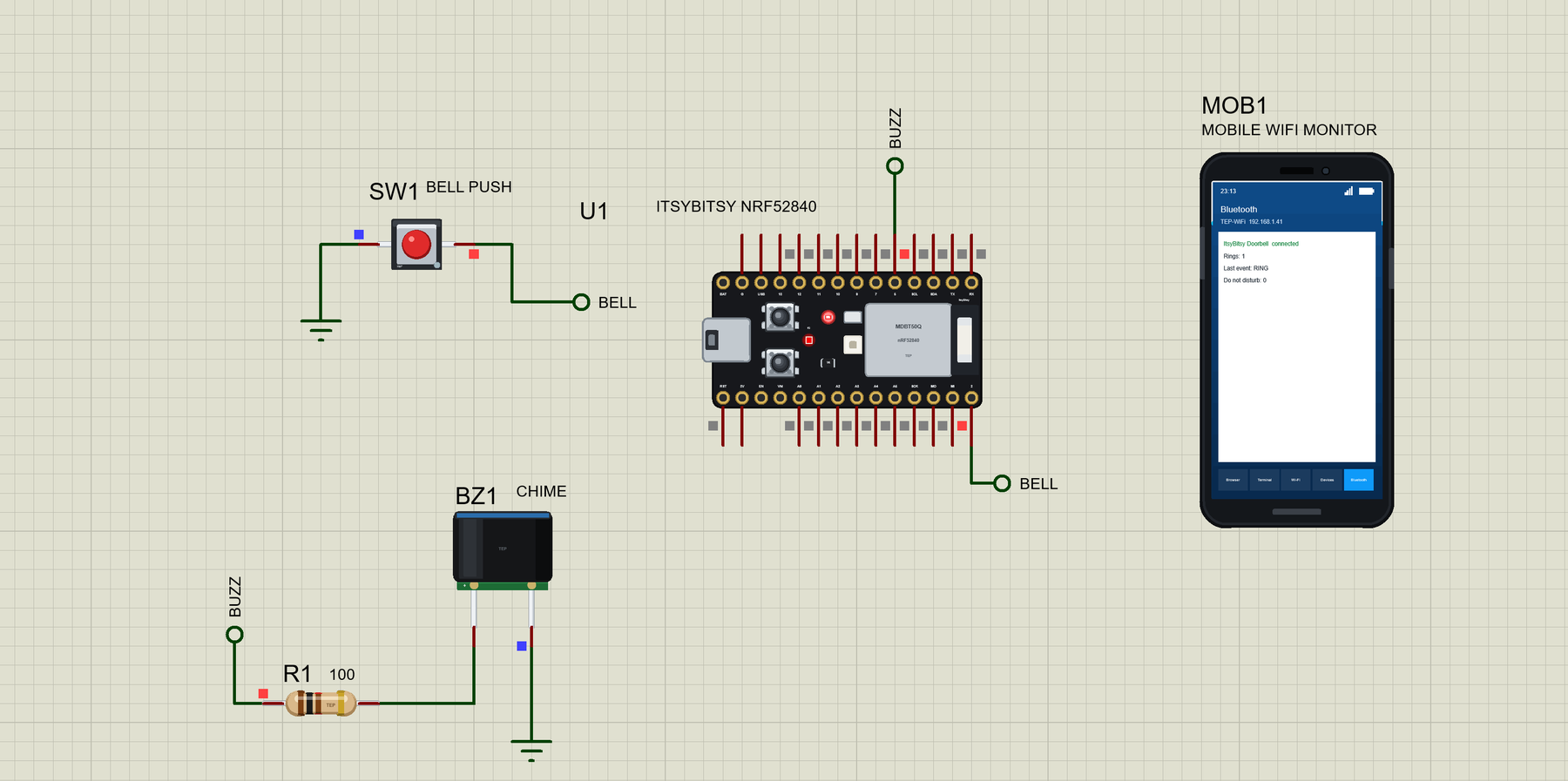
The circuit, the board and the results as they appear in nice!nano v2 nRF52840 Library for Proteus: BLE Macro Pad Simulation. Open an image for its full size.
README
 README
NICE!NANO V2 LIBRARY FOR PROTEUS - V1.0 (YOUR ARDUINO SKETCH, BLUETOOTH LE, THE PRO MICRO PINOUT)
Designed by The Engineering Projects
www.TheEngineeringProjects.com

IMPORTANT LINKS
Article (read it first - pictures, step by step, every feature explained):
  https://www.theengineeringprojects.com/2026/11/nice-nano-v2-library-for-proteus.html
Report a bug or suggest a feature (our forum):
  https://www.theengineeringprojects.com/forum
The demo's other parts are our libraries (included) - their articles:
  https://www.theengineeringprojects.com/2026/11/push-button-library-for-proteus.html
  https://www.theengineeringprojects.com/2026/11/potentiometer-library-for-proteus.html
  https://www.theengineeringprojects.com/2026/11/5mm-led-library-for-proteus.html
  https://www.theengineeringprojects.com/2026/11/resistor-library-for-proteus.html
  https://www.theengineeringprojects.com/2026/10/mobile-wifi-monitor-library-for-proteus.html
Support us (the libraries are free):
  https://www.theengineeringprojects.com/donate

FILE STRUCTURE
nice-nano-v2-TEP-v1.0/
|-- Proteus Library Files/
|   |-- TEPBUTTON.LIB                                    20.7 KB   the push button (demo), to LIBRARY
|   |-- TEPLAPTOP.LIB                                    39.5 KB   the laptop (demo), to LIBRARY
|   |-- TEPLED5MM.LIB                                    21.8 KB   the 5 mm LED (demo), to LIBRARY
|   |-- TEPMOBILE.LIB                                    13.1 KB   the phone (demo), to LIBRARY
|   |-- TEPNICENANO.LIB                                  32.0 KB   the nice!nano v2, to LIBRARY
|   |-- TEPPOT.LIB                                      208.6 KB   the potentiometer (demo), to LIBRARY
|   |-- TEPRESISTOR.LIB                                 306.9 KB   the resistor (demo), to LIBRARY
|-- Proteus Model Files/
|   |-- TEPBUTTON.DLL                                   274.0 KB   the push button, to MODELS
|   |-- TEPLED5MM.DLL                                   289.5 KB   the 5 mm LED, to MODELS
|   |-- TEPNET.DLL                                       3.01 MB   the board + monitors + network, to MODELS
|   |-- TEPPOT.DLL                                      310.0 KB   the potentiometer, to MODELS
|   |-- TEPRESISTOR.DLL                                 311.0 KB   the resistor, to MODELS
|-- Arduino Code/
|   |-- NiceNano_BLE_Macro_Pad/NiceNano_BLE_Macro_Pad.ino    6.6 KB   the demo sketch
|   |-- TEP Boards for Proteus/hardware/                 1.40 MB   the Arduino IDE add-on 2.0.0 (327 files)
|-- Proteus Simulation/
|   |-- NiceNano_BLE_Macro_Pad.hex                       32.6 KB   the demo sketch (U1)
|   |-- nice-nano-v2-BLE-Macro-Pad.pdsprj                28.3 KB   the demo: a Bluetooth LE macro pad
|   |-- TEPBUTTON.DLL                                   274.0 KB   copy of the model
|   |-- TEPLED5MM.DLL                                   289.5 KB   copy of the model
|   |-- TEPNET.DLL                                       3.01 MB   copy of the model
|   |-- TEPPOT.DLL                                      310.0 KB   copy of the model
|   |-- TEPRESISTOR.DLL                                 311.0 KB   copy of the model
|-- README.txt                                          ~13.2 KB   this file
Total: 10.45 MB (unzipped). The source code of the models is not included.

WHAT IS IT?
Proteus 8 has no nRF52840 processor model, so this is NOT a real nRF52840 chip. Our team has put a lot of effort into
building this board ourselves: it is Nice Technologies' nice!nano v2 - the Pro Micro replacement that wireless keyboard
makers use - the matte black board of 18 x 33.5 mm (drawn at true scale from the maker's pinout) with the Nordic
nRF52840 (an Arm Cortex-M4F with 1 MB of flash, 256 KB of RAM and Bluetooth LE), the mid-mount USB-C, the Li-Po charger,
the blue LED, the orange charge LED, the 32.768 kHz crystal, the three extra pads and the two rows of 13 gold pads (the
battery pads B- / B+ on top of the Pro Micro's 12) - and it runs YOUR Arduino sketch in Proteus:
  * You write a normal sketch with the nRF52840's pin numbers - n = P0.n, 32 + n = P1.n, as the community and
    Meshtastic variants - or with the Pro Micro names of the maker's pinout, D0 .. D21 (D2 is P0.17 = pin 17, not
    pin 2). digitalRead / digitalWrite, analogRead 0-1023 on A1, A2, A3 (P0.02, P0.29, P0.31), analogWrite,
    attachInterrupt, pulseIn, tone, Wire, SPI, Serial, Serial1 - and compile it in the Arduino IDE with our board
    package "TEP Boards for Proteus" 2.0.0 (in Arduino Code - see INSTALLATION).
  * The blue LED (pin 15, LED_BUILTIN, the real P0.15) lights when HIGH. The board has no buttons: RESET is a pin.
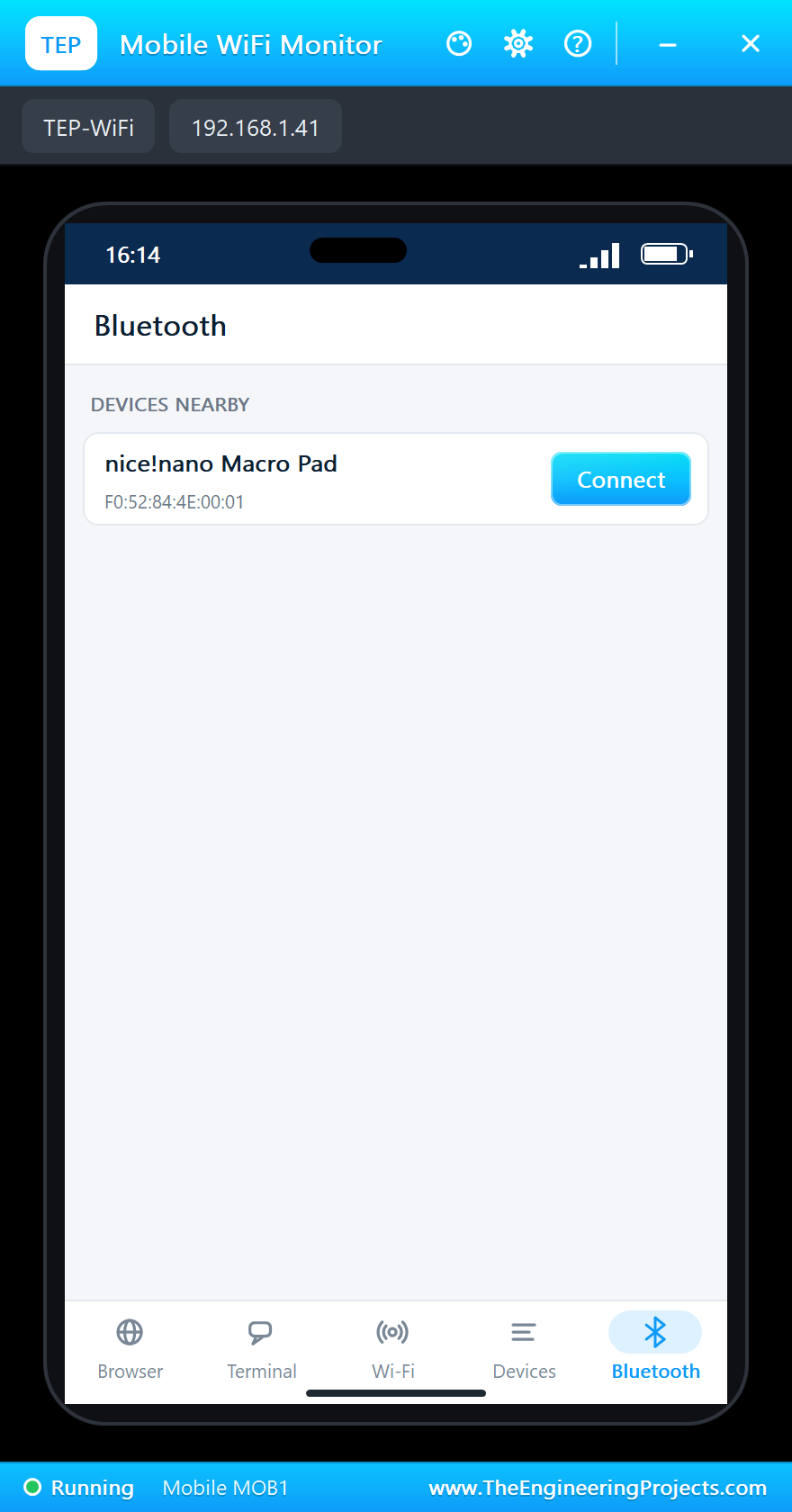
  * Bluetooth LE works through ArduinoBLE: the board advertises as a peripheral with your services and
    characteristics, and our Mobile WiFi Monitor's Bluetooth app is the central (it lists the board, connects, reads,
    writes and gets the notifications).
TEP additions: the USB-C opens the serial monitor (the same window as our TEP Serial Monitor Advance); the orange LED
lights with power (on the real board it shows the charging).
Limits (say them before you start): A0 is the Pro Micro's name for P1.15 (D18), which has no ADC on the nRF52840 -
analogRead works on A1, A2 and A3. The three extra pads (P1.01, P1.02, P1.07) are drawn, not pins of the part. The
3.3 V cut-off (P0.13) is not modelled: the VCC pin stays on. attachInterrupt: P1.15 (D18) and P0.29 (D20) share one
interrupt slot in the simulation - use one of the two for an interrupt. The charger and the battery are drawn, not
modelled. One phone is the central; the board cannot be a central itself (a split keyboard's two halves need that).
Your sketch gets 8 KB of RAM in the simulation (the real one: 256 KB), about 256 KB of flash, and int is 16 bits in the
simulation (use long for big numbers).

ONE DEVICE (search "NICENANO" in Pick Devices):
  NICENANO V2  "nice!nano v2" V1.0 (Microprocessor ICs > Bluetooth Boards), prefix U, model TEPNET.DLL.
  Its TEP window has no Windows title bar: the serial monitor (the USB-C, 115200 baud: Monitor, Plotter and Board
  tabs).
The same TEPNET.DLL also runs our other sketch boards and the phone; it replaces any older TEPNET.DLL (keep only this
newest one in MODELS).

TEST STATUS
V1.0: verified in Proteus 8.5 on 19 Nov 2026 with the demo project as shipped. What the Proteus run showed:
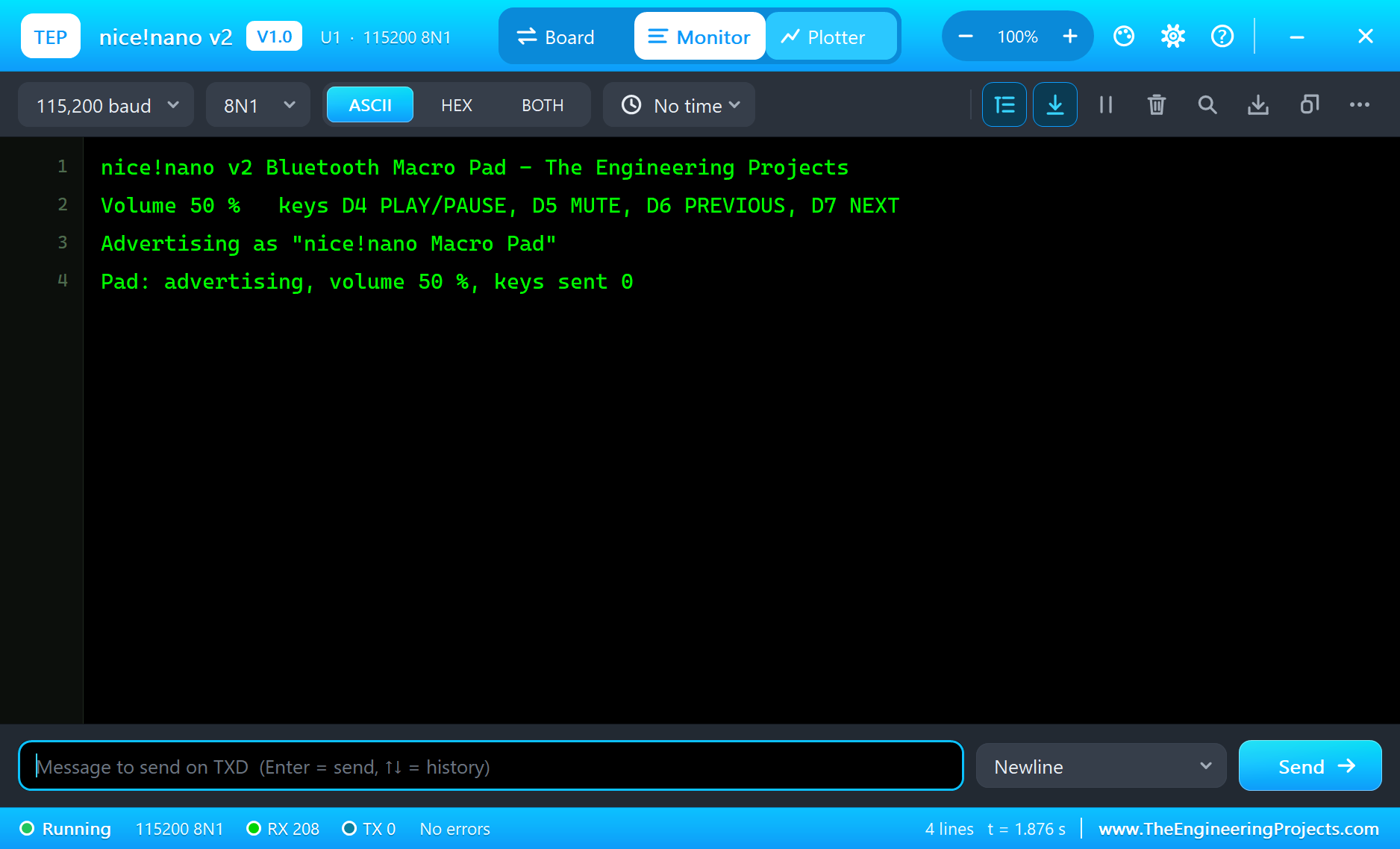
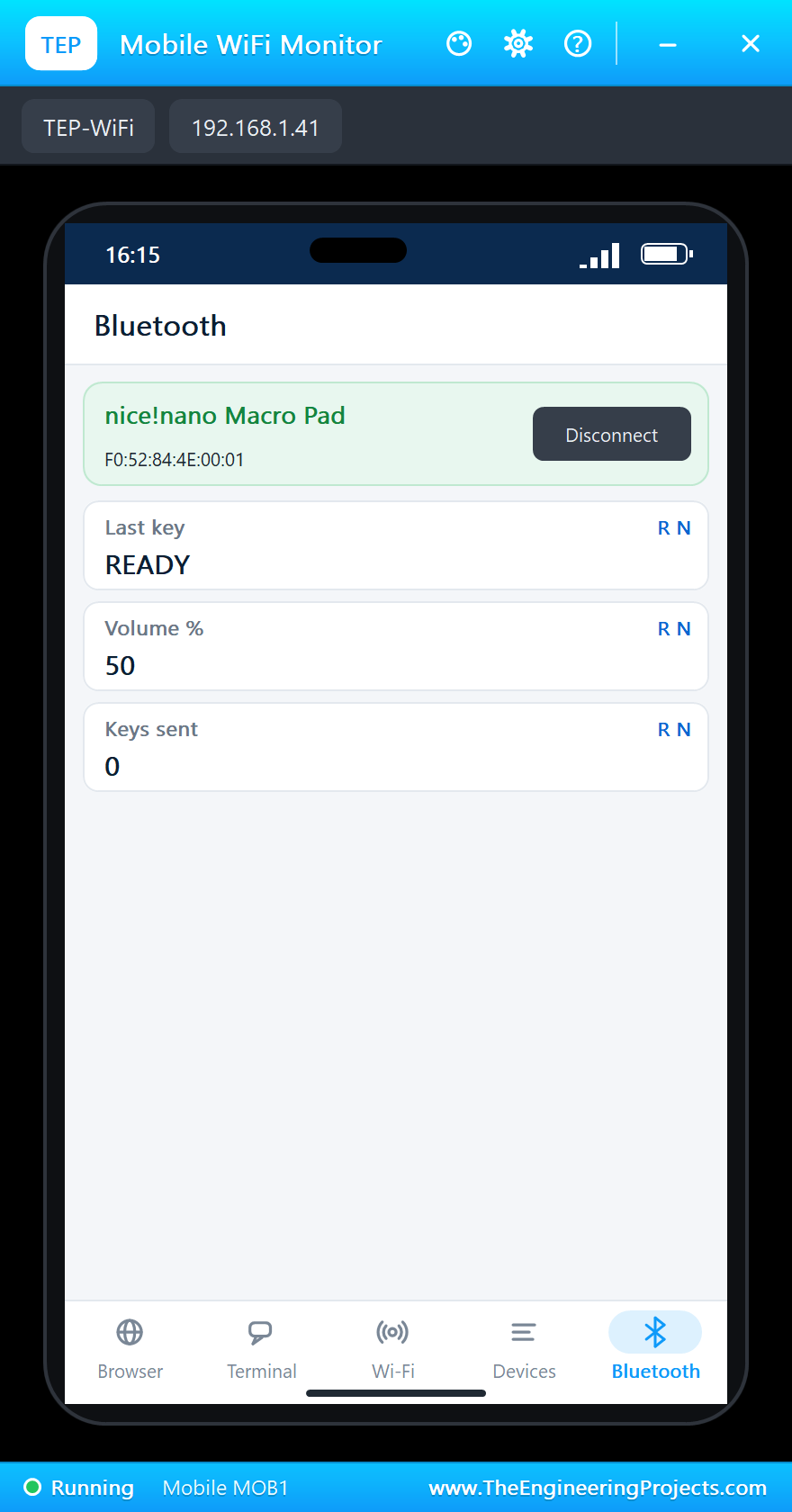
* nice-nano-v2-BLE-Macro-Pad: "Volume 50 %", "Advertising as "nice!nano Macro Pad"" - the blue LED blinks; the
  phone's Bluetooth app connects ("Phone connected", the blue LED on).
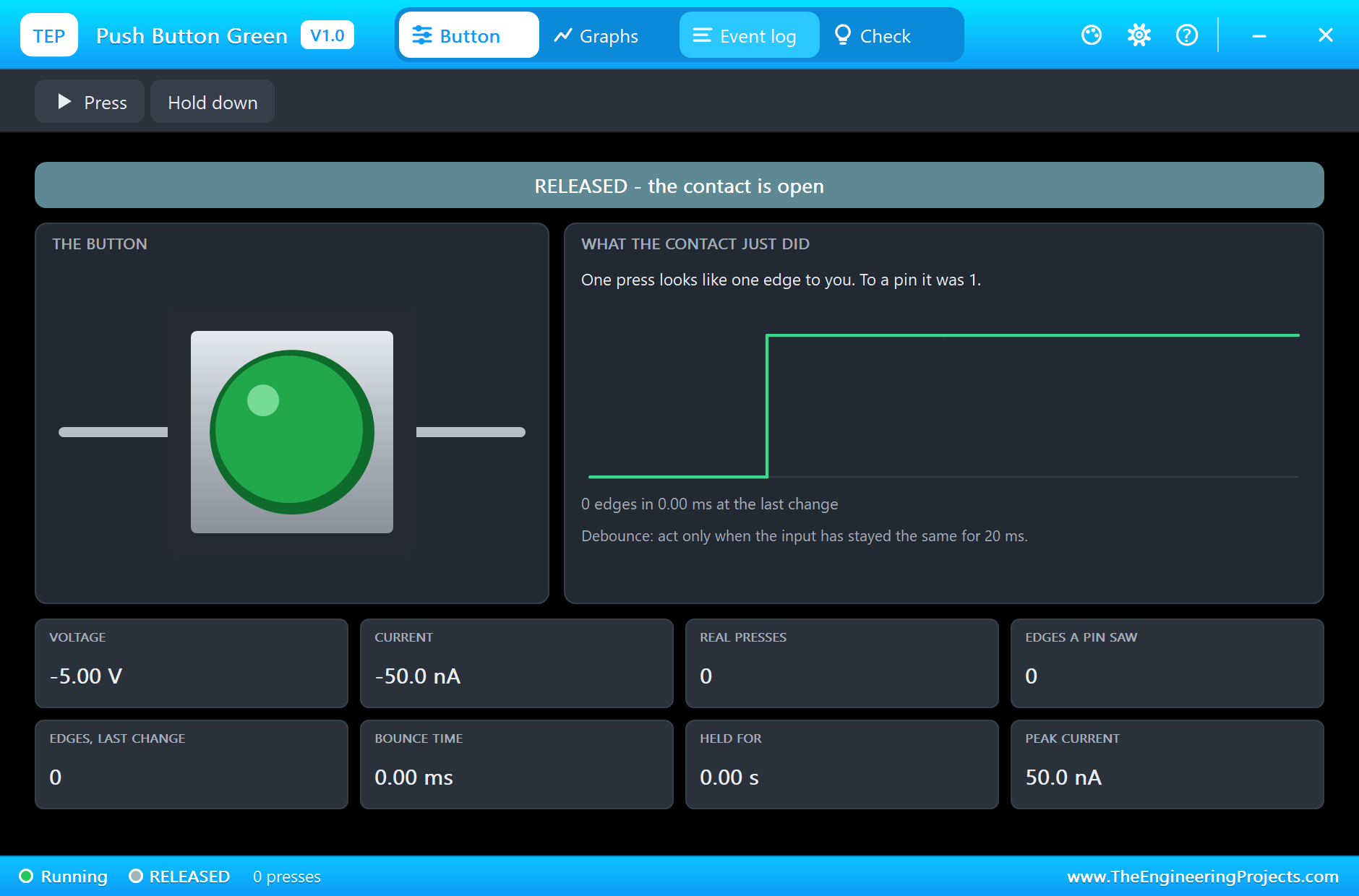
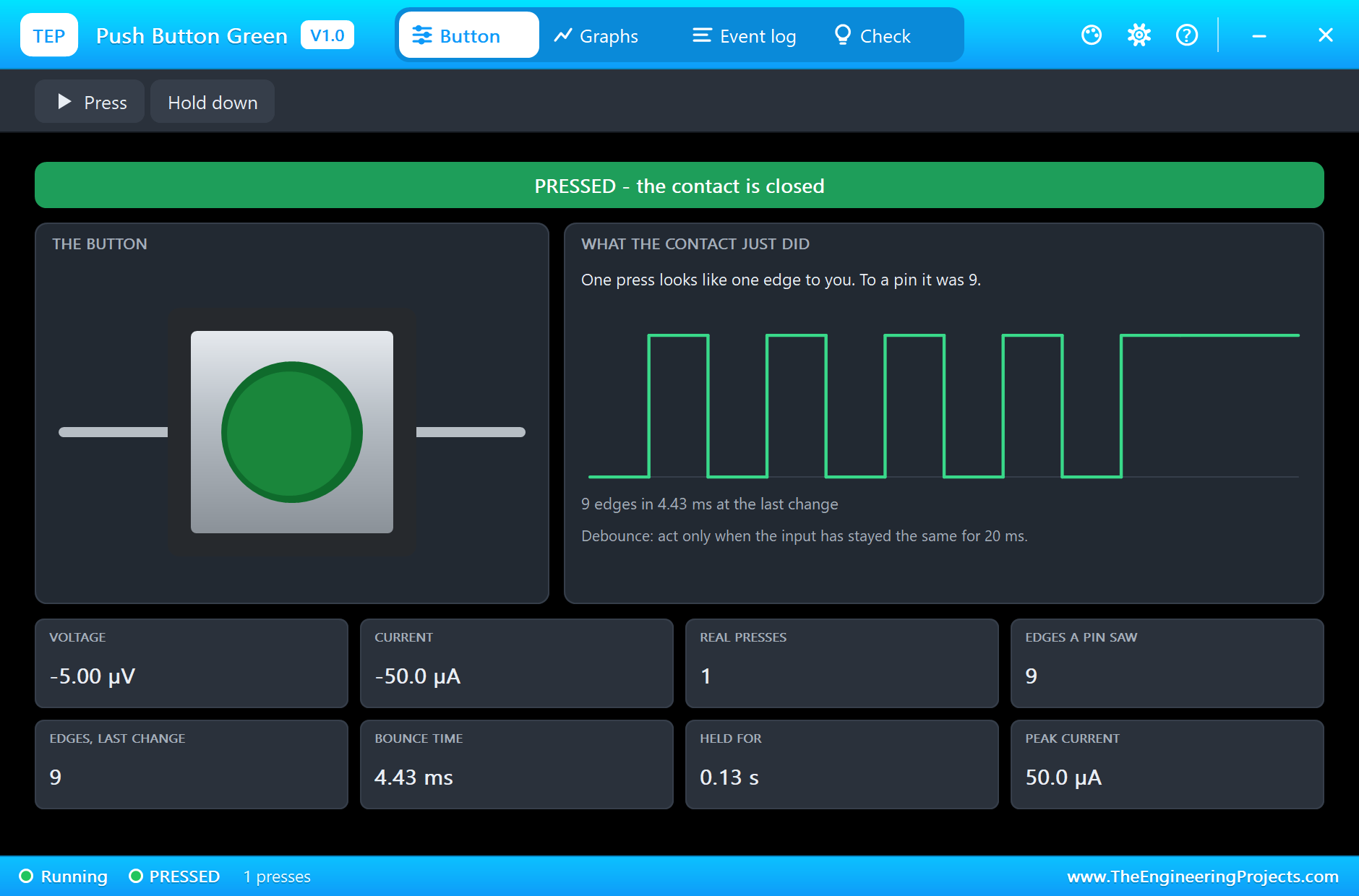
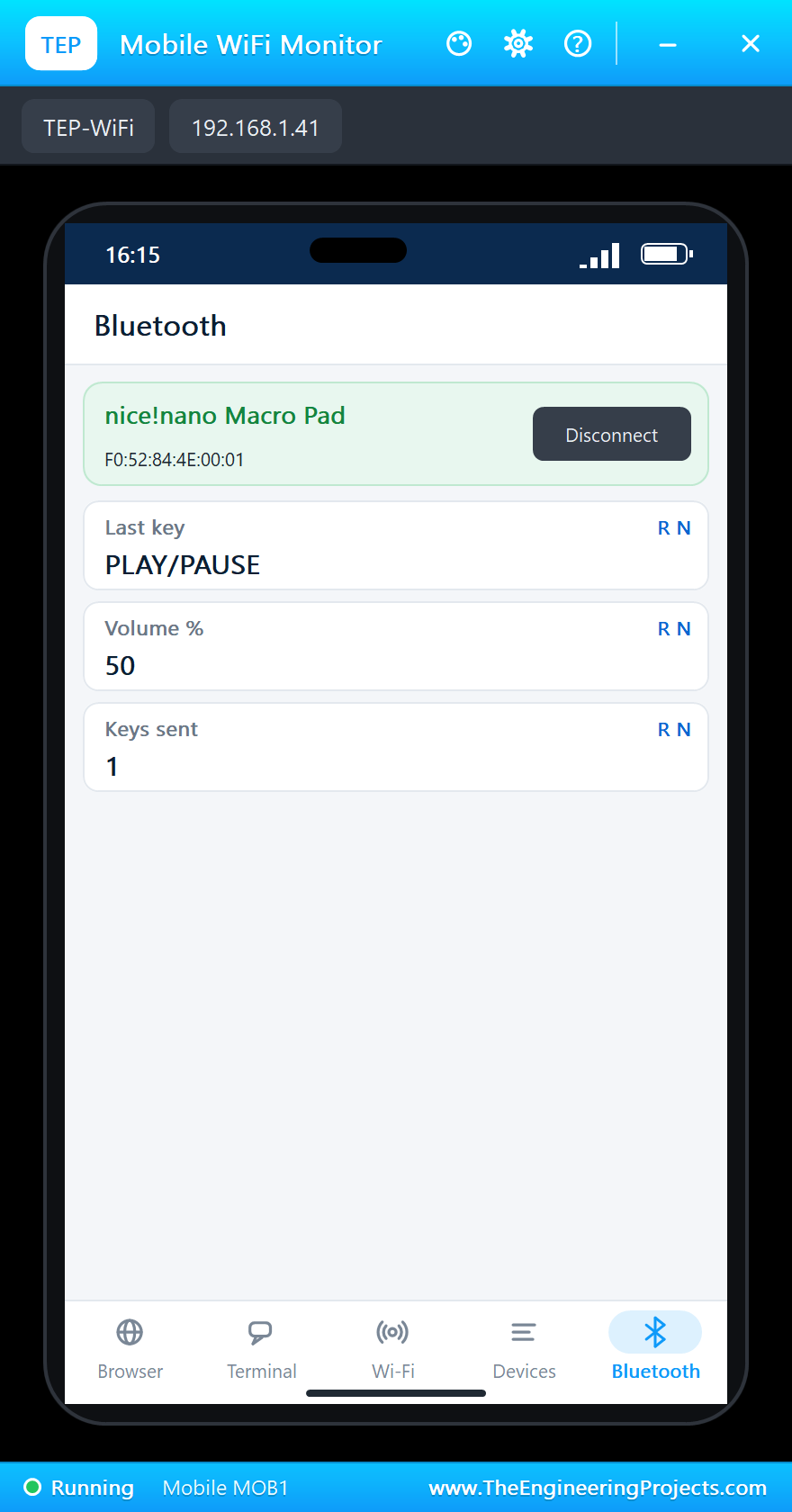
* SW1: ">> KEY 1: PLAY/PAUSE (sent 1)" (the key's window: 9 bounce edges in 4.43 ms, one key); RV1 +10 % twice:
  ">> VOLUME 60 %", ">> VOLUME 70 %"; SW2: ">> KEY 2: MUTE ON (sent 2)" - the red MUTE LED lit, the phone 0 %.
* SW4: ">> KEY 4: NEXT (sent 3)"; RV1 at 100 %: ">> VOLUME 100 % (unmuted)" - the MUTE LED off; SW3:
  ">> KEY 3: PREVIOUS (sent 4)"; "Pad: phone connected, volume 100 %, keys sent 4".
* about 25 s of simulation, no errors, with the keys', the pot's and the phone's windows open.

INSTALLATION (about 3 minutes)
1. Close Proteus. Extract the WHOLE ZIP to a normal folder (e.g. Desktop).
2. Copy everything in "Proteus Library Files" to the LIBRARY folder of Proteus, for example:
     C:\Program Files (x86)\Labcenter Electronics\Proteus 8 Professional\LIBRARY
   (on some PCs: C:\ProgramData\Labcenter Electronics\Proteus 8 Professional\LIBRARY). TEPNICENANO.LIB is the board;
   TEPBUTTON.LIB, TEPPOT.LIB, TEPLED5MM.LIB and TEPRESISTOR.LIB are the demo's push buttons, potentiometer, 5 mm LED and
   resistor, TEPMOBILE.LIB and TEPLAPTOP.LIB the phone and the laptop.
3. Copy the DLLs from "Proteus Model Files" (TEPNET.DLL, TEPBUTTON.DLL, TEPPOT.DLL, TEPLED5MM.DLL, TEPRESISTOR.DLL) to
   the MODELS folder (...\Proteus 8 Professional\MODELS) - replace an older TEPNET.DLL (this one is the first that knows
   this board).
4. Delete TEPNICENANO.IDX from the LIBRARY folder if it is there.
5. The Arduino IDE (only to compile your own sketches - the demo has its HEX file): copy the folder
   "Arduino Code\TEP Boards for Proteus\hardware" into your sketchbook folder (normally Documents\Arduino), so that
   Documents\Arduino\hardware\tep\avr\boards.txt exists (replace an older copy); restart the IDE. The Arduino AVR Boards
   platform must be installed (it comes with IDE 1.8.x; in IDE 2.x install "Arduino AVR Boards" from the Boards
   Manager once).
   Tools > Board > TEP Boards for Proteus > nice!nano v2 (TEP Proteus). ArduinoBLE is in the board package.
6. Start Proteus. In Pick Devices (P) search "NICENANO".

RUN THE DEMO
Keep the .hex file and the DLLs beside the project in "Proteus Simulation".
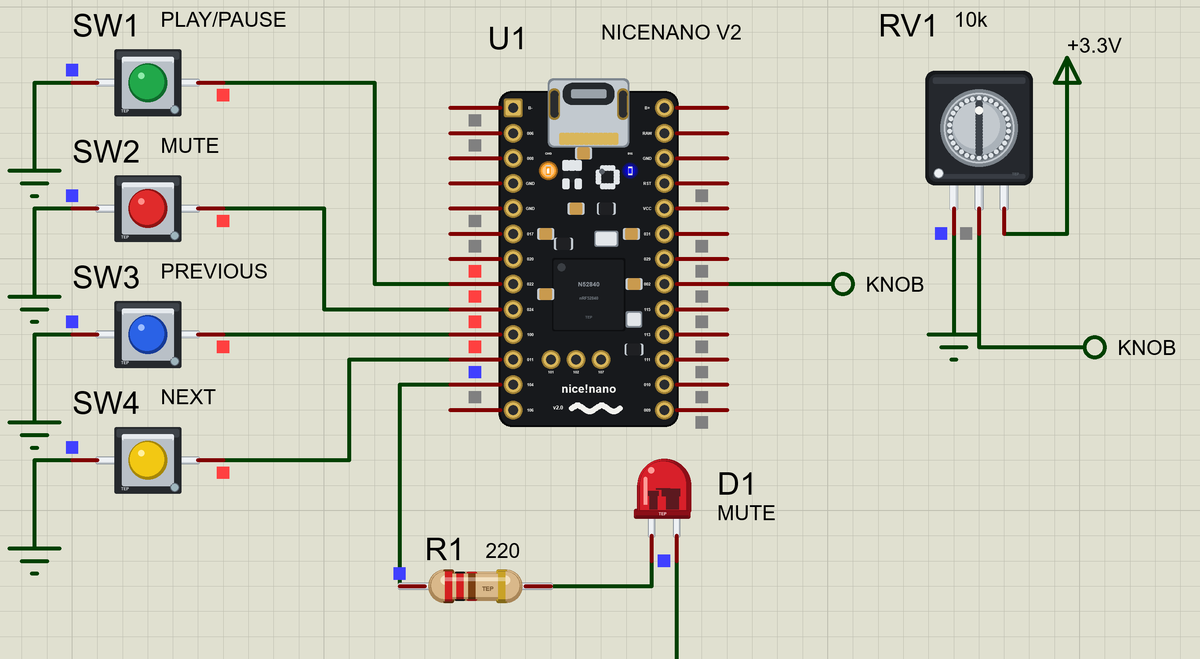
nice-nano-v2-BLE-Macro-Pad.pdsprj - U1 the nice!nano v2 (NiceNano_BLE_Macro_Pad.hex) is a Bluetooth media pad: SW1 ..
SW4 = our 6 mm push buttons (green PLAY/PAUSE on D4, red MUTE on D5, blue PREVIOUS on D6, yellow NEXT on D7; each pin
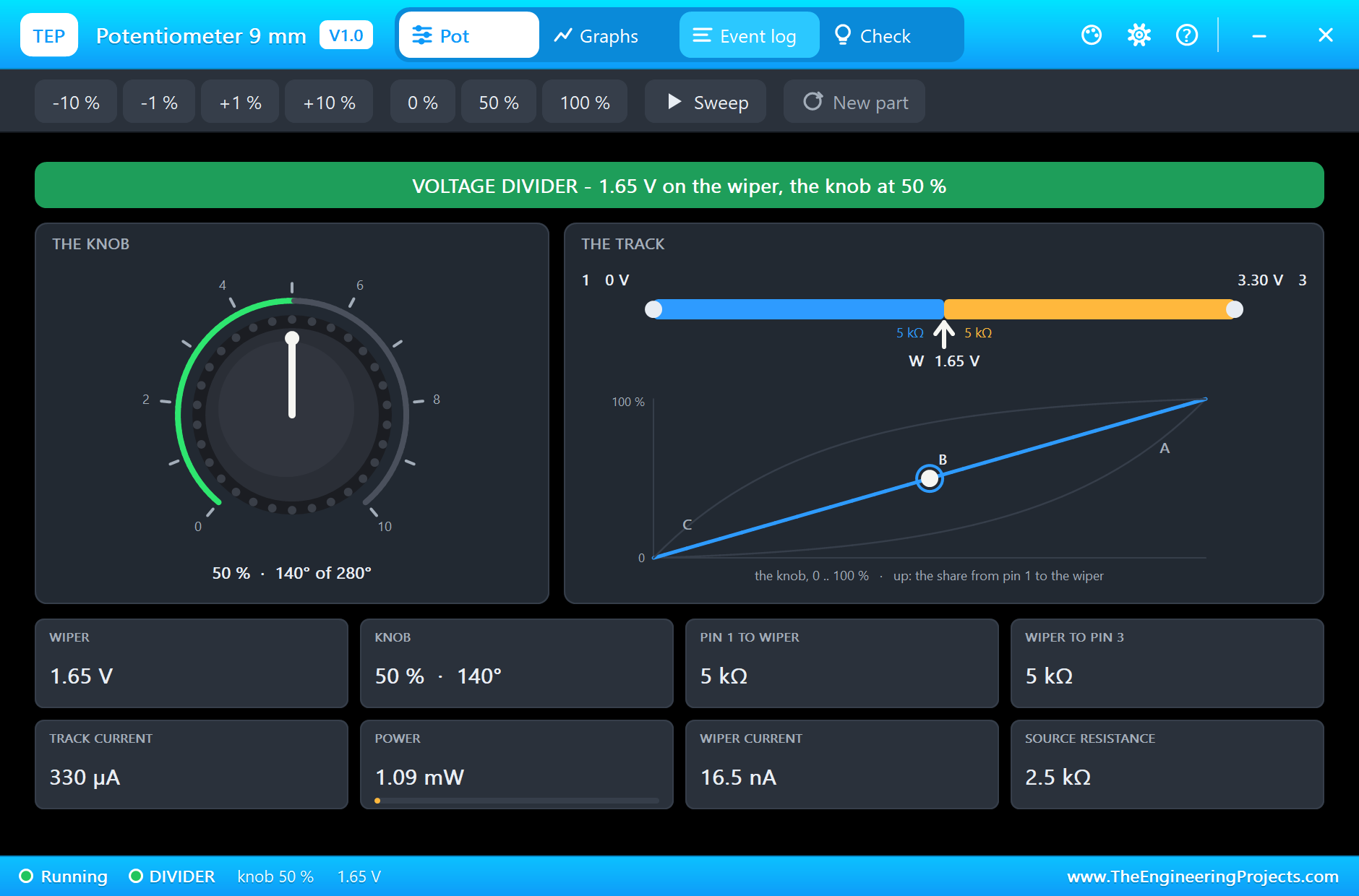
1 to ground, pin 2 to the board), RV1 = our 9 mm potentiometer, the volume knob (pin 1 to ground, pin 3 to +3.3V, the
wiper on A1 = D19 = KNOB), D1 = our 5 mm red LED, the MUTE light, through R1 (220 ohm) on D8; MOB1 = the phone (Mobile
WiFi Monitor), whose Bluetooth app connects to it.
Press Run. The monitor prints "Advertising as "nice!nano Macro Pad"" and the volume; the blue LED blinks. On the phone
open the Bluetooth app, press SCAN and connect (the blue LED stays on): it shows the last key, the volume and the keys
sent. In a key's window click Press (or click the key on the sheet): ">> KEY 1: PLAY/PAUSE (sent 1)" and the blue LED
blinks off once. In RV1's window turn the knob (the +10 % chip): ">> VOLUME 60 %". MUTE lights the red LED and the phone
reads 0 %; turning the knob unmutes, as on most media keyboards.
Closed a window? The USB-C opens the monitor, a click on a key, the pot or the phone's screen its window.

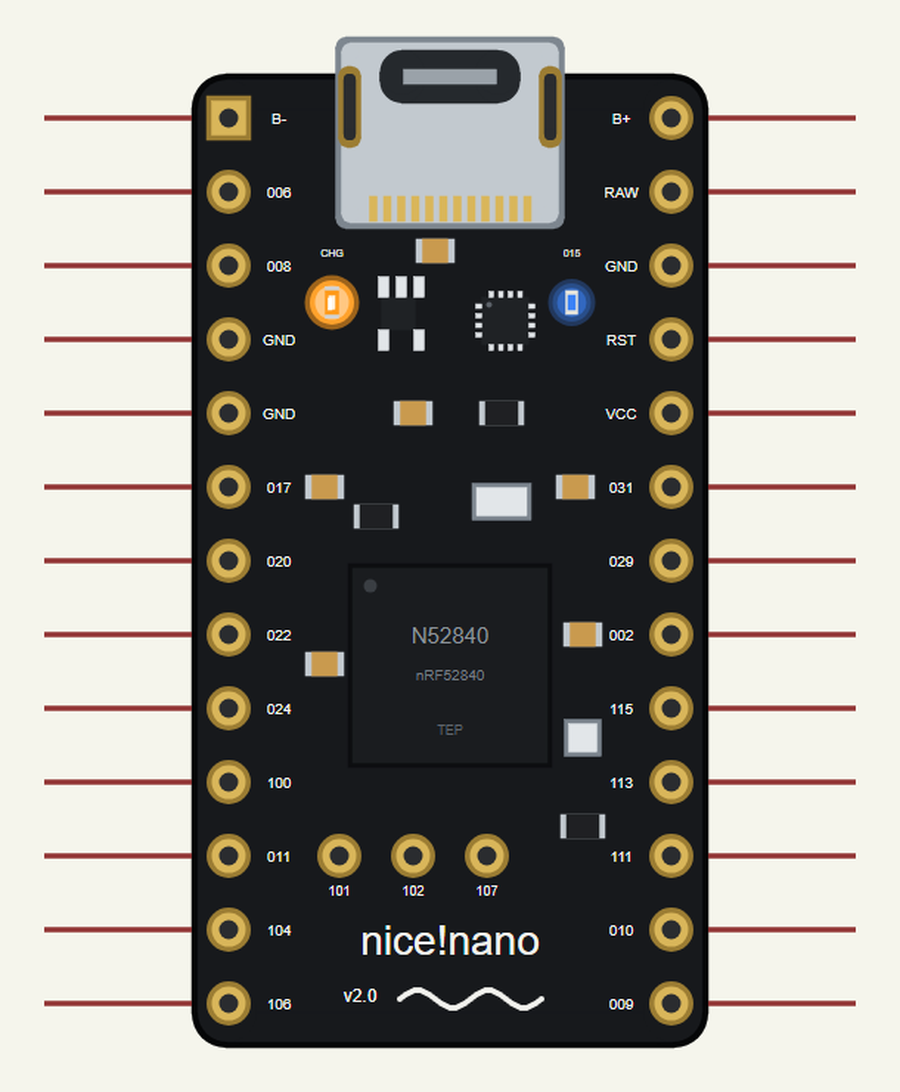
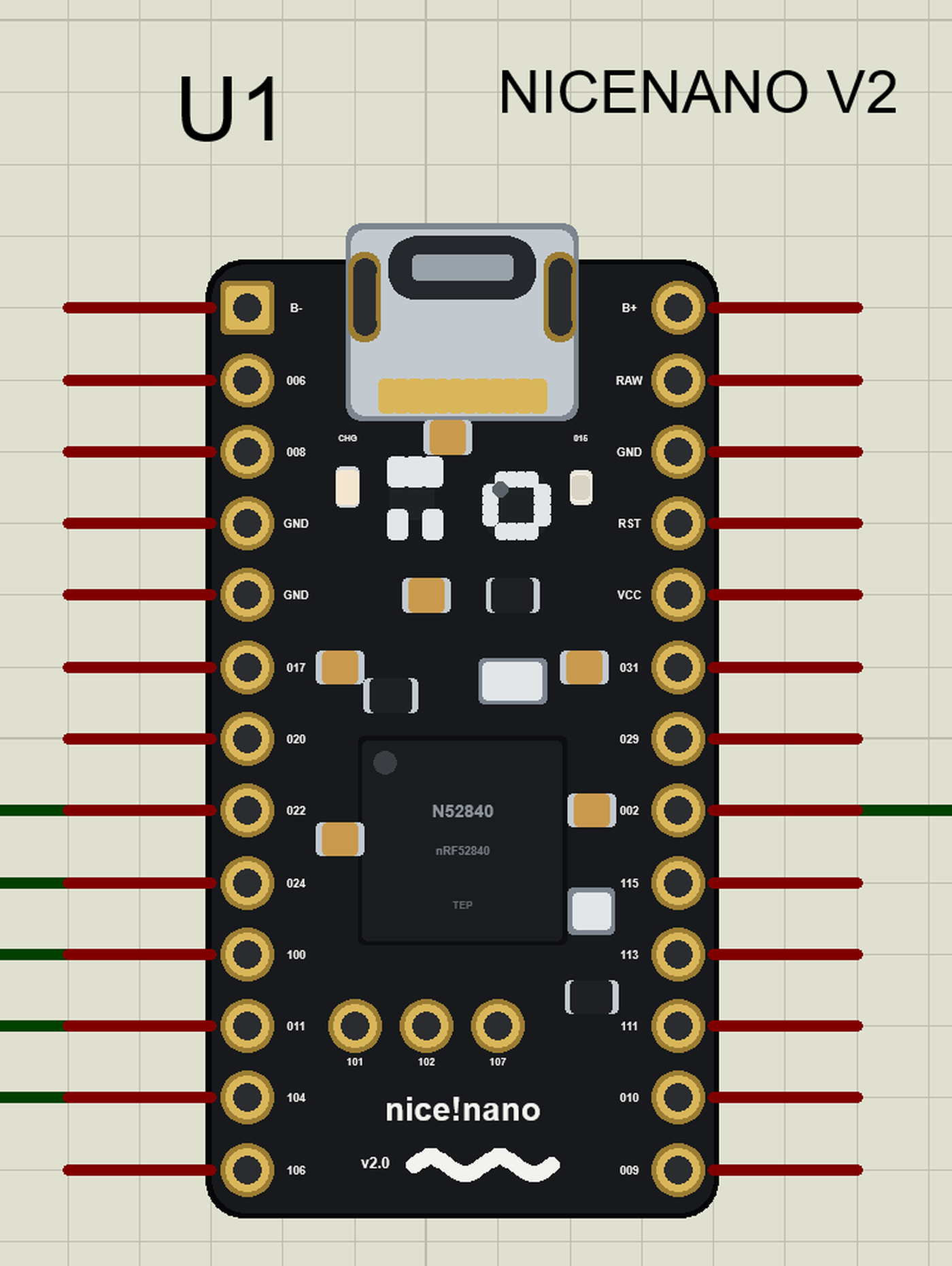
THE PINS (the label on the part = the real board's back silk, what it can do in the simulation; the maker's names)
  006, 008        Serial1 TX / RX, or GPIO (P0.06 = D1 = pin 6, P0.08 = D0 = pin 8)
  017, 020        Wire SDA / SCL, or GPIO (P0.17 = D2 = pin 17, P0.20 = D3 = pin 20)
  022, 024, 100   GPIO, PWM, interrupt, pulse timing (P0.22 = D4, P0.24 = D5, P1.00 = D6 = pin 32)
  011, 104, 106   GPIO, PWM, interrupt (P0.11 = D7, P1.04 = D8 = pin 36, P1.06 = D9 = pin 38)
  031, 029, 002   A3, A2, A1: analogRead 0 .. 1023 for 0 .. 3.3 V, or GPIO, PWM (P0.31 = D21, P0.29 = D20, P0.02 = D19)
  115             GPIO (P1.15 = D18 = pin 47, the Pro Micro's A0 - digital only)
  113, 111, 010   SPI SCK / MISO / MOSI, or GPIO (P1.13 = D15 = pin 45, P1.11 = D14 = pin 43, P0.10 = D16)
  009             SPI SS, or GPIO (P0.09 = D10)
  VCC, RAW, B+    3.3 V (the logic); the battery + (RAW and B+ are one net);   GND, B-  ground;   RST  the board's reset
The blue LED is pin 15 (LED_BUILTIN, LED_BLUE, lit when HIGH); pin 13 is the 3.3 V cut-off (EXT_VCC, not modelled).
Serial is the USB: the board's built-in monitor.

PROPERTIES (double-click the part > Edit Properties)
  PROGRAM      the sketch's HEX (Arduino IDE: Sketch > Export Compiled Binary with the TEP Proteus nice!nano v2)
  MONITOR      YES = the built-in serial monitor on Serial;  BAUD  its speed (115200, or AUTO)
  AUTOOPEN     YES = the monitor window opens at Run (the demo: YES)

TROUBLESHOOTING
* The phone's list is empty: call BLE.begin(), set a local name and BLE.advertise(); call BLE.poll() in loop().
* A key does nothing: the pin number is the nRF52840's - use the D names (pinMode(D4, INPUT_PULLUP)) or 22, not 4.
* analogRead always reads 0: only A1, A2 and A3 (P0.02, P0.29, P0.31) are analog inputs on the nRF52840.
* One key press counts twice: debounce it (a new level counts after 25 ms without a change).
* An integer goes wrong above 32767: int is 16 bits in the simulation - use long.

BUG REPORTS AND FEATURE REQUESTS
Please post them in our forum with a screenshot and the Serial Monitor text:
  https://www.theengineeringprojects.com/forum

LICENCES AND THIRD-PARTY NOTES
* The board model (TEPNET.DLL), the symbols and artwork (TEPNICENANO.LIB) and the push button, potentiometer, LED and
  resistor models are made by The Engineering Projects. The source code of the models is not included.
* TEP Boards for Proteus (Arduino Code): its core, the variants and the EEPROM, SPI and Wire libraries are modified
  copies of the Arduino AVR core 1.8.6 - GNU Lesser General Public License 2.1 (LGPL 2.1, the text:
  LICENSE-LGPL-2.1.txt); its ArduinoBLE and the others and our core files are MIT (LICENSE-MIT.txt).
* Our ArduinoBLE has the calls of the library of that name; its code is ours.
* Proteus is a product of Labcenter Electronics and is not included. nice!nano is a name of Nice Technologies LLC,
  nRF52840 of Nordic Semiconductor ASA, Pro Micro of SparkFun Electronics, Arduino of Arduino. The Bluetooth word mark
  belongs to Bluetooth SIG. This library is not made or endorsed by them or by Labcenter.

REBUILDING THE FIRMWARE (OPTIONAL)
The HEX file is supplied. Install TEP Boards for Proteus (INSTALLATION step 5), open Arduino Code\
NiceNano_BLE_Macro_Pad, select nice!nano v2 (TEP Proteus) and use Sketch > Export Compiled Binary.
A real nice!nano ships with the Adafruit nRF52 bootloader (UF2): most people run ZMK or BlueMicro on it; for Arduino
use an Adafruit-nRF52-based board package with a nice!nano variant and Bluefruit or your own Bluetooth code; its pins
work at 3.3 V.

MODEL SCOPE AND LIMITS
Modelled: the board's pins; digital I/O, analogRead 0 .. 1023 on A1 .. A3, PWM (analogWrite), pulse timing, tone and
attachInterrupt through the board model; Serial (the board's monitor), Serial1, Wire and SPI; the blue LED and RESET;
Bluetooth LE as a peripheral (ArduinoBLE) with the phone as the central.
Not modelled: the nRF52840 itself, the radio's range, the charger and the battery, the 3.3 V cut-off, the extra pads,
USB HID, the board as a central. The simulation runs below real time.
VERSION
TEP nice!nano v2 library V1.0 (Nov 2026). Device NICENANO V2 (TEPNICENANO.LIB / TEPNET.DLL), TEP Boards for Proteus
2.0.0 (adds this board: the nRF52840 pin numbers, the Pro Micro names D0 .. D21, A1 .. A3, the blue LED).
Demo sketch NiceNano_BLE_Macro_Pad V1.0. Demo parts: BUTTONGREENTEP, BUTTONREDTEP, BUTTONBLUETEP, BUTTONYELLOWTEP,
POTROTARY9TEP, LED5MMREDTEP, RESISTOR4BANDTEP and MOBILE WIFI MONITOR.Development1 release
 Development1 release
-
V2nice!nano v2 Library for Proteus V1.0this page
V2 is the only release in the Download Center so far. When a newer version is published, it appears above with its own download page.
Installation10 steps
 Installation10 steps
From the download to a working project, in order. The steps follow what the package contains.
You will need
- Proteus Design SuiteProteus 8 or newer (Labcenter), on Windows
- Arduino IDE1.8 or 2.x, with the board of the tutorial chosen under Tools → Board
- The compiler named in the tutorialto build the source files into firmware
- Any archive toolWindows, macOS and Linux extract ZIP files on their own

Steps
- 1
Extract the archive
Right-click 6e5ec629069141a19d6813e8244b1e39.zip and choose Extract All (or open it with 7-Zip or WinRAR) into a folder you can find again. Keep its folder structure (nice-nano-v2-TEP-v1.0) as it is.
- 2
Copy the library files into Proteus
Move TEPBUTTON.LIB, TEPLAPTOP.LIB and TEPLED5MM.LIB and 4 more and the files into the LIBRARY folder of your Proteus installation: C:\Program Files (x86)\Labcenter Electronics\Proteus 8 Professional\LIBRARY for Proteus 8, or the matching Proteus 7 folder. Older versions keep it under ProgramData\Labcenter Electronics. If Proteus is open, close it first.
- 3
Add the simulation model
Copy TEPBUTTON.DLL, TEPLED5MM.DLL and TEPNET.DLL and 2 more into the MODELS folder next to LIBRARY, so the component can run, not only be drawn.
- 4
Restart Proteus and place the component
Start Proteus, open a schematic, press P (Pick Devices) and search for the component by the name used in the tutorial. It appears with its pins ready to wire.
- 5
Install the Arduino library
In the Arduino IDE choose Sketch → Include Library → Add .ZIP Library and pick the library, or copy its folder into Documents\Arduino\libraries. Restart the IDE to see its examples.
- 6
Open the sketch in the Arduino IDE
Open NiceNano_BLE_Macro_Pad.ino, eeprom_clear.ino and eeprom_crc.ino and 17 more, select your board and port under Tools, then Verify. Sketch → Export Compiled Binary writes the HEX file a simulation needs.
- 7
Build the source code
Open abi.cpp, Arduino.h and binary.h and 52 more in the compiler named in the tutorial (MikroC, Keil, MPLAB, Code Composer or the Arduino IDE) and build it to get the firmware.
- 8
Load the HEX file
In Proteus double-click the microcontroller, set Program File to NiceNano_BLE_Macro_Pad.hex and run the simulation. For real hardware, flash the same file with your programmer.
- 9
Open the example simulation
Open nice-nano-v2-BLE-Macro-Pad.pdsprj in Proteus to see the wiring exactly as in the tutorial. Check the controller's Program File path, then press Play.
- 10
Follow the tutorial
nice!nano v2 nRF52840 Library for Proteus: BLE Macro Pad Simulation explains every connection and setting in order; keep it open beside the files while you build.
FAQs9 questionsContact TEP
 FAQs9 questions
How do I download nice!nano v2 Library for Proteus V1.0?
Wait for the 30-second guest countdown on this page, then press the download button; the file comes straight from our storage. Members who are logged in skip the wait. If the browser opens the file instead of saving it, use its Save as option. The download link is made for you when the countdown ends and works for 15 minutes; a saved or shared link stops working, so share this page instead.
What is inside the archive?
nice!nano v2 Library for Proteus V1.0 comes as a ZIP archive of 348 files (4.5 MB, 10.4 MB unpacked) holding Proteus library files, simulation model DLLs, a Proteus simulation, an Arduino sketch, an Arduino library, compiled HEX firmware and source code. Open the File Structure tab for the full list of 348 files.
What should I do if the download does not start?
Check the browser's download list first; an ad blocker or a company firewall can also hold it back, so try another browser or network. If the file arrives incomplete, download it again. For an installation problem, read the Install tab or tell us in the comments with your software version and the exact error message.
Is this file free?
Yes. Every file in the TEP Download Center is free for learning, personal and student projects. If you share it, link back to this page or the tutorial so others find the latest version.
How do I check that the file arrived complete?
Compare its SHA-256 with the one on this page, 5d2ce34cbd45aeb58992bb9d0ea52228c83bbf49b227ba097951470fe2d7dcaf. In PowerShell run Get-FileHash "6e5ec629069141a19d6813e8244b1e39.zip"; on macOS or Linux run shasum -a 256 "6e5ec629069141a19d6813e8244b1e39.zip". The same value means the file is exactly the one in our storage; a different one means the download broke off, so download it again.
Do I need WinRAR to open the ZIP file?
No. Windows, macOS and Linux open ZIP archives on their own (Extract All, or double-click). WinRAR and 7-Zip work too. Extract the whole archive before using the files.
Where do I put the LIB and IDX files?
Both files go into the LIBRARY folder of your Proteus installation (Proteus 8: C:\Program Files (x86)\Labcenter Electronics\Proteus 8 Professional\LIBRARY; Proteus 7 has the same folder under its own name). Restart Proteus afterwards and search for the component with P.
Which Proteus version does the library need?
The tutorial names the Proteus version the library was made and tested with. Most TEP libraries work in Proteus 7 and Proteus 8; if the component does not appear after a restart, check that both the LIB and the IDX file were copied and that Proteus was fully closed while copying.
How do I get the HEX file into the simulation?
Compile the sketch in the Arduino IDE (Sketch → Export Compiled Binary gives you the HEX next to the sketch), then in Proteus double-click the board, set Program File to that HEX and run.
Members skip the wait. Log in or join TEP.

- 0Total downloads
- 4%Popularity
- ProteusCategory
- 0Comments
- ssyedzainnasirUploaded by
- 24 Nov 2026Uploaded at


 SHA-256
5d2ce34cbd45aeb58992bb9d0ea52228c83bbf49b227ba097951470fe2d7dcaf


 Need help with this file?
 Tags
Related Proteus
All Proteus tutorials




Comments
0