


Folding vs. Press Braking: How CNC Folding Technology Is Reshaping Sheet Metal Fabrication


Sheet metal fabrication has always depended on finding the right balance between precision, speed, repeatability, and cost. For decades, press brakes have been a familiar choice for forming metal components, particularly in applications requiring substantial forming force or complex tooling arrangements. Advances in computer numerical control (CNC) technology are changing how manufacturers approach bending and folding. Modern folding systems can automate positioning, improve consistency, and reduce some of the setup demands traditionally associated with conventional press braking.
The difference is more than a matter of machine design. It can affect workflow, labor requirements, production flexibility, material handling, and the quality of finished parts. As manufacturers face tighter tolerances, shorter production runs, and growing pressure to reduce waste, understanding the distinction between CNC folding and press braking is becoming increasingly important. Both technologies have valuable roles, but their strengths are different, and choosing between them requires a clear understanding of the job at hand.
Understanding Press Braking
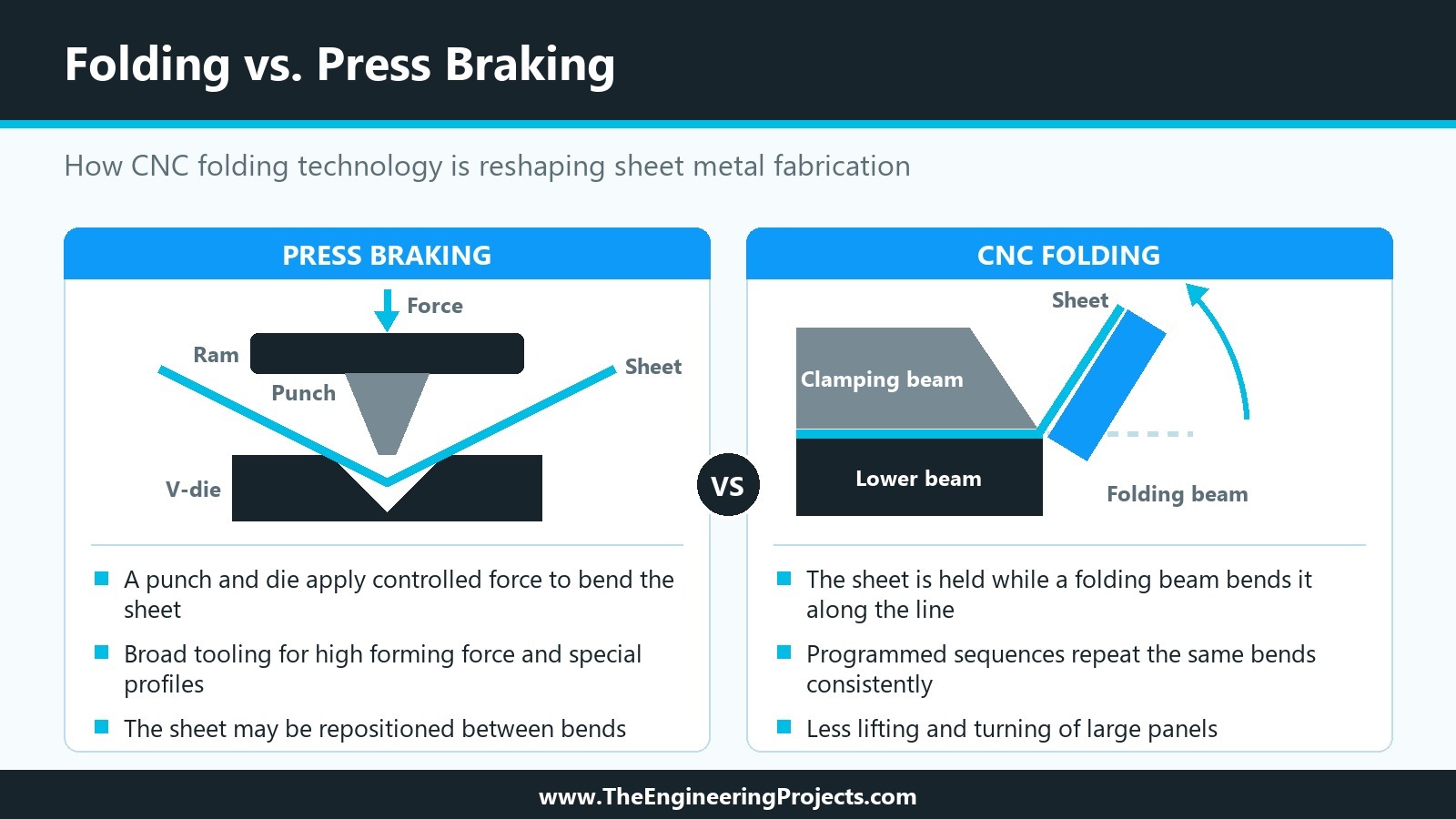
Press braking is one of the most established methods of sheet metal forming. A press brake uses a punch and die arrangement to apply controlled force to a sheet, creating bends at predetermined angles. Depending on the machine and tooling configuration, press brakes can handle a wide range of materials, thicknesses, and part geometries. Their versatility has made them a standard fixture in fabrication shops across industries such as automotive, construction, HVAC, industrial equipment, and general manufacturing.
Modern CNC press brakes have evolved considerably from manually operated equipment. Computer-controlled back gauges, programmable bending sequences, automatic angle compensation, and digital setup functions allow operators to produce highly repeatable components. This makes press braking particularly useful when a component requires multiple bends or when a manufacturer needs to maintain consistent dimensions across a large production run. The ability to accommodate different tooling configurations also gives press brakes considerable flexibility.
However, press braking can involve substantial setup and material handling. A sheet may need to be repositioned between operations, especially when producing larger or more complicated components. Tool selection and alignment are also important because an unsuitable configuration can lead to inaccurate bends, marking, or unnecessary production time. Skilled operators remain valuable because programming alone does not eliminate the need for practical knowledge about material behavior, springback, tooling, and bend allowances.
How CNC Folding Changes the Process
CNC folding approaches sheet metal forming from a different direction. Instead of relying primarily on a traditional punch-and-die action, folding machines typically hold the workpiece in position while folding beams manipulate the material along programmed bend lines. This design can reduce the need for operators to repeatedly reposition the sheet, particularly when producing parts with several bends.
Automation is central to the appeal of modern folding technology. A CNC folding machine can use programmed sequences to coordinate bending operations with consistent positioning and repeatable movements. Once a suitable program has been established, the same process can be repeated across numerous parts with less dependence on manual measurement and adjustment. This can be particularly valuable when manufacturers need predictable results while managing frequent design changes or smaller production batches.
Another important advantage is material handling. With certain folding configurations, the operator can maintain control of the sheet while the machine performs successive bends. This can simplify the workflow for larger panels and reduce some of the physical effort associated with repeatedly lifting, turning, and repositioning workpieces. Ergonomics is increasingly recognized as an important consideration in manufacturing, so improvements that reduce unnecessary manual handling can contribute to a more sustainable production environment.
Comparing Accuracy, Speed, and Flexibility
Accuracy is one of the main considerations when comparing forming technologies. Both modern CNC folding systems and CNC press brakes can produce highly precise components when properly programmed, maintained, and operated. The difference often comes down to the geometry of the component, the material, the required tolerance, and the production process rather than the machine type alone.
For parts involving many sequential bends, CNC folding can provide an efficient workflow because the sheet may remain in a controlled position throughout multiple operations. This can reduce opportunities for cumulative positioning errors. Press brakes, meanwhile, remain highly capable for applications where powerful forming, specialized tooling, or particular bend geometries are required. Manufacturers therefore need to evaluate the entire production sequence rather than assuming that one technology is universally faster.
Flexibility is another area where the two approaches can differ. Press brakes offer a broad tooling ecosystem, making them adaptable to many specialized applications. Folding machines can be particularly attractive for sheet-based components that require repeated bends and consistent positioning. In facilities producing a diverse mix of parts, the ability to move efficiently between different programs can become a significant advantage. CNC controls allow manufacturers to store and recall production parameters, reducing the need to recreate settings manually for repeat jobs.
The Impact on Labor and Production Workflow
Manufacturing technology is increasingly being evaluated not only by its mechanical capabilities but also by how effectively it supports the people operating it. Labor shortages, training requirements, and workplace ergonomics have encouraged manufacturers to look for equipment that can simplify repetitive processes without sacrificing quality.
CNC folding can help address some of these challenges by automating positioning and bending sequences. An operator still needs to understand the material, inspect components, load the machine correctly, and recognize potential problems, but the equipment can reduce the amount of repetitive intervention required during production. This can allow skilled workers to spend more time on programming, quality control, process improvement, and other higher-value activities.
Press brakes can also benefit significantly from automation. Modern systems increasingly incorporate programmable tooling, automated material handling, angle measurement, and integrated software. As a result, the distinction between traditional press braking and advanced automated fabrication is becoming less rigid. The broader trend is toward connected manufacturing systems in which software, machine controls, and production data work together to make forming processes more consistent and traceable.
Choosing the Right Technology for the Application
The decision between CNC folding and press braking should begin with the product rather than the machine. Manufacturers should consider material type and thickness, part dimensions, bend angles, production volume, tolerances, tooling requirements, and the number of operations required for each component.
For example, a manufacturer producing large enclosures, panels, cabinets, or similar products with multiple straightforward bends may find folding technology especially useful. Keeping the sheet positioned during successive operations can simplify production and reduce handling. On the other hand, components requiring high forming forces, specialized profiles, deep bends, or particular tooling arrangements may continue to be better suited to a press brake.
Production volume also matters. A technology that is highly efficient for a large batch may not deliver the same economic benefit for short-run production. Setup time, programming, tooling changes, operator requirements, and material movement should all be included when calculating the real cost of a part. Looking only at the machine's cycle time can give an incomplete picture of manufacturing efficiency.
Why CNC Technology Matters for the Future
The broader movement toward digital manufacturing is influencing both folding and press braking. CNC controls make it possible to integrate production planning, machine programming, digital drawings, and quality processes more closely. This can help manufacturers respond to increasingly customized orders without completely redesigning their production workflows.
Industry experts and manufacturing organizations have consistently emphasized automation, digitalization, and process efficiency as important elements of modern manufacturing competitiveness. The goal is not simply to make machines operate faster. It is to create production systems that are predictable, adaptable, measurable, and easier to optimize. CNC folding fits into this wider transformation by bringing greater control and repeatability to a process that has traditionally relied heavily on operator technique.
Software development is also expanding what manufacturers can expect from modern forming equipment. Digital simulations, automated programming, stored production recipes, and machine monitoring can reduce the gap between design and manufacturing. As these capabilities become more accessible, smaller fabrication businesses may also be able to adopt sophisticated production methods without relying entirely on manual setup expertise.
The Changing Role of the Fabricator
Automation does not eliminate the importance of skilled fabrication personnel. Instead, it changes where their expertise is applied. A modern operator may spend less time manually positioning every bend and more time verifying programs, managing material variation, monitoring quality, and optimizing production sequences.
This shift can be beneficial for both businesses and workers. When repetitive tasks are automated, human expertise can be directed toward problem-solving and process improvement. At the same time, training becomes increasingly important. Workers need to understand not only how to operate equipment but also how material properties, bend allowances, tooling, and machine programming interact.
The most successful fabrication environments are therefore unlikely to be defined solely by whether they use folding machines or press brakes. Their advantage will come from matching equipment capabilities with skilled people, reliable software, appropriate materials, and well-designed production processes. Technology works best when it supports a clear manufacturing strategy rather than being treated as a replacement for one.
Conclusion
The comparison between folding and press braking is not simply a contest between two machine types. Both technologies continue to serve important purposes in sheet metal fabrication, and each offers distinct advantages depending on the component, material, production volume, and required tolerances. Press brakes remain highly versatile and powerful, while CNC folding offers an increasingly attractive approach for automated, repeatable bending of many sheet metal products.
As fabrication becomes more digital, the focus is shifting toward efficient workflows that combine automation with human expertise. CNC folding technology demonstrates how even a familiar manufacturing process can evolve through better controls, reduced material handling, and greater process consistency. For manufacturers evaluating their next investment, the most useful question is not which technology is universally superior, but which system best fits the work they need to produce. A thoughtful assessment of production requirements can turn modern CNC technology into a practical tool for improving quality, efficiency, and long-term manufacturing capability.

Comments
0