


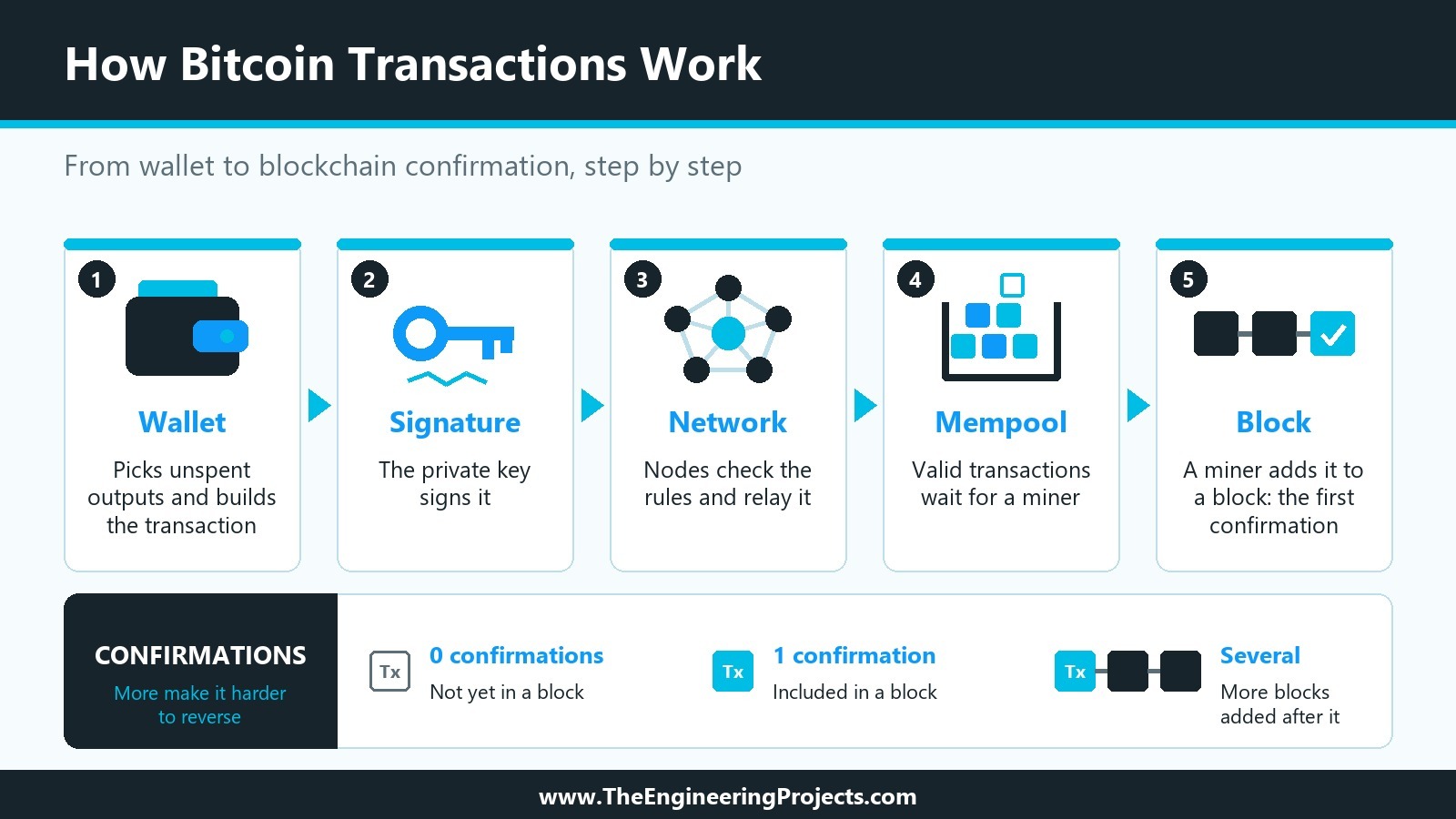
How Bitcoin Transactions Work: From Wallet to Blockchain Confirmation


Bitcoin is often described as a digital currency, but behind every Bitcoin payment there is a complete technical system working in the background. A Bitcoin transaction is not processed by a traditional bank or a central payment server. Instead, it is verified by a distributed network of computers and recorded on a public blockchain.
For beginners, this process can look complicated at first. However, if we divide it into smaller parts, it becomes much easier to understand.
In this tutorial, we will look at how a Bitcoin transaction works, what happens when a user sends BTC, how miners confirm transactions, and why blockchain confirmations are important.

What Is a Bitcoin Transaction?
A Bitcoin transaction is a digitally signed instruction that transfers ownership of Bitcoin from one address to another.
It is important to understand that Bitcoin does not work exactly like a traditional bank account. The Bitcoin blockchain does not simply store a balance for every user. Instead, it keeps track of previous transaction outputs that can be spent by their owners.
When you send Bitcoin, your wallet creates a transaction that references available funds and specifies where those funds should go.
A simplified transaction contains three important elements:
- Inputs
- Outputs
- Digital signatures
The inputs identify previously received Bitcoin that the sender wants to spend. The outputs define the new destinations for the Bitcoin. The digital signature proves that the person creating the transaction has control over the required private key.
This is one of the main reasons why private key security is so important in Bitcoin.
Bitcoin Wallets and Private Keys
A Bitcoin wallet does not technically store Bitcoin inside the device. The coins remain recorded on the blockchain.
The wallet stores or manages the cryptographic information needed to authorize transactions.
The most important part of this information is the private key.
A private key is a secret piece of data that allows the owner to sign a Bitcoin transaction. The corresponding public information can be used to create or identify Bitcoin addresses.
This creates a simple but powerful system:
Private key → Digital signature → Transaction authorization
If somebody obtains your private key, they may be able to authorize transactions from your address. For this reason, private keys should never be shared with other people or entered into unknown websites.
Hardware wallets, software wallets and other wallet solutions use different approaches to protect these credentials, but the underlying cryptographic principle remains similar.
Understanding the Blockchain
Before looking at the transaction process, it is useful to understand the technology that makes it possible. If you are new to the subject, this introduction to blockchain technology provides a useful starting point for understanding distributed ledgers, blockchain architecture and related concepts.
In Bitcoin, the blockchain works as a shared record of confirmed transactions. Rather than being maintained by one central organization, copies of the blockchain are maintained across the network.
This distributed structure allows different computers to independently check whether transactions follow the rules of the system.
What Happens When You Send Bitcoin?
Suppose Alice wants to send Bitcoin to Bob.
The first step happens inside Alice's wallet. The wallet selects suitable unspent transaction outputs and creates a new transaction.
The transaction contains information such as:
- The Bitcoin being spent
- The destination address
- The amount being transferred
- The transaction fee
- A digital signature
Alice's wallet then broadcasts the transaction to the Bitcoin network.
At this point, the transaction has been created, but it has not necessarily been permanently recorded in the blockchain.
This distinction is important.
A transaction can be visible on the network while still waiting for confirmation.
For readers who want a more general explanation of the process, the official how Bitcoin works guide from Bitcoin.org also explains the relationship between wallets, transactions, private keys, the blockchain and mining.
The Bitcoin Network
Bitcoin uses a peer-to-peer network instead of a central server.
When Alice broadcasts her transaction, Bitcoin nodes receive it and perform a number of checks. The nodes verify that the transaction follows the rules of the Bitcoin protocol.
For example, a node can check whether:
- The transaction format is valid.
- The digital signature is valid.
- The referenced Bitcoin has not already been spent.
- The transaction follows the network's consensus rules.
If the transaction passes these checks, it can be relayed to other nodes.
Eventually, the transaction can reach the mempool of nodes and become available to miners for inclusion in a block.
What Is the Bitcoin Mempool?
The mempool can be thought of as a waiting area for valid transactions that have not yet been included in a block.
There is not one single global mempool shared by every computer. Each node can maintain its own collection of pending transactions.
This is also why the transaction status can sometimes appear different across different blockchain services.
The transaction may be valid and visible on the network while still waiting for a miner to include it in a block.
During periods of high network activity, users may have to wait longer for confirmation.
How Are Transactions Added to the Blockchain?
Bitcoin uses a process called mining to add new blocks to the blockchain.
Miners collect transactions and construct candidate blocks. They then compete to produce a valid proof of work.
The proof-of-work mechanism requires miners to perform a large amount of computation. The goal is to find a block hash that satisfies the current network difficulty requirements.
Once a miner successfully produces a valid block, it can broadcast the block to the network.
Other nodes independently verify the block.
If the block follows the consensus rules, nodes can accept it and add it to their version of the blockchain.
The transaction included in that block now has its first confirmation.
Why Do Bitcoin Confirmations Matter?
A confirmation means that a transaction has been included in a block.
As additional blocks are added after that block, the transaction receives additional confirmations.
For example:
- 0 confirmations — The transaction has not yet been included in a block.
- 1 confirmation — The transaction is included in a block.
- Several confirmations — Additional blocks have been added after the transaction's block.
More confirmations generally make it increasingly difficult to reorganize the blockchain in a way that would remove or reverse the transaction.
This does not mean that every transaction requires the same number of confirmations. The appropriate policy depends on the amount involved, the application being used and the risk tolerance of the receiving party.
Where Can Bitcoin Payments Be Used?
Bitcoin was originally designed as a peer-to-peer electronic cash system, but its use has expanded into many different areas.
Some businesses accept Bitcoin directly for goods and services. Other platforms use Bitcoin as one of several supported payment methods.
Online services are another example. Users researching cryptocurrency-based gaming platforms may encounter Bitcoin casino welcome bonuses, for instance. In such cases, the important technical point is not the promotion itself but the underlying payment process: the user still needs to send cryptocurrency from a wallet to a destination controlled by the service.
Regardless of where Bitcoin is used, the basic transaction model remains the same. A wallet creates and signs a transaction, the network verifies it, and the transaction can eventually become part of the blockchain.
Users should also check the legal requirements and terms applicable in their location before using any cryptocurrency-based service.
What Is a Bitcoin Transaction Fee?
Bitcoin transactions normally include a fee paid to miners.
The fee is not simply a fixed percentage of the amount being transferred. Instead, it is influenced by factors such as transaction size and the level of competition for block space.
This means that sending a small amount of Bitcoin does not necessarily result in a very small transaction fee.
When many users are trying to get transactions confirmed at the same time, users may compete for limited block space by offering higher fees.
Modern Bitcoin wallets generally provide fee estimation tools to help users select an appropriate fee.
Bitcoin Security Depends on More Than the Blockchain
The Bitcoin protocol provides strong cryptographic security, but users can still lose funds because of problems outside the blockchain itself.
For example, a user may:
- Lose a private key or recovery phrase.
- Send Bitcoin to the wrong address.
- Install malicious wallet software.
- Give private information to a phishing website.
- Store wallet credentials insecurely.
Blockchain transactions are designed to be irreversible. There is normally no central authority that can simply cancel a transaction because the sender made a mistake.
This is both one of Bitcoin's strengths and one of its biggest responsibilities for users.
Why Bitcoin Is Interesting From an Engineering Perspective
Bitcoin is more than a digital payment method. It combines several areas of computer science and engineering into one distributed system.
It uses:
- Public-key cryptography
- Digital signatures
- Hash functions
- Peer-to-peer networking
- Distributed databases
- Consensus mechanisms
- Proof-of-work
- Incentive systems
The interesting part is how these components work together without requiring a central database administrator.
Every participating node can independently verify transactions according to the same protocol rules. This creates a system where trust is shifted away from a central institution and toward mathematics, software rules and distributed verification.
Final Thoughts
Understanding a Bitcoin transaction becomes much easier when the process is viewed as a sequence of technical steps.
First, a wallet creates a transaction using available Bitcoin and the recipient's address. The transaction is digitally signed using the sender's private key. It is then broadcast to the peer-to-peer network, checked by nodes and placed into the pool of pending transactions.
A miner eventually includes the transaction in a block. Once the block is accepted by the network, the transaction receives its first confirmation. Additional blocks provide further confirmation.
This combination of cryptography, networking and distributed consensus is what makes Bitcoin different from traditional payment systems.
For anyone interested in blockchain technology, understanding this transaction flow is a useful starting point before moving on to more advanced subjects such as transaction scripting, Lightning Network payments, wallet security and blockchain scalability.

Comments
0