


How Managed Service Providers Can Generate More Leads Through SEO


Managed service providers (MSPs) operate in a competitive market where attracting new business clients requires more than technical expertise. Companies looking for outsourced IT support often research potential providers online, compare services, and evaluate credibility before contacting anyone.
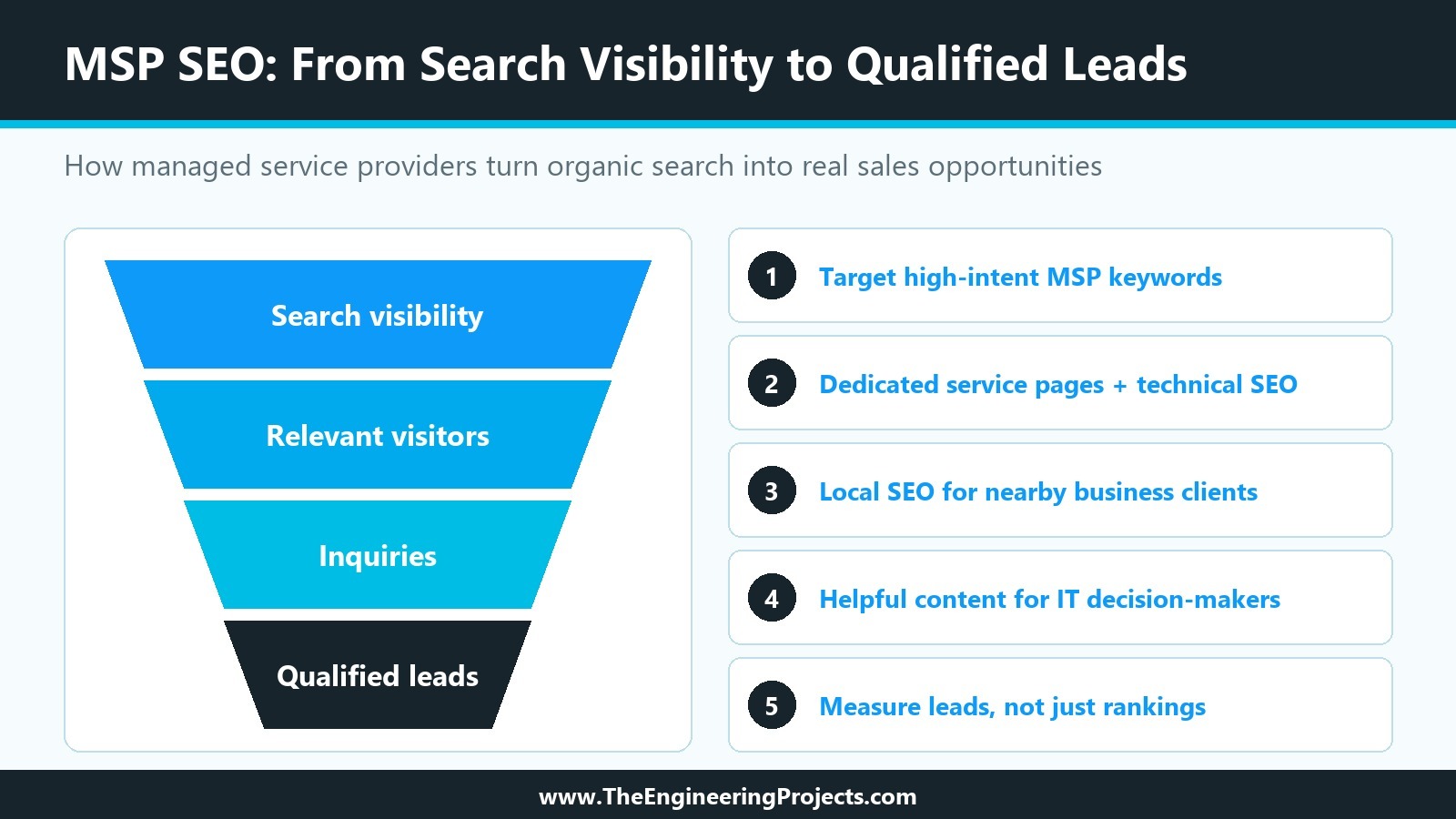
A strong MSP SEO strategy helps businesses appear in relevant searches and connect with decision-makers who need their services. However, attracting website visitors is only part of the process. A page that receives hundreds of visits but generates no qualified inquiries may contribute less to business growth than one attracting a smaller, more relevant audience.
Effective SEO for managed service providers combines targeted keywords, well-organized service pages, technical website improvements, and content that addresses business IT challenges.
Understanding how these elements work together can help MSPs turn organic search visibility into meaningful sales opportunities.
Why SEO Matters for MSP Lead Generation
Business owners and IT decision-makers use search engines to research cybersecurity support, network management, cloud services, and outsourced IT providers. Their searches often reflect specific operational problems, such as recurring downtime, security concerns, or limited internal IT resources.
MSPs that depend primarily on referrals may miss potential customers who are unfamiliar with their business. Search visibility creates another opportunity to reach organizations actively considering outside support.
However, successful MSP lead generation depends on attracting the right visitors rather than simply increasing traffic.
For example, someone researching basic computer troubleshooting may have little interest in purchasing managed IT services. A business searching for ongoing IT support in its city is more likely to represent a relevant sales opportunity.
By focusing on business needs and purchasing intent, MSPs can build an organic acquisition channel that supports their broader IT services lead generation efforts.
Build an SEO Strategy Around High-Intent MSP Keywords
Keyword selection influences whether an MSP attracts prospective customers or visitors seeking general information.
Broad searches such as "what is cloud computing" can generate educational traffic. More specific searches, including "managed IT services in Dallas" or "outsourced IT support for law firms," suggest that the searcher may be evaluating service providers.
A practical managed IT services SEO strategy connects these searches with relevant services, industries, and geographic markets.
Specialized SEO support can also help MSPs connect technical offerings with the language business buyers use. Agencies such as 95 Projects work with IT services businesses on targeted search strategies, service-page optimization, and visibility among relevant business audiences.
Identify Keywords That Indicate Buying Intent
High-intent MSP keywords often contain service descriptions, locations, or industry requirements.
Examples include:
- Managed IT services in Dallas
- Cybersecurity services for small businesses
- Outsourced IT support for accounting firms
- Microsoft 365 support for businesses
- Managed network security services
These searches provide clues about the buyer's requirements, although they do not guarantee an inquiry.
MSPs can use keyword research tools and Google Search Console to identify relevant search terms, examine existing visibility, and prioritize opportunities that match their actual capabilities.
Match Keywords to Services and Target Industries
Each important service should have a clear keyword focus.
An MSP offering cybersecurity, cloud management, and help desk support can develop separate pages explaining each service instead of placing everything on one general IT support page.
Industry-focused content can also be valuable when the provider has relevant expertise. For example, an MSP serving healthcare organizations might explain how its IT services address operational continuity, access controls, and applicable compliance requirements.
The goal is to create genuinely useful pages rather than multiple near-identical pages targeting slight keyword variations.
Optimize Your MSP Website for Search Engines
Even relevant keywords cannot compensate for a website that is difficult to navigate or understand.
A well-structured MSP website makes important services accessible to search engines while helping prospective customers quickly determine whether the provider meets their needs.
Create Dedicated Pages for Core IT Services
Dedicated MSP service pages should explain what the provider offers, which businesses benefit, and what the engagement typically involves.
For example, a managed IT services page might cover proactive monitoring, help desk support, patch management, and ongoing maintenance. A cybersecurity page could explain vulnerability management, endpoint protection, and incident response capabilities where those services are available.
Each page should include descriptive headings, straightforward language, relevant service details, and an appropriate next step.
Clear URLs, such as /services/managed-it-support/, also make the website easier to understand and navigate.
Improve Technical SEO and Website Performance
Technical SEO helps search engines discover and interpret website content.
Important checks include ensuring that valuable pages are indexable, fixing broken internal links, and reviewing redirects and canonical tags.
Website performance also matters to visitors. Slow-loading pages, difficult mobile navigation, and confusing layouts can interrupt the buying journey.
MSPs should prioritize readable mobile pages, efficient loading, accessible navigation, and logical connections between related services.
These improvements support usability and search accessibility, although no individual technical change guarantees higher rankings.
Use Local SEO to Attract Nearby Business Clients
Local SEO for MSPs is particularly useful when providers serve businesses within specific cities or regions.
A company searching for "managed IT services near me" may prefer a provider familiar with its local market, especially when on-site assistance is occasionally required.
An accurate Google Business Profile can help eligible MSPs communicate their services, contact information, business hours, and service areas.
Eligibility generally requires in-person contact with customers during stated business hours, either at the provider’s premises or at customer locations. An MSP operating entirely online is not eligible simply because it serves a particular city.
Business details should remain consistent across the company's website and relevant directories. Genuine customer reviews can also provide useful evidence of service quality.
Location-specific website content adds further context. An MSP serving Chicago businesses, for example, can explain its service coverage, on-site support arrangements, and experience with organizations in that market.
However, creating numerous nearly identical city pages without meaningful local relevance offers little value to prospective customers.
MSPs operating remotely or across multiple regions should accurately represent their actual locations and service coverage rather than creating artificial local presences.
Create Helpful Content That Attracts Potential MSP Clients
Not every prospective customer begins by searching for a managed service provider.
Many initially research operational problems, technology decisions, or security risks. Helpful educational content allows MSPs to reach these businesses earlier in their decision-making process.
Useful content topics include:
- Cybersecurity checklists for small businesses
- Guides to estimating outsourced IT support costs
- Cloud migration planning for growing companies
- Managed IT services versus internal IT teams
- Common causes of business network downtime
The strongest articles answer specific questions and demonstrate practical knowledge.
For example, an article comparing internal IT teams with managed services could explain staffing requirements, service coverage, costs, and accountability. Businesses evaluating outsourcing could then explore the provider's relevant managed IT service page.
This connection between educational content and commercial pages helps visitors progress naturally from initial research toward considering a service.
Updating existing articles when technologies, service offerings, or guidance change is equally important for keeping information accurate and useful.
Turn Organic Website Traffic Into Qualified Leads
Search visibility creates opportunities, but converting visitors into business inquiries requires a clear and credible website experience.
A prospective customer who lands on a cybersecurity service page should immediately understand what the provider offers, who the service supports, and how to request assistance.
Clear calls to action (CTAs), such as "Schedule an IT Consultation" or "Request a Security Assessment," give visitors an obvious next step.
Contact forms should request enough information to understand the inquiry without creating unnecessary friction. Company name, business email, service requirements, and a brief description of the problem may be sufficient for an initial conversation.
Trust signals can also influence buying decisions. Relevant certifications, accurately presented partnerships, customer testimonials, and detailed case studies help visitors evaluate a provider's capabilities.
Case studies are particularly useful when they explain a client's original challenge, the work performed, and measurable outcomes supported by actual project records.
For visitors not yet ready to speak with sales, helpful guides and clear service navigation offer opportunities to continue their research.
Measure SEO Performance Beyond Google Rankings
Keyword rankings provide visibility into search performance, but they do not fully explain whether SEO contributes to revenue.
MSPs need to measure what happens after visitors reach their websites.
Google Search Console provides information about search impressions, clicks, queries, and pages appearing in Google Search. Google Analytics 4 (GA4) can help measure website interactions and important actions configured as key events.
For MSP lead generation, useful measurements include contact form submissions, consultation bookings, phone inquiries, and organic landing pages associated with those actions.
Configure and test tracking for successful form submissions and completed bookings. Track phone-link clicks separately from confirmed calls, since clicking a number does not establish that a conversation occurred.
Connecting website inquiries with customer relationship management (CRM) records provides additional insight into lead quality.
For example, ten inquiries from businesses outside an MSP's service area may be less valuable than three conversations with companies matching its ideal customer profile.
Tracking qualified leads, sales opportunities, and eventual customers helps MSPs evaluate which SEO activities contribute to commercial results rather than relying exclusively on traffic growth.
Next Steps for Building an MSP SEO Strategy
An effective MSP SEO strategy starts with understanding what prospective customers need and whether the website clearly addresses those requirements.
Begin by reviewing existing service pages and identifying searches that match the company's core offerings. Address important technical issues that interfere with usability or search accessibility, then improve navigation and calls to action.
Develop helpful content around genuine customer questions, strengthen relevant local visibility, and monitor which pages produce qualified inquiries.
SEO is an ongoing process of improving visibility, content, and the customer experience. For managed service providers, its value comes from helping suitable business prospects discover, evaluate, and inquire about relevant IT services.

Comments
0