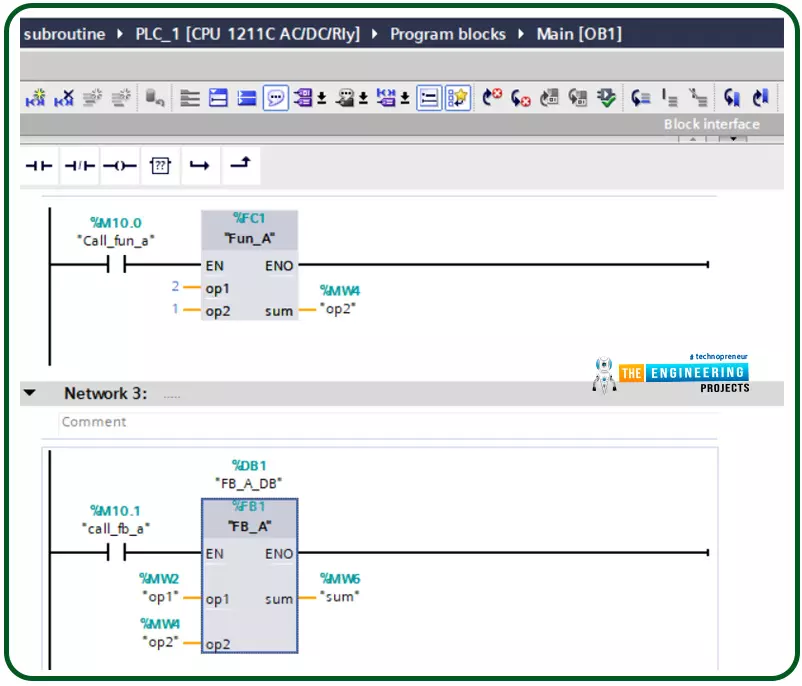
Hello friends, after completing that basic part of ladder logic programming, let us today go through one topic which is not essential to know to complete a PLC ladder program but it is important t have our code readable program and reusable pieces of code. That could happen by using what so-called a subroutine. So what is a subroutine? Well, it is a piece of code that includes a few rungs to perform specific tasks. that piece of code can be reused numerous times through the program when we need to call it for performing that task. That subroutine enables us to structure our code like building blocks so that the program will be readable very easy and also reusable later in other projects. The idea of dividing the program into routines to apply the divide and conquer technique is very crucia ...
Hi Everyone! Hope you’re well today. Happy to see you around. In this post today, I’ll walk you through the Introduction to TDA2005.TDA2005 is a 20-watt Class B dual audio amplifier integrated chip. It comes in a Multiwatt11 package and is carefully designed for car radio applications. It can support the current up to 3.5A which is quite high which makes it a suitable pick for constructing power booster amplifiers.
I suggest you read this post all the way through as I’ll detail the complete Introduction to TDA2005 covering datasheet, pinout, features, and applications.
Let’s jump right in.
Introduction to TDA2005
TDA2005 is a 20-watt Class B dual audio amplifier integrated chip. It is particularly designed for car radio applications.
...
Hi Everyone! Hope you’re well today. I welcome you on board. In this post today, I’ll walk you through the list of New Proteus Libraries of Digital Sensors.
I told you earlier, our team has designed these proteus libraries after a lot of hard work and you won’t find them anywhere online. We are designing these proteus libraries to help you better understand the working of sensors through proteus simulations. Also, we have added the interfacing of these sensors with Arduino boards, where you can observe the working and simulation of sensors with microcontrollers or Arduino Boards.
If you think we are missing something important, something that should be a part of the Proteus library, share your valuable suggestion in the comment section below, and ...
When businesses select high-pressure gas containment systems, the margin for error is non-existent. From medical oxygen distribution to beverage carbonation, industrial welding, and scuba diving, compressed gas storage relies heavily on material science and strict manufacturing standards. Aluminum has become the modern material of choice for high-pressure gas storage, replacing heavier traditional metals without sacrificing strength. Understanding how an experienced cylinder manufacturer approaches the design and production of these essential vessels reveals the critical engineering choices that guarantee both safety and peak operational performance.
1. Material Selection and Heavy-Duty Aluminum Alloys
Safety in high-pressure containment begins ...
Hello friends, I hope you all are fine and enjoying yourself. Today I am going to share a new project titled Interfacing of temperature sensor LM35 with Arduino UNO in Proteus ISIS. So far, I have only worked on temperature sensor DS18B20 for temperature measurements and I have also uploaded a tutorial on Interfacing of Temperature Sensor 18B20 with Arduino.
Recently I got a chance to work on a project regarding temperature sensing but the condition of this project was that to use only LM35 for temperature detection. Then, I get to know much about LM35, its operating conditions and features. So I thought I should also upload its tutorial as it will also be advantageous for engineering students. Because learning new things is always a charm.
An exc ...
Hello everyone, I hope you all are fine. In today's tutorial, we are going to share a new Lipo Battery Library for Proteus. Proteus has a 12V battery module in it but they are quite simple in looks, so we have simply designed a stylish looking lipo battery, I hope you will find it useful for a better project presentation.
This Proteus Library has two Lipo Batteries in it, one is of 3.7V and the second one is of 11.1V, these are normally available Lipo models in the market. Although, you can change the voltage level of these batteries from their properties panel. Let's first have a look at the brief introduction of Lipo Baterry:
What is Lipo Battery???
Lipo is an abbreviation of lithium polymer battery, designed using lithium-ion technology and ...
Hello friends. We hope you are doing fine. The world is full of colours. Isn’t it? We humans can see and differentiate the colours very easily. But teaching robots and AI apps about colours is a real challenge. With the advancement of computer vision and embedded systems, this task has become easier than before. Today, we are going to make an RGB colour identifier using the ESP32-CAM. This project combines the power of OpenCV with the ESP32-CAM module to create a simple but effective system for detecting and tracking basic colors in real time.
System Architecture
1. Overview
This system consists of an ESP32-CAM module acting as a live-streaming camera server and a Python-based computer vision application running on a remote computer. The Python application fetches images from the ...
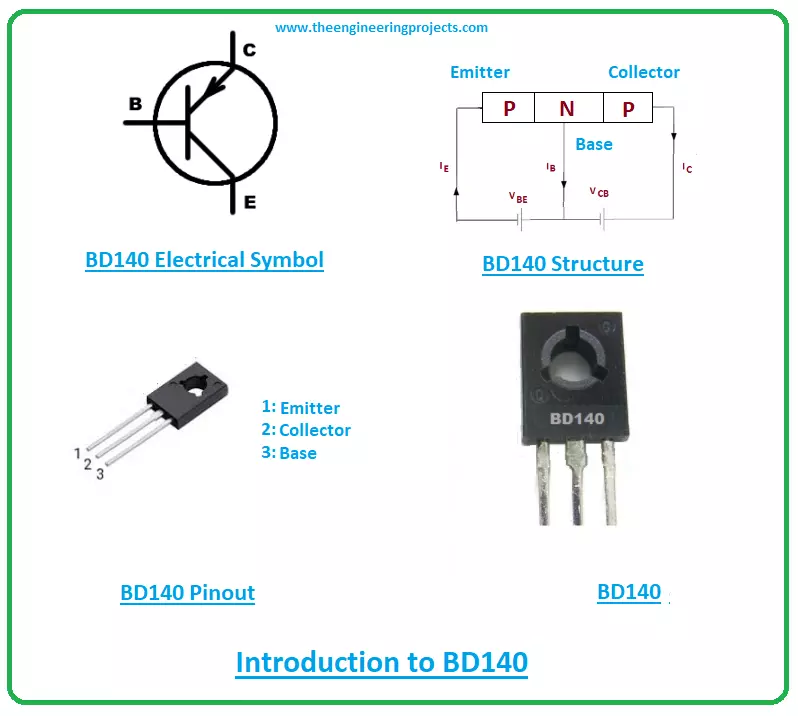
Hello Friends! Hope this finds you well. I welcome you on board. Thank you for clicking this read. In this post today, I’ll walk you through the Introduction to BD140.
BD140 is a medium power bipolar junction transistor that is mainly used for switching and amplification purpose. It belongs to the PNP transistor category and comes in the TO-126 package. It is made up of silicon material with collector current 1.5A which indicates it can support loads under 1.5A. The collector-base and collector-emitter terminal voltages are 80V and emitter-base voltage is 5V which is used to bias the transistor.
In this post, I’ll be detailing the complete introduction to BD140 covering pinout, working, absolute maximum ratings, physical dimensions, alternatives ...
Hello everyone! I hope you all will be fine. Today, I am going to elaborate that how to create your First Project using NI LabVIEW Programming. This software is very easy to use in comparison to the other software. You do not have to write the complete source code for the desired output, like in other software e.g. Arduino, MATLAB, Dev C++, Eclipse etc. instead you have to just implement your logic using Field Programmable Gate Array (FPGA) blocks. The program is designed with the help of the FPGA blocks, is usually known as “Virtual Instruments”.
Normally we used to call it as VI’s. We create in “Block Diagram” window as described in our previous tutorial on Introduction to LabView. If you haven't read that tutorial then I owuld suggest you to ...
SMS verification checks that a user can receive a code on a phone number. Many mobile apps, web dashboards, and IoT systems use it during sign up, login, password reset, or device pairing.
A physical SIM card can test this flow, but it slows the work. You need a phone, a mobile plan, network signal, and often more than one number. That setup works for a final field test. It does not work well when a team needs fast, repeatable checks.
A better test setup uses virtual phone numbers, SMS APIs, and clear test cases. This lets developers check the whole path without swapping SIM cards or waiting on a phone.
Why SMS Verification Matters In Engineering Projects
SMS verification acts like a door check. The system sends a short code to a phone number ...