Hello, Students here I am present to cover an article on a series of Electronic devices and circuit theory. The foremost article of this series is Ideal diode vs practical diode. I try to elaborate on basic to modern theory related to the diode. This component act as fundamental to many important circuit devices such as rectifiers, transformers, etc. The question which we cover in this article are;
What is a diode?
How a diode is formed? Which methodology manufacturer utilized while the formation of the diode?
What is the concept of doping and PN junction in diode theory?
How does a Diode work?
What type of biasing allows a diode to conduct? Under which situation of biasing diode offers a restriction while conducting?
Upon which cha ...
Hey Guys! I hope everyone's fine. Today, we are going to have a look at What is MOSFET? We will cover MOSFET Definition, Full Form, Symbol, Working & Applications in detail.
MOSFETs are commonly used in many electronic applications. A number of MOSFETs are added in tiny memory chips or microprocessors that are widely used in cell phones and laptops. It is a voltage-controlled device that is used for amplification and switching purposes. I'll try to touch every area related to MOSFET. Let's get started.
What is MOSFET?
MOSFET is an advanced type of FET, manufactured with controlled oxidation of semiconductor, having 4 Terminals, named:
Drain(D)
Gate(G)
Source(S)
Body(B)
where,
Gate(G) Terminal is practically insul ...
In a number of applications where speed, latency, and light detection are critical, silicon has reached the limits of its capabilities. Global shipments of silicon between 2021 and 2025 are expected to total 17,600 million square inches, according to Statista. It is clear from this report that Moore's law has the potential to last at least until 2025. However, it is also critical to identify a suitable silicon substitute.
Future iterations of the machine will be able to learn from and adapt to its environment thanks to technologies like artificial intelligence. Because of this, more potent and flexible computational processes are required. It is more probable that the production of chips will usher in a new computing revolution. The following are a few possible silicon chip substitutes th ...
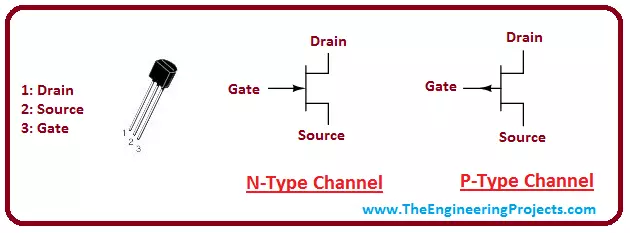
Hello Guys! I hope you are doing great and having fun. I am back to give you a daily dose of knowledge that will enhance your learning skills and put you ahead of others. Today, I am going to give you details on the Introduction to JFET. It is a Junction Field Effect Transistor that consists of three terminals named drain, source and gate. It comes in two configurations called the P-Type channel and the N-Type channel. I'll give you brief details on JFET and try to cover as many aspects as possible. Let's get started:
Introduction to JFET
JFET (Junction Field Effect Transistor) is a uni-polar voltage-controlled device that consists of three terminals called drain, source and gate.
Unlike bipolar junction transistors which are bipolar current-controlled devices in which a small amo ...
Hello friends, I hope this article finds you happy, healthy, and content. Today, we are about to discuss one of the most commonly known types of transistors which you might have heard of many times when reading about transistors, the transistor under study is none other than the “Bipolar Junction Transistor’’, also known as BJT . In this article, we will go through the basics of the bipolar junction transistor including its meaning ,definition, types, characteristics, and applications. So, let's get started.
Definition of BJT
A BJT in its full form is written as bipolar junction transistor and we can define it as,
"A bipolar junction transistor is a three-terminal semiconductor device which is made up of two PN junctions within its structure a ...
Hey Friends! Hope you are doing great. I am back to give you a daily dose of valuable information so you can always stay ahead of your competitors. I have previously updated the article on NPN transistor that is used for amplification and switching purpose. Today, I am going to unveil the details on the Introduction to PNP Transistor which falls under the category of bipolar junction transistors and comes with three layers i.e. two P-doped layers and one N-doped layer where an N-doped layer exists between two P-doped layers.
Main Function: Small current at one terminal is used to control large current at other terminals.
Major Charge Carriers: Holes
These NPN and PNP transistors come with their own benefits based on the nature of the e ...
Hey Guys! Hope you are doing great. Today, I am going to discuss the details on the Introduction to BJT (Bipolar Junction Transistor). It is an electronic component mainly used for amplification and switching purpose. As the name suggests, it is composed of two junctions called emitter-base junction and collector-base junction.
Don't confuse BJT with regular transistors. A transistor is a semiconductor device, comes with three terminals that are used for external connection with electronic circuits. A transistor is termed as a trans resistor which is used as switch or gate for electronic signals. Small signals applied between one pair of its terminals are used to control much larger signals at the other pair of terminals.
Actually, transistors are divided into two categories called u ...
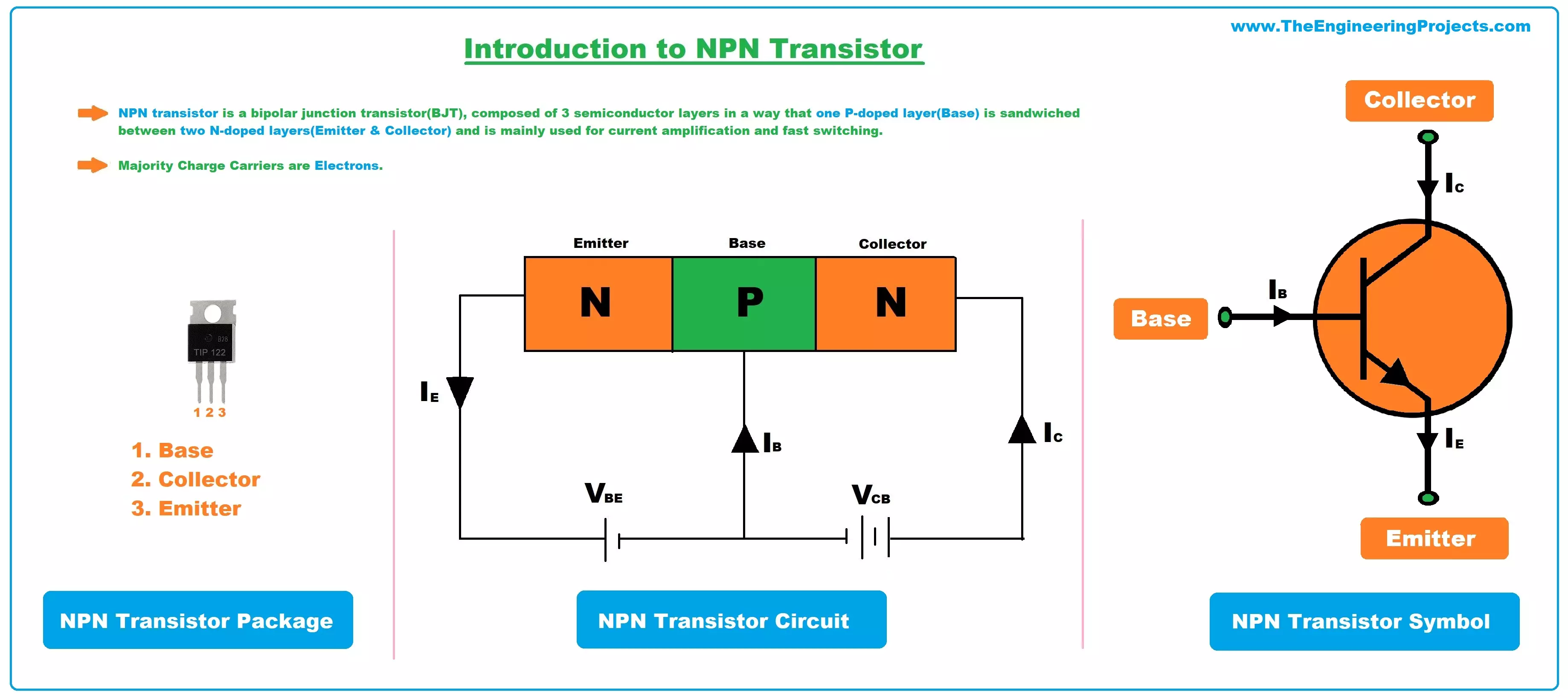
Hello Friends! I hope you are well. Today, I am going to give you a detailed Introduction to NPN transistor. In this tutorial, we'll look at the NPN transistor, how it works, circuit diagram, output characteristics curve, and applications. It is a bipolar junction transistor mainly used for current amplification and switching purposes.
BJTs (Bipolar Junction Transistor) are divided into two types i.e. NPN transistor and PNP transistor. Both transistors are different in terms of their electrical composition and construction, however, both are used for amplification and switching purposes in one way or the other.
What is NPN Transistor?
NPN transistor is a bipolar junction transistor(BJT), composed of 3 semiconductor layers in a way that o ...
Hello friends, I hope you all are doing great. In our previous lecture, we studied the Basic PN Diode in detail and today, we will discuss a special type of diode called Schottky Diode. This diode was designed by the German physicist Walter H. Schottky, so it's named after him, thus called Schottky.
This diode is mostly used in radio frequency (RF) circuits or in power supplies. So let's get started with the basics of Schottky Diode:
Schottky Diode
Schottky Diode (also called Schottky Barrier Diode or Hot Carrier Diodes), discovered by German physicist Walter H. Schottky, is a special type of diode in which the P-layer(of PN junction) is replaced by the metal layer(i.e. Aluminium, Tungsten, Molybdenum, Platinum, Chromium etc.), while the N layer is of silicon(semiconductor - ...
Hi Guys! Hope you are doing great. Today, we will have a look at an electronic component named Diode. We will discuss Diode working, Symbol, Applications and characteristics in detail.
A diode is an electronic component, that allows the flow of current in one direction only. It exhibits low resistance in one direction and very high resistance in the opposite direction. Whoever has been a science student, knows about diodes. Although it seems to be a tiny component of a circuit, apparently it is true but it has a lot of complexities or you can say, it's a storm in a teacup.
Diodes are normally used in rectifiers, where they convert AC signals to DC signals. They come with a wide range of applications including power conversion, radio modulation, l ...