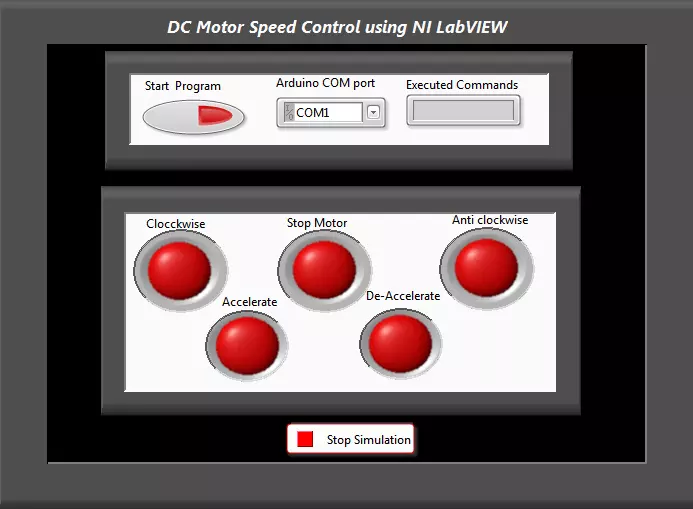
Hello everyone! I hope you all will be absolutely fine and having fun. Today, I am going to share my knowledge with all of you guys, about how to make a simple Virtual Instrument (VI) for DC Motor Speed Control in LabVIEW. In my previous tutorials, I have worked on DC Motor Speed Control using Arduino, in which I have controlled the DC Motor Speed using Arduino and after that I made some advancements in it and then created DC Motor Speed Control in Matlab in which commands were sent from Matlab. So, now we are gonna do the DC Motor Speed Control in LabVIEW.If you are working on DC Motor then you should also have a look at DC Motor Direction Control using Arduino.
In this tutorial, I am going to work on the program for DC Motor speed Control usin ...
Hey Fellas! I warmly welcome you to be here. Today I'm going to discuss the Introduction to Transformer. I'll unlock the complete details of its working principle, construction, types, and applications. It is widely used for the transformation of electrical energy. The inception of transformation has revolutionized the electrical field and made our life easy more than ever before.
Because of its extensive advantages, it works as a core for electrical engineering. In today's tutorial, I have explained in detail all about Transformer but still if you got trouble anywhere, then you can ask in comments and I will try my best to resolve them. So, now let's get started with Introduction to Transformer:
1. Introduction to Transformer
Transformer is a ...
Hi Friends! Hope you are doing well. We always strive to give you valuable information as per your needs and requirements so you keep coming back for what we have to offer. Today, I'll uncover the details on the Introduction to ATmega168. It is an 8-bit AVR microcontroller that comes with 32-pin interface and is mainly based on RISC CMOS technology. The Program memory is 16K, based on Flash, and incorporates read-write capabilities.
The module comes with a wide temperature range from -40 to 85 ºC while operating voltage ranges from 1.8 to 5.5 V. If you are working on project that is related to automation and embedded systems, you can not write off the importance of this module that comes with an ability of performing a number of functions at once ...
Hey Mentees! Welcome from the team of The Engineering Projects. We hope You are having a reproductive day. To add more reproduction, let's learn another Logical Circuit from scratch.
In this Tutorial, we'll grasp the following topics:
What are D-Type Flip Flop?
Which is the IC of D Flip Flop in Proteus ISIS?
How is the working of D Flip Flop?
How can we design the Truth Table of D Flip Flop?
How can we Perform the formation of D Flip Flops in Proteus ISIS?
Moreover, we'll have small chunks of information in DID YOU KNOW Sections. At this instance, Let's start the learning.
D-Type Flip Flops
D-Type Flip Flops are important Logical Circuits and we Introduce it as:
"The D-Type Flip Flop is a type of Flip Flop that captures the value of D ...
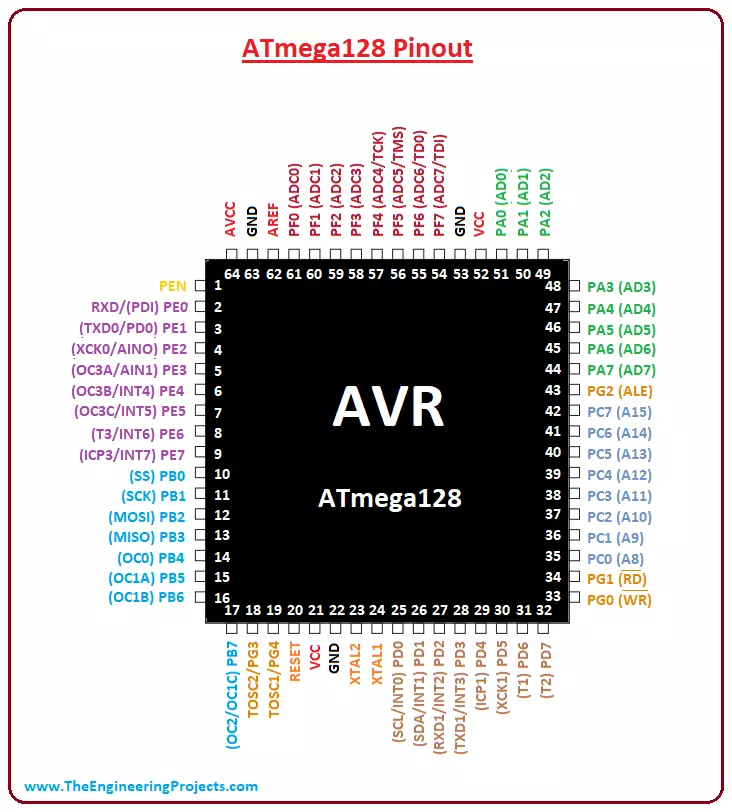
Hey Guys! Hope you are doing well. I am back to feed you with valuable information relating to engineering and technology. Today, I'll uncover the details on the Introduction to ATmega128. It is an AVR, 8-bit low power microcontroller, that comes with a 64-pin interface and is based on RISC architecture. Availability of 133 Powerful Instructions with single clock cycle and 32 x 8 General Purpose Working Registers make this device an ideal choice for many applications where decent code execution is required.
The memory space incorporates on this module is more than normal AVR controllers including Program memory around 128K, enough to store the number of instructions on a single chip.
In this post, I'll try to cover each and everything related t ...
Hello friends, hope you all are fine and having fun with your lives. In today's post we are gonna have a look at How to use Temperature Sensor 18B20 in Proteus ISIS. I will use Arduino board as a microcontroller and will connect the temperature sensor with it and then will display the code on LCD. I have already posted the same tutorial in which I have done Interfacing of Temperature Sensor 18B20 with Arduino but in that project I have used the real components and designed the hardware. But today, I will just show you the simulation so that you could test the simulation first and then design it in hardware.
Temperature Sensor 18B20 is the most commonly used temperature sensor. Its a one wire sensor means it sends data through a single wire and we ...
Hi Everyone! Glad to have you on board. Today, I am going to share a new version of Arduino Mega 1280 Library for Proteus V2.0. I have already shared its previous version i.e. Arduino Mega 1280 Proteus LibraryV(1.0). I have recevied many bug reportings from engineering students(for previous version), so I have tried to improve its performance in this newer version, but still if you find any bug/error, use the comments section.
We have already shared numerous Proteus Libraries of Embedded sensors and these days, we are in the the process of upgrading their versions.
First, we will download Proteus library zip file and then will add it in our Proteus software to simulate Arduino Mega 1280. Before moving further, first we’ll learn what is Arduino M ...
Hello friends, hope you all are fine. In today's project, we are gonna design Electronic Quiz Project with 8051 Microcontroller. I have done this project recently in which we need to design a quiz project game using 8051 Microcontroller. It was quite a big project and we have to work quite hard to make it done. In this project we have used many components on which I have already post tutorials so that you guys first get introduction to those components. So, first of all you should read Interfacing of LCD with 8051 Microcontroller, after that you must check Interfacing of Keypad with 8051 Microcontroller and finally get your hands on Serial communication with 8051 Microcontroller. These tutorial are must to read because these are all gonna use in t ...
Hey Fellas! Hope you are doing fine. Microcontrollers play an important role in the development of embedded systems. They are used where automation is an integral part of the system. Today, I am going to unlock the details on the Introduction to Atmega16.
It is a 40-pin low power 8-bit microcontroller which is developed using CMOS technology and based on AVR architecture. This is the most commonly used AVR microcontroller which belongs to Atmel Mega family.
You must have a look at microcontroller called Atmega328 that also belongs to the mega family.
Other microcontrollers that are readily available and fall under AVR category are Atmega 8 and Atmega 32. All these controllers perform similar tasks, however, they are only different in terms of ...
Hello everyone! I hope you all will be absolutely fine and having fun. Today, I am going to share my knowledge about Creating First Program with myRIO. Before doing anything on NI myRIO you must know that how to configure this device. So, before going into the details of this tutorial I would like to suggest you to must visit Getting Started with myRIO and How to Configure myRIO on WiFi for the better understanding of this tutorial.
NI myRIO is an amazing processing tool that has a very high processing speed as compared to other microcontroller e.g. Arduino, raspberry pi, gellilio etc. So, it can be used for the real time projects where there is need to respond very quickly according to the assigned tasks. NI myRIO was launched by National Instr ...