Hello friends, I hope you all are doing great. In today's tutorial, I am going to share new Magnetic Reed Switch Library for Proteus. We are quite proud to share it as its not been designed before. Our TEP Team has designed it and I think they need a little appreciation. :P You can interface it with any Microcontroller like Arduino, PIC or 8051 Microcontroller etc.
As Proteus is a simulation software so we can't produce magnetic field in it. That's why, we have placed a TestPin and when you provide HIGH Signal to that TestPin then it will act as it has magnet around. Similarly, if you provide LOW Signal to that TestPin then it will behave normal and will sense no magnet around. Rite now, we have just designed two Magnetic Reed Switches but soon we ...
Hello friends, I hope you all are doing great. In today's tutorials, I am gonna share a new C945 Library for Proteus. If you have searched for this transistor in Proteus, then you must have known that it's not available in Proteus. We have designed this transistor in Proteus and here's its library.
If you don't know much about this transistor then you should have a look at Introduction to C945, in which I have explained in detail the basics of this transistor. Today, first of all, I will show you How to install this library and after that we will design a simple Proteus Simulation in which we will see How to simulate C945 in Proteus. You should also check this amazing list of New Proteus Libraries for Engineering Students. So, let's get started wi ...
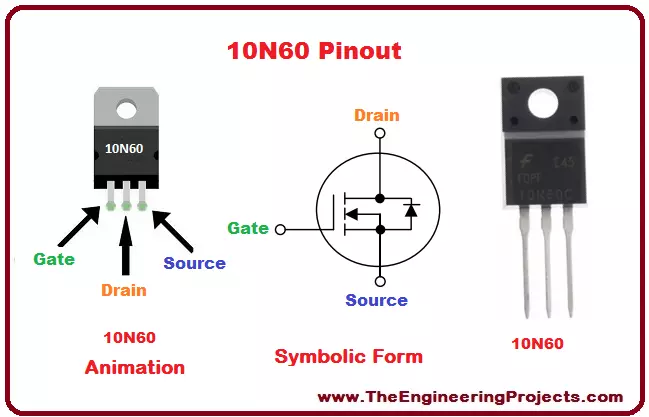
Hello everyone! I hope you all will be absolutely fine and having fun. Today, I am going to provide you a detailed discussion on Introduction to 10N60. Before going into the details of this article you should also have a look at Introduction to 4N60, 78M05, 2N3772, 2SC3320, 20N60. It is basically a high voltage Metal Oxide Semiconductor Field Effect Transistor (MOSFET). It is a power MOSFET and is able to control the certain level of the power. 10-N-60 is also a high current power MOSFET. This device has three terminals and is made up of silicon. It has around 10 ampere of current conduction capability i.e. this device is able to conduct 10A of current through it. 10-N-60 has a lot of amazing features.
It features include low on-state resistance ...
Hello everyone! I hope you all will be absolutely fine and having fun. Today, I am going to explain you about Introduction to TL431. TL 431 are programmable shunt regulator diodes having three terminals. Its a low temperature coefficient diode and can be programmed from reference voltage (Vref) up to 36V when it is attached to 2 external resistors.
TL 431 has an impedance of 0.22 ohms and has a current range from 1mA to 100mA. In several different applications zener diodes can be replaced with TL 431 diode due to its efficiency. These applications include power supplies, Operational Amplifier (Op-amp) circuitry and digital voltmeters. TL-431 can either be used as positive or as negative voltage reference because it operates as shunt regulator. T ...
Hello friends, hope you all are fine and having fun with your lives. Today I am gonna post 555 Timer projects list which are already posted on our blog. Actually, I have posted many 555 Timer Projects on my blog but we don't have a list of these tutorials and they are quite scattered. So, today I thought to arrange them in a proper list so that you can find all of them in one place. All these 555 timer projects are simulated in my favorite simulating software Proteus. I have also given their simulations for download in almost all tutorials. If you feel problem in any of them then ask in comments and I will resolve them.
All these 555 Timer Projects and tutorials are written and designed completely by our team so we hold the complete ownership for ...
Hello Friends! Hope you’re well today. I welcome you on board. In this post today, I’ll walk you through the Introduction to 2SC1061.2sc1601 is an NPN bipolar junction transistor used for switching and amplification purposes. During the amplification process, the small input current across one pair of terminals is used to generate a large output current across other pairs of terminals.
2sc1601 is known as a semiconductor device made of silicon material. This is a bipolar junction transistor where two charge carriers (electrons and holes) play an important role in the conductivity inside the transistor. As this is an NPN transistor so here major charge carriers are electrons while holes are the minority carriers.
I suggest you buckle up as I’ll detail the complete Introduction to 2SC1 ...
Hi Friends! Hope you are getting along with life pretty well. Today, I'll uncover the detailed Introduction to 2n5415 which is a PNP transistor mainly used for general purpose low-power amplifying and switching applications.
It comes with three layers: two P semiconductor layers and one doped N-layer where later is encapsulated between other two P-layers.
There are two major types of transistor: Bipolar Junction Transistor and Unipolar Transistor. This transistor falls under the category of Bipolar Junction Transistor as it comes with two charge carriers i.e. electrons and holes where later are the major charge carriers in PNP transistors.
In this post, I'll try to nail down everything related to 2n5415: its main features, working, and applicat ...
Update: I have updated the code and removed the bug. Thanks for informing. Now this code will work perfectly.
Buy This Project
Hello friends, hope you all are fine and having good health. Today, as the name suggests, I am gonna post on how to Receive SMS with AT Commands using Sim900 and Arduino. I have already posted a tutorial on How to Send SMS with Arduino UNO and Sim900, so now we are gonna check the opposite. Sending SMS is quite easy, you just need to write some AT commands and write the message you wanna send and hit the Cntrl + Z and it will be sent. But receiving a text message on your SIM900 shield is a bit difficult because now you need to place a check when user will send a message. So, ideally whenever anyone send a message to yo ...
Hello friends, I hope you all are doing great. In today's tutorial, we are gonna have a look at detailed Introduction to TIP122. It is a Darlington braces NPN transistor. It works like an ordinary NPN transistor, but as it consists of a Darlington pair it has a decent collector current assessment of nearby 5 amperes and it's gain is around 1000. This transistor can bear 100 volts around collector and emitter terminals due to this feature it can be used for high loads.
This is a common purpose transistor it used in different industrial projects. It manufactured for less time taking switching submissions. In today’s post, we will have a look at its protection, wreck, distinction, entitlements, etc. I will also share some links where I have connecte ...
Hello friends, hope you all are fine. Today, I am going to share a new Bluetooth Library for Proteus. Using this Library, now you can quite easily use Bluetooth modules in Proteus ISIS. I have designed two Bluetooth modules which are HC-05 and HC-06. We all know about these modules. We use these modules for sending data through Bluetooth. Till now, there's no such Bluetooth Library designed for Proteus and we are the first developers of this awesome Bluetooth Library for Proteus. I hope you guys are gonna like it. I have also posted a tutorial in which I have done Arduino Bluetooth Communication using HC05 in hardware. I hope that one will also be interesting to read, if you have planned to start working on Bluetooth Module.
Other bloggers are wel ...