Hi Guys! Hope you’re well today. Thank you for viewing this read. In this post today, I’ll walk you through the Arduino Mega 1280 Library for Proteus.
You may already be familiar with Arduino Boards, in case you don’t, they are the open-source easy to use hardware and software platform used in modern electronic projects. These boards receive inputs and convert them into outputs to activate motors, LEDs, electrical circuits, robots, and embedded systems.
They are mainly designed for newbies and non-tech geeks who hesitate to construct the electrical circuits from the get-go and hate diving into the nitty-gritty of architecting electrical wires accurately to fashion electrical circuits.
Arduino boards come with both ready-made electronic kit and ...
Hello Guys! I welcome you on board. Happy to see you around. In this post today, I’ll walk you through the Introduction to Arduino MKR GSM 1400.
The Arduino MKR GSM 1400 is a microcontroller board that is based on the SAMD21 microcontroller. This device connects with a cellular network for developing communication. This GSM board is a one-stop solution for developing your sensor network or you can use it as a device sending a text message about the occurring of certain events remotely.
A module from u-blox, the SARA-U201 (which is a power chipset that activates using multiple cellular range bands) is responsible for GSM / 3G connectivity inside the device.
I recommend you read this post till the end as I’ll detail the complete Introduction to A ...
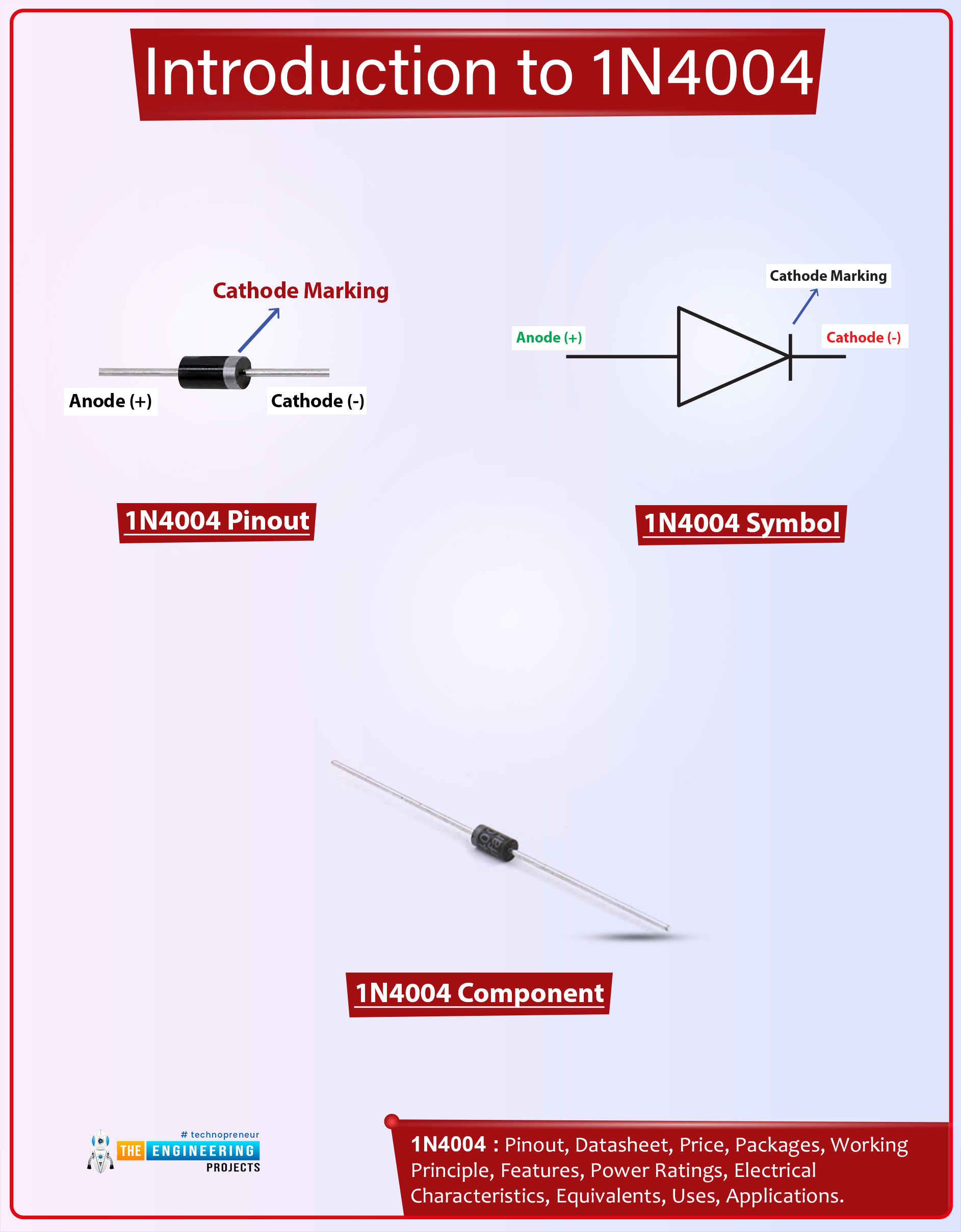
Hi Guys! I welcome you on board. Happy to see you around. In this post today, I’ll walk you through the Introduction to 1n4004.The 1n4004 is a diode that allows the current to flow in one direction only. It blocks the flow of current in the opposite direction. It comes with two terminals called anode and cathode and current always flows from the anode terminal to the cathode terminal. This device comes with a reverse peak voltage of around 400V and it can support loads under 1A.
I’d recommend reading the Introduction to 1n4007 that I’ve uploaded previously. This diode is almost similar to the device 1n4004 that I’m going to stretch in this post.
I suggest you buckle up as I’ll discuss the complete introduction to 1n4004 covering datasheet, pinout, features, equivalents, and applicati ...
Hi Friends! I welcome you on board. Happy to see you around. In this post today, I’ll document a detailed guide on the PCB manufacturing process.
PCB is hands down a crucial part of modern electronics. From cell phones and digital clocks to remote control and television sets, you will find inside a printed circuit board that connects the electrical components through sophisticated layers of copper traces. These electrical copper traces help in the flow of current through the connected components.
Needless to say, PCB has revolutionized the electronics industry. You’ll never find bulky electronics incorporated with scores of wires and electrical components. Nowadays, electronic devices are more compact and sophisticated, cover less space, and ...
Hi Guys! Hope you’re well today. I welcome you on board. In this post today, I’ll walk you through the Introduction to Arduino MKR WAN 1310.
The Arduino MKR WAN 1310 includes Lora connectivity that can perform very long-range transmission operations consuming low power.
This device is an ideal pick for the hobbyists requiring to develop IoT devices using the minimum networking experience using low power devices.
The MKR WAN 1300 is incorporated with the Microchip® SAMD21 which is the low-power processor, the MKR family’s characteristic crypto chip (the ECC508), and the Murata CMWX1ZZABZ LoRa® module.
Before you read further, I recommend you have a look at Introduction to Arduino Nano Every and Arduino MKR Vidor 4000 that I have uploaded previo ...
Hi Guys! Hope you’re well today. I welcome you on board. In this post today, I’ll walk you through the Introduction to Arduino Nano 33 BLE.
Arduino Nano 33 BLE is an advanced version of Arduino Nano board that is based on a robust and powerful processor the nRF52840 from Nordic Semiconductors, a 32-bit ARM® Cortex™-M4 CPU. It comes with a crystal oscillator frequency of around 64MHz. It features 32 times bigger program memory than the Arduino Uno board, helping you store programs with much larger memory. With this device, you can produce a lot more variable as it comes with RAM that is 128 times bigger than the RAM of Arduino Uno.
Before you move further, I recommend you read this article on the Introduction to Arduino Nano which we have publish ...
Hi Friends! Hope you’re well today. I welcome you on board. In this post today, I’ll walk you through the 5 strategies to optimize your digital presence in search engines.
The digital presence is very important for all types of websites. Simply put, the website’s ranking is very important to increase its traffic and recognition, whether it is an e-commerce store or a personal blog.
Search engine optimization (SEO) is the term used to define the ranking of your site in the search engine result page.
Want to know the SEO factors that can influence the website’s ranking?
Keep reading.
Why is your digital presence so important?
The digital presence of your brand is important since almost the entire world has turned into a digital sphere. The follo ...
Hi Friends! Hope you're well today. I welcome you on board. In this post today, I'll share 8 Photography Exercises and Ideas to Develop Your Artistic Style. Many beginner photographers face similar challenges and problems. While you can read up on the technicalities, light, and basic composition rules, it’s not so easy to take unique and interesting shots with artistic value. Lots of amateur photographers struggle with finding their visual style and being different from others, which might lead to doubts about your artistic abilities. You should, however, always remember that the ability to ‘see’ the perfect shot usually comes with practice. You have to push your boundaries and keep challenging yourself. A good solution is to pay attention to phot ...
Hi Friends! Hope you’re well today. I welcome you on board. In this post today, I’ll detail how apps are saving lives in the wilderness.
Whenever disaster strikes in the wilderness, be it from fires, storms, or other natural disasters, it can be a daunting task for people and animals to get the help they need to get out of potentially life-threatening circumstances. Animals, particularly endangered species, get caught in all kinds of situations that require attention, but obviously, they can’t just pick up the phone and call for help, and for people, they might not have the means to fare much better if their phones are out of service or they get injured and can't move.
When it comes to wildlife rescue operations and conservation, location-based ...
Hi Guys! I welcome you on board. Happy to see you around. In this post today, I’ll give you a detailed Introduction to Arduino MKR WiFi 1010.
The Arduino MKR Wifi 1010 is a solution to your basic IoT applications. Using this device, you can develop a WiFi-connected sensors network or can produce a BLE device connected to your cell phone. This board is based on the SAMD21 microcontroller and comes with a clock speed of around 32.768 kHz (RTC), 48 MHz. There are 8 digital pins, 13 PWM pins, and 7 analog pins incorporated on the board. The operating voltage is 3.3V while the voltage through USB or Vin is 5V.
I suggest you read this post all the way through, as I’ll detail the complete introduction to Arduino MKR Wifi 1010 covering pinout, pin descr ...