


Project Files of 18650 Li-ion Battery Library for Proteus Simulation
 Libraries
 Code
 Projects
 Simulation
f98ffc49489247638dedf4afce21954f.zip

18650 Li-ion Battery Library for Proteus V1.0
18650 Li-ion Battery Library for Proteus V1.0 comes as a ZIP archive of 13 files (1.5 MB, 3.2 MB unpacked) holding Proteus library files, simulation model DLLs, a Proteus simulation, an Arduino sketch and compiled HEX firmware.
- LIBProteus library
- DLLProteus model
- DSNProteus simulation
- INOArduino sketch
- HEXHEX firmware
Description
18650-Li-ion-Battery-Library-for-Proteus-v1.0.zip with the 18650 lithium-ion cell for Proteus simulation (TEP18650.LIB and TEP18650.DLL), our N-MOSFET library for the load switch, our Arduino UNO V4.0, the A4 capacity tester demo with its sketch and a README.

File Structure
 File Structure
6.2 KB201.9 KB11.9 KB17.9 KB319.5 KB883.5 KB295 KB21.6 KB27.1 KB319.5 KB883.5 KB295 KB16 KBGallery12 images from the tutorialOpen the tutorial
 Gallery12 images from the tutorial
The circuit, the board and the results as they appear in 18650 Li-ion Battery Library for Proteus Simulation. Open an image for its full size.
README
 README
18650 LI-ION BATTERY LIBRARY FOR PROTEUS SIMULATION - V1.0 (the 18650 lithium-ion cell, 3.7 V 2600 mAh, with a pop-up)
Designed by The Engineering Projects
www.TheEngineeringProjects.com

IMPORTANT LINKS
Article (read it first - pictures, step by step, every feature explained):
  https://www.theengineeringprojects.com/2026/11/18650-li-ion-battery-library-for-proteus.html
Report a bug or suggest a feature (our forum):
  https://www.theengineeringprojects.com/forum/category/motor-driver-proteus-library
The demo runs on our Arduino UNO V4.0 (included) - working LEDs, RESET and a
built-in serial monitor, no Virtual Terminal to wire - its own article:
  https://www.theengineeringprojects.com/2026/10/arduino-uno-library-for-proteus-v40.html
The demo measures it with our INA219 library (installed from its own package - not in this zip):
  https://www.theengineeringprojects.com/2026/10/ina219-current-sensor-library-for-proteus-v1-0.html
The demo's load switch is our N-MOSFET library's IRLZ44N (its LIB and DLL are in this zip; its own article):
  https://www.theengineeringprojects.com/2026/11/n-mosfet-library-for-proteus.html
Support us (the libraries are free):
  https://www.theengineeringprojects.com/donate

FILE STRUCTURE
18650-Li-ion-Battery-TEP-v1.0/
|-- Proteus Library Files/
|   |-- ArduinoV4TEP.LIB                              201.9 KB   TEP Arduino boards V4.0 (UNO) -> LIBRARY
|   |-- TEP18650.LIB                                   11.9 KB   the library -> LIBRARY folder
|   |-- TEPNMOS.LIB                                    17.9 KB   a part the demo uses -> LIBRARY folder
|-- Proteus Model Files/
|   |-- TEP18650.DLL                                  319.5 KB   the model -> MODELS folder
|   |-- TEPARDUINO.DLL                                883.5 KB   the Arduino board model -> MODELS folder
|   |-- TEPNMOS.DLL                                   295.0 KB   its model -> MODELS folder
|-- Proteus Simulation/
|   |-- 18650-Capacity-Tester-INA219-ArduinoUnoV4.pdsprj   21.6 KB   the demo project
|   |-- Liion18650_Demo.hex                            27.1 KB   the demo firmware
|   |-- TEP18650.DLL                                  319.5 KB   copy of the model
|   |-- TEPARDUINO.DLL                                883.5 KB   copy of the board model
|   |-- TEPNMOS.DLL                                   295.0 KB   copy of its model
|-- Arduino Code/
|   |-- Liion18650_Demo/Liion18650_Demo.ino             6.2 KB   the demo sketch (source of the .hex)
|-- README.txt                                        ~17.0 KB   this file
Total: 3.22 MB (unzipped). The C++ source code of the models is not included.

WHAT IS IT?
The 18650 lithium-ion cell - 18.4 mm across, 65 mm long, 3.7 V, 2600 mAh: the cell of laptop packs,
power banks, torches and
countless projects - drawn at true scale on its side (the blue sleeve, the white ring and the button
of the + end on the left, the
flat - end on the right, a nickel strip to each pin; our own drawing, no maker's mark). A BARE cell,
without a protection board:
  * The voltage follows the charge left: 4.20 V full, 4.02 V at 80 %, 3.84 V at 50 %, 3.70 V at 20
    %, 3.60 V at 10 %, then a
    steep fall to 3.00 V empty - behind 60 mohm (more when cold) and a slow polarisation that grows
    as the cell runs empty,
    so the voltage sags under a load and springs back at rest.
  * The charge is counted: every ampere second out or in moves it. At the sheet's standard 0.5 A the
    cell reaches its 2.75 V
    end voltage as the charge runs out, so a discharge test gives the 2600 mAh of the sheet. SPEED
    runs that battery clock
    faster (3600: an hour of charging or discharging each simulated second).
  * Charging: the cell takes a charge less and less willingly over the last 15 %, so at 4.20 V the
    current tapers off by itself
    (stop at about 50 mA); a source without a voltage limit drives the voltage up.
  * There is NO protection inside. Nothing cuts the load off and nothing stops a charge. Below 2.5 V
    the model reports an
    OVER-DISCHARGE, above 4.25 V an OVERCHARGE, and it counts the milliamp-hours taken or pushed
    there.
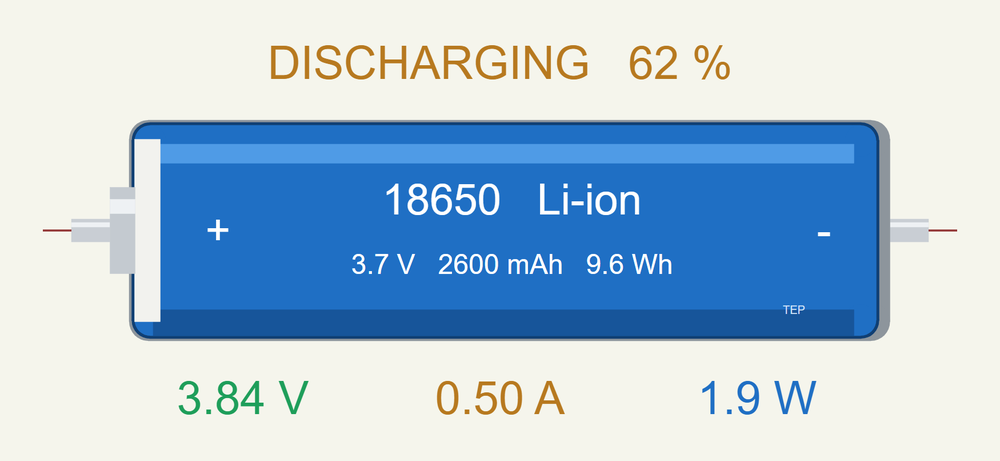
  * On the sheet the cell writes its state and the charge left above itself and its volts, amps and
    watts under itself at Run.
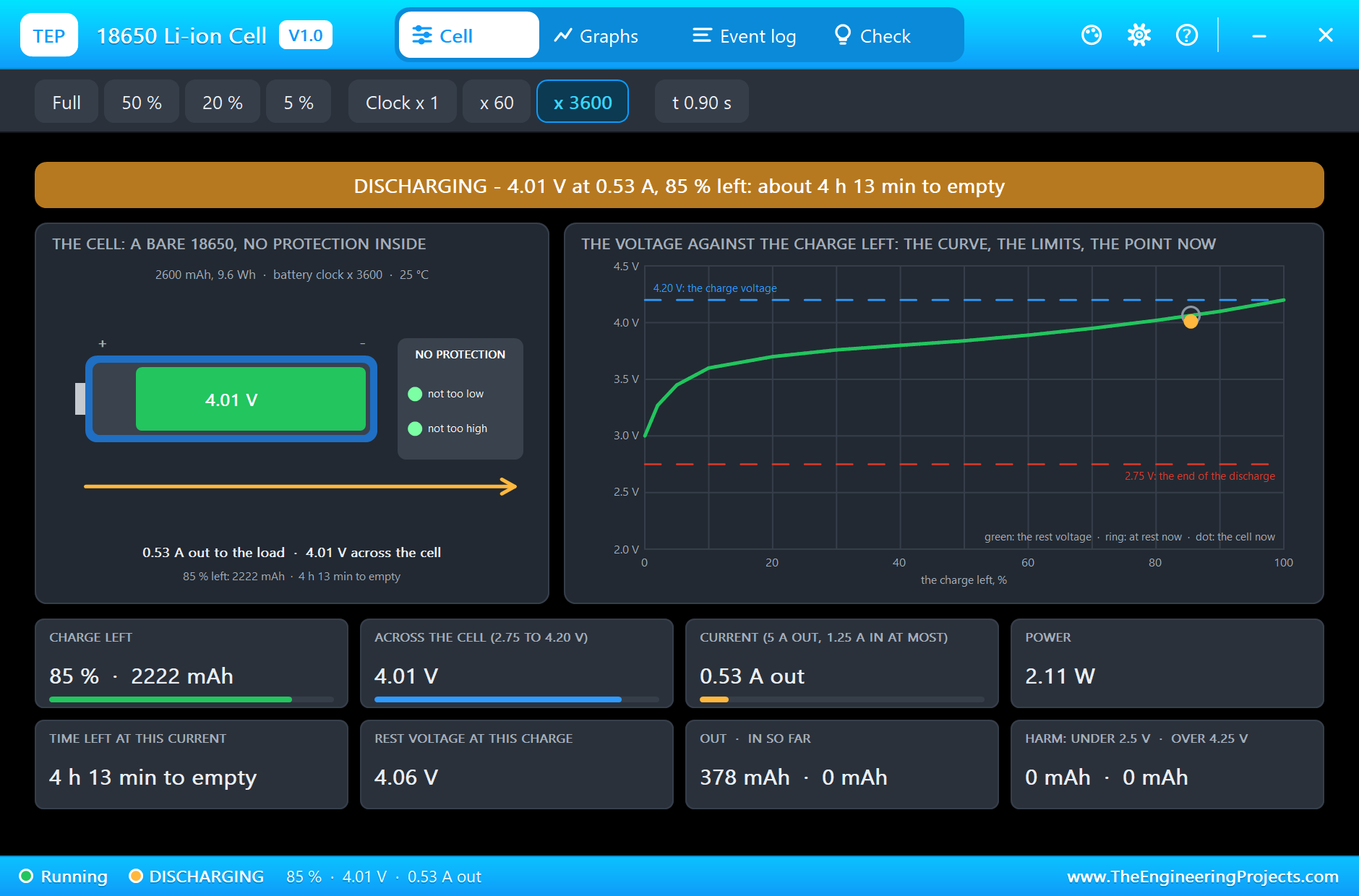
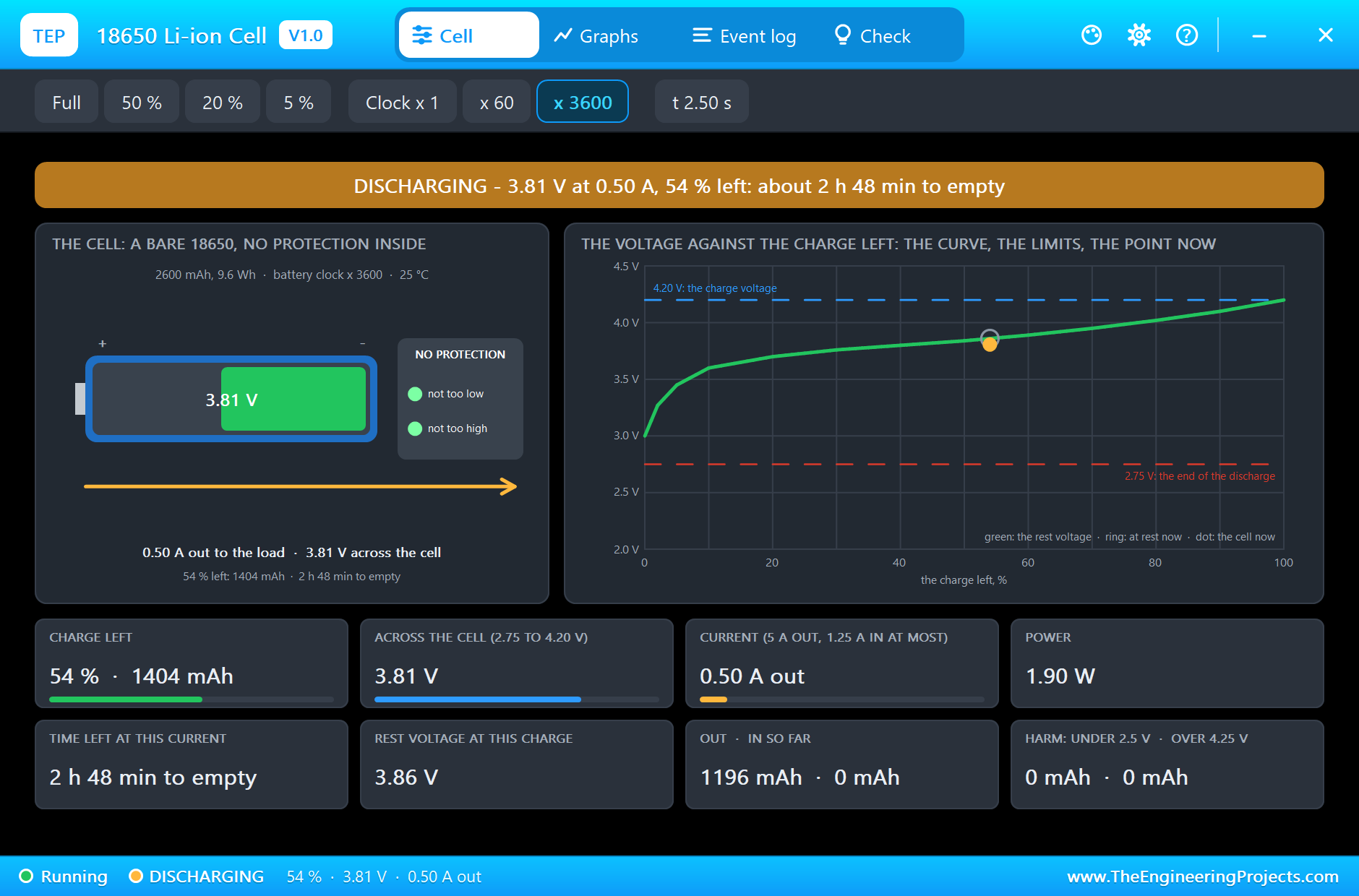
    Click it at Run for the pop-up: the cell with its charge and the current's direction, the
    voltage curve with the limits and
    the working point, eight live values; graphs, an event log and a check page.
The body is drawn as on the real part and to true scale against our Arduino.
The TEP signature and the pop-up are TEP additions.

ONE DEVICE (search "LIION" in Pick Devices):
  LIION18650TEP  "18650 Li-ion Cell 3.7 V 2600 mAh V1.0" in TEP18650.LIB (Electromechanical >
  Batteries), prefix BAT, model
                 TEP18650.DLL (analog). Pin + on the left (the button end), pin - on the right (the
                 flat end). The name starts
                 with L so that it sorts after the embedded ARDUINO UNO V4.0.

THE POP-UP
Click the part at Run. Tabs:
    Cell       chips: set the charge (Full, 50 %, 20 %, 5 %); the battery clock (x 1, x 60, x 3600).
    The cell on its side, filled
               to the charge left, with its voltage; two lamps for what harms it (too low, too
               high); the current's direction
               and size; the rest voltage against the charge left with the two limits (2.75 V the
               end of the discharge, 4.20 V
               the charge voltage), the rest point (ring) and the cell now (dot); eight live values:
               the charge left in % and
               mAh, the volts across the cell, the current and its direction, the power, the time
               left at this current, the
               rest voltage at this charge, the mAh out and in so far, the harm so far (mAh under
               2.5 V, mAh over 4.25 V).
    Graphs     the live values over the last 2, 6 or 15 s. Live / Freeze.
    Event log  every change and warning; filters All / Changes / Warnings, Pause, Clear
    Check      what the part is doing and what to look at, each with a verdict (green = fine, amber
    = check, red = wrong)
    Settings   theme, text size, open at Run, window size
    Help       report a bug, suggest a feature, article, updates, donate, forum; Copy diagnostics
    for a bug report

TEST STATUS
V1.0: verified in Proteus 8.5 on 16 Nov 2026 (the demo project as shipped: an A4 sheet, an Arduino UNO V4.0).
What the runs showed (the model's own numbers and the sketch's monitor):
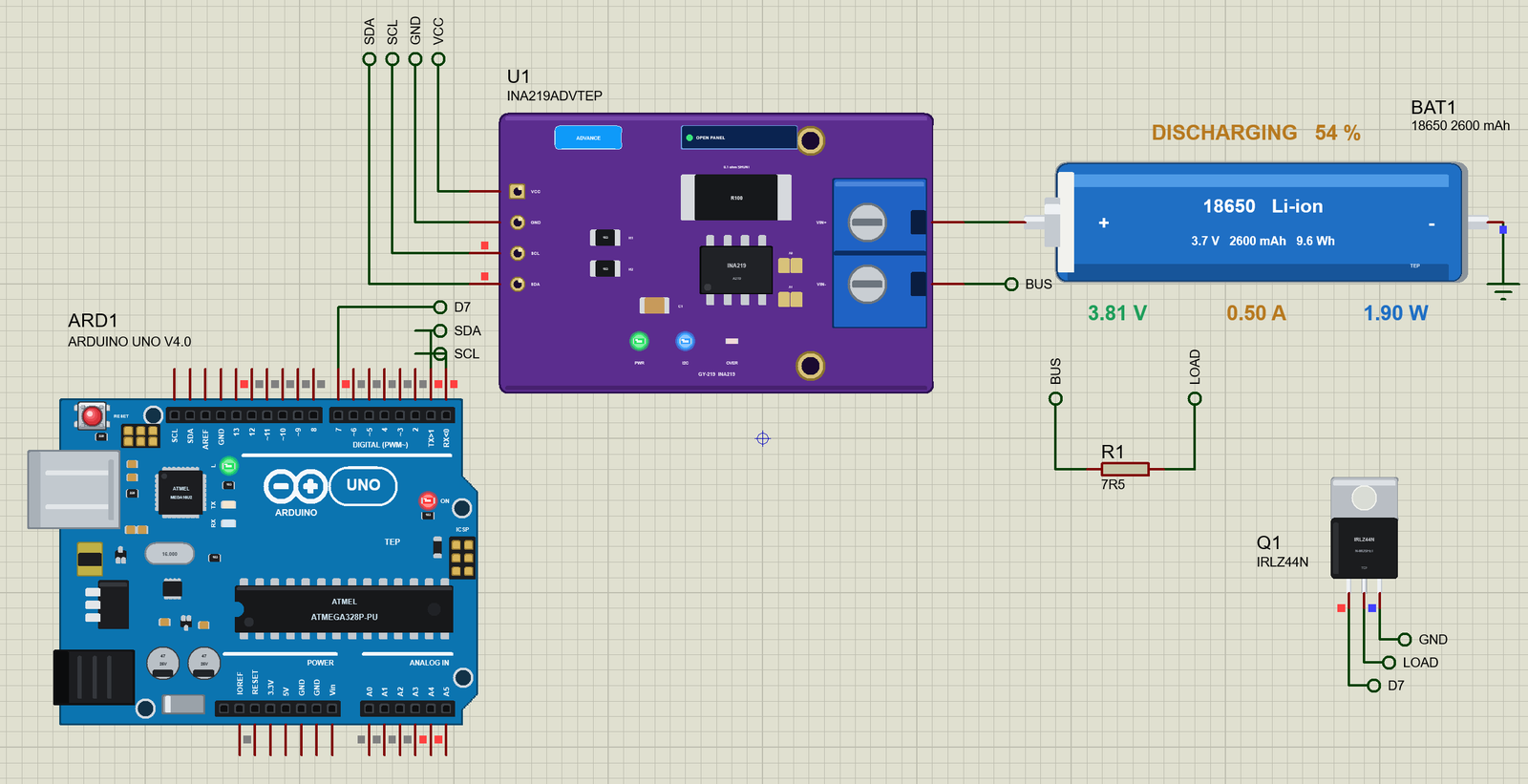
The demo as shipped (Liion18650_Demo, SOC 100 %, SPEED 3600, R1 7.5 ohm, Q1 IRLZ44N on pin 7), one
run (lifinal4), the model's own
pauses:
  * The load on (the log at 0.4 s): 4.10 V at 0.54 A. At 0.9 s: 85 % left (2222 mAh), 4.01 V at 0.53
    A out, 2.11 W; about
    4 h 13 min to empty.
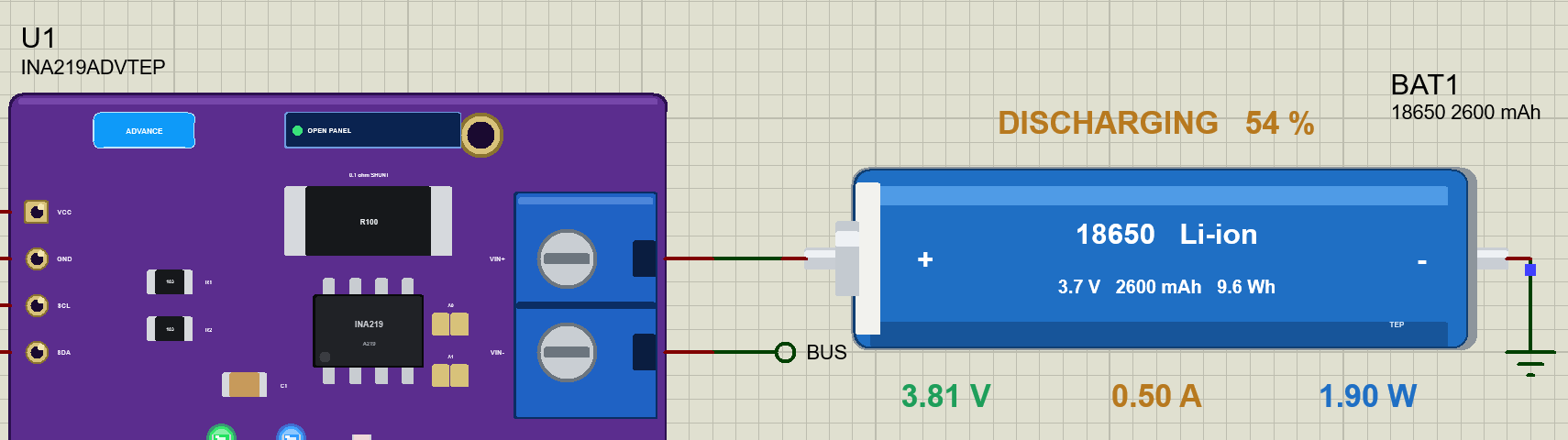
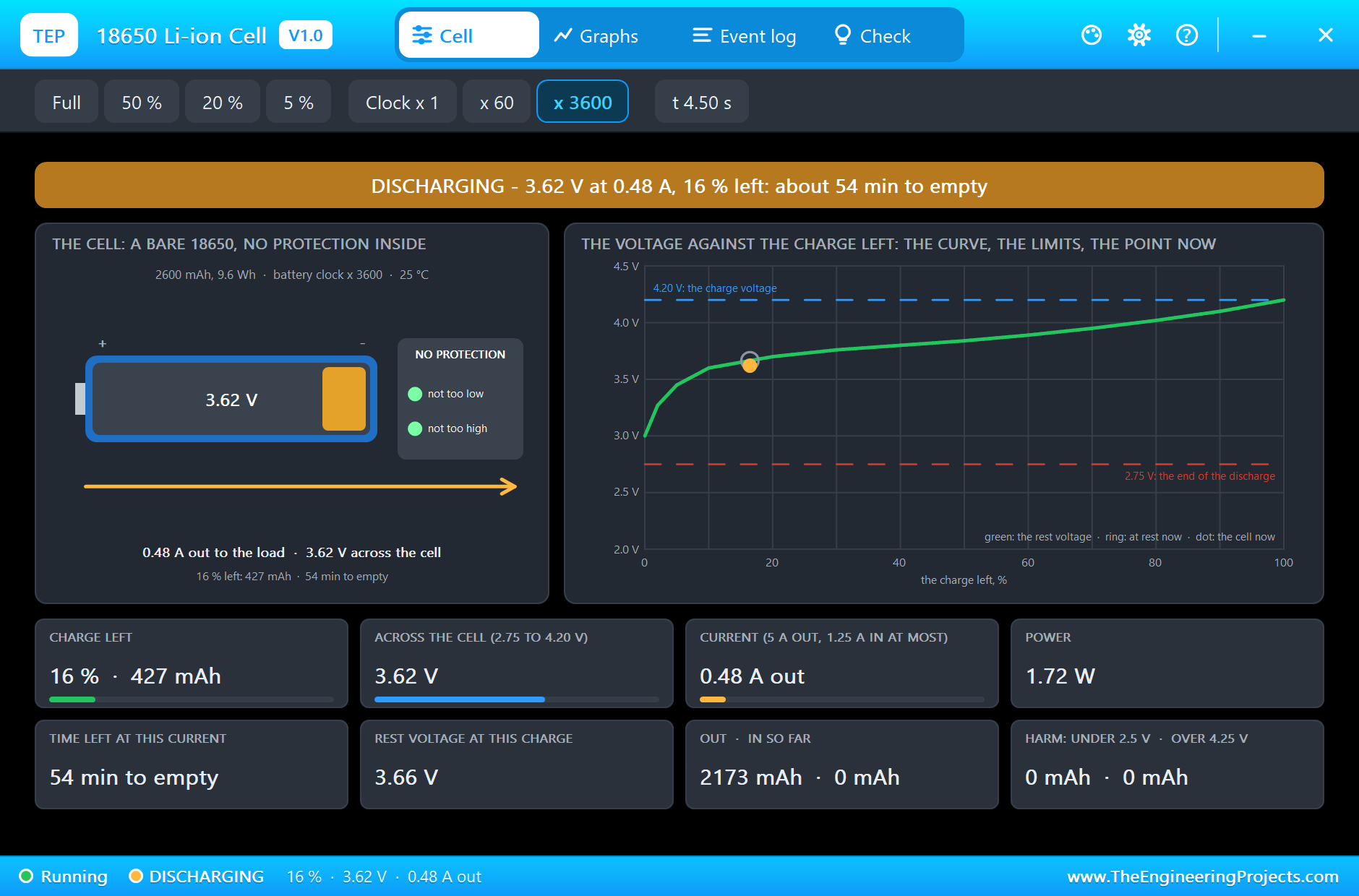
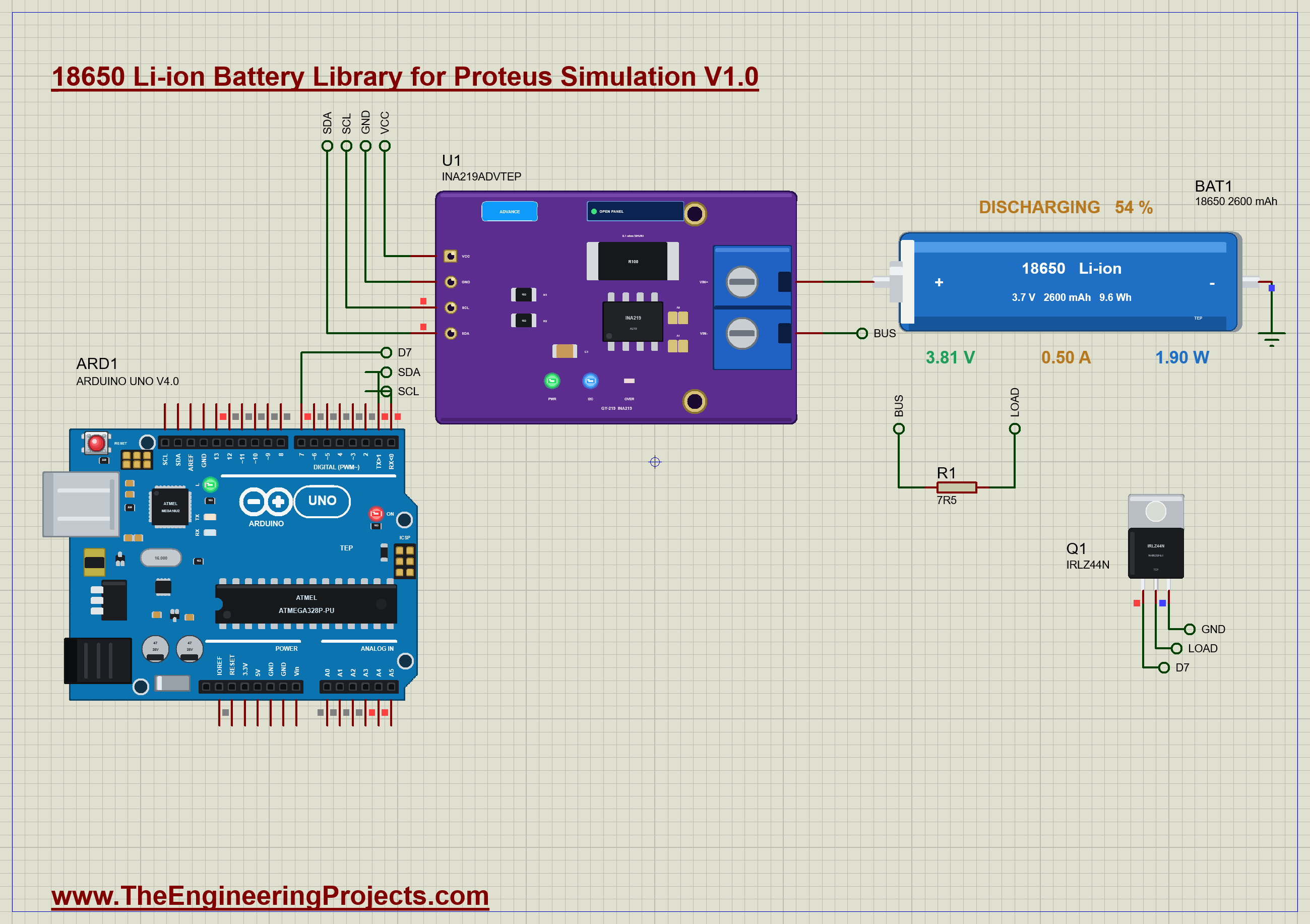
  * Down the curve: 54 % (1404 mAh), 3.81 V at 0.50 A, 1.90 W, rest voltage 3.86 V (2.5 s); 16 %
    (427 mAh), 3.62 V at 0.48 A
    (4.5 s). The log's marks: 75 % left at 1.452 s, 50 % at 2.741 s, 25 % at 4.068 s, LOW (10 %) at
    4.884 s.
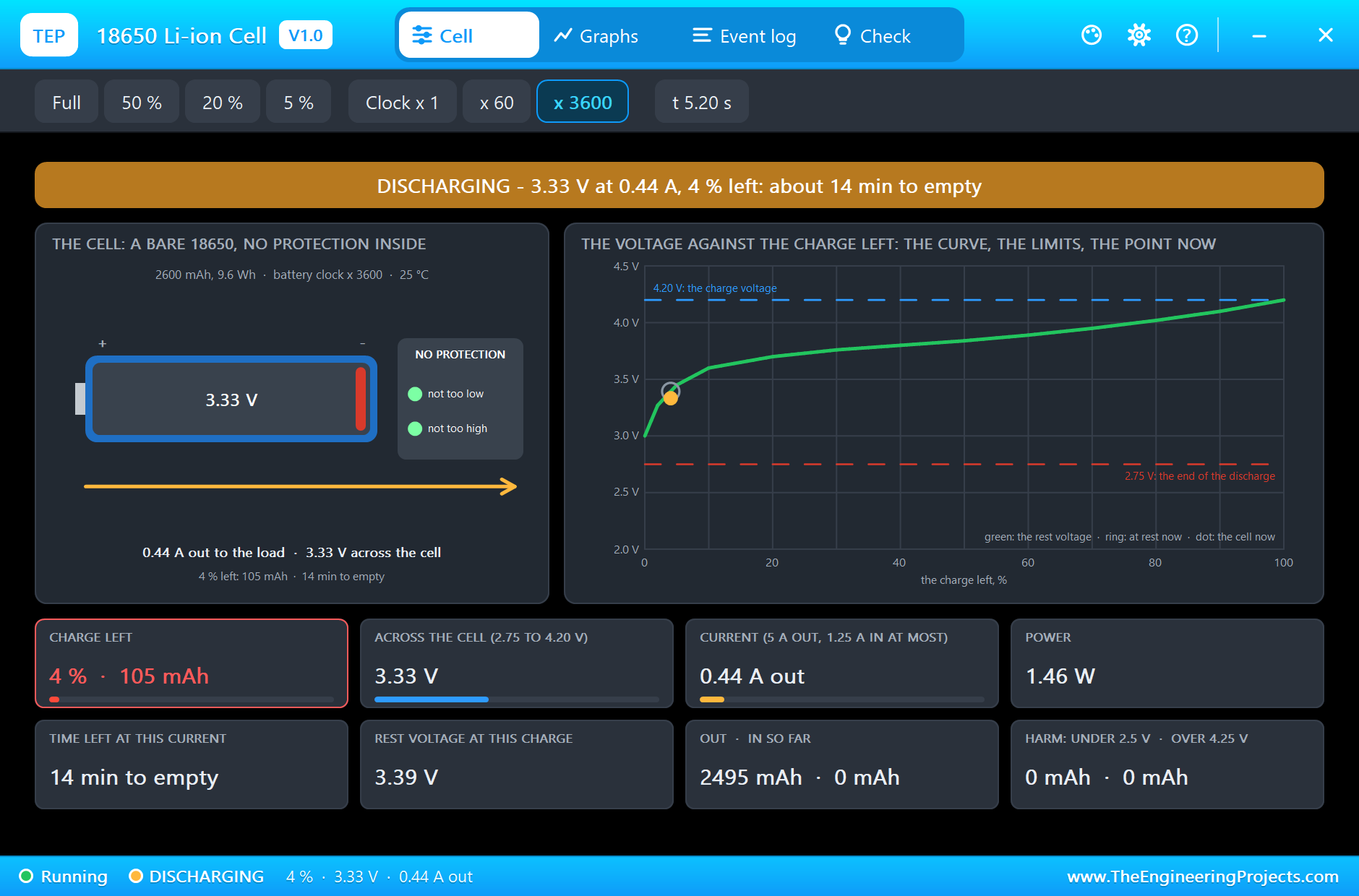
  * The steep end: 4 % (105 mAh), 3.33 V at 0.44 A, 14 minutes to empty (5.2 s).
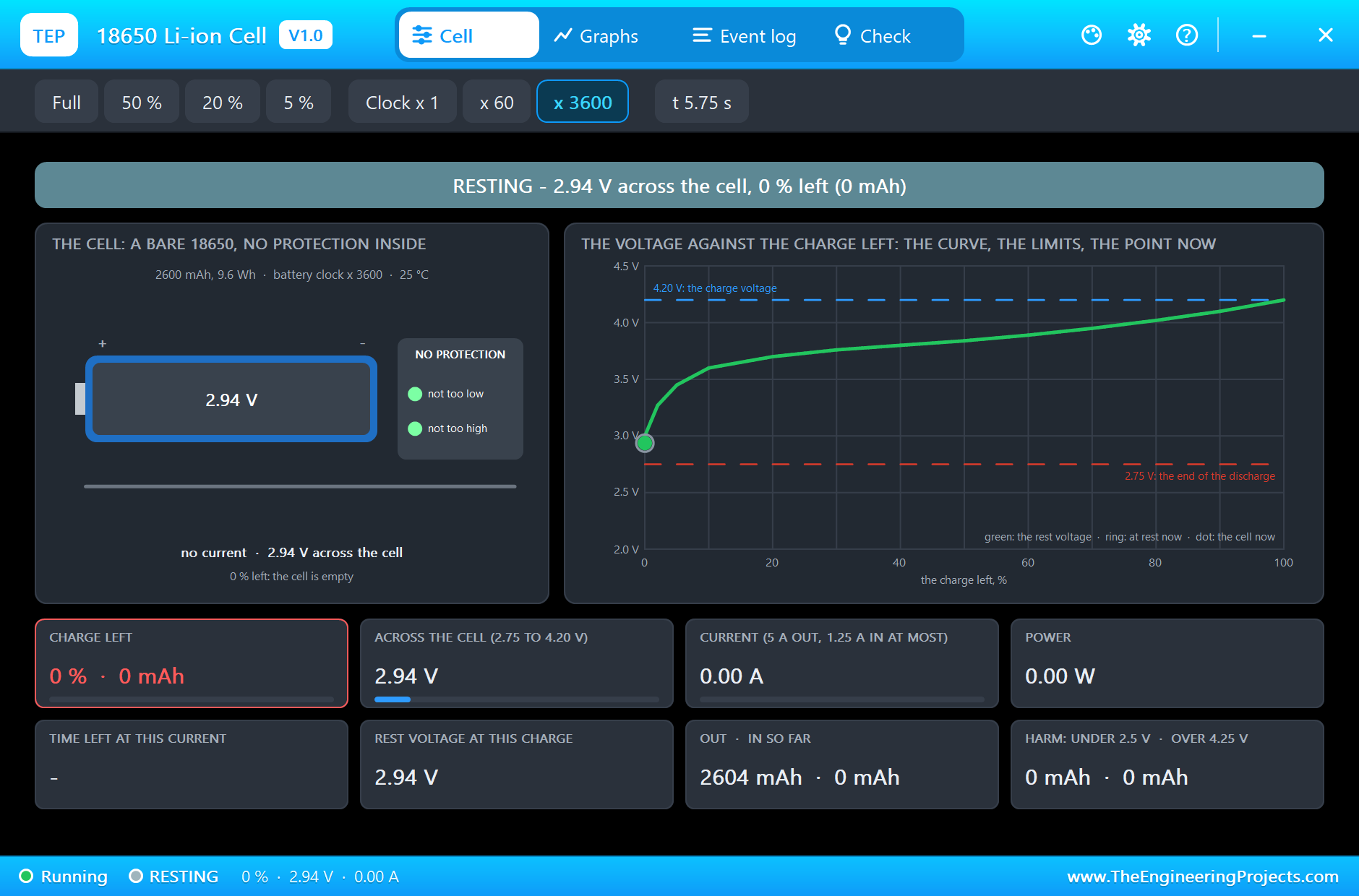
  * The sketch switched the load off under 2.75 V and printed "DONE at 2.71 V: capacity 2587 mAh,
    9.76 Wh in 5.25 h"; the cell
    rests from 5.578 s at 2.94 V (0 % left). The cell's own count: 2604 mAh (9.82 Wh) out; the
    lowest 2.70 V, the highest
    4.20 V, the most 0.54 A; no over-discharge, no overcharge.
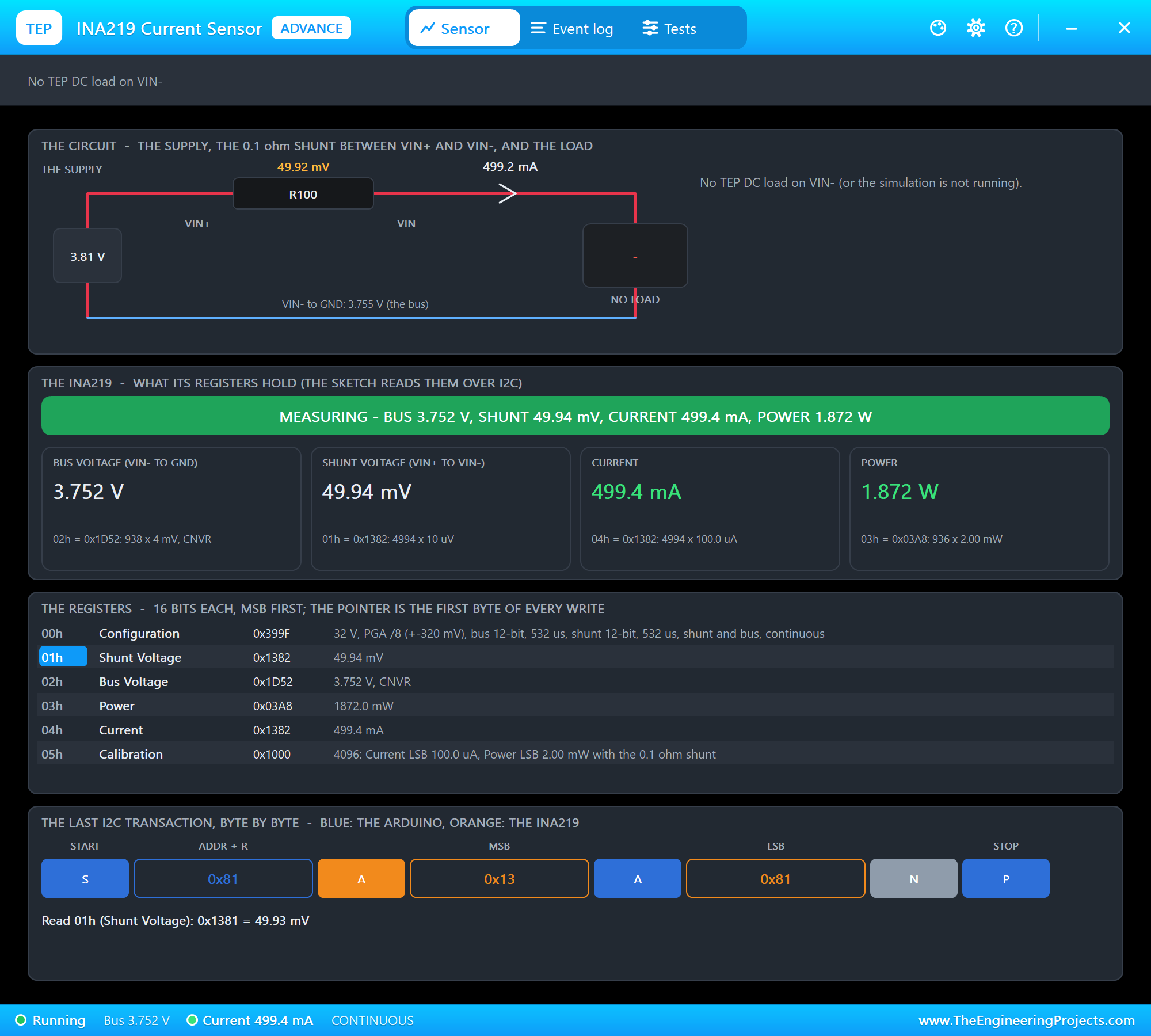
  * The INA219 (U1) read 3.752 V on the bus, 49.94 mV on the shunt, 499.4 mA (2.5 s). 133 s for the
    7.4 s of the run.
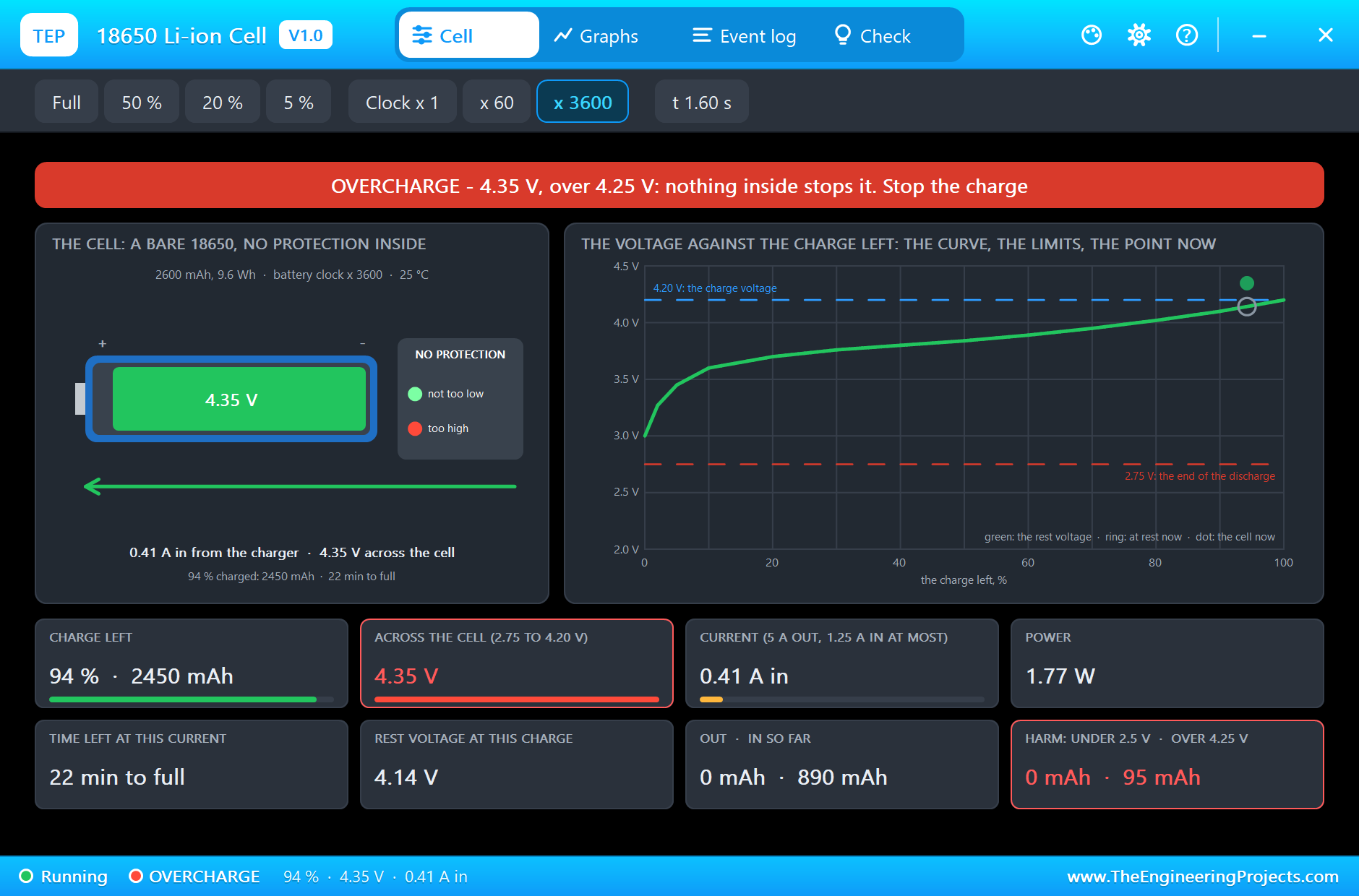
A second run with a wrong charger (licheck4: SOC 60 %, R1 1.5 ohm from the bus to the UNO's 5 V
rail): charging 0.62 A in at
4.00 V; OVERCHARGE at 1.413 s (4.26 V). At 1.6 s: 4.35 V, 0.41 A in, 94 %, 95 mAh pushed in over
4.25 V. Full at 2.458 s; at
3.45 s the cell sits at 4.96 V with 0.03 A still flowing in, 269 mAh over 4.25 V. Nothing inside the
cell stops it.

INSTALLATION (about 2 minutes)
1. Close Proteus. Extract the WHOLE ZIP to a normal folder (e.g. Desktop).
2. Copy everything in "Proteus Library Files" (TEP18650.LIB, TEPNMOS.LIB and our Arduino library
V4.0, ArduinoV4TEP.LIB, with the ARDUINO UNO V4.0 used by the demo) to the LIBRARY folder of
Proteus, for example:
     C:\Program Files (x86)\Labcenter Electronics\Proteus 8 Professional\LIBRARY
   (use the folder that already holds Proteus's own .LIB files).
3. Copy TEP18650.DLL, TEPNMOS.DLL and TEPARDUINO.DLL from "Proteus Model Files" to the MODELS folder
(...\Proteus 8 Professional\MODELS).
4. Delete TEP18650.IDX from the LIBRARY folder if it is there (Proteus makes a new index).
5. Start Proteus. In Pick Devices (P) search "LIION".

RUN THE DEMO
"Proteus Simulation\18650-Capacity-Tester-INA219-ArduinoUnoV4.pdsprj" (an A4 sheet) - keep the .hex
file and the DLLs beside the project.
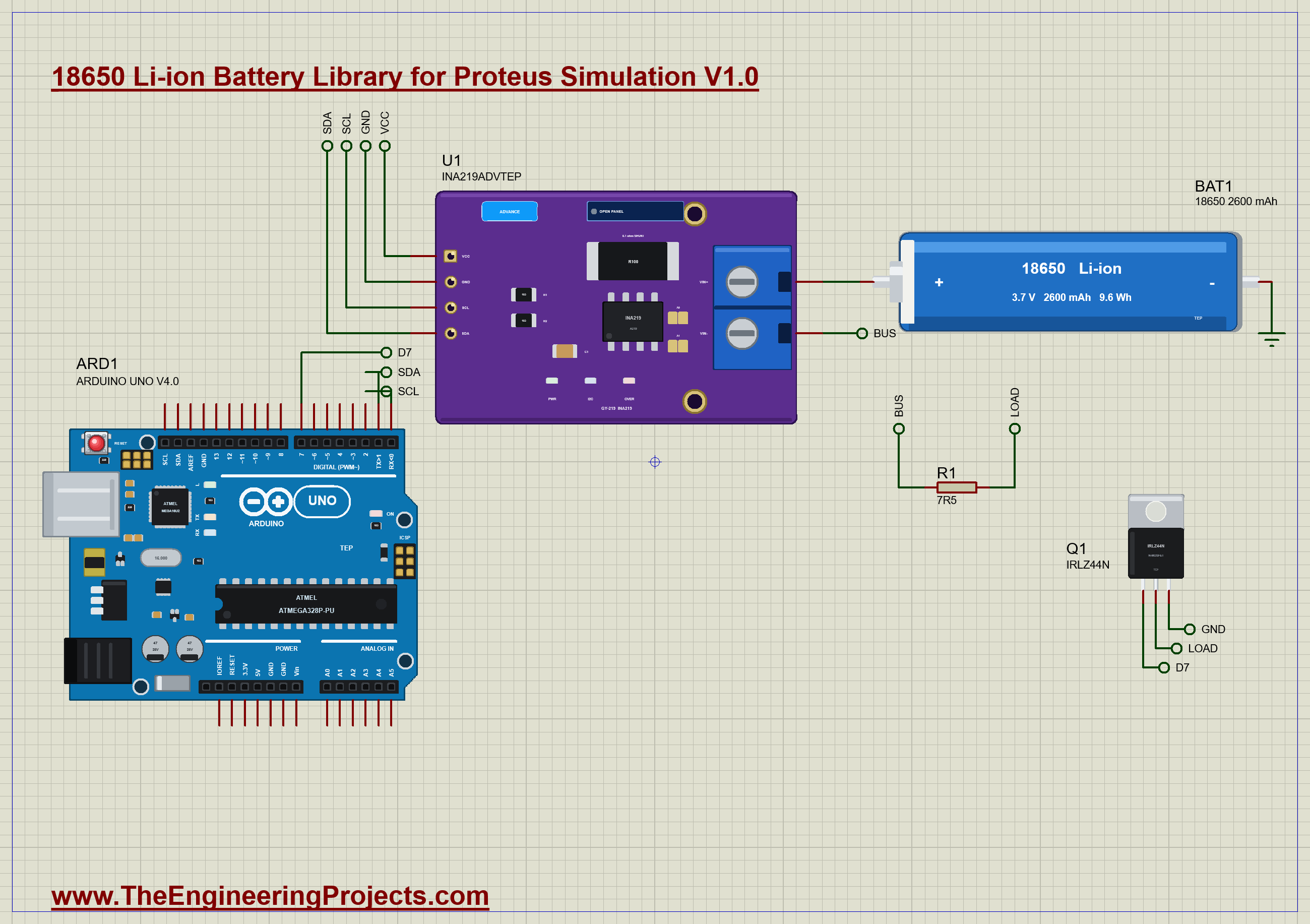
  An 18650 capacity tester:
  ARD1:   Arduino UNO V4.0 running Liion18650_Demo.hex, its serial monitor built in (window "TEP
  Arduino UNO - ARD1").
  U1:     our INA219 (its pop-up version) between the cell's + (VIN+) and the bus (VIN-); SDA A4,
  SCL A5.
  BAT1:   the 18650 cell, SOC 100 %, SPEED 3600 (an hour each simulated second), TEMP 25.
  R1:     7.5 ohm, the load, from the bus to the MOSFET's drain (about 0.5 A: the cell's standard
  discharge; 2 W on a real bench).
  Q1:     our IRLZ44N logic-level N-MOSFET, the load's switch: drain on the load, source on ground,
  gate on the UNO's pin 7.
          The sketch switches the load on, adds the current up a hundred times a second, switches
          the load off at 2.75 V and
          prints the capacity it has measured; the UNO's LED lights while the load is on.
Closed the monitor? Click the UNO's USB port.

WIRING (the same in Proteus and on a real board)
  + is the button end, - the flat end (and the whole can under the sleeve). Use a cell holder or
  spot-welded strips; do not
  solder straight onto a cell. Put a protection board (or your own cut-off, as in the demo) between
  a bare cell and its load.
REAL HARDWARE:
 * Charge only with a lithium-ion charger: a constant current up to 4.20 V, then 4.20 V until the
   current falls to about 50 mA.
 * Never discharge below 2.75 V and never charge a cell that has been left under 2.5 V.
 * Never short a cell: it can give tens of amperes, burn and vent. Many "18650" cells sold loose are
   bare cells like this one.
 * Do not charge below 0 C. On a real tester add 220 ohm in the gate lead and 100 kohm from the gate
   to ground.

THE DEMO SKETCH ON THE SERIAL MONITOR (Liion18650_Demo V1.0, 9600 baud)
The sketch reports every 500 ms. Type a command:
  start      test again       stop      switch the load off       rate 1000      report every 1000
  ms       help
EXPECTED MONITOR OUTPUT
  18650 capacity tester - The Engineering Projects
  The load goes on now and off at 2.75 V. Battery clock x 3600: a simulated second is an hour.
  Commands: start | stop | rate 500 | help
  Test started: the load is on
  Cell 4.13 V  0.54 A  2.24 W  0 mAh so far, 0.00 h
  Cell 4.04 V  0.53 A  2.14 W  264 mAh so far, 0.49 h
  Cell 3.96 V  0.52 A  2.06 W  527 mAh so far, 0.99 h
  ...
  Cell 3.57 V  0.47 A  1.68 W  2260 mAh so far, 4.50 h
  Cell 3.23 V  0.42 A  1.37 W  2488 mAh so far, 5.00 h
  DONE at 2.71 V: capacity 2587 mAh, 9.76 Wh in 5.25 h
  Cell 2.94 V  at rest  -  measured 2587 mAh

PROPERTIES (double-click the part > Edit Properties)
  Charge at the start (SOC)            %, 0 - 100 (80)
  Battery clock (SPEED)                1 real time, 3600 an hour of charging or discharging each
  simulated second, 1 - 7200 (1)
  Temperature (TEMP)                   C, -20 - 60: charge only between 0 and 45 C; a cold cell
  holds less (25)
Every run starts again from the properties.

LINKS.INI (OPTIONAL)
The Help page cards of the pop-up open web pages. To point them somewhere else without a new DLL,
put a text file named links.ini next to TEP18650.DLL with lines KEY=URL, for example:
  ARTICLE=https://www.theengineeringprojects.com/...
Keys: WEBSITE, FORUM, BUG_REPORT, FEATURE_REQUEST, ARTICLE, USER_GUIDE,
UPDATE_CHECK, DONATE. Only http:// and https:// links are used; lines starting
with # are comments.

TROUBLESHOOTING
* OVER-DISCHARGE: the cell is under 2.5 V and the load is still on. Nothing inside the cell stops
  it: switch the load off.
* OVERCHARGE: more than 4.25 V across the cell - the charger has no 4.2 V limit. Use a lithium-ion
  charger.
* The measured capacity is under 2600 mAh: the load is heavier than 0.5 A (the voltage sags to 2.75
  V sooner) or the cell is cold.
* The charge hardly moves: at SPEED 1 a 2600 mAh cell needs hours, as a real one does. Raise SPEED
  (60 or 3600).
* The voltage jumps up when the load goes off: that is the cell's own resistance and polarisation -
  a rested cell reads higher.
* The part is not simulated: TEP18650.DLL is missing from MODELS and from the project folder. No UNO
  / no monitor window: TEPARDUINO.DLL is missing, or click the UNO's USB port.

BUG REPORTS AND FEATURE REQUESTS
Please post them in our forum with a screenshot, the Serial Monitor text, the
simulation log and the pop-up's Copy diagnostics text:
  https://www.theengineeringprojects.com/forum/category/motor-driver-proteus-library

SUPPORT US
This library is free. If it saves you time, please support our work:
  https://www.theengineeringprojects.com/donate

WEBSITE
  https://www.theengineeringprojects.com/

LICENCES AND THIRD-PARTY NOTES
* The model (TEP18650.DLL), the symbols and artwork, the other parts of ours in the demo and the
  Arduino Library V4.0 (ArduinoV4TEP.LIB / TEPARDUINO.DLL, with its built-in TEP Serial Monitor
  Advance) are made by The Engineering Projects. The models use only standard Windows libraries; no
  Visual C++ redistributable is needed.
  The C++ source code is not included.
* Arduino UNO V4.0 (ArduinoV4TEP.LIB / TEPARDUINO.DLL, our Arduino Library V4.0 - its
  microcontroller is Proteus's own AVR model): The Engineering Projects,
  https://www.theengineeringprojects.com/2026/10/arduino-uno-library-for-proteus-v40.html
* The .hex file is built from the demo sketch and the Arduino AVR core 1.8.6, which includes
  LGPL-licensed code; its source code is available at
  https://github.com/arduino/ArduinoCore-avr/tree/1.8.6
* Proteus is a product of Labcenter Electronics and is not included. Arduino is a trademark of Arduino SA.
  This library is not made or endorsed by Arduino or Labcenter.

REBUILDING THE FIRMWARE (OPTIONAL)
The HEX file is supplied; Arduino IDE is not needed to run the demo. To edit the sketch, open
Arduino Code\Liion18650_Demo\Liion18650_Demo.ino, select Arduino Uno and use Sketch > Export
Compiled Binary. Replace the simulation's .hex with the exported HEX. The sketch needs 9,856 bytes
of flash and 522 bytes of RAM.

MODEL SCOPE AND LIMITS
Modelled: the rest voltage against the charge left (fourteen points - ours, shaped like the usual
curves of such cells: 4.20 V
full, 3.84 V at 50 %, 3.60 V at 10 %, 3.00 V empty, a collapse below); 60 mohm (the sheet says 65
mohm at most at 1 kHz) and
3 % more for every degree under 25 C; a polarisation of 50 mohm with 30 s, growing over the last 10
% to about 0.6 ohm at
empty (ours); the charge counter with the battery clock;
a charge taper over the last 15 % (ours); self-discharge 2 % a month; a cold cell's smaller capacity
(0.6 % a degree - ours);
the reports and counts under 2.5 V and over 4.25 V (ours).
Not modelled: ageing and cycle life, the capacity's small loss at high currents beyond the voltage
sag, heating, swelling,
venting and fire, the lasting harm of an over-discharge or an overcharge (reported and counted, the
cell does not age).

VERSION
TEP 18650 Li-ion Battery library V1.0 (Nov 2026). Device LIION18650TEP (TEP18650.LIB /
TEP18650.DLL). Demo sketch Liion18650_Demo V1.0 (the INA219 read straight with Wire). The demo also
uses our N-MOSFET library (TEPNMOS: IRLZ44NTEP), shipped in this package. Demo board: ARDUINO UNO
V4.0 (TEP Arduino Library V4.0) with its built-in serial monitor.Development1 release
 Development1 release
-
V1.018650 Li-ion Battery Library for Proteus V1.0this page
V1.0 is the only release in the Download Center so far. When a newer version is published, it appears above with its own download page.
Installation8 steps
 Installation8 steps
From the download to a working project, in order. The steps follow what the package contains.
You will need
- Proteus Design SuiteProteus 8 or newer (Labcenter), on Windows
- Arduino IDE1.8 or 2.x, with the board of the tutorial chosen under Tools → Board
- Any archive toolWindows, macOS and Linux extract ZIP files on their own
Steps
- 1
Extract the archive
Right-click f98ffc49489247638dedf4afce21954f.zip and choose Extract All (or open it with 7-Zip or WinRAR) into a folder you can find again. Keep its folder structure (18650-Li-ion-Battery-TEP-v1.0) as it is.
- 2
Copy the library files into Proteus
Move ArduinoV4TEP.LIB, TEP18650.LIB and TEPNMOS.LIB and the files into the LIBRARY folder of your Proteus installation: C:\Program Files (x86)\Labcenter Electronics\Proteus 8 Professional\LIBRARY for Proteus 8, or the matching Proteus 7 folder. Older versions keep it under ProgramData\Labcenter Electronics. If Proteus is open, close it first.
- 3
Add the simulation model
Copy TEP18650.DLL, TEPARDUINO.DLL and TEPNMOS.DLL into the MODELS folder next to LIBRARY, so the component can run, not only be drawn.
- 4
Restart Proteus and place the component
Start Proteus, open a schematic, press P (Pick Devices) and search for the component by the name used in the tutorial. It appears with its pins ready to wire.
- 5
Open the sketch in the Arduino IDE
Open Liion18650_Demo.ino, select your board and port under Tools, then Verify. Sketch → Export Compiled Binary writes the HEX file a simulation needs.
- 6
Load the HEX file
In Proteus double-click the microcontroller, set Program File to Liion18650_Demo.hex and run the simulation. For real hardware, flash the same file with your programmer.
- 7
Open the example simulation
Open 18650-Capacity-Tester-INA219-ArduinoUnoV4.pdsprj in Proteus to see the wiring exactly as in the tutorial. Check the controller's Program File path, then press Play.
- 8
Follow the tutorial
18650 Li-ion Battery Library for Proteus Simulation explains every connection and setting in order; keep it open beside the files while you build.
FAQs9 questionsContact TEP
 FAQs9 questions
How do I download 18650 Li-ion Battery Library for Proteus V1.0?
Wait for the 30-second guest countdown on this page, then press the download button; the file comes straight from our storage. Members who are logged in skip the wait. If the browser opens the file instead of saving it, use its Save as option. The download link is made for you when the countdown ends and works for 15 minutes; a saved or shared link stops working, so share this page instead.
What is inside the archive?
18650 Li-ion Battery Library for Proteus V1.0 comes as a ZIP archive of 13 files (1.5 MB, 3.2 MB unpacked) holding Proteus library files, simulation model DLLs, a Proteus simulation, an Arduino sketch and compiled HEX firmware. Open the File Structure tab for the full list of 13 files.
What should I do if the download does not start?
Check the browser's download list first; an ad blocker or a company firewall can also hold it back, so try another browser or network. If the file arrives incomplete, download it again. For an installation problem, read the Install tab or tell us in the comments with your software version and the exact error message.
Is this file free?
Yes. Every file in the TEP Download Center is free for learning, personal and student projects. If you share it, link back to this page or the tutorial so others find the latest version.
How do I check that the file arrived complete?
Compare its SHA-256 with the one on this page, 6556e101cb22944bd59cd1ed5cc5113f75f3f6ac5750c470af7872ec775652fc. In PowerShell run Get-FileHash "f98ffc49489247638dedf4afce21954f.zip"; on macOS or Linux run shasum -a 256 "f98ffc49489247638dedf4afce21954f.zip". The same value means the file is exactly the one in our storage; a different one means the download broke off, so download it again.
Do I need WinRAR to open the ZIP file?
No. Windows, macOS and Linux open ZIP archives on their own (Extract All, or double-click). WinRAR and 7-Zip work too. Extract the whole archive before using the files.
Where do I put the LIB and IDX files?
Both files go into the LIBRARY folder of your Proteus installation (Proteus 8: C:\Program Files (x86)\Labcenter Electronics\Proteus 8 Professional\LIBRARY; Proteus 7 has the same folder under its own name). Restart Proteus afterwards and search for the component with P.
Which Proteus version does the library need?
The tutorial names the Proteus version the library was made and tested with. Most TEP libraries work in Proteus 7 and Proteus 8; if the component does not appear after a restart, check that both the LIB and the IDX file were copied and that Proteus was fully closed while copying.
How do I get the HEX file into the simulation?
Compile the sketch in the Arduino IDE (Sketch → Export Compiled Binary gives you the HEX next to the sketch), then in Proteus double-click the board, set Program File to that HEX and run.
Members skip the wait. Log in or join TEP.

- 0Total downloads
- 4%Popularity
- ProteusCategory
- 0Comments
- ssyedzainnasirUploaded by
- 16 Nov 2026Uploaded at


 SHA-256
6556e101cb22944bd59cd1ed5cc5113f75f3f6ac5750c470af7872ec775652fc


 Need help with this file?
 Tags
Related Proteus
All Proteus tutorials



Comments
0