


Project Files of GPS Accuracy Survey with NEO-7M on Raspberry Pi 5 - Proteus Simulation
 Libraries
 Code
 Projects
 Simulation
740f7d26bc164a6fa6aab0c548eff943.zip

GPS Accuracy Survey with NEO-7M on Raspberry Pi 5 - Proteus Simulation V1.0
GPS Accuracy Survey with NEO-7M on Raspberry Pi 5 - Proteus Simulation V1.0 comes as a ZIP archive of 135 files (13.6 MB, 26.6 MB unpacked) holding Proteus library files, simulation model DLLs, a Proteus simulation, source code and a nested archive.
- LIBProteus library
- DLLProteus model
- DSNProteus simulation
- SRCSource code
- ZIPNested archive
Description
GPS-Accuracy-Survey-NEO-7M-Raspberry-Pi-5-Proteus-Simulation-v1.0.zip: the complete Proteus simulation project (a Raspberry Pi 5, a u-blox NEO-7M GPS module, a 128x64 OLED, the Laptop and Mobile WiFi Monitors), the Python program gnss_survey.py, every LIB and DLL, the TEP Pi runtime and a README.

File Structure
 File Structure
39.5 KB13.1 KB73.3 KB112.4 KB60.5 KB3.3 MB34.3 KB620.8 KB36 KB169.8 KB628.1 KB99.3 KB65.3 KB4.8 MB4.1 MB80 B97.8 KB26.8 KB1.2 MB1.1 MB88.9 KB27.3 KB55.8 KB79.8 KB105.8 KB193.8 KB113.8 KB48.8 KB145.8 KB36.8 KB29.3 KB42.3 KB28.8 KB67.3 KB89.3 KB153.8 KB22.8 KB38.8 KB2.1 KB9.9 KB4.1 KB1.3 KB4.7 KB431 B2.5 KB17.5 KB283 B6.5 KB37.9 KB11.1 KB5.5 KB885 B13.6 KB9 KB878 B1.5 KB4 KB1004 B10 B110 B2.6 KB1.1 KB8.9 KB58.5 KB12.4 KB6.6 KB18.5 KB20.7 KB27.8 KB21.1 KB7.1 KB7.7 KB2.7 KB51.2 KB100.9 KB1.2 KB24.3 KB7.4 KB53.6 KB26.1 KB20.5 KB60.5 KB19.6 KB1.6 KB8.4 KB20.9 KB2.6 KB539 B1.4 KB9.7 KB2.8 KB21 B92 B7.9 KB264 B3.4 KB3.8 KB17.5 KB55.2 KB3.3 KB10.8 KB1.5 KB4.2 KB7.3 KB2.5 KB32.6 KB14.5 KB283 B17.4 KB257 B691 B14.5 KB12.8 KB3.6 KB1.7 KB37 KB418 B6.2 KB7 KB37.3 KB10.6 KB23.7 KB28.7 KB8.8 KB16.9 KB3.0 MB342.5 KB463 KB17.9 KB30.2 KB3.0 MB342.5 KB463 KB17.9 KB9.4 KBGallery12 images from the tutorialOpen the tutorial
 Gallery12 images from the tutorial
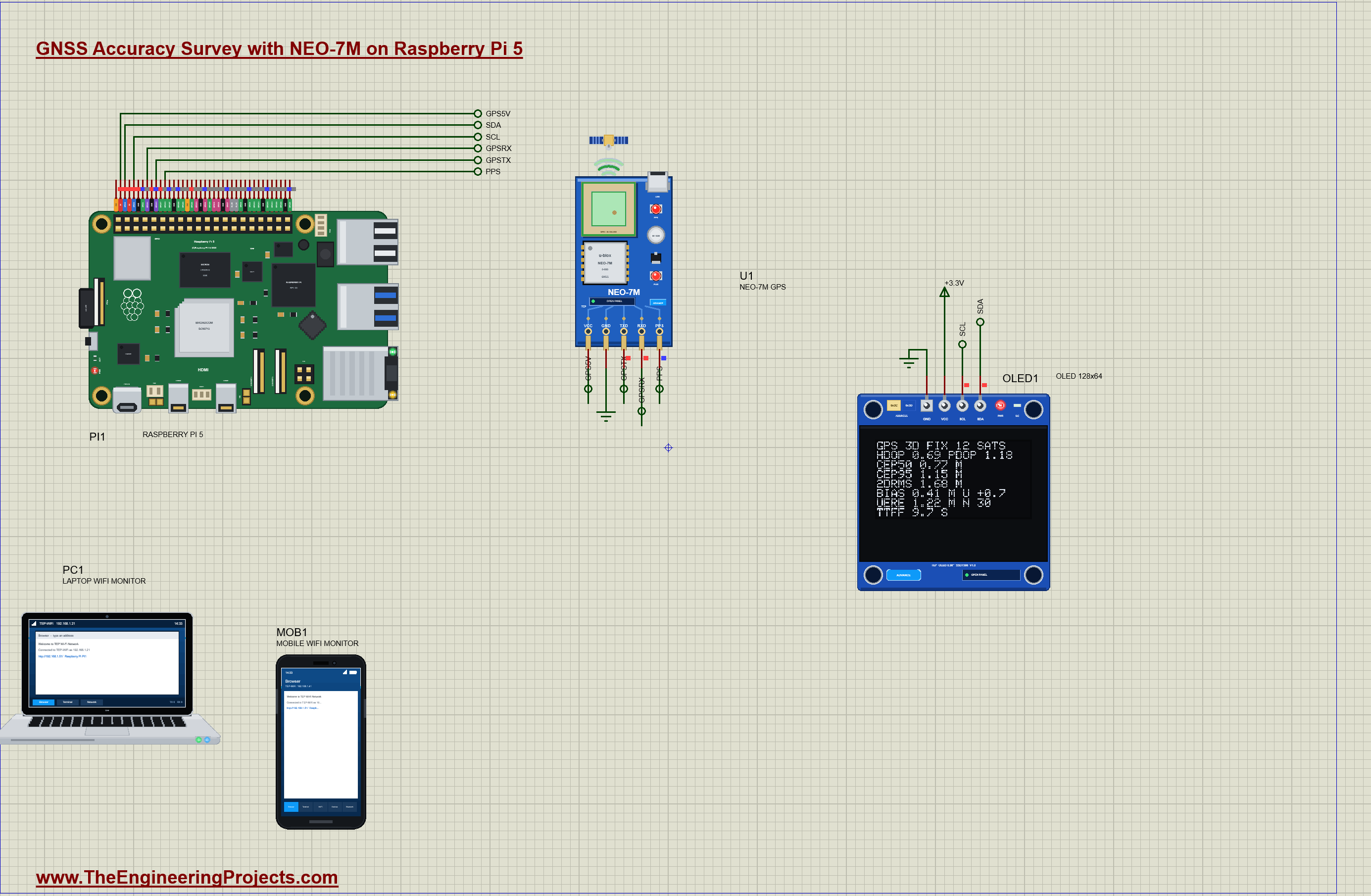
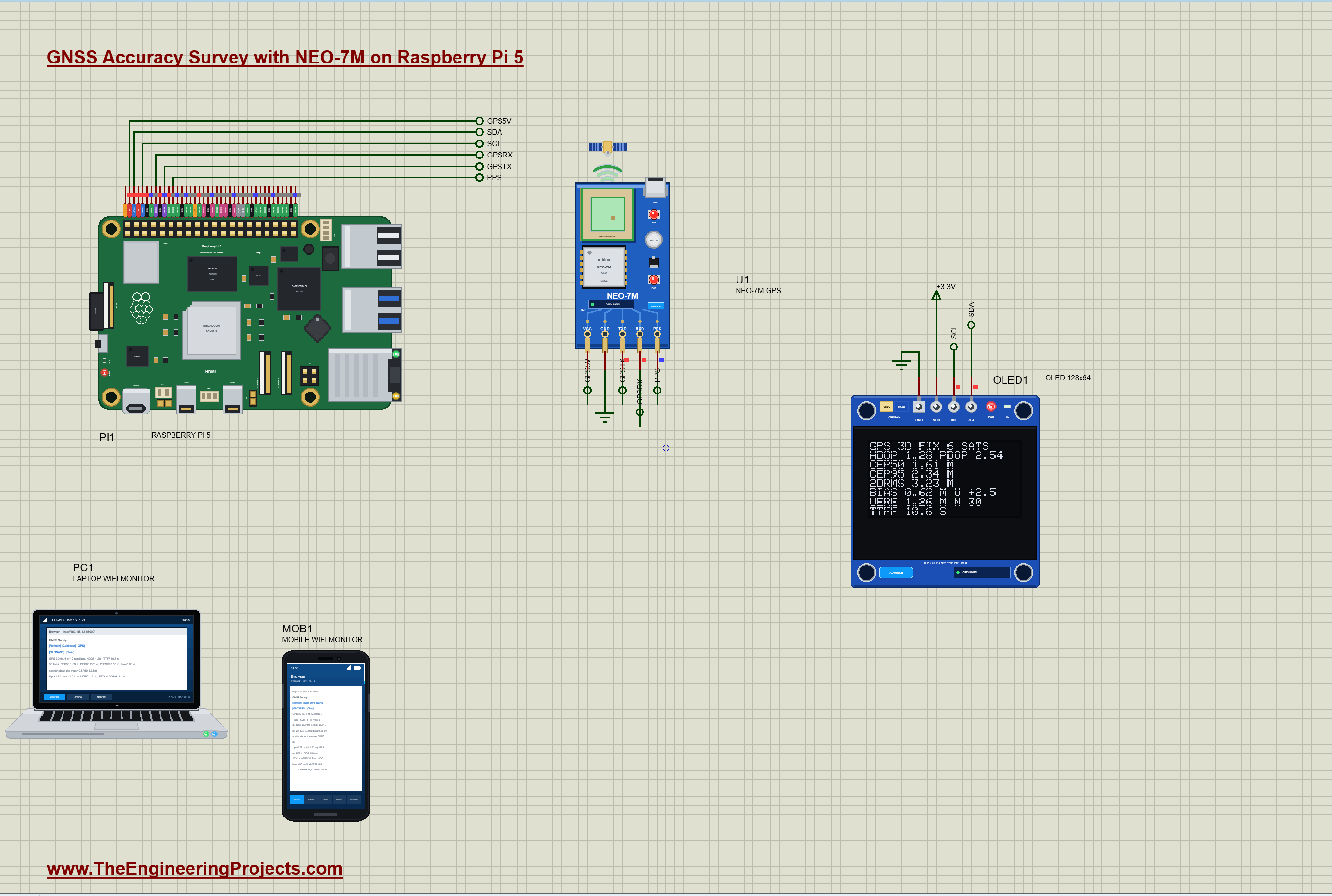
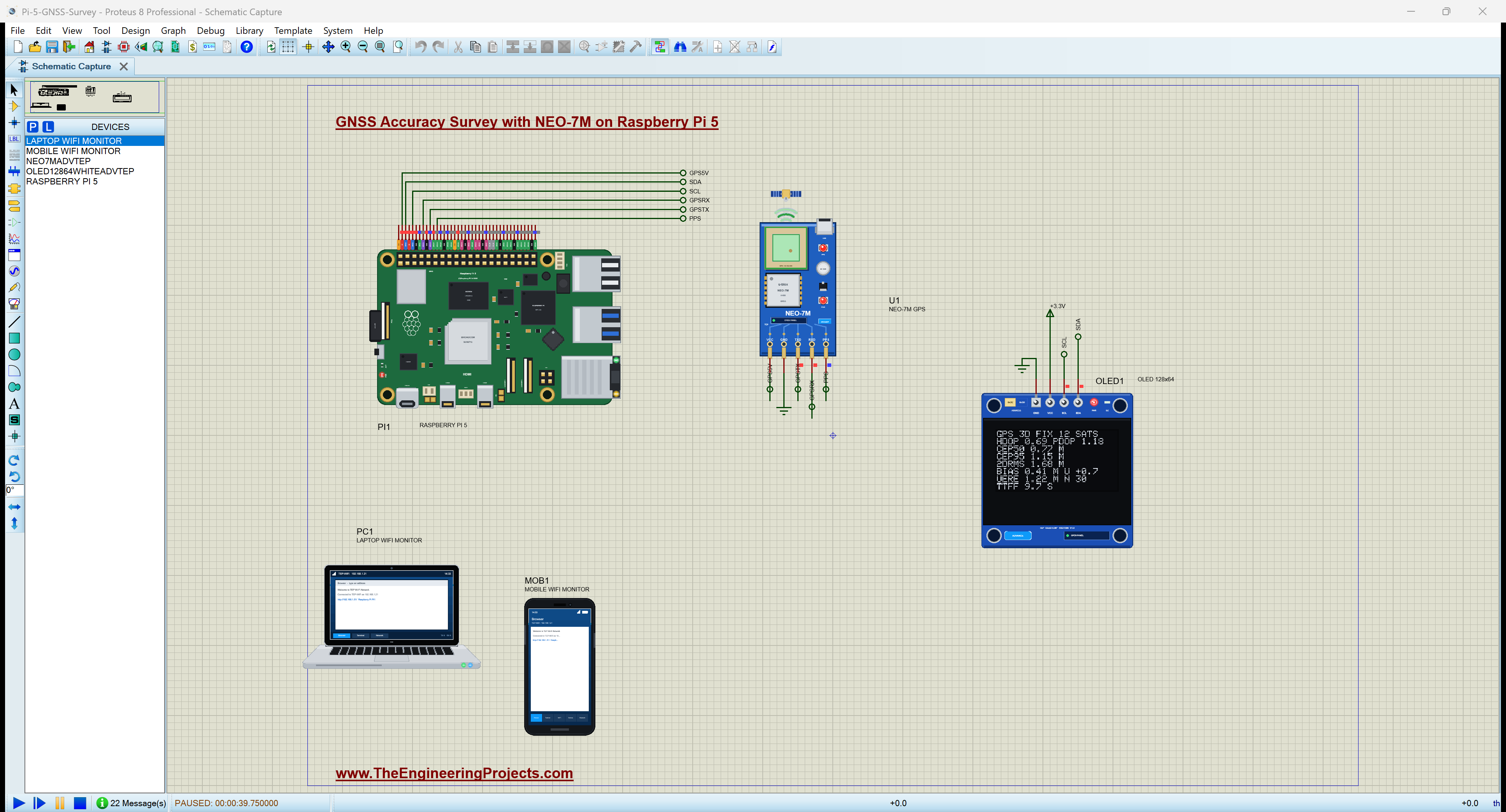
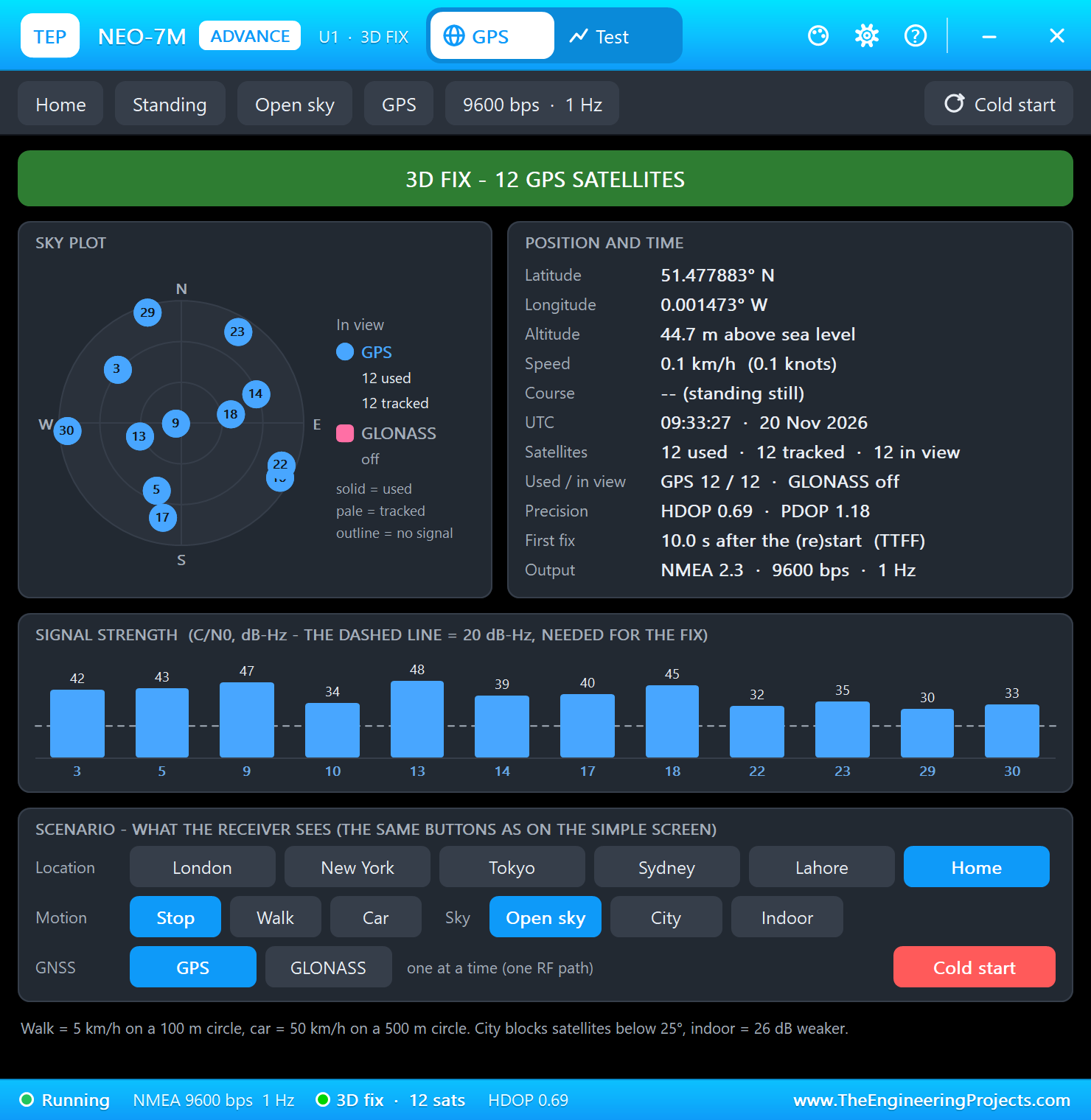
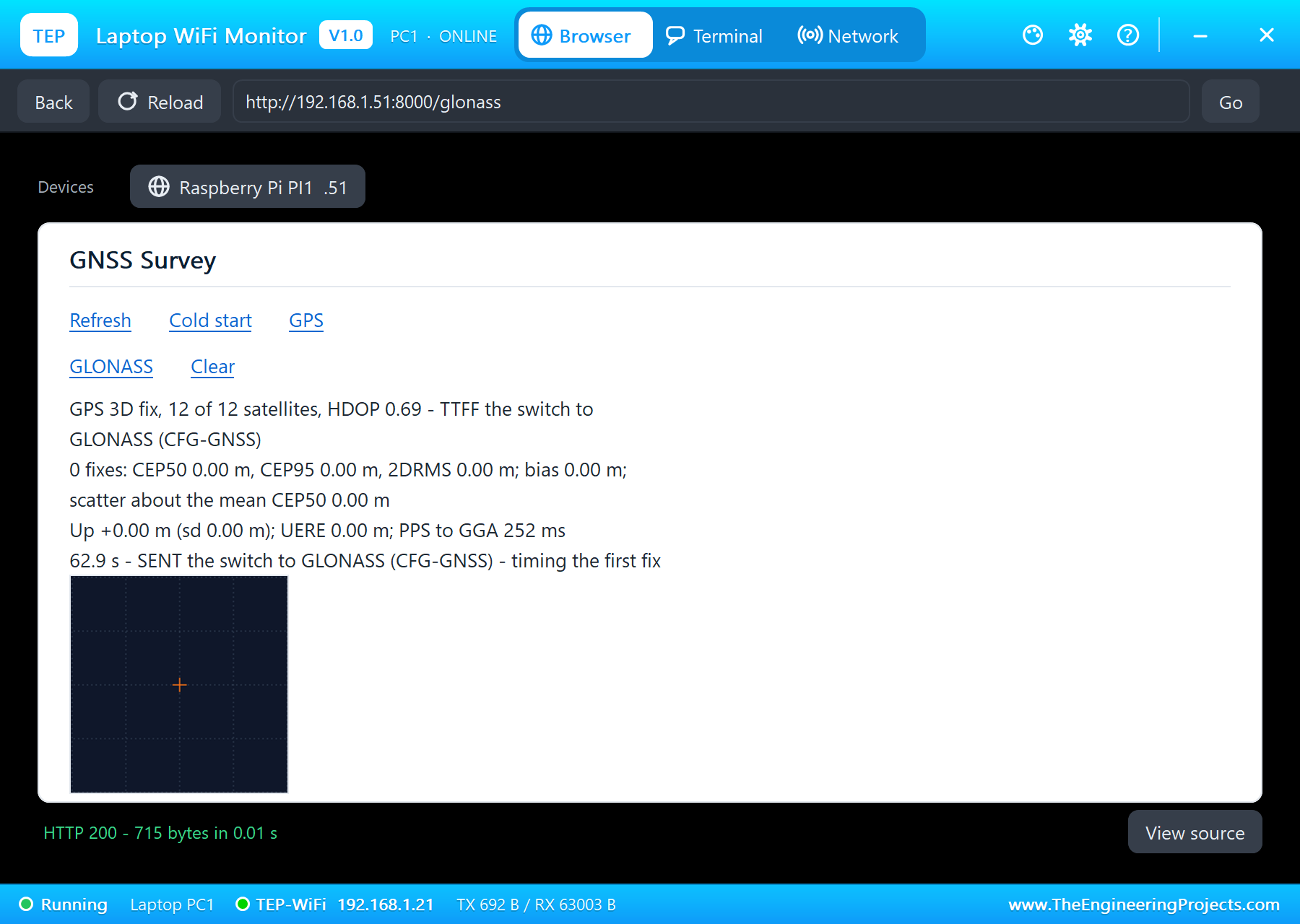
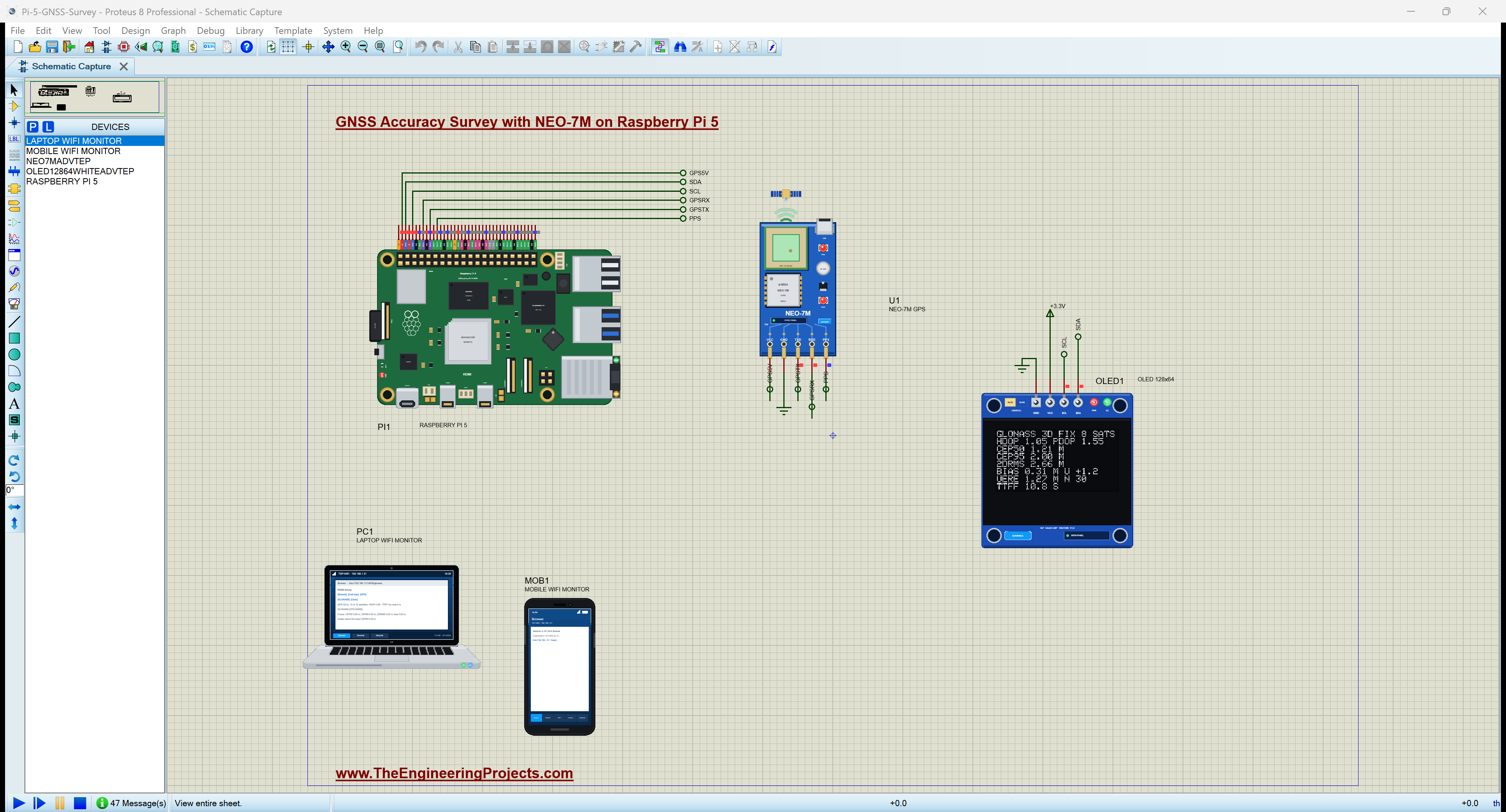
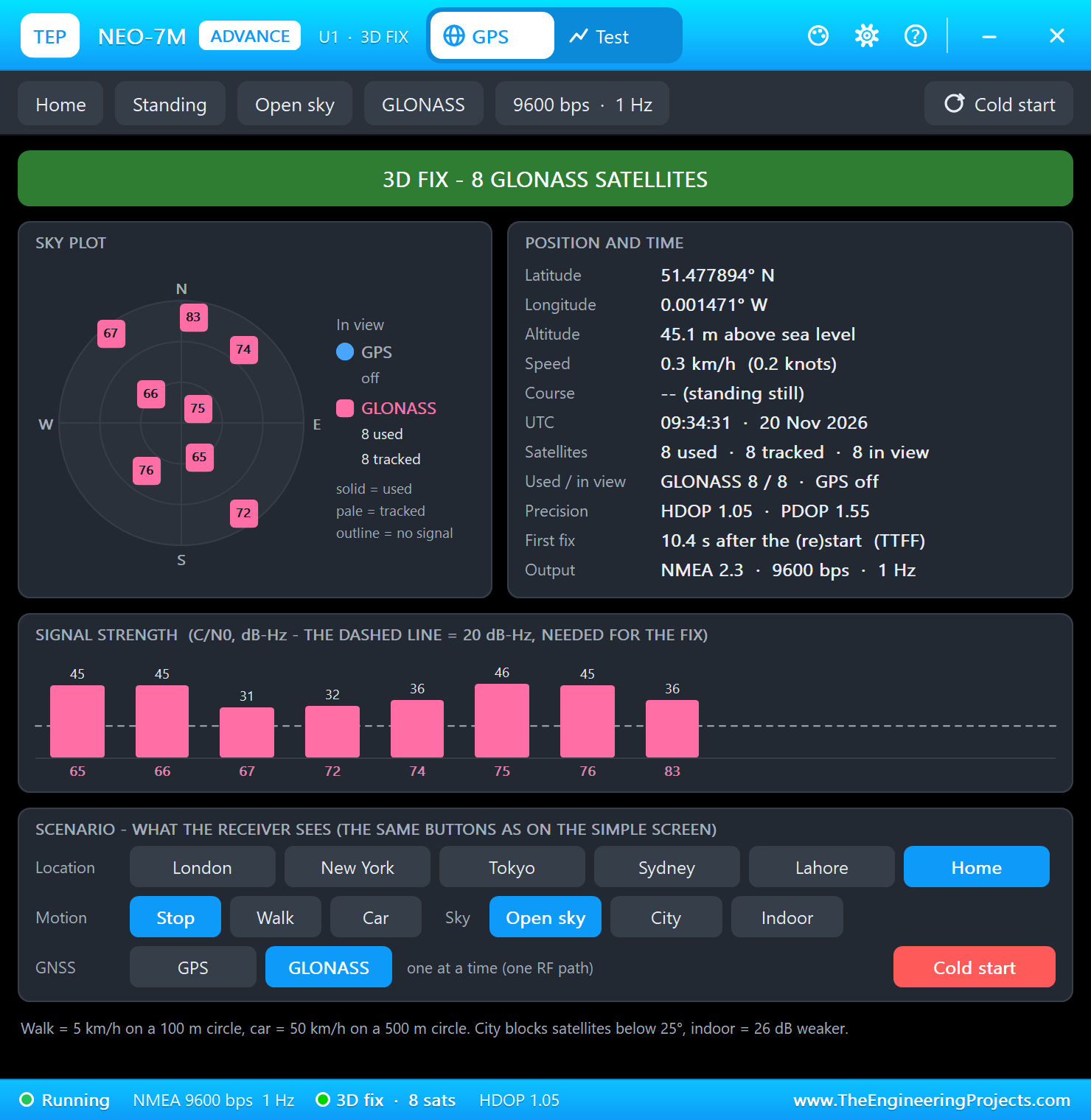
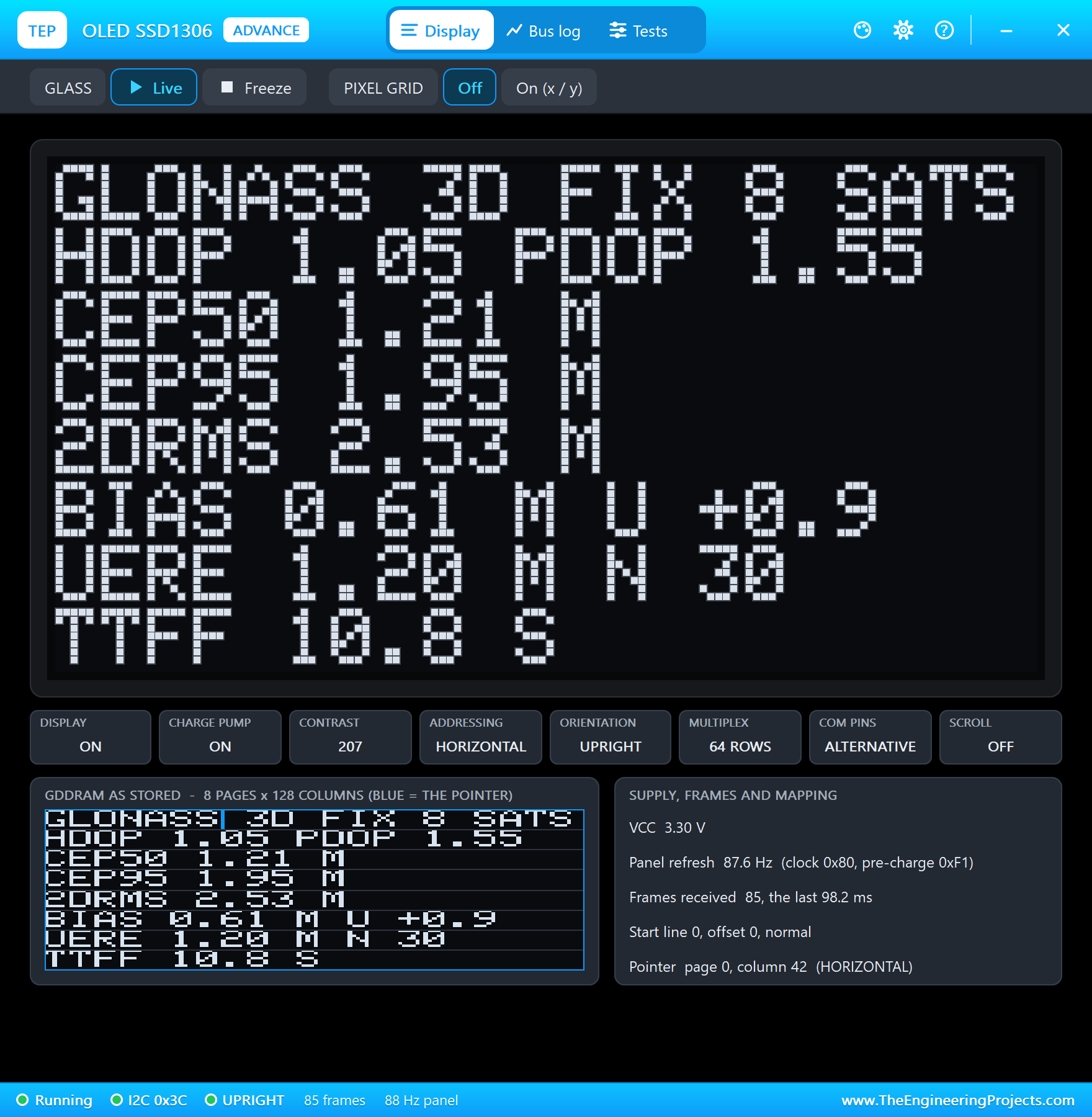
The circuit, the board and the results as they appear in GPS Accuracy Survey with NEO-7M on Raspberry Pi 5 - Proteus Simulation. Open an image for its full size.
README
 README
===============================================================================================================
  GPS Accuracy Survey with NEO-7M on Raspberry Pi 5 - Proteus Simulation - Project V1.0
  The Engineering Projects - www.TheEngineeringProjects.com
===============================================================================================================

IMPORTANT LINKS
  The project tutorial (circuit, code, simulation results):
  https://www.theengineeringprojects.com/2026/11/gps-accuracy-survey-neo-7m-raspberry-pi-5-proteus-simulation.html
  The libraries this project is built from (each post has its own full download and tutorial):
    Raspberry Pi 5 board:
      https://www.theengineeringprojects.com/2026/10/raspberry-pi-5-library-for-proteus.html
    NEO-7M GPS module:
      https://www.theengineeringprojects.com/2026/10/neo-7m-library-for-proteus.html
    OLED SSD1306:
      https://www.theengineeringprojects.com/2026/10/oled-ssd1306-library-for-proteus-v1-0.html
    Laptop WiFi Monitor:
      https://www.theengineeringprojects.com/2026/10/laptop-wifi-monitor-library-for-proteus.html
    Mobile WiFi Monitor:
      https://www.theengineeringprojects.com/2026/10/mobile-wifi-monitor-library-for-proteus.html
  Support our free work: https://www.theengineeringprojects.com/donate

FILE STRUCTURE
Pi-5-GNSS-Survey-TEP-v1.0/
|-- Proteus Library Files/
|   |-- TEPLAPTOP.LIB                                  39.5 KB   a part of the project -> LIBRARY folder
|   |-- TEPMOBILE.LIB                                  13.1 KB   a part of the project -> LIBRARY folder
|   |-- TEPNEO7M.LIB                                   73.3 KB   a part of the project -> LIBRARY folder
|   |-- TEPOLED12864.LIB                              112.4 KB   a part of the project -> LIBRARY folder
|   |-- TEPRPI5.LIB                                    60.5 KB   a part of the project -> LIBRARY folder
|-- Proteus Model Files/
|   |-- TEPNET.DLL                                     3.01 MB   a model -> MODELS folder
|   |-- TEPOLED.DLL                                   342.5 KB   a model -> MODELS folder
|   |-- TEPUBLOX.DLL                                  463.0 KB   a model -> MODELS folder
|   |-- TEPPi/python/                                 17.54 MB   Python 3.11 embeddable -> MODELS\TEPPi (33 files)
|   |-- TEPPi/runtime/                                 1.11 MB   TEP Pi runtime, gpiozero -> MODELS\TEPPi (87 files)
|-- Proteus Simulation/
|   |-- gnss_survey.py                                 17.9 KB   the program PI1 runs
|   |-- Pi-5-GNSS-Survey.pdsprj                        30.2 KB   the project simulation
|   |-- TEPNET.DLL                                     3.01 MB   copy of the model
|   |-- TEPOLED.DLL                                   342.5 KB   copy of the model
|   |-- TEPUBLOX.DLL                                  463.0 KB   copy of the model
|-- Python Code/
|   |-- gnss_survey.py                                 17.9 KB   the program (the same file)
|-- README.txt                                        ~10.0 KB   this file
Total: 26.62 MB (unzipped). The C++ source code of the models is not included.

WHAT IS IT?
  How good is a GPS position? A Raspberry Pi 5 surveys a u-blox NEO-7M receiver standing on a known point (a
  surveyed benchmark) and measures it the way GNSS engineers do: how far its average lies from the truth (accuracy),
  how much it scatters (precision), the circles that hold 50 % and 95 % of its fixes, the time to first fix after a
  cold start, GPS against GLONASS, and the open sky against a city street.
    * PI1 RASPBERRY PI 5 runs gnss_survey.py on Ethernet at 192.168.1.51 (port 8000).
    * U1 a NEO-7M GPS module (NEO7MADVTEP) on the Pi's UART (/dev/serial0, 9600 baud): its TXD to the Pi's RXD
      (GPIO15, pin 10), its RXD from the Pi's TXD (GPIO14, pin 8), PPS to GPIO18 (pin 12), VCC from the Pi's 5V
      (pin 2). Its home = the benchmark: GPSLAT 51.47788, GPSLON -0.00148, GPSALT 46 (the Greenwich observatory);
      GPSTTFF 10 (the cold-start time to first fix of the simulation; the data sheet: 30 s).
    * OLED1 an SSD1306 128x64 OLED (OLED12864WHITEADVTEP, 0x3C) on I2C1 (SDA GPIO2, SCL GPIO3), VCC +3.3V.
    * Laptop WiFi Monitor (PC1) and Mobile WiFi Monitor (MOB1) open http://192.168.1.51:8000/.
  What the program does:
    NMEA in       GGA (the fix, satellites, HDOP, altitude), GSA (2D / 3D, PDOP / HDOP / VDOP), GSV (in view), the
                  checksum of every sentence checked; $GP = GPS, $GL = GLONASS
    UBX out       CFG-RST (cold start: all saved navigation data cleared, the receiver restarted) - the time to
                  first fix is timed from the command; CFG-GNSS (GPS or GLONASS - the NEO-7M has one RF path, both
                  at once is refused with a NAK); every UBX frame with its 8-bit Fletcher checksum; ACK / NAK read
    the survey    each fix as east / north / up metres from the benchmark; over the last 30 fixes: the bias (the
                  mean's distance from the true point), the scatter about the mean, CEP50 / CEP95 (the circles
                  around the true point holding 50 % / 95 % of the fixes), DRMS and 2DRMS, the vertical error, the
                  mean HDOP and the user equivalent range error UERE = DRMS / HDOP
    PPS           the pulse at the top of each second against the arrival of the GGA sentence for it
  Its pages:
    /             the dashboard with the links Cold start, GPS, GLONASS and Clear
    /scatter.bmp  the window's fixes around the benchmark with the CEP50 / CEP95 circles        /data   JSON
  Python libraries: lgpio and serial (both in the TEPPi runtime; on Raspberry Pi OS: python3-lgpio and python3-serial);
  threading, http.server.

TEST STATUS
  Tested in Proteus 8 Professional on Windows 11, the run that made the tutorial's screenshots (the program's times):
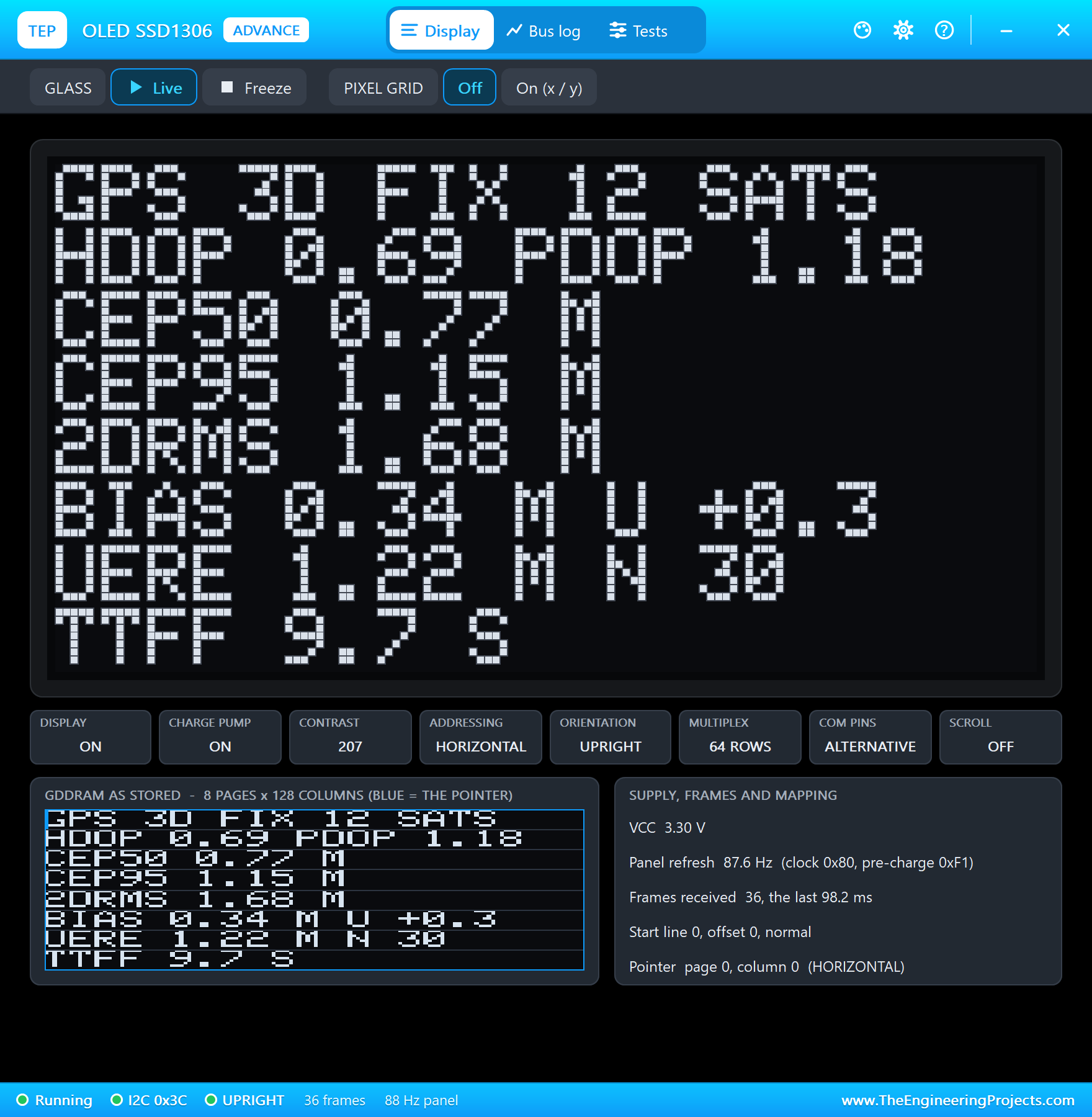
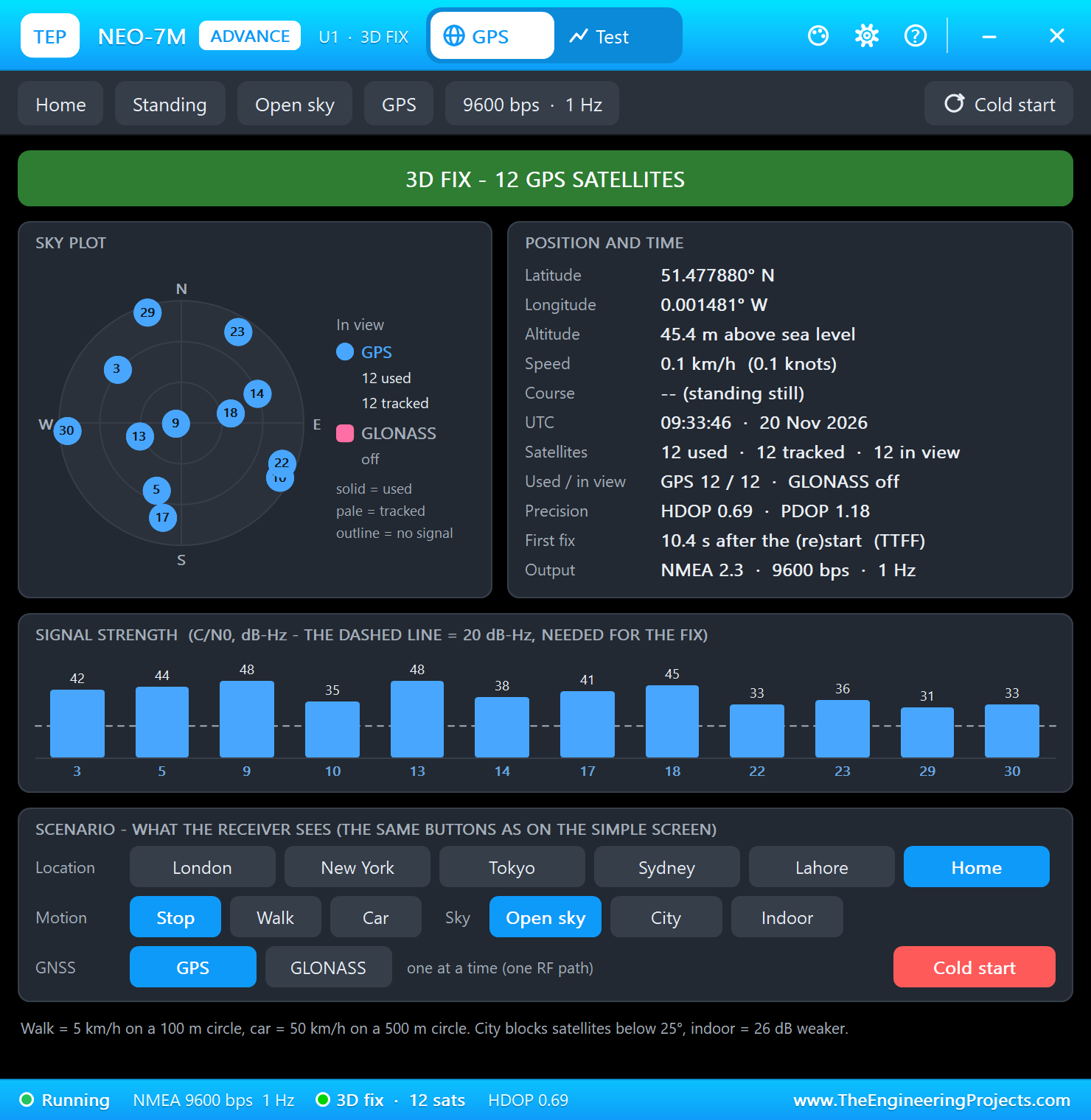
  - Power-up: "FIRST FIX after power-up: 9.7 s - GPS, 12 satellites, HDOP 0.69".
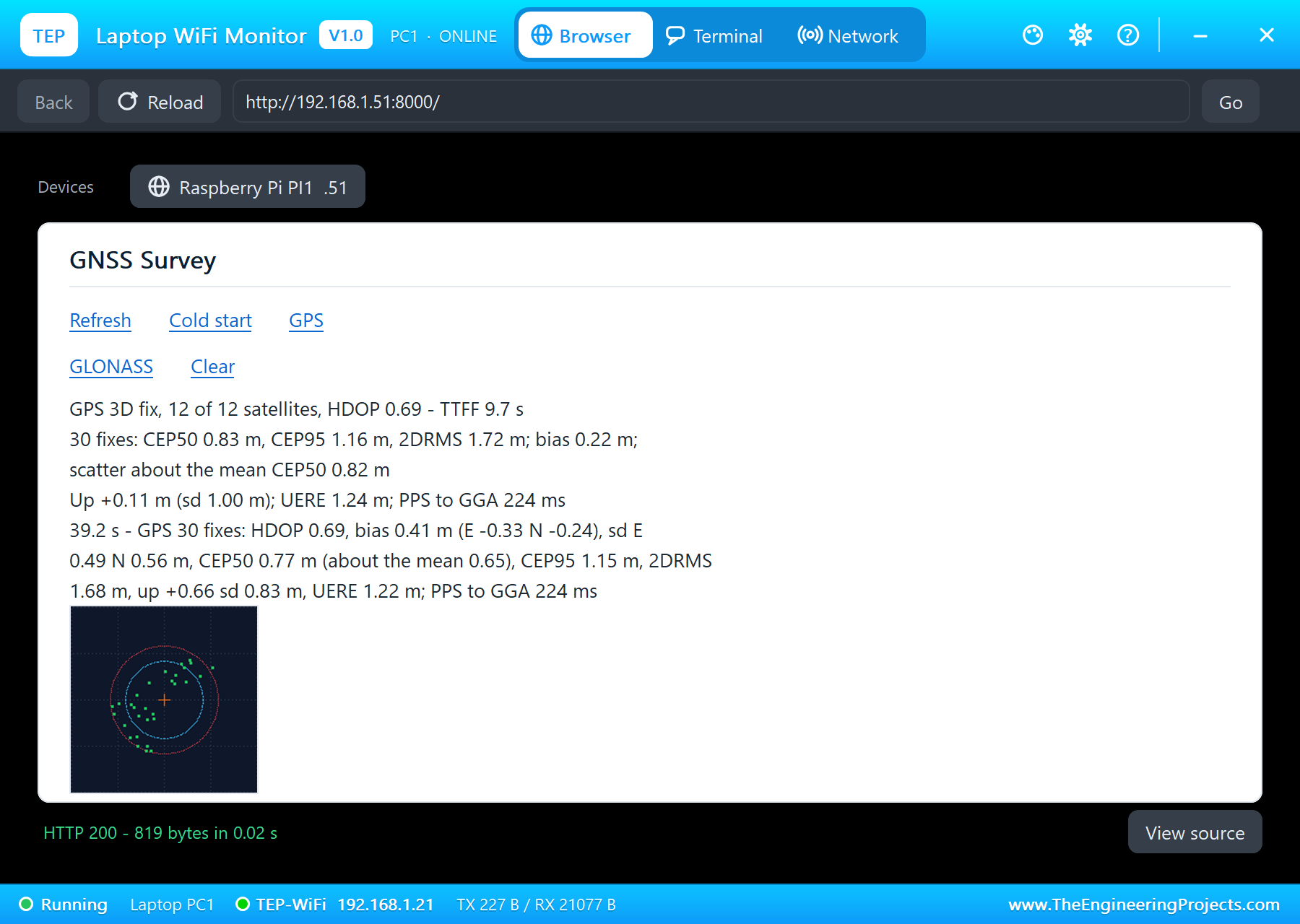
  - GPS, open sky, 30 fixes (39.2 s): bias 0.41 m, sd E 0.49 / N 0.56 m, CEP50 0.77 m (about the mean 0.65 m), CEP95
    1.15 m, 2DRMS 1.68 m, up +0.66 m (sd 0.83 m), UERE 1.22 m; PPS to GGA 224 ms.
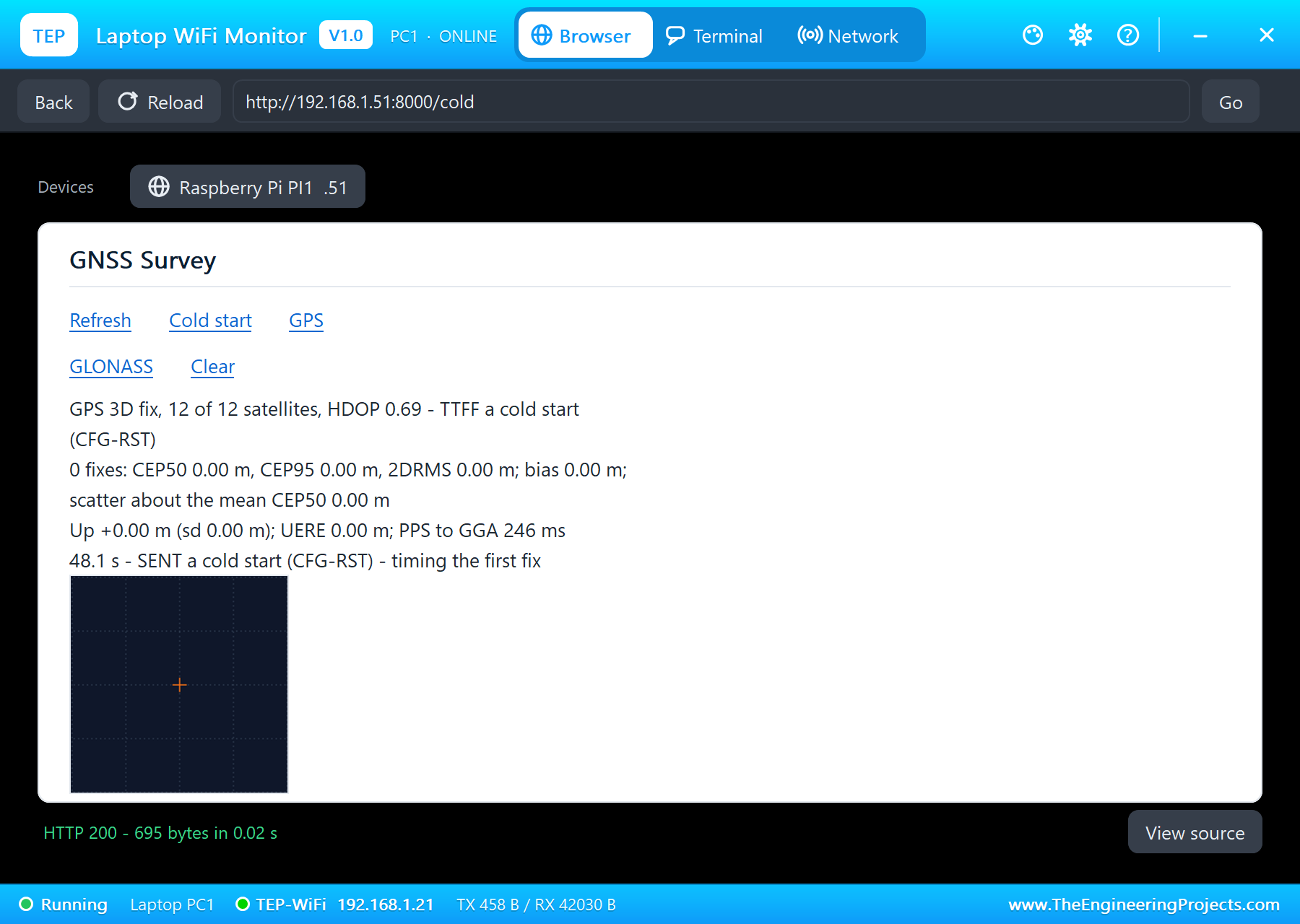
  - Cold start (CFG-RST) at 48.1 s: "FIRST FIX after a cold start (CFG-RST): 10.6 s" (U1's pop-up: 10.4 s after the
    restart).
  - GLONASS (CFG-GNSS) at 62.9 s: "UBX ACK for class 06 id 3E"; the first fix 10.8 s later, 8 GLONASS satellites, HDOP
    1.05; 30 fixes: CEP50 1.21 m, CEP95 2.00 m, 2DRMS 2.66 m, UERE 1.27 m.
  - Sky CITY on U1's pop-up, then GPS (CFG-GNSS, ACK) at 113.1 s: the first fix 10.6 s later on 6 of 12 satellites
    (the low ones behind the buildings), HDOP 1.29; 30 fixes: CEP50 1.65 m, CEP95 2.05 m, 2DRMS 3.11 m, UERE 1.21 m.
  - The UERE stayed at 1.2 - 1.3 m all through: the errors grew with the HDOP, not with the receiver.
  - 166.7 s of simulation in 619 s.

INSTALLATION
  1. Close Proteus. Extract the WHOLE zip file, for example to your Desktop.
  2. Copy the files from "Proteus Library Files" into the LIBRARY folder of Proteus, for example
     C:\Program Files (x86)\Labcenter Electronics\Proteus 8 Professional\LIBRARY
  3. Copy everything in "Proteus Model Files" - the DLL files and the TEPPi folder - into the MODELS folder (next
     to LIBRARY).
  4. Start Proteus. Press P in the schematic and search for RASPBERRY PI 5 or NEO7MADVTEP to check that the parts
     are there.

RUN THE SIMULATION
  1. Open "Proteus Simulation\Pi-5-GNSS-Survey.pdsprj". Keep gnss_survey.py and the DLL files beside it.
  2. Press Play. The receiver starts cold: the first fix comes after about 10 s, then the statistics fill up.
  3. Open the Laptop WiFi Monitor (PC1) or the Mobile WiFi Monitor (MOB1) and press Go. Click Cold start for a
     timed restart, GLONASS / GPS to switch the system. On U1's pop-up, Sky: City or Indoor.

PROPERTIES USED IN THIS PROJECT
  PI1 RASPBERRY PI 5           PROGRAM=gnss_survey.py, ETHERNET=IN (192.168.1.51)
  U1 NEO7MADVTEP               GPSLAT=51.47788, GPSLON=-0.00148, GPSALT=46, GPSTTFF=10, GPSGNSS=GPS
  OLED1 OLED12864WHITEADVTEP;  PC1, MOB1 HOMEPAGE=http://192.168.1.51:8000/

TROUBLESHOOTING
  * The pop-up says NO POWER: VCC must come from a real supply - here the Pi's 5V pin.
  * No fix and no numbers: the module's TXD goes to the Pi's RXD (pin 10) and its RXD to the Pi's TXD (pin 8).
  * GLONASS gives a NAK: the NEO-7M takes one system at a time; CFG-GNSS with GPS and GLONASS both on is refused.
  * The statistics jump after a switch: the window starts again after every cold start and every switch.
  * The terminal cannot start Python: the TEPPi folder is not in MODELS.

LICENCES
  * The project, the program, the parts (LIB files) and the models (DLL files) are made by The Engineering Projects
    and are free for learning and for your own projects. The models use only standard Windows libraries.
    The C++ source code of the models is not included; the source code is not included for any model.
  * TEPPi\python is the Python 3.11 Windows embeddable package (Python Software Foundation License); TEPPi\runtime
    holds our TEP Pi runtime with gpiozero and colorzero (BSD licences) - their licence files are inside the folders.
  * Proteus is a product of Labcenter Electronics and is not included. Raspberry Pi is a trademark of Raspberry Pi
    Ltd; u-blox is a trademark of u-blox AG. This project is not made or endorsed by them.

VERSION
  V1.0 - the first release of the project.
===============================================================================================================Development1 release
 Development1 release
-
V1.0GPS Accuracy Survey with NEO-7M on Raspberry Pi 5 - Proteus Simulation V1.0this page
V1.0 is the only release in the Download Center so far. When a newer version is published, it appears above with its own download page.
Installation7 steps
 Installation7 steps
From the download to a working project, in order. The steps follow what the package contains.
You will need
- Proteus Design SuiteProteus 8 or newer (Labcenter), on Windows
- Pythonto build the source files into firmware
- Any archive toolWindows, macOS and Linux extract ZIP files on their own

Steps
- 1
Extract the archive
Right-click 740f7d26bc164a6fa6aab0c548eff943.zip and choose Extract All (or open it with 7-Zip or WinRAR) into a folder you can find again. Keep its folder structure (Pi-5-GNSS-Survey-TEP-v1.0) as it is.
- 2
Copy the library files into Proteus
Move TEPLAPTOP.LIB, TEPMOBILE.LIB and TEPNEO7M.LIB and 2 more and the files into the LIBRARY folder of your Proteus installation: C:\Program Files (x86)\Labcenter Electronics\Proteus 8 Professional\LIBRARY for Proteus 8, or the matching Proteus 7 folder. Older versions keep it under ProgramData\Labcenter Electronics. If Proteus is open, close it first.
- 3
Add the simulation model
Copy TEPNET.DLL, TEPOLED.DLL and TEPUBLOX.DLL and 7 more into the MODELS folder next to LIBRARY, so the component can run, not only be drawn.
- 4
Restart Proteus and place the component
Start Proteus, open a schematic, press P (Pick Devices) and search for the component by the name used in the tutorial. It appears with its pins ready to wire.
- 5
Build the source code
Open gnss_survey.py, attr.py and color.py and 28 more in the compiler named in the tutorial (MikroC, Keil, MPLAB, Code Composer or the Arduino IDE) and build it to get the firmware.
- 6
Open the example simulation
Open Pi-5-GNSS-Survey.pdsprj in Proteus to see the wiring exactly as in the tutorial. Check the controller's Program File path, then press Play.
- 7
Follow the tutorial
GPS Accuracy Survey with NEO-7M on Raspberry Pi 5 - Proteus Simulation explains every connection and setting in order; keep it open beside the files while you build.
FAQs8 questionsContact TEP
 FAQs8 questions
How do I download GPS Accuracy Survey with NEO-7M on Raspberry Pi 5 - Proteus Simulation V1.0?
Wait for the 30-second guest countdown on this page, then press the download button; the file comes straight from our storage. Members who are logged in skip the wait. If the browser opens the file instead of saving it, use its Save as option. The download link is made for you when the countdown ends and works for 15 minutes; a saved or shared link stops working, so share this page instead.
What is inside the archive?
GPS Accuracy Survey with NEO-7M on Raspberry Pi 5 - Proteus Simulation V1.0 comes as a ZIP archive of 135 files (13.6 MB, 26.6 MB unpacked) holding Proteus library files, simulation model DLLs, a Proteus simulation, source code and a nested archive. Open the File Structure tab for the full list of 135 files.
What should I do if the download does not start?
Check the browser's download list first; an ad blocker or a company firewall can also hold it back, so try another browser or network. If the file arrives incomplete, download it again. For an installation problem, read the Install tab or tell us in the comments with your software version and the exact error message.
Is this file free?
Yes. Every file in the TEP Download Center is free for learning, personal and student projects. If you share it, link back to this page or the tutorial so others find the latest version.
How do I check that the file arrived complete?
Compare its SHA-256 with the one on this page, f928c05c48c42e11a472abafc703ac540f844b269da20b5189d20f524d515dbb. In PowerShell run Get-FileHash "740f7d26bc164a6fa6aab0c548eff943.zip"; on macOS or Linux run shasum -a 256 "740f7d26bc164a6fa6aab0c548eff943.zip". The same value means the file is exactly the one in our storage; a different one means the download broke off, so download it again.
Do I need WinRAR to open the ZIP file?
No. Windows, macOS and Linux open ZIP archives on their own (Extract All, or double-click). WinRAR and 7-Zip work too. Extract the whole archive before using the files.
Where do I put the LIB and IDX files?
Both files go into the LIBRARY folder of your Proteus installation (Proteus 8: C:\Program Files (x86)\Labcenter Electronics\Proteus 8 Professional\LIBRARY; Proteus 7 has the same folder under its own name). Restart Proteus afterwards and search for the component with P.
Which Proteus version does the library need?
The tutorial names the Proteus version the library was made and tested with. Most TEP libraries work in Proteus 7 and Proteus 8; if the component does not appear after a restart, check that both the LIB and the IDX file were copied and that Proteus was fully closed while copying.
Members skip the wait. Log in or join TEP.

- 0Total downloads
- 4%Popularity
- Raspberry PiCategory
- 0Comments
- ssyedzainnasirUploaded by
- 25 Nov 2026Uploaded at


 SHA-256
f928c05c48c42e11a472abafc703ac540f844b269da20b5189d20f524d515dbb


 Need help with this file?
 Tags
Related Raspberry Pi
All Raspberry Pi tutorials



More GPS project files
All GPS tutorials


Comments
0