


Project Files of Thermoelectric Generator Logger on Raspberry Pi 5 - Proteus Simulation
 Libraries
 Code
 Projects
 Simulation
46fdd18b31c94c669617c43126231eac.zip
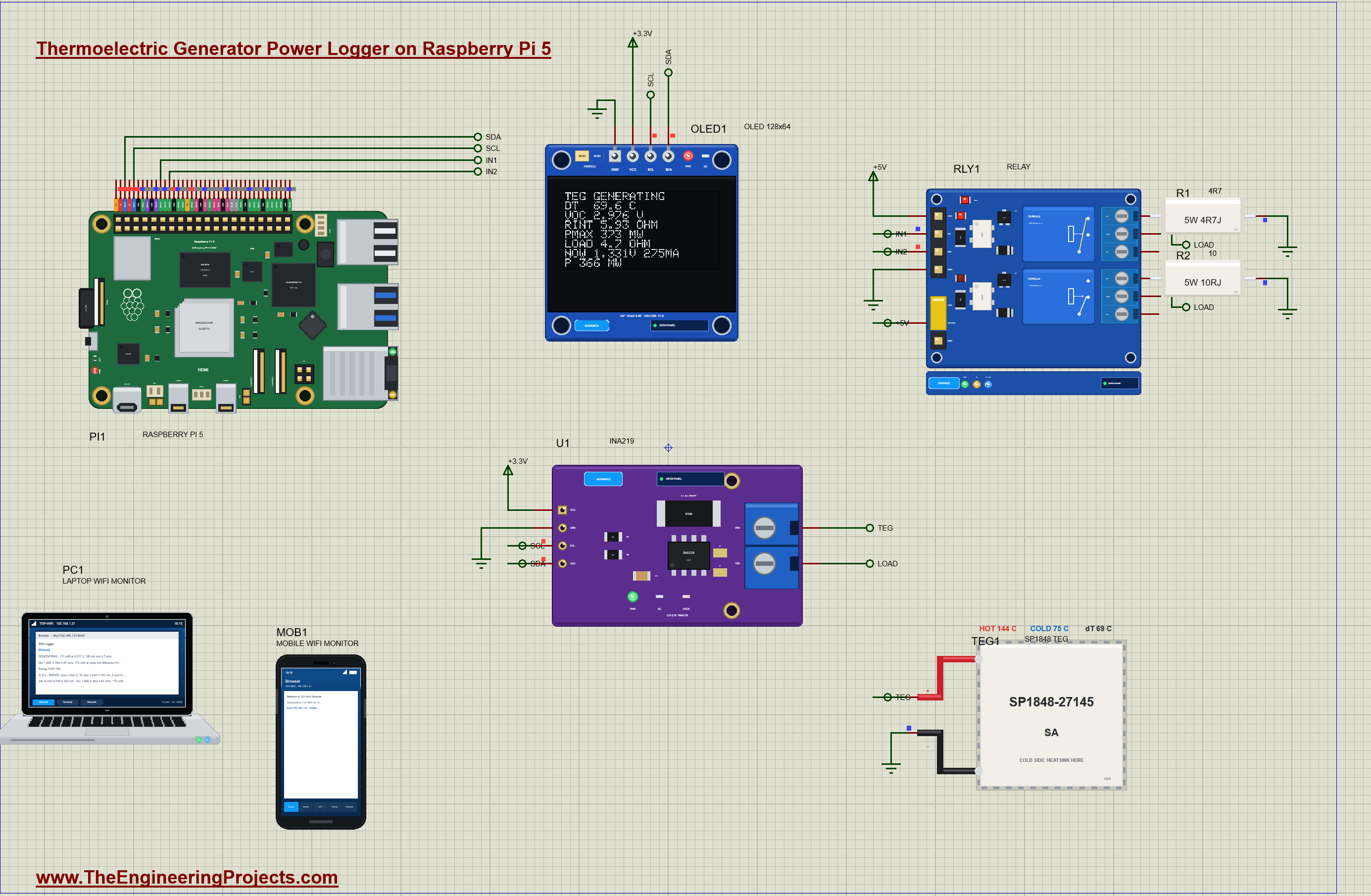
Thermoelectric Generator Logger on Raspberry Pi 5 - Proteus Simulation V1.0
Thermoelectric Generator Logger on Raspberry Pi 5 - Proteus Simulation V1.0 comes as a ZIP archive of 144 files (14.5 MB, 28.8 MB unpacked) holding Proteus library files, simulation model DLLs, a Proteus simulation, source code and a nested archive.
- LIBProteus library
- DLLProteus model
- DSNProteus simulation
- SRCSource code
- ZIPNested archive
Description
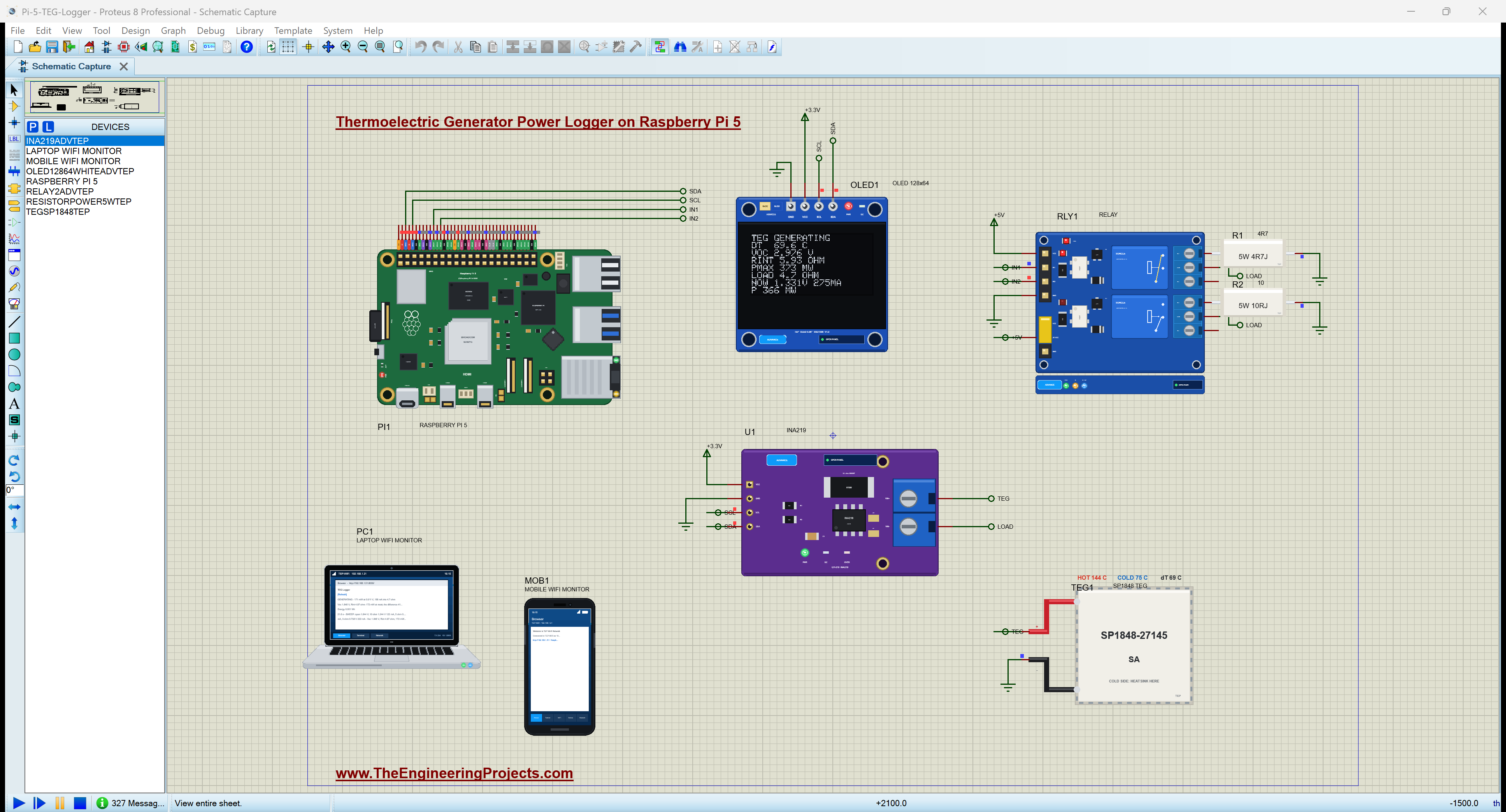
Thermoelectric-Generator-Logger-Raspberry-Pi-5-Proteus-Simulation-v1.0.zip: the complete Proteus simulation project (a Raspberry Pi 5, an SP1848 thermoelectric generator, an INA219, a 2-channel relay module, two power resistors, a 128x64 OLED, the Laptop and Mobile WiFi Monitors), the Python program teg_logger.py, every LIB and DLL, the TEP Pi runtime and a README.

File Structure
 File Structure
62.6 KB39.5 KB13.1 KB112.4 KB157.2 KB490.4 KB60.5 KB14.7 KB3.3 MB34.3 KB620.8 KB36 KB169.8 KB628.1 KB99.3 KB65.3 KB4.8 MB4.1 MB80 B97.8 KB26.8 KB1.2 MB1.1 MB88.9 KB27.3 KB55.8 KB79.8 KB105.8 KB193.8 KB113.8 KB48.8 KB145.8 KB36.8 KB29.3 KB42.3 KB28.8 KB67.3 KB89.3 KB153.8 KB22.8 KB38.8 KB2.1 KB9.9 KB4.1 KB1.3 KB4.7 KB431 B2.5 KB17.5 KB283 B6.5 KB37.9 KB11.1 KB5.5 KB885 B13.6 KB9 KB878 B1.5 KB4 KB1004 B10 B110 B2.6 KB1.1 KB8.9 KB58.5 KB12.4 KB6.6 KB18.5 KB20.7 KB27.8 KB21.1 KB7.1 KB7.7 KB2.7 KB51.2 KB100.9 KB1.2 KB24.3 KB7.4 KB53.6 KB26.1 KB20.5 KB60.5 KB19.6 KB1.6 KB8.4 KB20.9 KB2.6 KB539 B1.4 KB9.7 KB2.8 KB21 B92 B7.9 KB264 B3.4 KB3.8 KB17.5 KB55.2 KB3.3 KB10.8 KB1.5 KB4.2 KB7.3 KB2.5 KB32.6 KB14.5 KB283 B17.4 KB257 B691 B14.5 KB12.8 KB3.6 KB1.7 KB37 KB418 B6.2 KB7 KB37.3 KB10.6 KB23.7 KB28.7 KB8.8 KB16.9 KB319.5 KB3.0 MB342.5 KB304.5 KB330 KB319 KB37.4 KB13.9 KB319.5 KB3.0 MB342.5 KB304.5 KB330 KB319 KB13.9 KB10.1 KBGallery12 images from the tutorialOpen the tutorial
 Gallery12 images from the tutorial
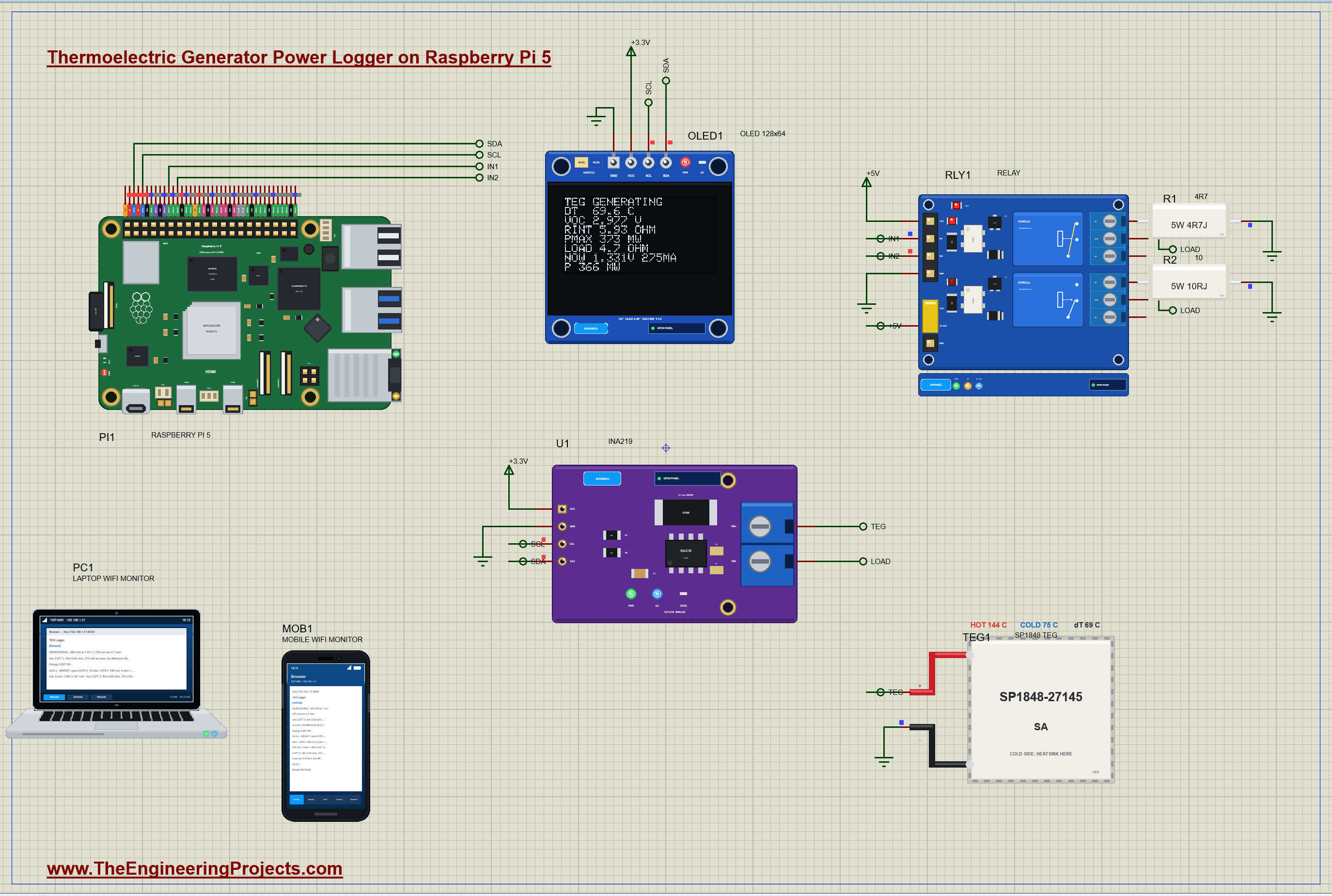
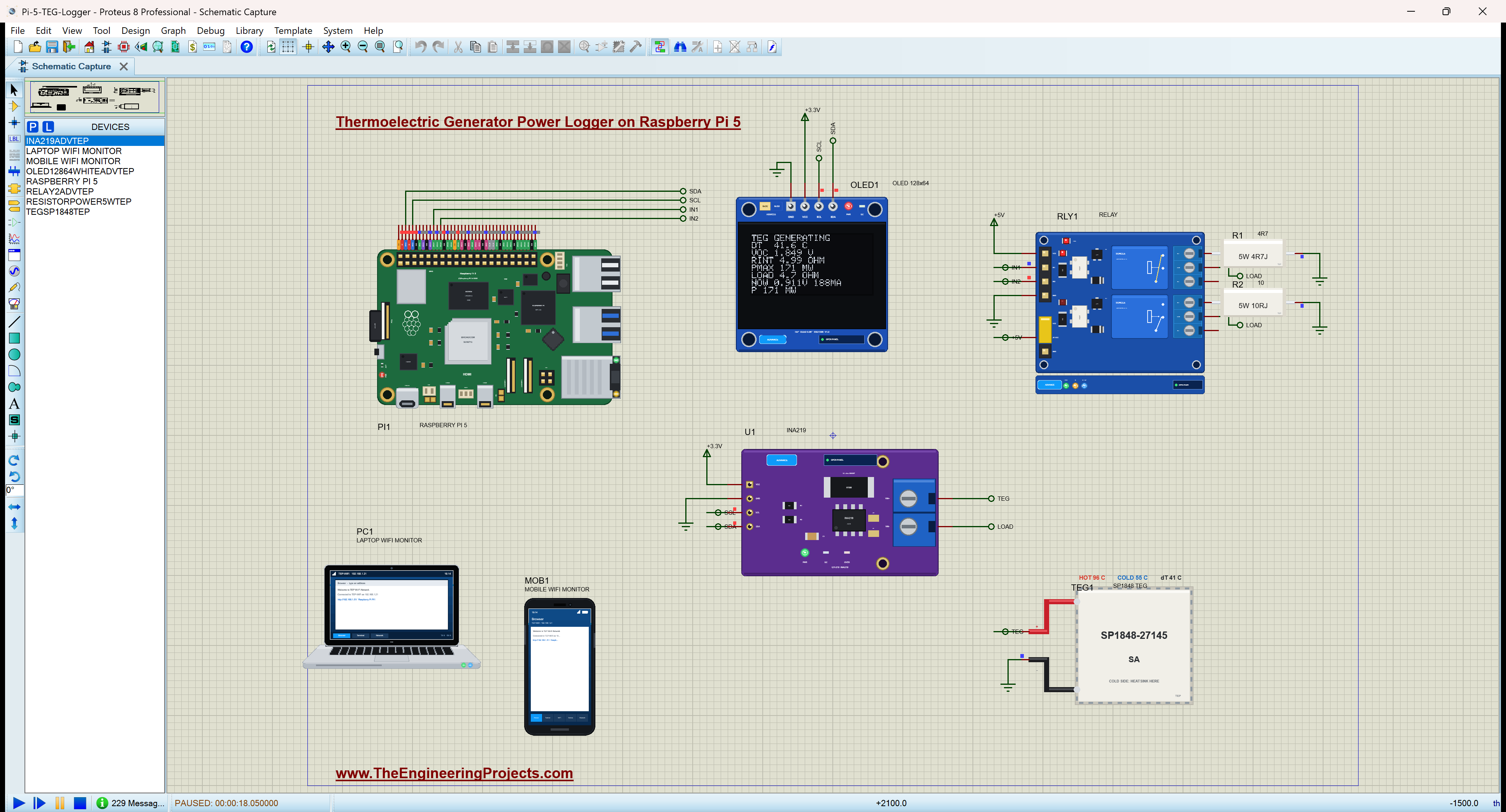
The circuit, the board and the results as they appear in Thermoelectric Generator Logger on Raspberry Pi 5 - Proteus Simulation. Open an image for its full size.
README
 README
===============================================================================================================
  Thermoelectric Generator Logger on Raspberry Pi 5 - Proteus Simulation - Project V1.0
  The Engineering Projects - www.TheEngineeringProjects.com
===============================================================================================================

IMPORTANT LINKS
  The project tutorial (circuit, code, simulation results):
  https://www.theengineeringprojects.com/2026/11/thermoelectric-generator-logger-raspberry-pi-5-proteus-simulation.html
  The libraries this project is built from (each post has its own full download and tutorial):
    Raspberry Pi 5 board:
      https://www.theengineeringprojects.com/2026/10/raspberry-pi-5-library-for-proteus.html
    Thermoelectric generator:
      https://www.theengineeringprojects.com/2026/11/thermoelectric-generator-library-for-proteus.html
    INA219 current sensor:
      https://www.theengineeringprojects.com/2026/10/ina219-current-sensor-library-for-proteus-v1-0.html
    Relay module:
      https://www.theengineeringprojects.com/2026/10/relay-module-library-for-proteus-v1-0.html
    Power resistor:
      https://www.theengineeringprojects.com/2026/11/power-resistor-library-for-proteus.html
    OLED SSD1306:
      https://www.theengineeringprojects.com/2026/10/oled-ssd1306-library-for-proteus-v1-0.html
    Laptop WiFi Monitor:
      https://www.theengineeringprojects.com/2026/10/laptop-wifi-monitor-library-for-proteus.html
    Mobile WiFi Monitor:
      https://www.theengineeringprojects.com/2026/10/mobile-wifi-monitor-library-for-proteus.html
  Support our free work: https://www.theengineeringprojects.com/donate

FILE STRUCTURE
Pi-5-TEG-Logger-TEP-v1.0/
|-- Proteus Library Files/
|   |-- TEPINA219.LIB                                  62.6 KB   a part of the project -> LIBRARY folder
|   |-- TEPLAPTOP.LIB                                  39.5 KB   a part of the project -> LIBRARY folder
|   |-- TEPMOBILE.LIB                                  13.1 KB   a part of the project -> LIBRARY folder
|   |-- TEPOLED12864.LIB                              112.4 KB   a part of the project -> LIBRARY folder
|   |-- TEPPOWERRES.LIB                               157.2 KB   a part of the project -> LIBRARY folder
|   |-- TEPRELAY.LIB                                  490.4 KB   a part of the project -> LIBRARY folder
|   |-- TEPRPI5.LIB                                    60.5 KB   a part of the project -> LIBRARY folder
|   |-- TEPTEG.LIB                                     14.7 KB   a part of the project -> LIBRARY folder
|-- Proteus Model Files/
|   |-- TEPINA219.DLL                                 319.5 KB   a model -> MODELS folder
|   |-- TEPNET.DLL                                     3.01 MB   a model -> MODELS folder
|   |-- TEPOLED.DLL                                   342.5 KB   a model -> MODELS folder
|   |-- TEPPOWERRES.DLL                               304.5 KB   a model -> MODELS folder
|   |-- TEPRELAY.DLL                                  330.0 KB   a model -> MODELS folder
|   |-- TEPTEG.DLL                                    319.0 KB   a model -> MODELS folder
|   |-- TEPPi/python/                                 17.54 MB   Python 3.11 embeddable -> MODELS\TEPPi (33 files)
|   |-- TEPPi/runtime/                                 1.11 MB   TEP Pi runtime, gpiozero -> MODELS\TEPPi (87 files)
|-- Proteus Simulation/
|   |-- Pi-5-TEG-Logger.pdsprj                         37.4 KB   the project simulation
|   |-- teg_logger.py                                  13.9 KB   the program PI1 runs
|   |-- TEPINA219.DLL                                 319.5 KB   copy of the model
|   |-- TEPNET.DLL                                     3.01 MB   copy of the model
|   |-- TEPOLED.DLL                                   342.5 KB   copy of the model
|   |-- TEPPOWERRES.DLL                               304.5 KB   copy of the model
|   |-- TEPRELAY.DLL                                  330.0 KB   copy of the model
|   |-- TEPTEG.DLL                                    319.0 KB   copy of the model
|-- Python Code/
|   |-- teg_logger.py                                  13.9 KB   the program (the same file)
|-- README.txt                                         ~9.9 KB   this file
Total: 28.83 MB (unzipped). The C++ source code of the models is not included.

WHAT IS IT?
  A logger for a thermoelectric generator (TEG) on a Raspberry Pi 5: every 5 s it measures the module as a
  battery - its open-circuit voltage and its internal resistance - works out the most power a load could take,
  keeps the best load of a small bank on between the sweeps, and reads the temperature difference from the
  voltage alone.
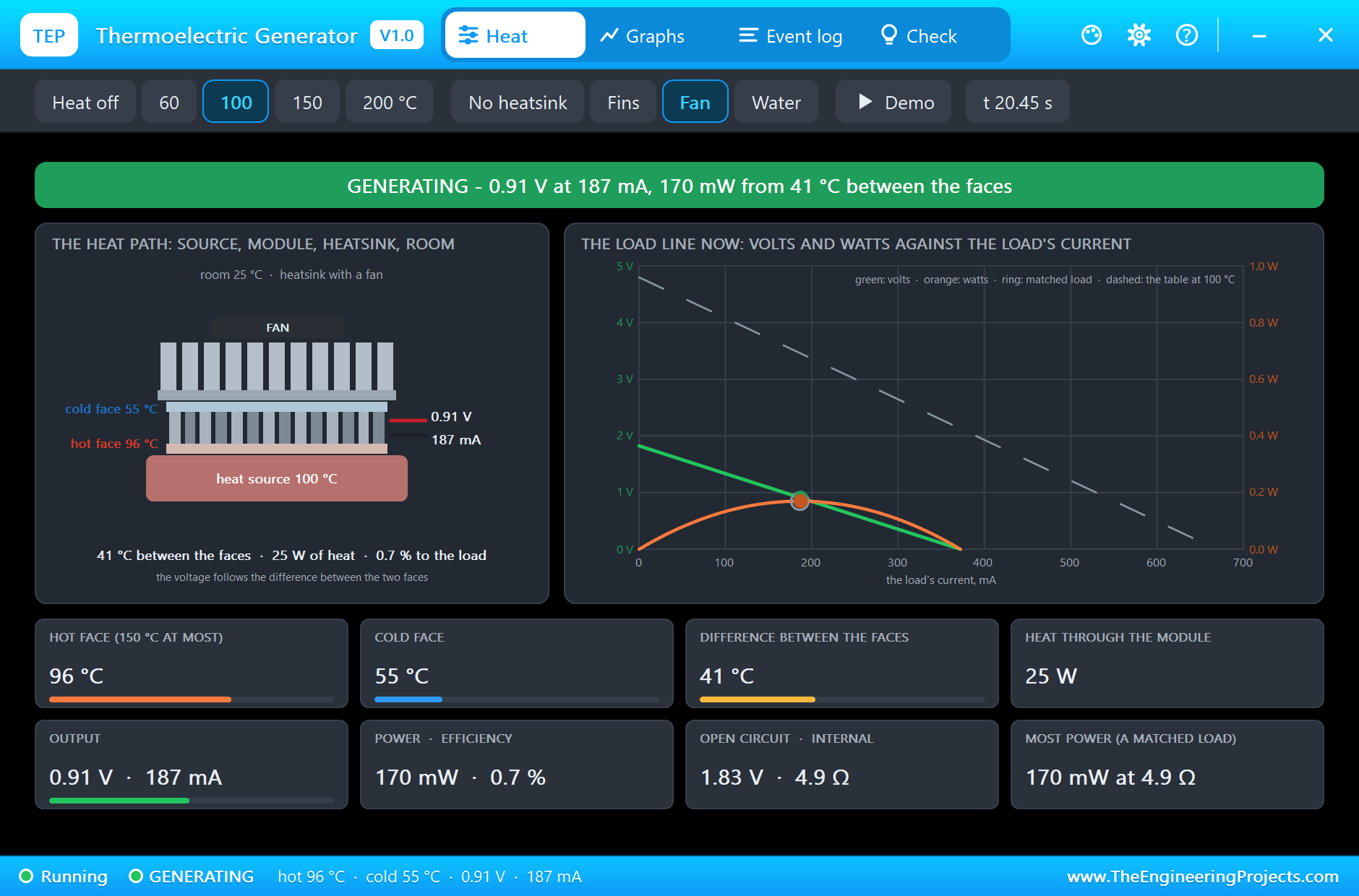
    * TEG1 an SP1848 thermoelectric module (TEGSP1848TEP): SOURCE 100 (C), HEATSINK FAN, SPEED 20 (twenty seconds of
      heating every simulated second); + to VIN+ of the INA219, - to GND.
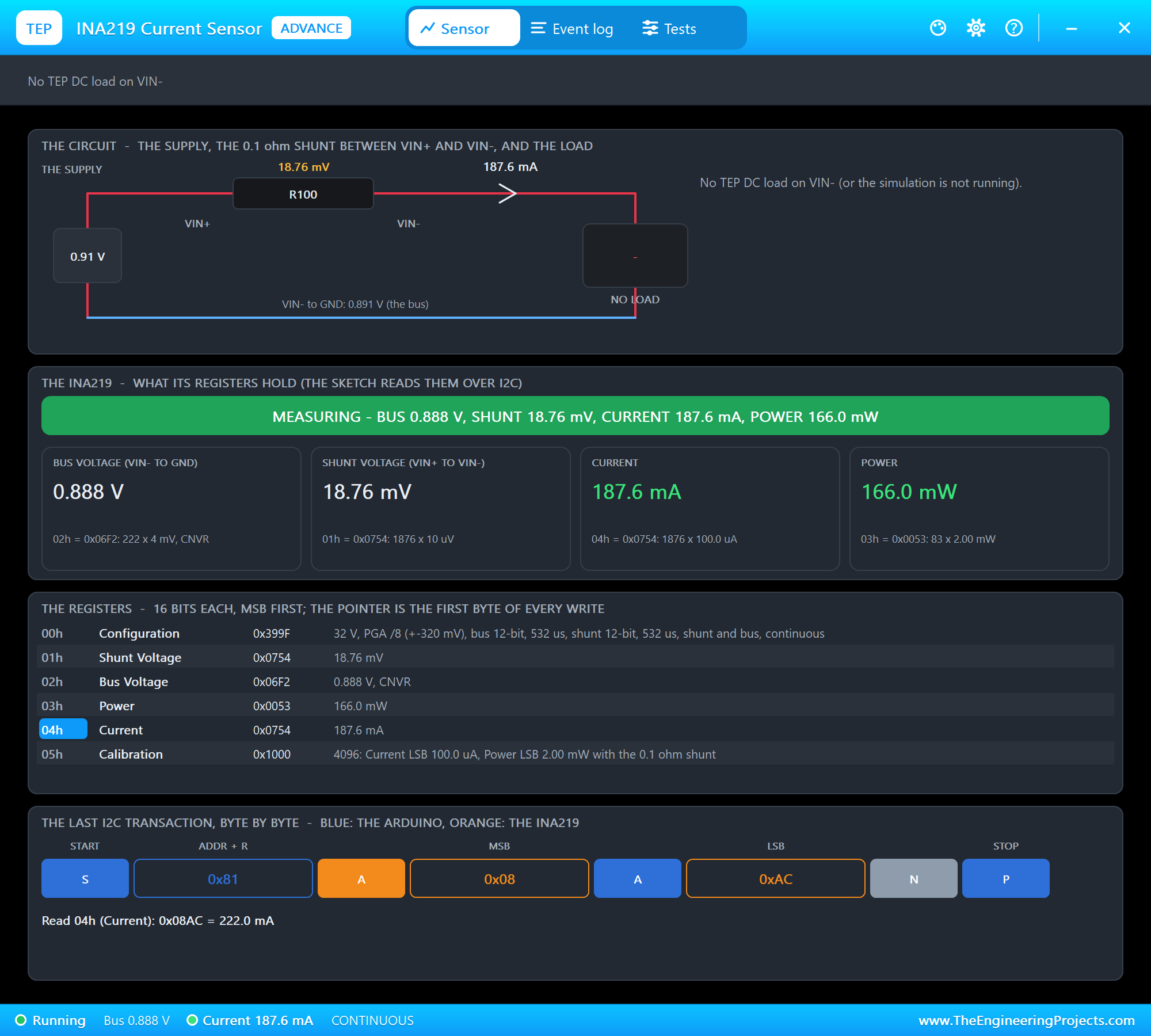
    * U1 an INA219 (INA219ADVTEP, 0x40) on I2C1 (SDA GPIO2, SCL GPIO3), VCC +3.3V: VIN+ from the TEG, VIN- to the bank.
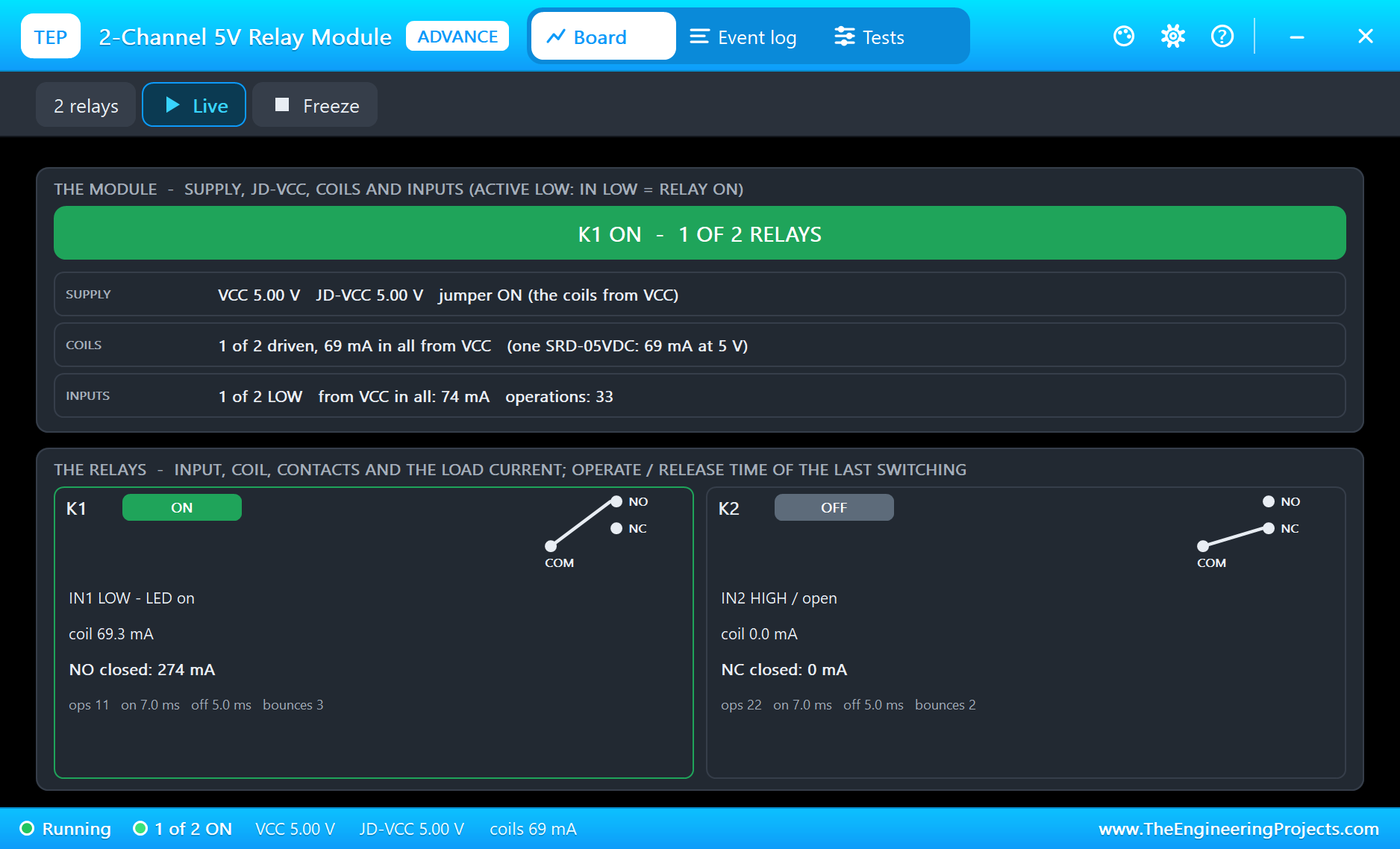
    * RLY1 a 2-channel relay module (RELAY2ADVTEP), VCC / JD-VCC +5V: IN1 on GPIO17 (pin 11), IN2 on GPIO27 (pin 13),
      both active LOW; COM1 / COM2 on LOAD, NO1 to R1 4.7 ohm, NO2 to R2 10 ohm (RESISTORPOWER5WTEP), both to GND.
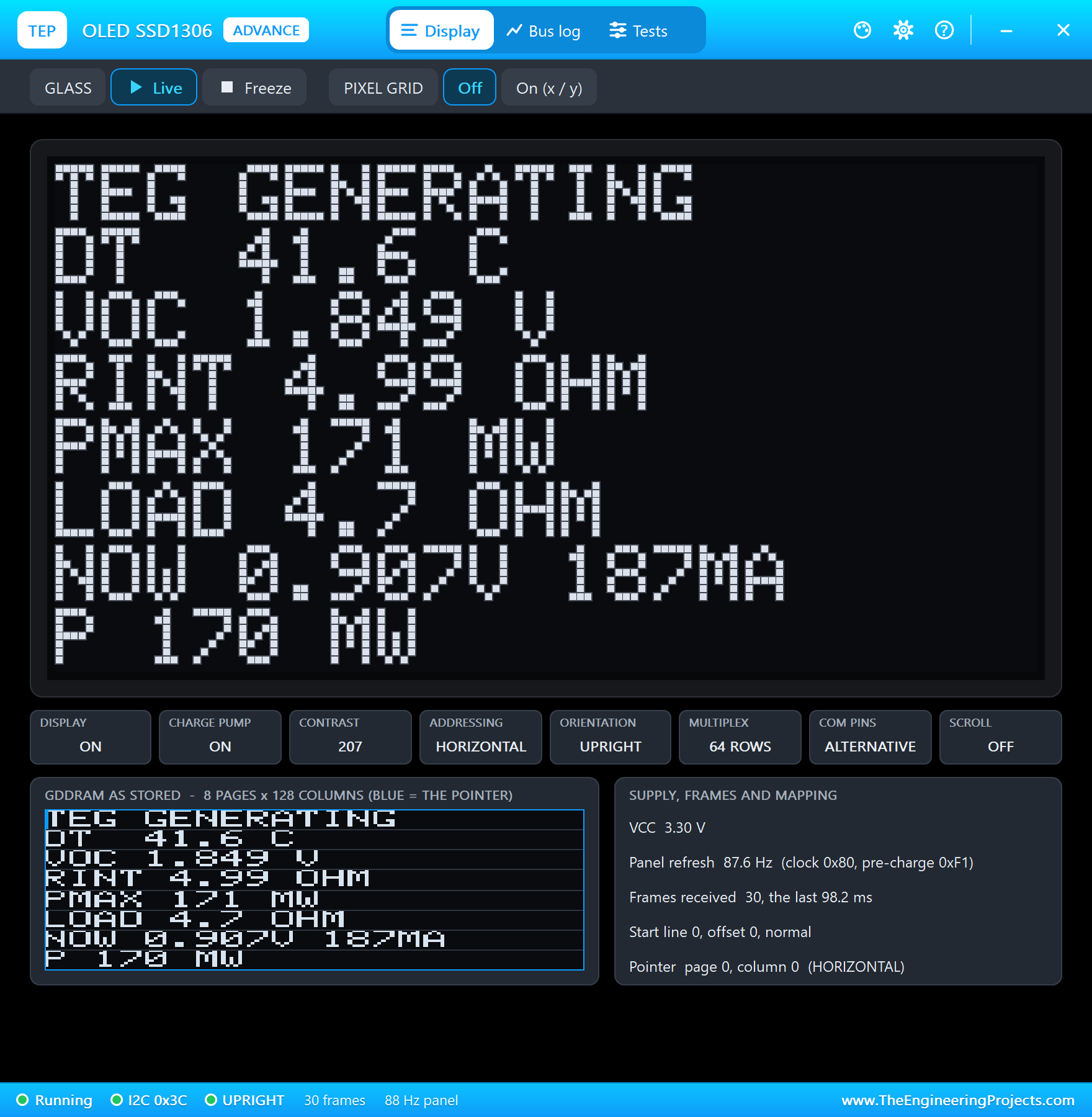
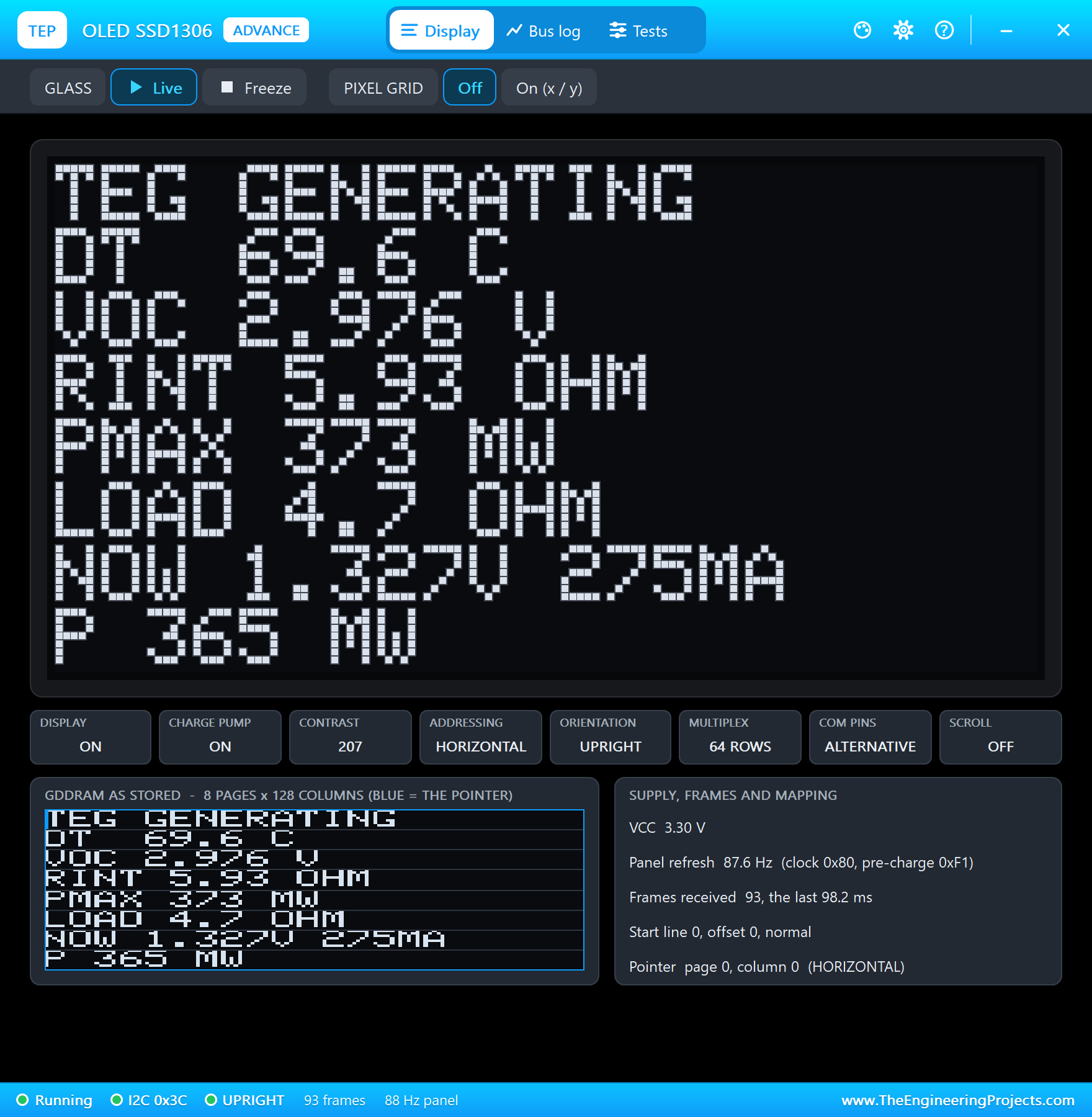
    * U2 an SSD1306 128x64 OLED (OLED12864WHITEADVTEP, 0x3C) on I2C1, VCC +3.3V.
    * RASPBERRY PI 5 (PI1) runs teg_logger.py on Ethernet at 192.168.1.51 (port 8000).
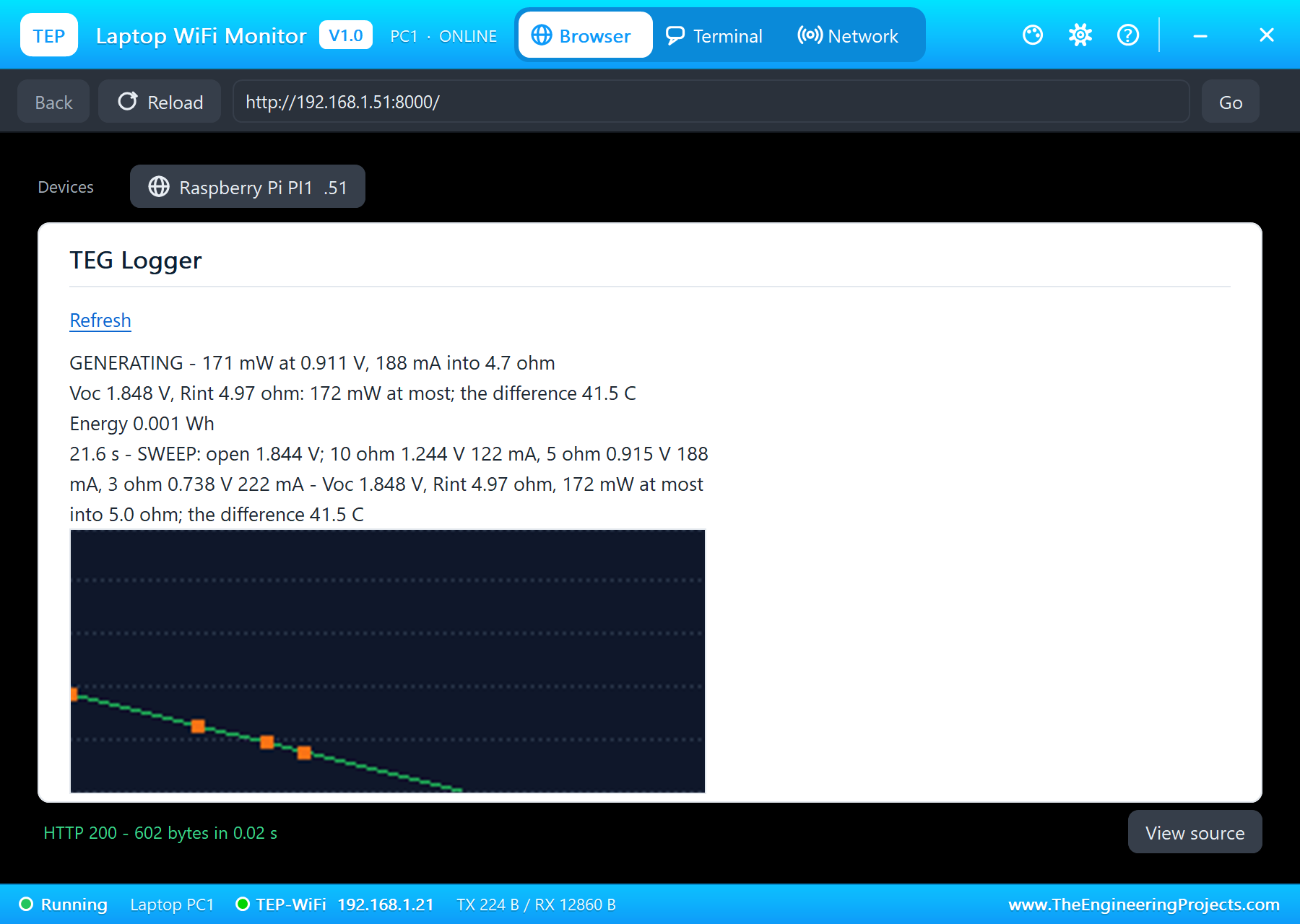
    * Laptop WiFi Monitor (PC1) and Mobile WiFi Monitor (MOB1) open http://192.168.1.51:8000/.
  How it measures:
    a sweep        every 5 s: open, 10, 4.7 and 3.2 ohm (both), 0.3 s each; a straight line V = Voc - I x Rint
                   through the four points (least squares) gives Voc and Rint
    the best       the most a load can take: Voc^2 / (4 Rint), into a load equal to Rint; between the sweeps the
                   bank's load closest to Rint stays on, and its power and energy are logged
    the difference from Voc by the module's table: 0.97 V at 20 C, 1.8 V at 40 C, 2.4 V at 60 C, 3.6 V at 80 C,
                   4.8 V at 100 C between its faces, straight lines between
    a warning      DIFFERENCE FALLING when it drops a third under its best of the last 30 s
  Its pages:
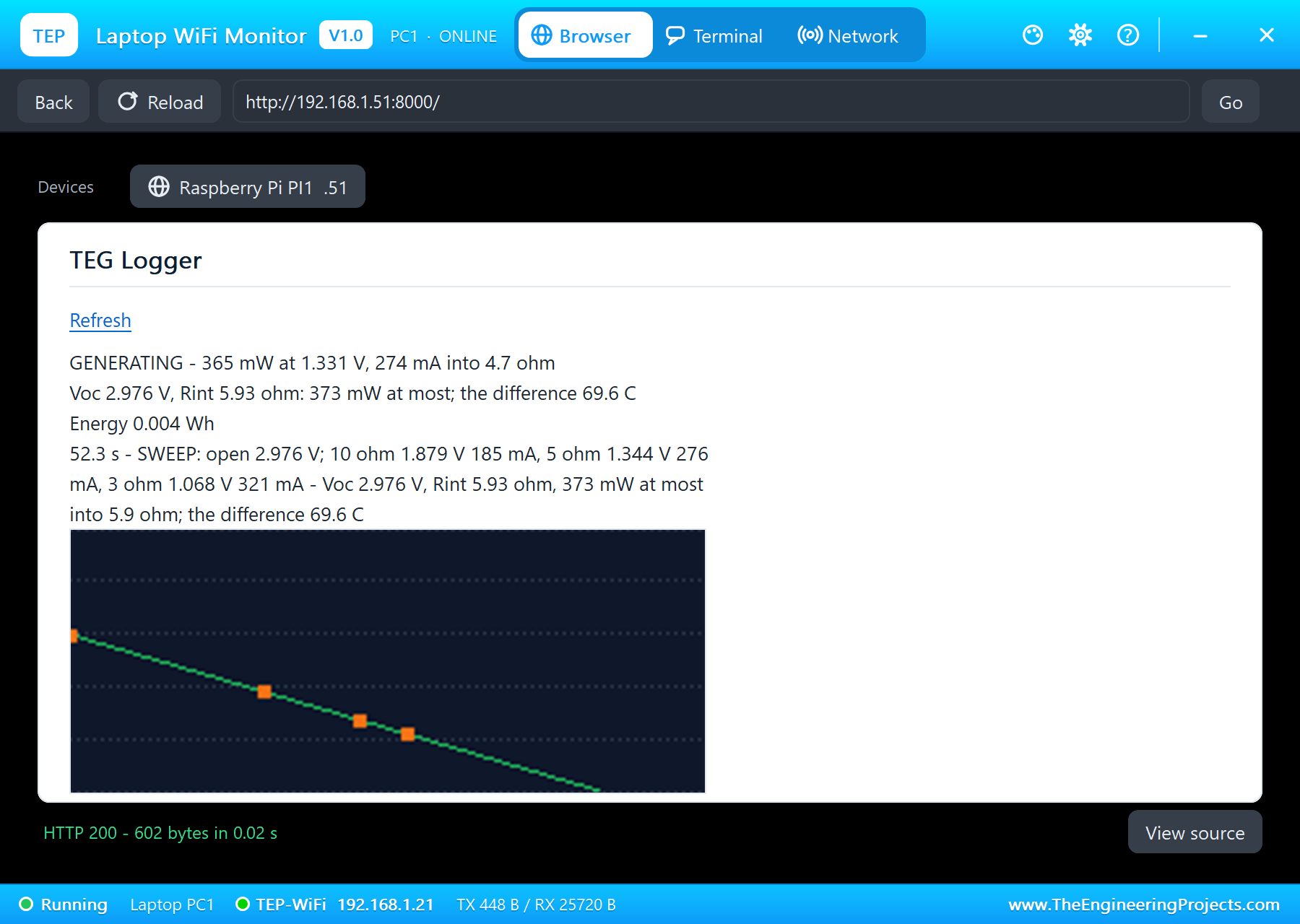
    /          the dashboard: the power, Voc, Rint, the most power, the difference, the energy, the last sweep's line
    /line.bmp  the last sweep: the four points and the fitted line        /data   JSON
  No extra Python library: lgpio (in the TEPPi runtime and on Raspberry Pi OS), threading, http.server.

TEST STATUS
  Tested in Proteus 8 Professional on Windows 11, the run that made the tutorial's screenshots (the program's times):
  - 100 C with a fan: "open 1.848 V; 10 ohm 1.240 V 122 mA, 5 ohm 0.911 V 188 mA, 3 ohm 0.742 V 222 mA - Voc 1.848 V,
    Rint 4.98 ohm, 171 mW at most into 5.0 ohm; the difference 41.6 C"; the matched 4.7 ohm: 0.907 V, 187 mA, 170 mW.
    TEG1's pop-up: 41 C between the faces, 1.82 V open, 4.9 ohm, 170 mW at most.
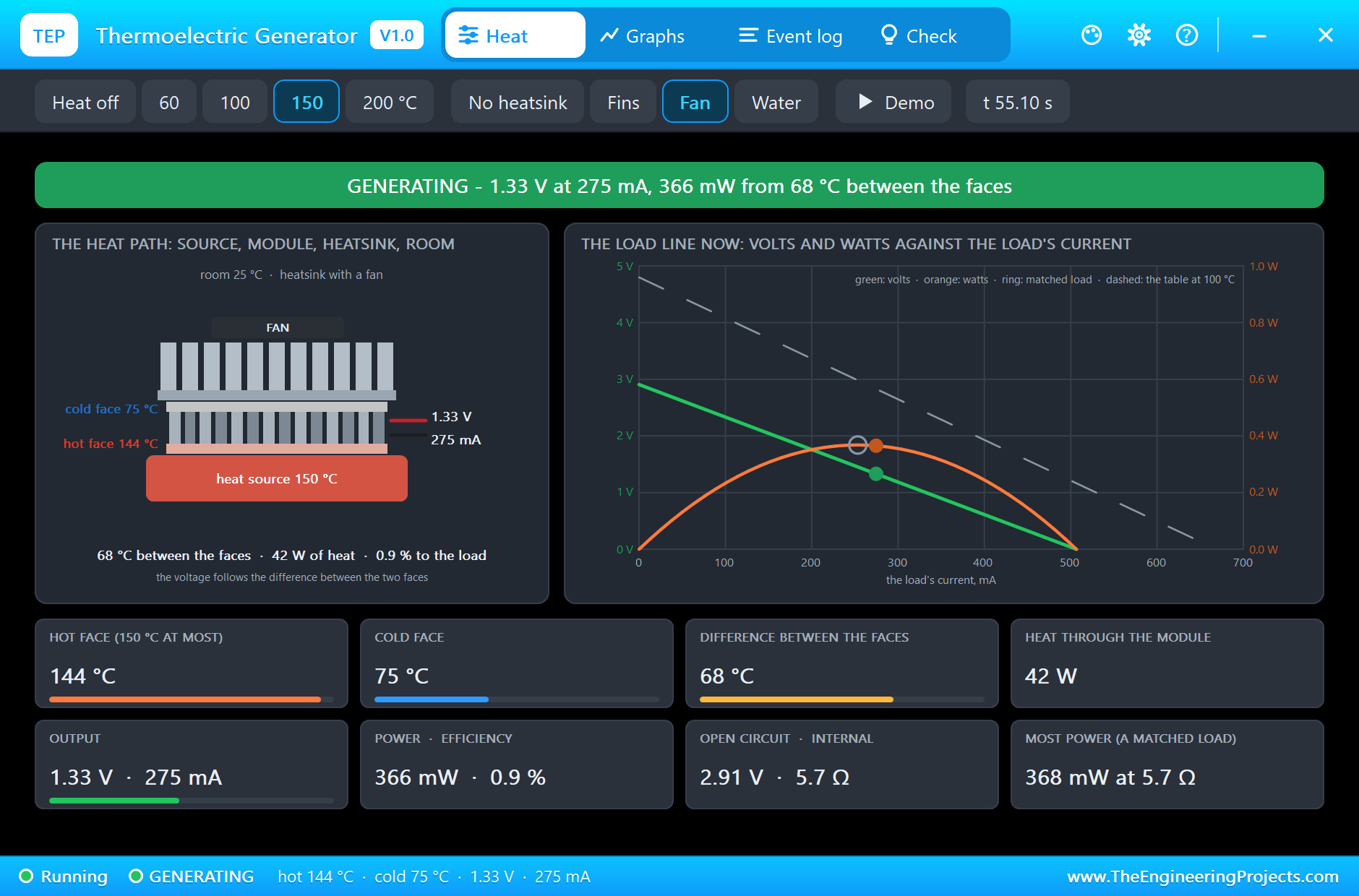
  - 150 C at 26.6 s: that sweep "REJECTED - the points miss a straight line by up to 207 mV: the heat changed during";
    then Voc 2.976 V, Rint 5.93 ohm, 373 mW at most, the difference 69.6 C (the pop-up: 68 C, 2.91 V, 5.7 ohm, 368 mW).
  - No heatsink at 58.6 s: 62.7 s "DIFFERENCE FALLING - 4.9 C, a third under the best 69.7 C" - 0.24 V open, 3 mW (the
    cold face 145 C under a 150 C hot face). The fan back at 75 s: 83.3 s "the difference back: 69.3 C".
  - 101 s of simulation in 477 s.

INSTALLATION
  1. Close Proteus. Extract the WHOLE zip file, for example to your Desktop.
  2. Copy the files from "Proteus Library Files" into the LIBRARY folder of Proteus, for example
     C:\Program Files (x86)\Labcenter Electronics\Proteus 8 Professional\LIBRARY
  3. Copy everything in "Proteus Model Files" - the DLL files and the TEPPi folder - into the MODELS folder (next
     to LIBRARY).
  4. Start Proteus. Press P in the schematic and search for RASPBERRY PI 5, TEGSP1848TEP or INA219ADVTEP to check
     that the parts are there.

RUN THE SIMULATION
  1. Open "Proteus Simulation\Pi-5-TEG-Logger.pdsprj". Keep teg_logger.py and the DLL files beside it.
  2. Press Play. The heat source is at 100 C with a fan on the heatsink; the first sweep comes after a few seconds.
  3. Click TEG1 for its pop-up: press 150 C, then the heatsink NONE (the fan off) and watch the difference fall,
     then FAN again.
  4. Open the Laptop WiFi Monitor (PC1) or the Mobile WiFi Monitor (MOB1) and press Go for the dashboard.

PROPERTIES USED IN THIS PROJECT
  PI1 RASPBERRY PI 5           PROGRAM=teg_logger.py, ETHERNET=IN (192.168.1.51)
  TEG1 TEGSP1848TEP            SOURCE=100, HEATSINK=FAN, AMBIENT=25, SPEED=20
  U1 INA219ADVTEP;  RLY1 RELAY2ADVTEP;  U2 OLED12864WHITEADVTEP
  R1 4R7, R2 10 (RESISTORPOWER5WTEP)
  PC1, MOB1                    HOMEPAGE=http://192.168.1.51:8000/

TROUBLESHOOTING
  * The relays never click: their VCC and JD-VCC need a real 5 V supply (+5V), not a net label.
  * Voc and Rint read 0: the TEG's + must go through the INA219 (VIN+ to VIN-) to the relays' COM pins.
  * The temperatures creep: that is the real heat path; SPEED 20 makes each simulated second twenty.
  * The OLED stays blank: SDA / SCL on GPIO2 / GPIO3, address 0x3C, VCC 3.3 V.
  * The terminal cannot start Python: the TEPPi folder is not in MODELS.

LICENCES
  * The project, the program, the parts (LIB files) and the models (DLL files) are made by The Engineering Projects
    and are free for learning and for your own projects. The models use only standard Windows libraries.
    The C++ source code of the models is not included; the source code is not included for any model.
  * TEPPi\python is the Python 3.11 Windows embeddable package (Python Software Foundation License); TEPPi\runtime
    holds our TEP Pi runtime with gpiozero and colorzero (BSD licences) - their licence files are inside the folders.
  * Proteus is a product of Labcenter Electronics and is not included. Raspberry Pi is a trademark of Raspberry Pi
    Ltd. This project is not made or endorsed by them.

VERSION
  V1.0 - the first release of the project.
===============================================================================================================Development1 release
 Development1 release
-
V1.0Thermoelectric Generator Logger on Raspberry Pi 5 - Proteus Simulation V1.0this page
V1.0 is the only release in the Download Center so far. When a newer version is published, it appears above with its own download page.
Installation7 steps
 Installation7 steps
From the download to a working project, in order. The steps follow what the package contains.
You will need
- Proteus Design SuiteProteus 8 or newer (Labcenter), on Windows
- Pythonto build the source files into firmware
- Any archive toolWindows, macOS and Linux extract ZIP files on their own

Steps
- 1
Extract the archive
Right-click 46fdd18b31c94c669617c43126231eac.zip and choose Extract All (or open it with 7-Zip or WinRAR) into a folder you can find again. Keep its folder structure (Pi-5-TEG-Logger-TEP-v1.0) as it is.
- 2
Copy the library files into Proteus
Move TEPINA219.LIB, TEPLAPTOP.LIB and TEPMOBILE.LIB and 5 more and the files into the LIBRARY folder of your Proteus installation: C:\Program Files (x86)\Labcenter Electronics\Proteus 8 Professional\LIBRARY for Proteus 8, or the matching Proteus 7 folder. Older versions keep it under ProgramData\Labcenter Electronics. If Proteus is open, close it first.
- 3
Add the simulation model
Copy TEPINA219.DLL, TEPNET.DLL and TEPOLED.DLL and 10 more into the MODELS folder next to LIBRARY, so the component can run, not only be drawn.
- 4
Restart Proteus and place the component
Start Proteus, open a schematic, press P (Pick Devices) and search for the component by the name used in the tutorial. It appears with its pins ready to wire.
- 5
Build the source code
Open teg_logger.py, attr.py and color.py and 28 more in the compiler named in the tutorial (MikroC, Keil, MPLAB, Code Composer or the Arduino IDE) and build it to get the firmware.
- 6
Open the example simulation
Open Pi-5-TEG-Logger.pdsprj in Proteus to see the wiring exactly as in the tutorial. Check the controller's Program File path, then press Play.
- 7
Follow the tutorial
Thermoelectric Generator Logger on Raspberry Pi 5 - Proteus Simulation explains every connection and setting in order; keep it open beside the files while you build.
FAQs8 questionsContact TEP
 FAQs8 questions
How do I download Thermoelectric Generator Logger on Raspberry Pi 5 - Proteus Simulation V1.0?
Wait for the 30-second guest countdown on this page, then press the download button; the file comes straight from our storage. Members who are logged in skip the wait. If the browser opens the file instead of saving it, use its Save as option. The download link is made for you when the countdown ends and works for 15 minutes; a saved or shared link stops working, so share this page instead.
What is inside the archive?
Thermoelectric Generator Logger on Raspberry Pi 5 - Proteus Simulation V1.0 comes as a ZIP archive of 144 files (14.5 MB, 28.8 MB unpacked) holding Proteus library files, simulation model DLLs, a Proteus simulation, source code and a nested archive. Open the File Structure tab for the full list of 144 files.
What should I do if the download does not start?
Check the browser's download list first; an ad blocker or a company firewall can also hold it back, so try another browser or network. If the file arrives incomplete, download it again. For an installation problem, read the Install tab or tell us in the comments with your software version and the exact error message.
Is this file free?
Yes. Every file in the TEP Download Center is free for learning, personal and student projects. If you share it, link back to this page or the tutorial so others find the latest version.
How do I check that the file arrived complete?
Compare its SHA-256 with the one on this page, e97c1765a0272850888b1a8247df3ac29aea010c7fb6dd17a9af0b5b6398620b. In PowerShell run Get-FileHash "46fdd18b31c94c669617c43126231eac.zip"; on macOS or Linux run shasum -a 256 "46fdd18b31c94c669617c43126231eac.zip". The same value means the file is exactly the one in our storage; a different one means the download broke off, so download it again.
Do I need WinRAR to open the ZIP file?
No. Windows, macOS and Linux open ZIP archives on their own (Extract All, or double-click). WinRAR and 7-Zip work too. Extract the whole archive before using the files.
Where do I put the LIB and IDX files?
Both files go into the LIBRARY folder of your Proteus installation (Proteus 8: C:\Program Files (x86)\Labcenter Electronics\Proteus 8 Professional\LIBRARY; Proteus 7 has the same folder under its own name). Restart Proteus afterwards and search for the component with P.
Which Proteus version does the library need?
The tutorial names the Proteus version the library was made and tested with. Most TEP libraries work in Proteus 7 and Proteus 8; if the component does not appear after a restart, check that both the LIB and the IDX file were copied and that Proteus was fully closed while copying.
Members skip the wait. Log in or join TEP.

- 0Total downloads
- 4%Popularity
- Raspberry PiCategory
- 0Comments
- ssyedzainnasirUploaded by
- 24 Nov 2026Uploaded at


 SHA-256
e97c1765a0272850888b1a8247df3ac29aea010c7fb6dd17a9af0b5b6398620b


 Need help with this file?
 Tags
Related Raspberry Pi
All Raspberry Pi tutorials




More Raspberry Pi project files
All Raspberry Pi tutorials

Comments
0