


Project Files of LD2410 Radar Sensor Library for Proteus Simulation
 Libraries
 Code
 Projects
 Simulation
fd3e30ec12894d418c7486c8f390d55f.zip

LD2410 Radar Sensor Library for Proteus V1.0
LD2410 Radar Sensor Library for Proteus V1.0 comes as a ZIP archive of 16 files (1.8 MB, 4.1 MB unpacked) holding Proteus library files, simulation model DLLs, a Proteus simulation, an Arduino sketch and compiled HEX firmware.
- LIBProteus library
- DLLProteus model
- DSNProteus simulation
- INOArduino sketch
- HEXHEX firmware
Description
LD2410-Radar-Sensor-Library-for-Proteus-v1.0.zip with the LD2410 24 GHz radar for Proteus simulation (TEPLD2410.LIB and TEPLD2410.DLL), our 5 mm LED and Resistor libraries, our Arduino UNO V4.0, the A4 demo with its sketch and a README.

File Structure
 File Structure
6.2 KB201.9 KB15.3 KB21.8 KB306.9 KB883.5 KB326 KB289.5 KB311 KB24.2 KB22.4 KB883.5 KB326 KB289.5 KB311 KB15.3 KBGallery12 images from the tutorialOpen the tutorial
 Gallery12 images from the tutorial
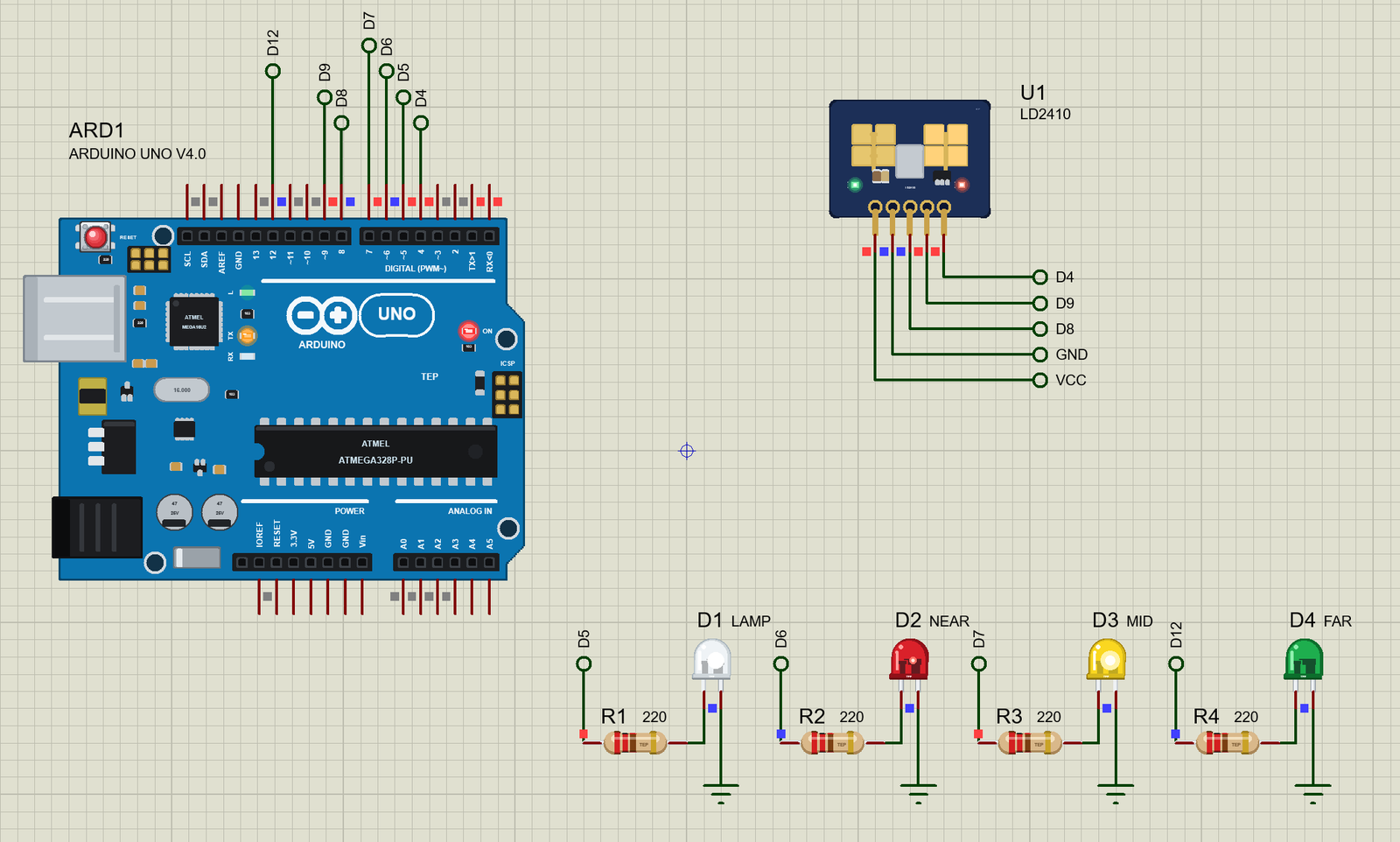
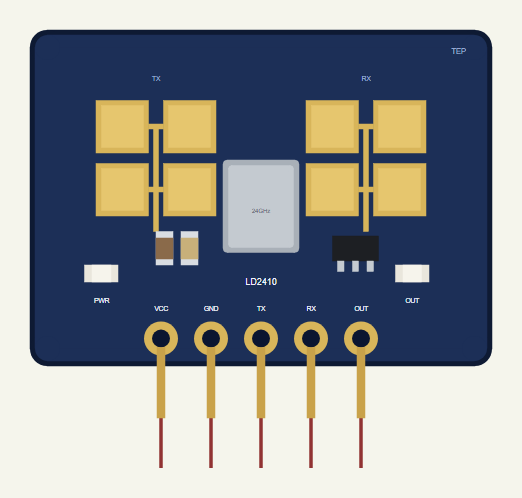
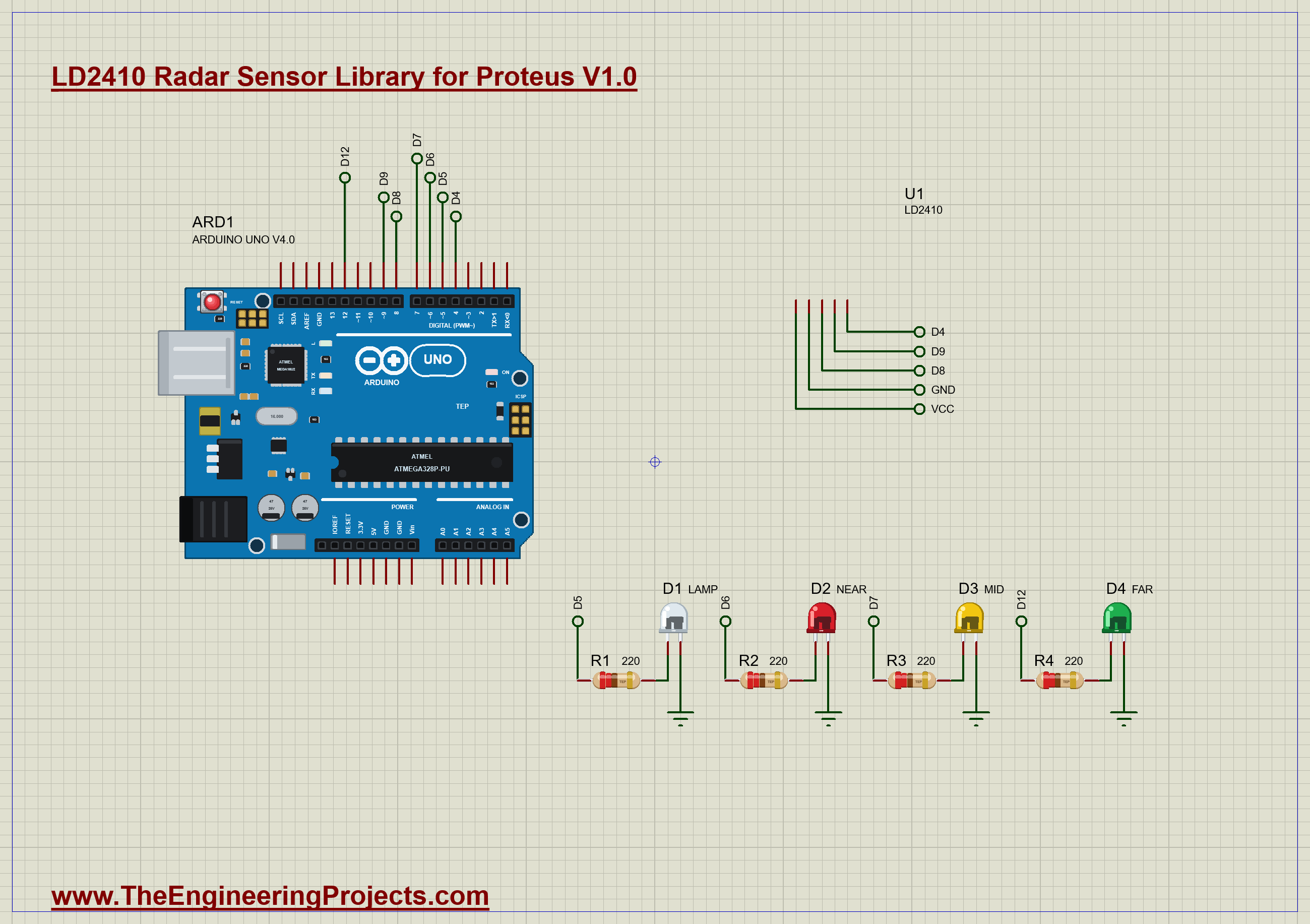
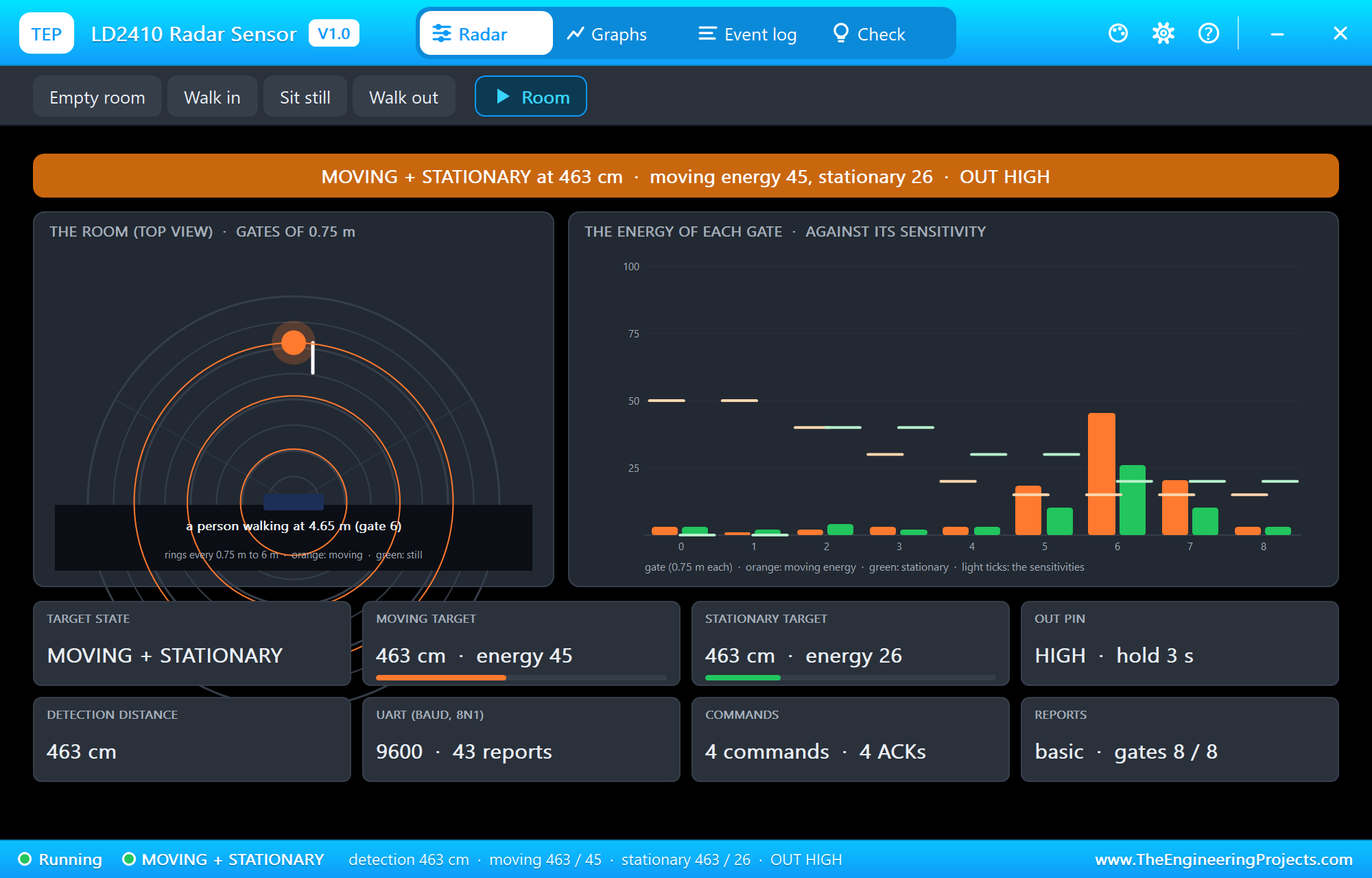
The circuit, the board and the results as they appear in LD2410 Radar Sensor Library for Proteus Simulation. Open an image for its full size.
README
 README
LD2410 RADAR SENSOR LIBRARY FOR PROTEUS SIMULATION - V1.0 (a 24 GHz presence radar over UART, a pop-up)
Designed by The Engineering Projects
www.TheEngineeringProjects.com

IMPORTANT LINKS
Article (read it first - pictures, step by step, every feature explained):
  https://www.theengineeringprojects.com/2026/11/ld2410-radar-sensor-library-for-proteus.html
Report a bug or suggest a feature (our forum):
  https://www.theengineeringprojects.com/forum/category/pir-sensor-proteus-library
The demo runs on our Arduino UNO V4.0 (included) - working LEDs, RESET and a
built-in serial monitor, no Virtual Terminal to wire - its own article:
  https://www.theengineeringprojects.com/2026/10/arduino-uno-library-for-proteus-v40.html
The lamp and the zone LEDs are our 5 mm LED library (in this zip; its article):
  https://www.theengineeringprojects.com/2026/11/5mm-led-library-for-proteus.html
The resistors are our Resistor library (in this zip):
  https://www.theengineeringprojects.com/2026/11/resistor-library-for-proteus.html
Support us (the libraries are free):
  https://www.theengineeringprojects.com/donate

FILE STRUCTURE
LD2410-Radar-Sensor-TEP-v1.0/
|-- Proteus Library Files/
|   |-- ArduinoV4TEP.LIB                              201.9 KB   TEP Arduino boards V4.0 (UNO) -> LIBRARY
|   |-- TEPLD2410.LIB                                  15.3 KB   the library -> LIBRARY folder
|   |-- TEPLED5MM.LIB                                  21.8 KB   a part the demo uses -> LIBRARY folder
|   |-- TEPRESISTOR.LIB                               306.9 KB   a part the demo uses -> LIBRARY folder
|-- Proteus Model Files/
|   |-- TEPARDUINO.DLL                                883.5 KB   the Arduino board model -> MODELS folder
|   |-- TEPLD2410.DLL                                 326.0 KB   the model -> MODELS folder
|   |-- TEPLED5MM.DLL                                 289.5 KB   its model -> MODELS folder
|   |-- TEPRESISTOR.DLL                               311.0 KB   its model -> MODELS folder
|-- Proteus Simulation/
|   |-- LD2410_Demo.hex                                22.4 KB   the demo firmware
|   |-- LD2410-Radar-ArduinoUnoV4.pdsprj               24.2 KB   the demo project
|   |-- TEPARDUINO.DLL                                883.5 KB   copy of the board model
|   |-- TEPLD2410.DLL                                 326.0 KB   copy of the model
|   |-- TEPLED5MM.DLL                                 289.5 KB   copy of its model
|   |-- TEPRESISTOR.DLL                               311.0 KB   copy of its model
|-- Arduino Code/
|   |-- LD2410_Demo/LD2410_Demo.ino                     6.2 KB   the demo sketch (source of the .hex)
|-- README.txt                                        ~16.1 KB   this file
Total: 4.14 MB (unzipped). The C++ source code of the models is not included.

WHAT IS IT?
An HLK-LD2410 24 GHz human presence radar module, drawn at its real size (22 x 16 mm) from above:
the board with its gold patch
antennas (four for the transmitter, four for the receiver), the radar chip's shield, the regulator
and two LEDs. The module is our
own drawing (no maker's mark); the behaviour follows the maker's serial protocol document:
  * The radar sees moving people and still people - by their breathing - up to about 6 m, in
    distance gates of 0.75 m (0 - 8).
    Each gate has a moving and a stationary energy (0 - 100), compared with that gate's sensitivity.
  * UART 8N1, 256000 baud from the factory (9600 - 460800 can be set with command 0x00A1). It
    reports by itself: F4 F3 F2 F1,
    the length, the data, F8 F7 F6 F5. The basic data: 0x02 0xAA, the target state (0 no one, 1
    moving, 2 still, 3 both), the
    moving distance (cm) and energy, the stationary distance and energy, the detection distance,
    0x55 0x00. In engineering mode
    (0x0062) every report also carries the energy of each gate.
  * Commands: FD FC FB FA, the length, the command word, the value, 04 03 02 01; the ACK returns the
    word | 0x0100 and a status.
    0x00FF enables configuration (the reports stop), 0x00FE ends it; 0x0060 max gates and the
    unmanned duration, 0x0061 the
    parameters, 0x0064 a gate's sensitivity, 0x00A0 the firmware version, 0x00A1 the baud rate,
    0x00A2 factory reset, 0x00A3
    restart.
  * OUT is high while someone is there, and for the unmanned duration (5 s from the factory) after
    the last detection.
  * On the sheet the module comes alive at Run: PWR lights with the supply, OUT lights with the OUT
    pin (both LEDs our additions),
    and the receiving antennas warm with the echo of a person (our way of showing it). Click it at
    Run for the pop-up: the room
    with the person and the gates, the energy of each gate against its sensitivity, the readings and
    the scene chips; graphs,
    an event log and a check page.
The body is drawn as on the real part and to true scale against our Arduino.
The TEP signature and the pop-up are TEP additions.

ONE DEVICE (search "LD2410" or "radar" in Pick Devices):
  LD2410TEP  "LD2410 Radar Sensor V1.0" in TEPLD2410.LIB (Sensors > Motion), prefix U, model
  TEPLD2410.DLL (mixed: analog and
            digital). Five pins along the bottom: VCC (5 V), GND, TX (its UART out), RX (its UART
            in), OUT (presence).

THE POP-UP
Click the part at Run. Tabs:
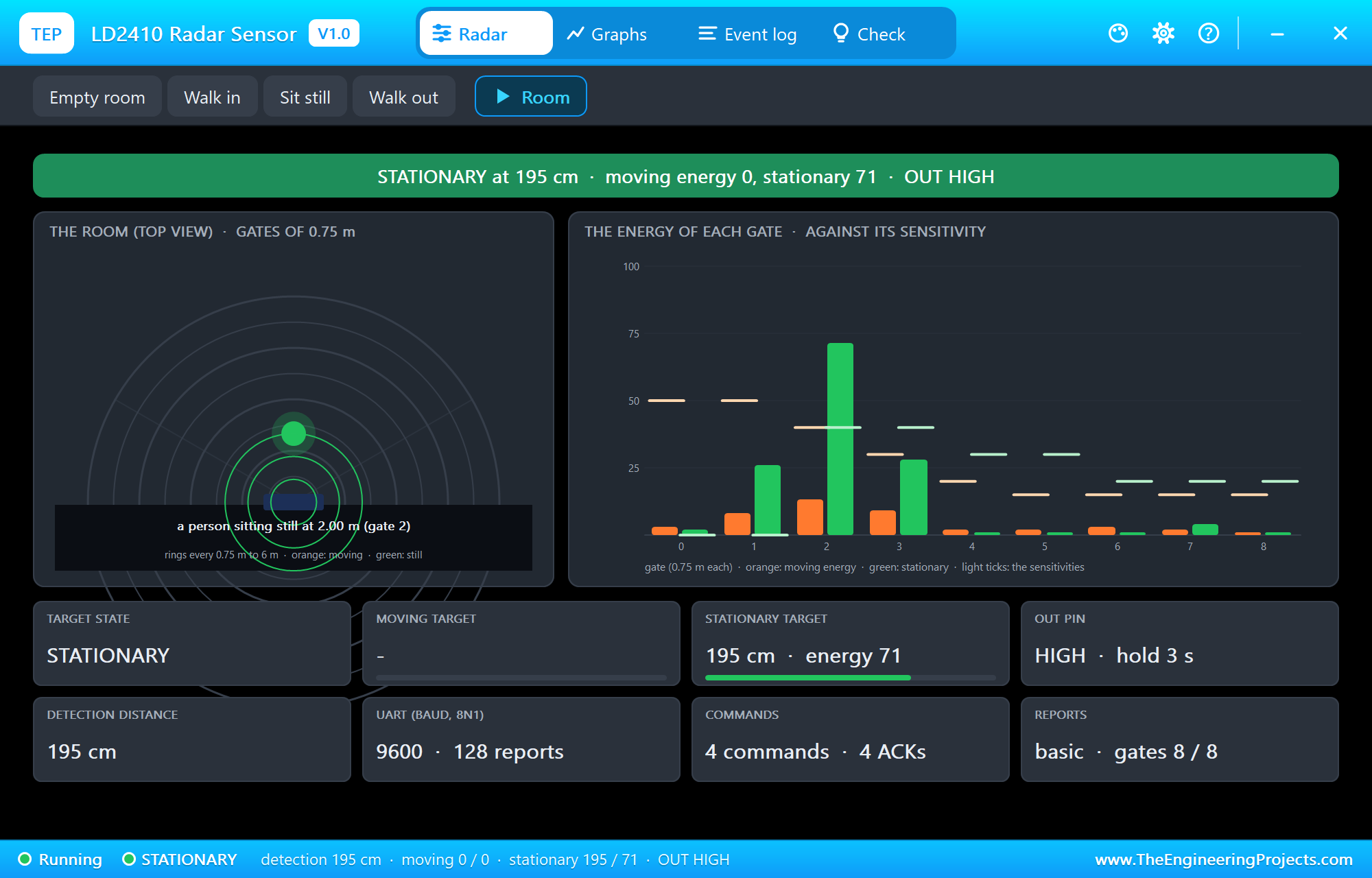
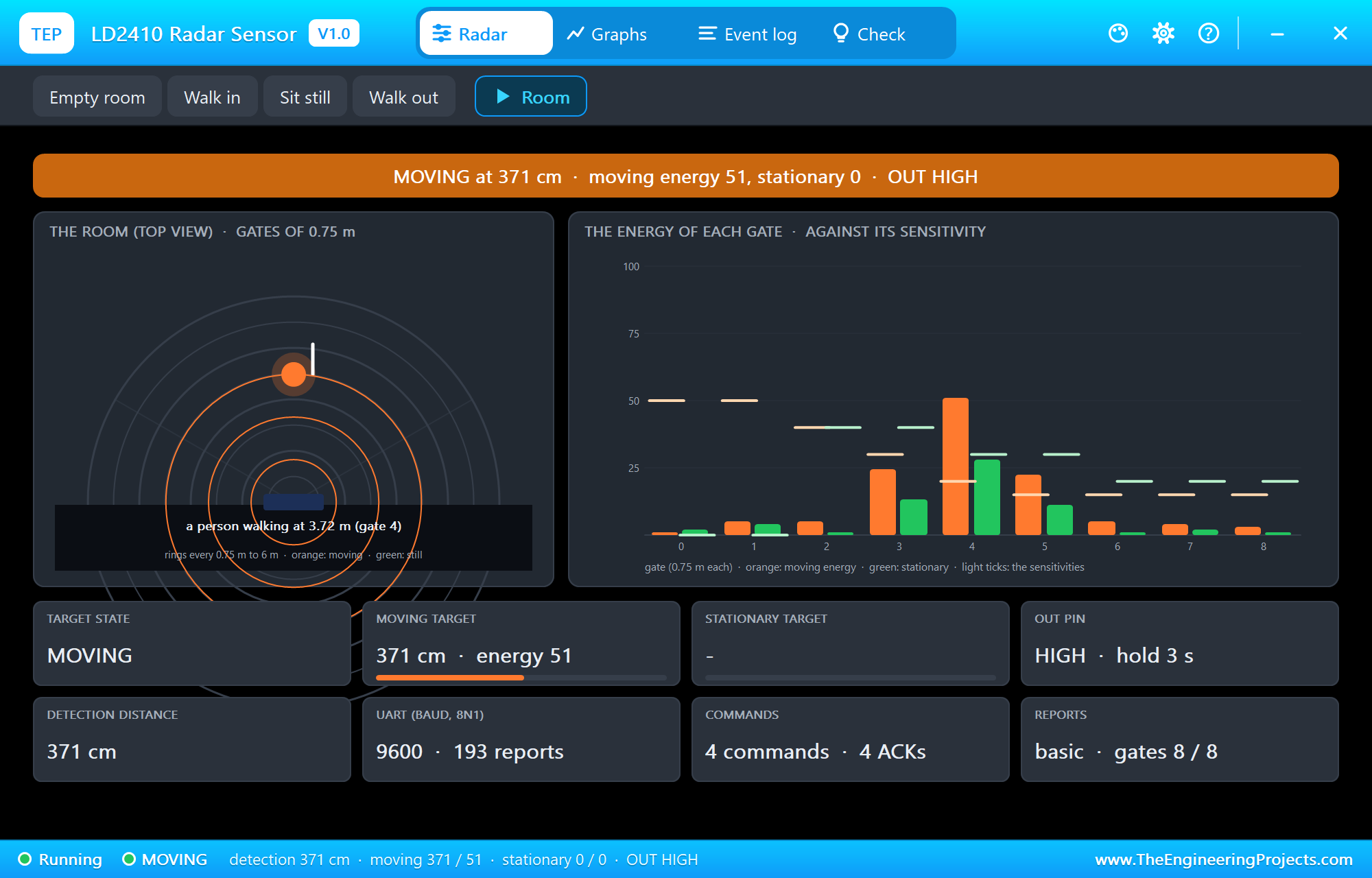
    Radar      chips: Empty room, Walk in (from 6 m to 1.5 m), Sit still, Walk out, and Room (the
    scene again from now). The room
                from above - the radar, its gates every 0.75 m, the person (orange walking, green
                still); the moving (orange)
                and stationary (green) energy of each gate with its sensitivity; eight tiles: the
                target state, the moving and
                the stationary target, OUT, the detection distance, the UART, the commands and the
                report mode.
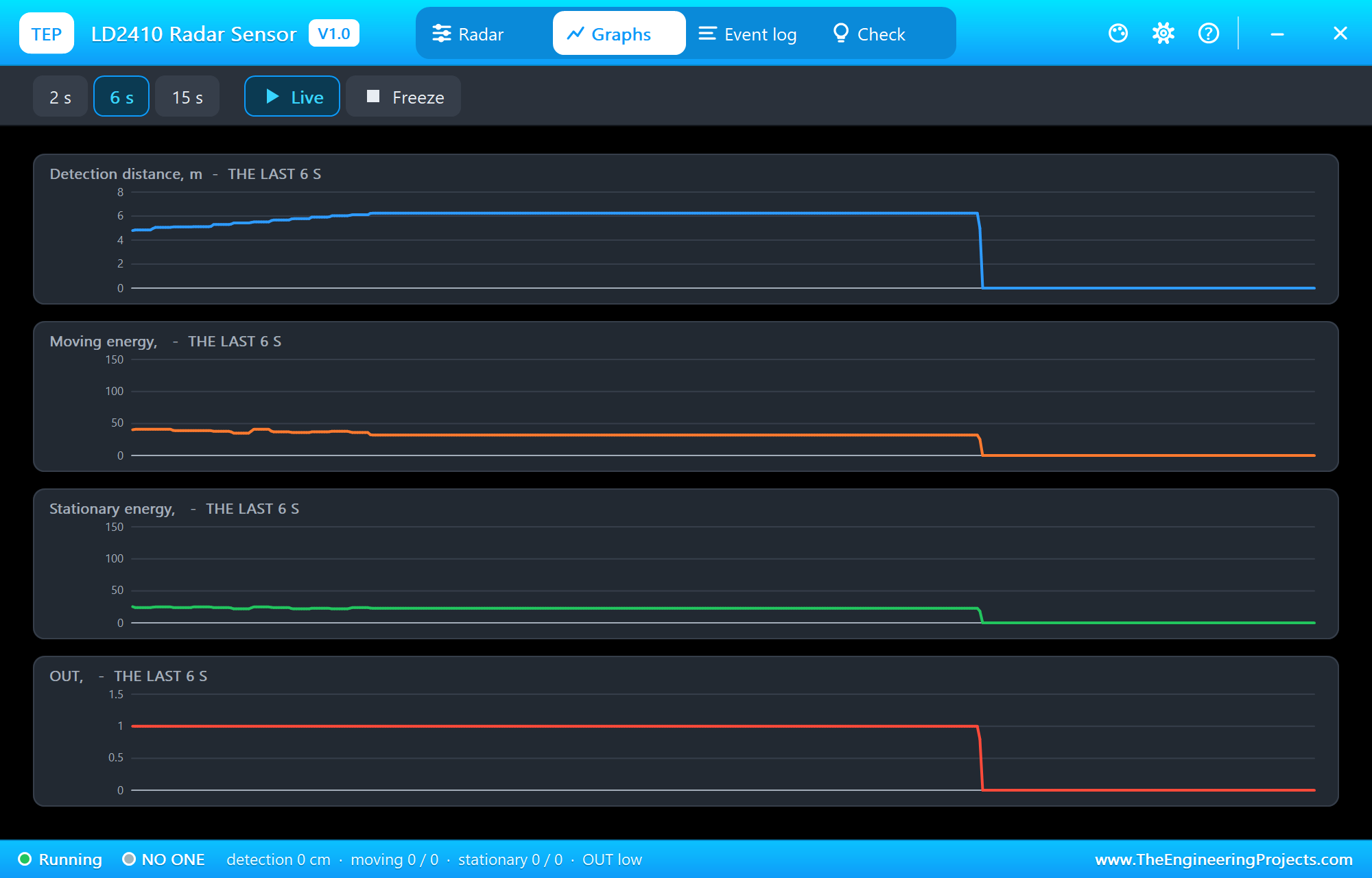
    Graphs     the live values over the last 2, 6 or 15 s. Live / Freeze.
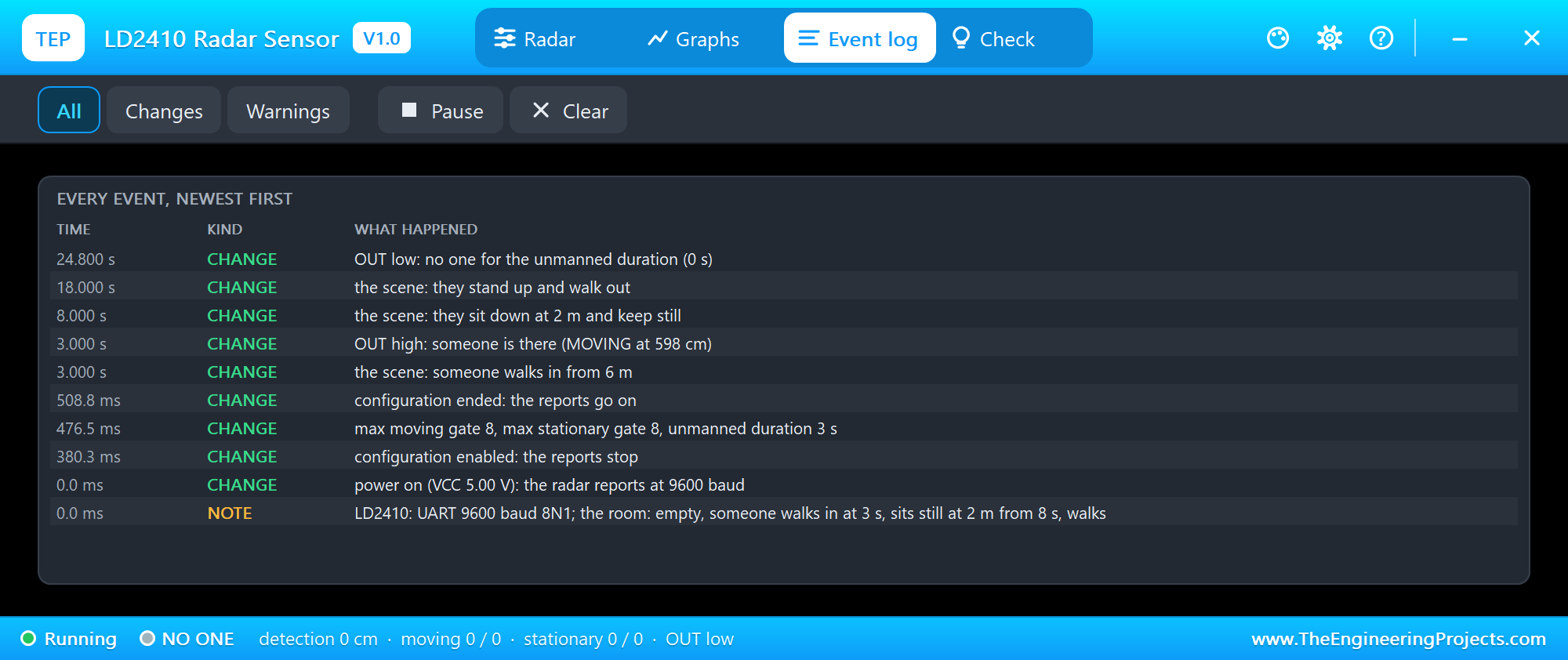
    Event log  every change and warning; filters All / Changes / Warnings, Pause, Clear
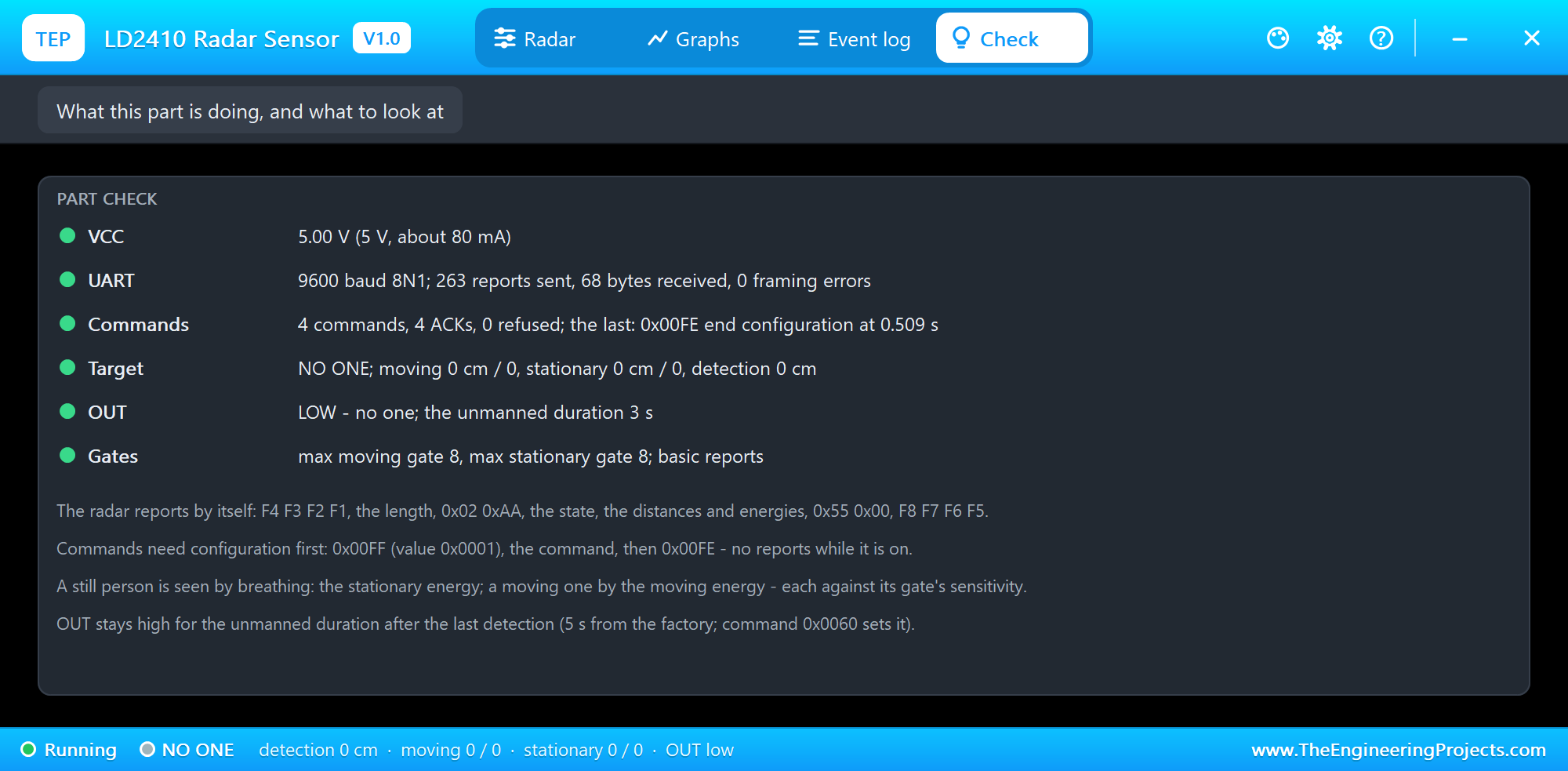
    Check      what the part is doing and what to look at, each with a verdict (green = fine, amber
    = check, red = wrong)
    Settings   theme, text size, open at Run, window size
    Help       report a bug, suggest a feature, article, updates, donate, forum; Copy diagnostics
    for a bug report

TEST STATUS
V1.0: verified in Proteus 8.5 on 20 Nov 2026 (the demo project as shipped: an A4 sheet, an Arduino UNO V4.0).
What the runs showed (the model's own numbers and the sketch's monitor):
  * The project loads and starts cleanly; the demo ran 26.5 simulated seconds in 251 s on our PC
    with the pop-up open and the pictures
    being taken.
  * Configuration over the UART (9600 baud, AltSoftSerial on D8 / D9): 0x00FF -> protocol 1, buffer
    64; 0x00A0 -> firmware
    V2.04.23022511; 0x0060 -> max gates 8 / 8, unmanned duration 3 s; 0x00FE -> the reports go on. 4
    commands, 4 ACKs.
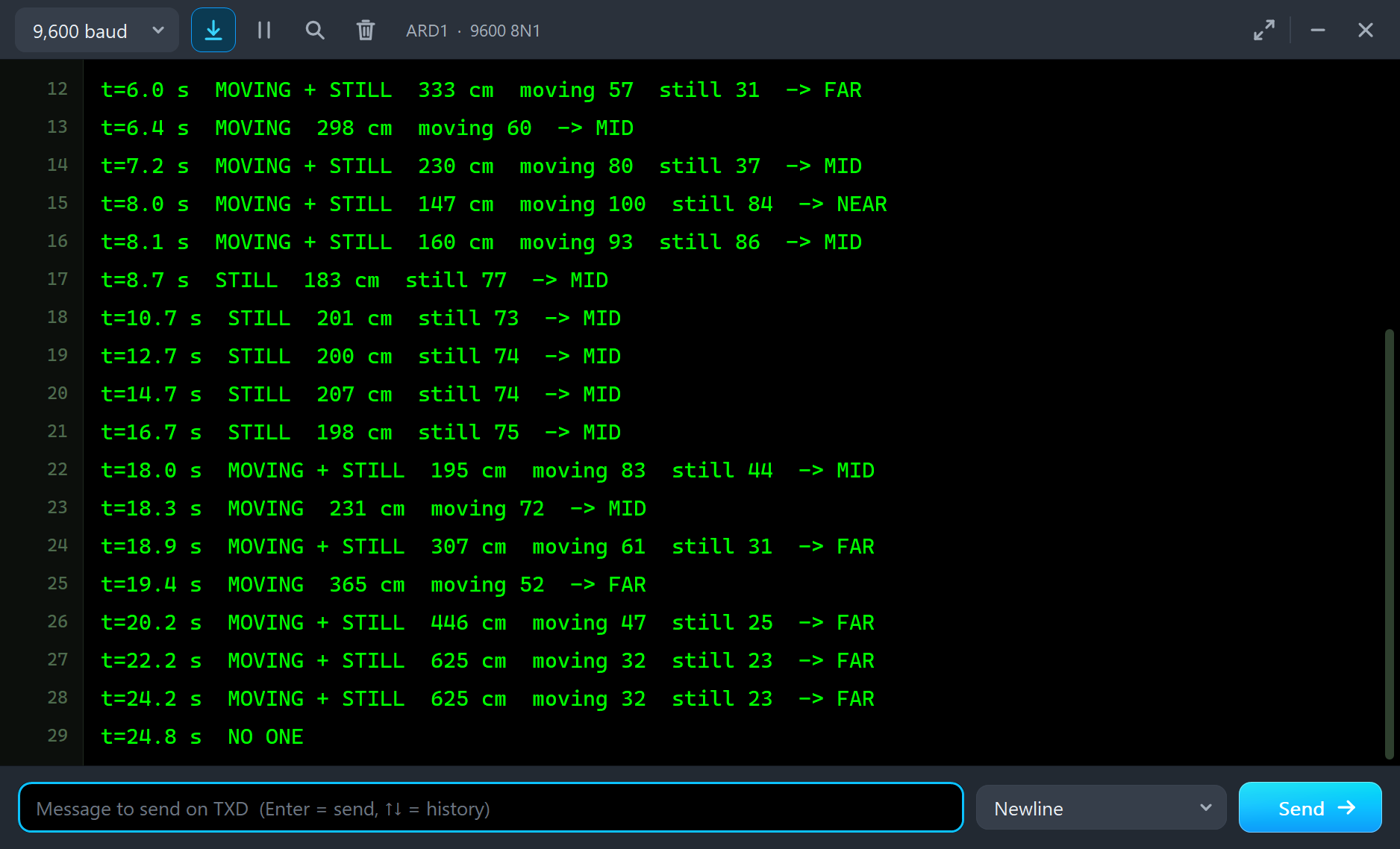
  * Someone walks in at 3 s: MOVING + STILL at 472 cm (moving energy 44), MOVING 298 cm (FAR ->
    MID), 230 cm (moving 80),
    147 cm at 8.0 s (moving 100, still 84 - NEAR), 160 cm (MID); OUT high, the lamp on.
  * Sitting still at 2 m from 8.7 s: STILL 183 - 207 cm, the stationary energy 73 - 77, the moving
    target gone - the lamp stays on.
  * Walking out at 18 s: MOVING 231 cm -> 365 cm (FAR) -> 446 cm -> 625 cm, out of range at about
    21.7 s; the last target held for
    the unmanned duration, then NO ONE at 24.8 s - OUT low, the lamp off.
  * 262 reports sent, no framing errors, 0 refused commands. The pop-up: Radar, Graphs, Event log,
    Check - all four followed the run.

INSTALLATION (about 2 minutes)
1. Close Proteus. Extract the WHOLE ZIP to a normal folder (e.g. Desktop).
2. Copy everything in "Proteus Library Files" (TEPLD2410.LIB, TEPLED5MM.LIB, TEPRESISTOR.LIB and our
Arduino library V4.0, ArduinoV4TEP.LIB, with the ARDUINO UNO V4.0 used by the demo) to the LIBRARY
folder of Proteus, for example:
     C:\Program Files (x86)\Labcenter Electronics\Proteus 8 Professional\LIBRARY
   (use the folder that already holds Proteus's own .LIB files).
3. Copy TEPLD2410.DLL, TEPLED5MM.DLL, TEPRESISTOR.DLL and TEPARDUINO.DLL from "Proteus Model Files"
to the MODELS folder (...\Proteus 8 Professional\MODELS).
4. Delete TEPLD2410.IDX from the LIBRARY folder if it is there (Proteus makes a new index).
5. Start Proteus. In Pick Devices (P) search "LD2410".

RUN THE DEMO
"Proteus Simulation\LD2410-Radar-ArduinoUnoV4.pdsprj" (an A4 sheet) - keep the .hex file and the
DLLs beside the project.
  A presence lamp:
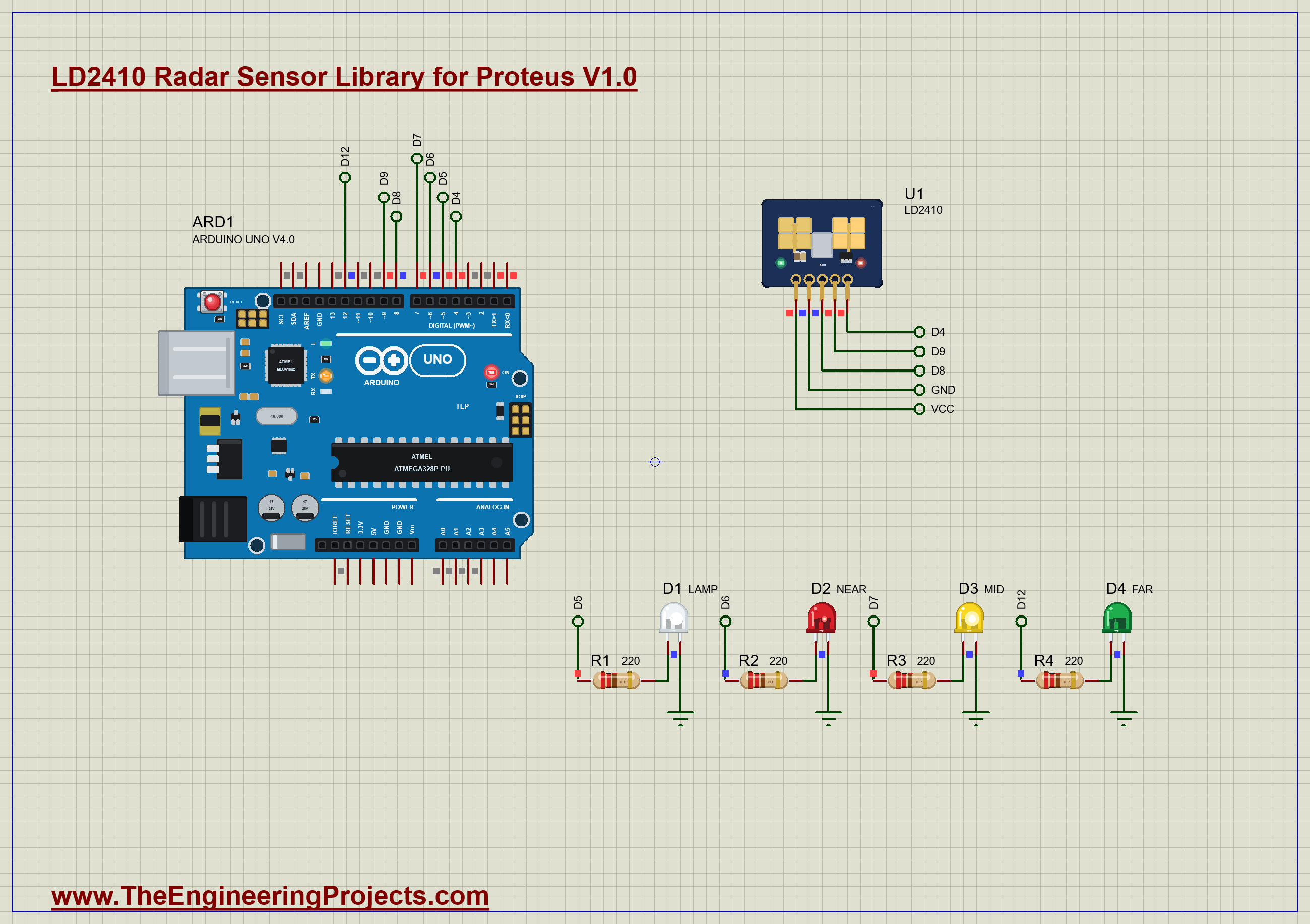
  ARD1:   Arduino UNO V4.0 running LD2410_Demo.hex, its serial monitor built in (window "TEP Arduino
  UNO - ARD1").
  U1:     the LD2410 module: PROFILE ROOM (empty, someone walks in from 6 m at 3 s, sits still at 2
  m from 8 s, walks out at
          18 s), BAUD 9600 (the factory's 256000 is too fast for a software UART - set the module
          once with 0x00A1);
          VCC on VCC, GND, TX on D8, RX on D9 (AltSoftSerial), OUT on D4.
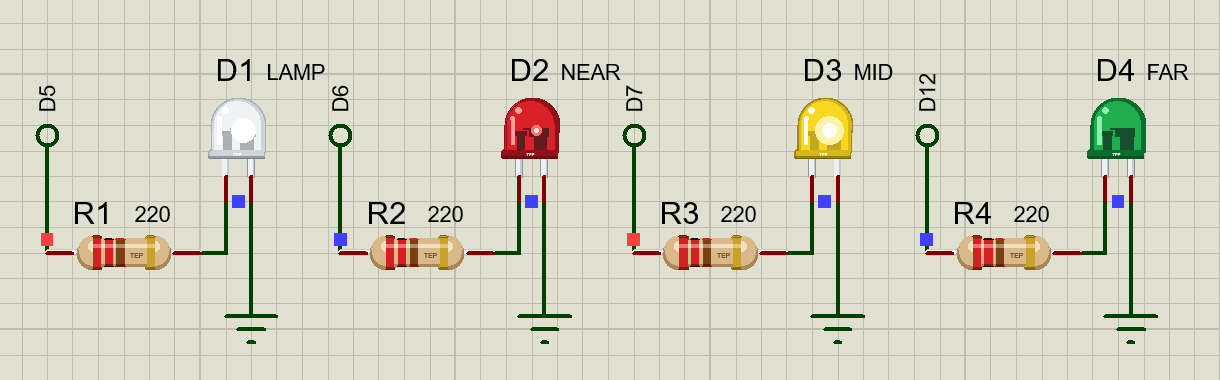
  D1-D4:  our 5 mm LEDs, each through 220 ohm: LAMP white (D5), NEAR red (D6), MID yellow (D7), FAR
  green (D12).
          The sketch enables configuration, reads the firmware version, sets max gates 8 / 8 and an
          unmanned duration of 3 s,
          ends configuration and then reads the reports. The lamp follows OUT; the zone LEDs follow
          the detection distance
          (under 1.5 m, under 3 m, beyond). To rebuild the sketch, install AltSoftSerial (Arduino
          Library Manager).
Closed the monitor? Click the UNO's USB port.

WIRING (the same in Proteus and on a real board)
  VCC to 5 V, GND to ground, TX to a UART input (D8 here, AltSoftSerial), RX to a UART output (D9),
  OUT to any input (D4). The
  radar's UART is 3.3 V: a 5 V board should drive RX through a divider (1 k / 2 k).
REAL HARDWARE:
 * The factory baud rate is 256000: use a hardware UART (a Mega, an ESP32) or set the radar once to
   9600 for an UNO.
 * Mount it upright, facing the room, away from fans and curtains that move - they are "people" to a
   radar.
 * Tune the gates: lower the sensitivity of gates where something moves that is not a person, raise
   it where people sit.
 * The radar sees through thin plastic and wood, not through metal.

THE DEMO SKETCH ON THE SERIAL MONITOR (LD2410_Demo V1.0, 9600 baud)
The sketch prints each change of the target and every 2 s while someone is there. EXPECTED MONITOR
OUTPUT
  LD2410 presence lamp - The Engineering Projects
  Configuration on: protocol 1, buffer 64
  Firmware V2.04.23022511
  Max gates 8 / 8, unmanned duration 3 s
  Configuration off - reading the reports
  t=.. s  MOVING  ... cm  moving ..  -> FAR

PROPERTIES (double-click the part > Edit Properties)
  The room (PROFILE)                    ROOM (someone walks in, sits still, walks out) or STEADY
  (the state below; the chips) (ROOM)
  The baud rate (BAUD)                  9600 - 460800; the factory's 256000 (256000)
  STEADY: the state (STATE)             NONE, MOVING or STILL (NONE)
  STEADY: the distance (DISTANCE)       0.3 - 6 m (2)
Every run starts again from the properties.

LINKS.INI (OPTIONAL)
The Help page cards of the pop-up open web pages. To point them somewhere else without a new DLL,
put a text file named links.ini next to TEPLD2410.DLL with lines KEY=URL, for example:
  ARTICLE=https://www.theengineeringprojects.com/...
Keys: WEBSITE, FORUM, BUG_REPORT, FEATURE_REQUEST, ARTICLE, USER_GUIDE,
UPDATE_CHECK, DONATE. Only http:// and https:// links are used; lines starting
with # are comments.

TROUBLESHOOTING
* No reports: the baud rate differs (BAUD), TX / RX are swapped, or configuration is still enabled
  (send 0x00FE).
* Nothing received on an UNO in Proteus: SoftwareSerial cannot receive there (no pin-change
  interrupts) - use
  AltSoftSerial (RX D8, TX D9) as the demo does, or a hardware UART.
* No ACK: send 0x00FF (value 0x0001) first - the radar refuses other commands without it.
* A still person is lost: raise the stationary sensitivity of that gate (a lower threshold), or the
  max stationary gate.
* OUT stays high after the person left: that is the unmanned duration - 0x0060 sets it.
* The part is not simulated: TEPLD2410.DLL is missing from MODELS and from the project folder.
* The part is not simulated: TEPLD2410.DLL is missing from MODELS and from the project folder. No
  UNO / no monitor window: TEPARDUINO.DLL is missing, or click the UNO's USB port.

BUG REPORTS AND FEATURE REQUESTS
Please post them in our forum with a screenshot, the Serial Monitor text, the
simulation log and the pop-up's Copy diagnostics text:
  https://www.theengineeringprojects.com/forum/category/pir-sensor-proteus-library

SUPPORT US
This library is free. If it saves you time, please support our work:
  https://www.theengineeringprojects.com/donate

WEBSITE
  https://www.theengineeringprojects.com/

LICENCES AND THIRD-PARTY NOTES
* The model (TEPLD2410.DLL), the symbols and artwork, the other parts of ours in the demo and the
  Arduino Library V4.0 (ArduinoV4TEP.LIB / TEPARDUINO.DLL, with its built-in TEP Serial Monitor
  Advance) are made by The Engineering Projects. The models use only standard Windows libraries; no
  Visual C++ redistributable is needed.
  The C++ source code is not included.
* Arduino UNO V4.0 (ArduinoV4TEP.LIB / TEPARDUINO.DLL, our Arduino Library V4.0 - its
  microcontroller is Proteus's own AVR model): The Engineering Projects,
  https://www.theengineeringprojects.com/2026/10/arduino-uno-library-for-proteus-v40.html
* The .hex file is built from the demo sketch and the Arduino AVR core 1.8.6, which includes
  LGPL-licensed code; its source code is available at
  https://github.com/arduino/ArduinoCore-avr/tree/1.8.6
* Proteus is a product of Labcenter Electronics and is not included. Arduino is a trademark of Arduino SA.
  This library is not made or endorsed by Arduino or Labcenter.

REBUILDING THE FIRMWARE (OPTIONAL)
The HEX file is supplied; Arduino IDE is not needed to run the demo. To edit the sketch, open
Arduino Code\LD2410_Demo\LD2410_Demo.ino, select Arduino Uno and use Sketch > Export Compiled
Binary. Replace the simulation's .hex with the exported HEX. The sketch needs 8,148 bytes of flash
and 612 bytes of RAM.

MODEL SCOPE AND LIMITS
Modelled: the UART at the set baud rate; the basic and engineering report frames every 100 ms; the
command frames and their
ACKs (configuration, max gates and the unmanned duration, the parameters, engineering mode, gate
sensitivity, the firmware version,
the baud rate after a restart, factory reset, restart) and no reports during configuration; the
gates and their default
sensitivities; the target state with the hold, OUT; the supply current; the room scene (PROFILE, the
chips). Our choices: the
energies a person gives (falling with the distance; a still person by breathing), the noise, the
report interval, the firmware
number. Not modelled: the angle of the beam, several people at once, the light sensor and the
Bluetooth of later versions.

VERSION
TEP LD2410 Radar Sensor library V1.0 (Nov 2026). Device LD2410TEP (TEPLD2410.LIB / TEPLD2410.DLL).
Demo sketch LD2410_Demo V1.0 (AltSoftSerial at 9600, the maker's frames parsed by hand). The demo
also uses our 5 mm LED (TEPLED5MM) and Resistor (TEPRESISTOR) libraries, shipped in this package.
Demo board: ARDUINO UNO V4.0 (TEP Arduino Library V4.0) with its built-in serial monitor.Development1 release
 Development1 release
-
V1.0LD2410 Radar Sensor Library for Proteus V1.0this page
V1.0 is the only release in the Download Center so far. When a newer version is published, it appears above with its own download page.
Installation8 steps
 Installation8 steps
From the download to a working project, in order. The steps follow what the package contains.
You will need
- Proteus Design SuiteProteus 8 or newer (Labcenter), on Windows
- Arduino IDE1.8 or 2.x, with the board of the tutorial chosen under Tools → Board
- Any archive toolWindows, macOS and Linux extract ZIP files on their own
Steps
- 1
Extract the archive
Right-click fd3e30ec12894d418c7486c8f390d55f.zip and choose Extract All (or open it with 7-Zip or WinRAR) into a folder you can find again. Keep its folder structure (LD2410-Radar-Sensor-TEP-v1.0) as it is.
- 2
Copy the library files into Proteus
Move ArduinoV4TEP.LIB, TEPLD2410.LIB and TEPLED5MM.LIB and 1 more and the files into the LIBRARY folder of your Proteus installation: C:\Program Files (x86)\Labcenter Electronics\Proteus 8 Professional\LIBRARY for Proteus 8, or the matching Proteus 7 folder. Older versions keep it under ProgramData\Labcenter Electronics. If Proteus is open, close it first.
- 3
Add the simulation model
Copy TEPARDUINO.DLL, TEPLD2410.DLL and TEPLED5MM.DLL and 1 more into the MODELS folder next to LIBRARY, so the component can run, not only be drawn.
- 4
Restart Proteus and place the component
Start Proteus, open a schematic, press P (Pick Devices) and search for the component by the name used in the tutorial. It appears with its pins ready to wire.
- 5
Open the sketch in the Arduino IDE
Open LD2410_Demo.ino, select your board and port under Tools, then Verify. Sketch → Export Compiled Binary writes the HEX file a simulation needs.
- 6
Load the HEX file
In Proteus double-click the microcontroller, set Program File to LD2410_Demo.hex and run the simulation. For real hardware, flash the same file with your programmer.
- 7
Open the example simulation
Open LD2410-Radar-ArduinoUnoV4.pdsprj in Proteus to see the wiring exactly as in the tutorial. Check the controller's Program File path, then press Play.
- 8
Follow the tutorial
LD2410 Radar Sensor Library for Proteus Simulation explains every connection and setting in order; keep it open beside the files while you build.
FAQs9 questionsContact TEP
 FAQs9 questions
How do I download LD2410 Radar Sensor Library for Proteus V1.0?
Wait for the 30-second guest countdown on this page, then press the download button; the file comes straight from our storage. Members who are logged in skip the wait. If the browser opens the file instead of saving it, use its Save as option. The download link is made for you when the countdown ends and works for 15 minutes; a saved or shared link stops working, so share this page instead.
What is inside the archive?
LD2410 Radar Sensor Library for Proteus V1.0 comes as a ZIP archive of 16 files (1.8 MB, 4.1 MB unpacked) holding Proteus library files, simulation model DLLs, a Proteus simulation, an Arduino sketch and compiled HEX firmware. Open the File Structure tab for the full list of 16 files.
What should I do if the download does not start?
Check the browser's download list first; an ad blocker or a company firewall can also hold it back, so try another browser or network. If the file arrives incomplete, download it again. For an installation problem, read the Install tab or tell us in the comments with your software version and the exact error message.
Is this file free?
Yes. Every file in the TEP Download Center is free for learning, personal and student projects. If you share it, link back to this page or the tutorial so others find the latest version.
How do I check that the file arrived complete?
Compare its SHA-256 with the one on this page, 54b49d628f98df35ed8121623cf8081c61193f98488ed252f800b46ddea422b2. In PowerShell run Get-FileHash "fd3e30ec12894d418c7486c8f390d55f.zip"; on macOS or Linux run shasum -a 256 "fd3e30ec12894d418c7486c8f390d55f.zip". The same value means the file is exactly the one in our storage; a different one means the download broke off, so download it again.
Do I need WinRAR to open the ZIP file?
No. Windows, macOS and Linux open ZIP archives on their own (Extract All, or double-click). WinRAR and 7-Zip work too. Extract the whole archive before using the files.
Where do I put the LIB and IDX files?
Both files go into the LIBRARY folder of your Proteus installation (Proteus 8: C:\Program Files (x86)\Labcenter Electronics\Proteus 8 Professional\LIBRARY; Proteus 7 has the same folder under its own name). Restart Proteus afterwards and search for the component with P.
Which Proteus version does the library need?
The tutorial names the Proteus version the library was made and tested with. Most TEP libraries work in Proteus 7 and Proteus 8; if the component does not appear after a restart, check that both the LIB and the IDX file were copied and that Proteus was fully closed while copying.
How do I get the HEX file into the simulation?
Compile the sketch in the Arduino IDE (Sketch → Export Compiled Binary gives you the HEX next to the sketch), then in Proteus double-click the board, set Program File to that HEX and run.
Members skip the wait. Log in or join TEP.

- 0Total downloads
- 4%Popularity
- ProteusCategory
- 0Comments
- ssyedzainnasirUploaded by
- 25 Nov 2026Uploaded at


 SHA-256
54b49d628f98df35ed8121623cf8081c61193f98488ed252f800b46ddea422b2


 Need help with this file?
 Tags
Related Proteus
All Proteus tutorials





Comments
0