Hello friends, I hope you all are doing great. In today's tutorial, we are gonna have a look at detailed Introduction to 74ls04. 74LS04is a participant of 74XXYY integrated sequence. The seventy-four sequences are numerical logic incorporated circuitries. This integrated circuit consists of 6 not gates. These gats do the function of reversing of different functions. To the existence of six gates, it also is known as hex inverter.
This integrated circuit is offered in numerous suites. You can select a suitable suite dependent on conditions. This module has fourteen pinouts which perform different functions. It is used in different memory units. In today’s post, we will have a look at its protection, wreck, oddness, privileges, etc. I will also shar ...
Hello friends,hope you are fine and enjoying your lives. In today's tutorial, we will know How to Upload Bootloader in Atmega328 using Arduino UNO, which is quite simple and easy and a basic level tutorial. We all know that, Arduino UNO uses Atmega328 as a microcontroller and have you ever thought of using ATmega328 alone instead of using complete Arduino UNO. If you haven't thought yet then think now :) Yes we can use Atmega328 alone instead of using it as a whole with Arduino board. But that's not the topic of today's tutorial and I am gonna cover it soon that How can we use Atmega328 alone.
So now the questions arises that what we are gonna do with the rest of the Arduino board? As we have taken the Atmega328 out of it now there's no use of res ...
Hello friends, I hope you all are doing great. In today's tutorial, we are gonna have a look at detailed Introduction to TIP31. The TIP31 is a typical NPN transistor which is frequently cast-off for intermediate power submissions. This (BJT) is a three (3) points expedient which works for intensification or swapping submissions. It is designed by linking three units of semiconductors with alternatively dissimilar doping. The central unit which is (base) is thin and the other two external areas (emitter and collector) are greatly doped.
Some transistors can intensify a minor current which will then be dominant sufficient to work a spotlight or other higher current expedients. These diplomacies are also capable to notice an alteration in voltage an ...
Hi learner! I hope you are doing great. Today, I am sharing version 3.0 of the PIR sensor library for Proteus. We have already shared V1.0 and V2.0 of the PIR Sensor Library. PIR Sensor V1.0 Library for Proteus adds a digital PIR Sensor in Proteus, while the PIR Sensor V2.0 Library adds an analog PIR Sensor to simulate. These libraries were loved by the users and this motivated us to work more on it. PIR V3.0 is analog in nature, has an error-free structure and the Pinout structure is better organized. Moreover, the design is improved a little bit and we have omitted the website link from the sensor to make it look professional.
Same as the previous version, this PIR has four pins and the details of each of them will be discussed in detail later. Therefore, don’t worry if you have no expe ...
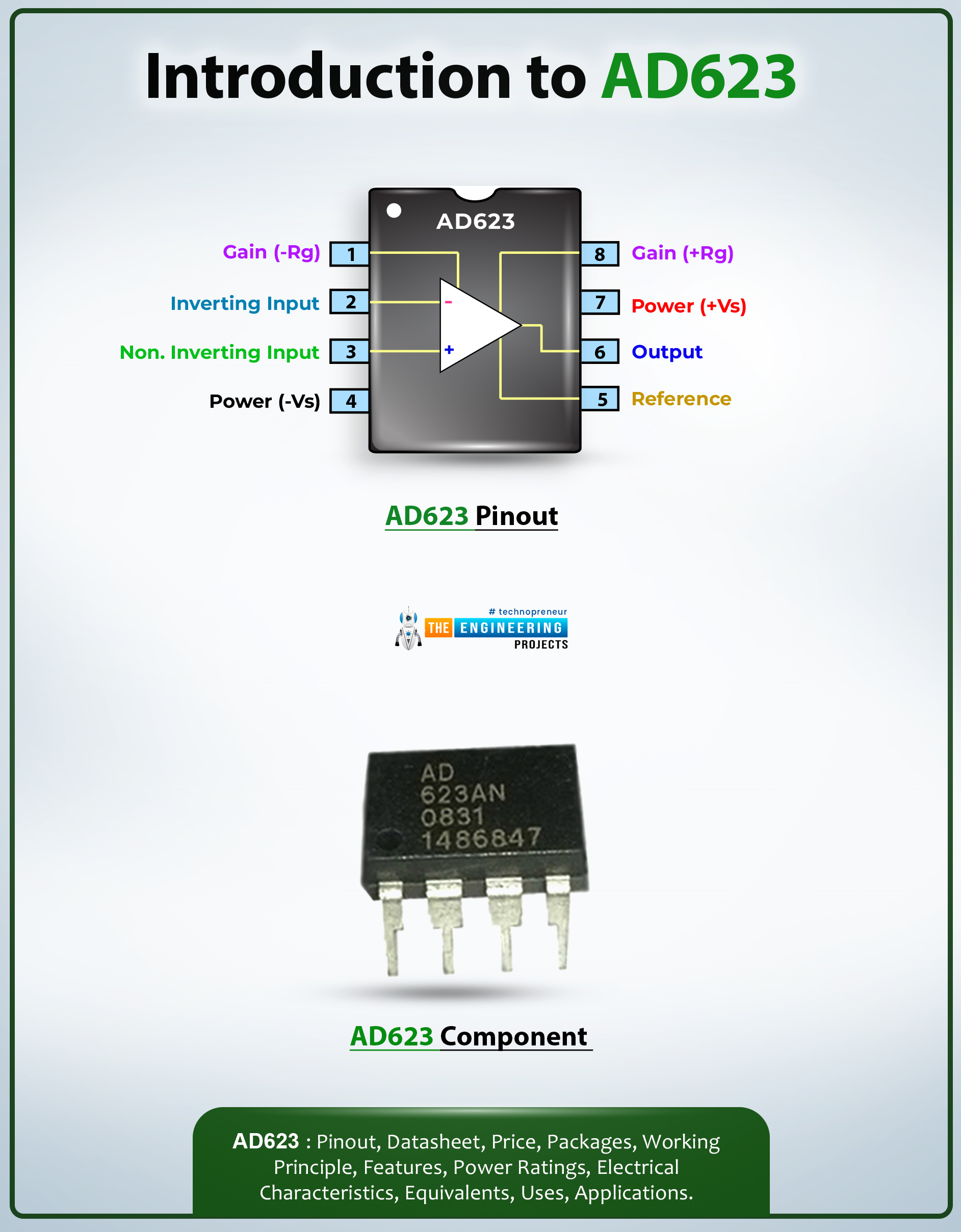
Hi Friends! I welcome you on board. Happy to see you around. In this post today, I’ll walk you through the Introduction to AD623.The AD623 is an instrumentation amplifier integrated with a rail-to-rail feature. It is mainly used in battery-operated applications due to the low current of 500uA.
It features a bandwidth of around 800 kHz which doesn’t require impedance matching since it incorporates buffer amplifiers that are attached to their input pins.
I suggest you buckle up as I’ll detail the complete Introduction to AD623 featuring datasheet, pinout, features, equivalents, and applications.
Let’s jump right in.
Introduction to AD623
The AD623 is an instrumentation amplifier that falls under the category of differential amplifiers that incorporate buffer amplifiers attache ...
Hi Guys! Hope you’re well today. I welcome you on board. In this post today, I’ll walk you through the Introduction to Arduino Nano 33 BLE.
Arduino Nano 33 BLE is an advanced version of Arduino Nano board that is based on a robust and powerful processor the nRF52840 from Nordic Semiconductors, a 32-bit ARM® Cortex™-M4 CPU. It comes with a crystal oscillator frequency of around 64MHz. It features 32 times bigger program memory than the Arduino Uno board, helping you store programs with much larger memory. With this device, you can produce a lot more variable as it comes with RAM that is 128 times bigger than the RAM of Arduino Uno.
Before you move further, I recommend you read this article on the Introduction to Arduino Nano which we have publish ...
Hello friends, I hope you all are fine and having fun with your lives. Today, I am going to share a new Home Automation Project using XBee & Arduino. Home Automation Project is a most commonly designed project by the engineering students. So, that's why I have thought to create a complete Home Automation Project so that engineering students can get benefit out of it.
We all know about automation which is originated from automate or automatic. In automation the task is done automatically and you don't need to control it. In normal Home automation project, there are few sensors which are displayed wirelessly to user and there are few controls like user can ON or OFF Lights, Fans etc via remote or mobile App.
In this Project, I have used Arduino ...
Yesterday, I have posted a new Arduino Lilypad / Nano Library for Proteus in which we have seen how to add that library into Proteus so that you could be able to use these boards in Proteus. That was quite easy. Today I am gonna post a small project in which we will see how to use that library and produce an Arduino Lilypad simulation in Proteus. In this Arduino Lilypad simulation in Proteus, I am gonna use obviously he Arduino Lilypad board along with few LED lightsand will make them blink. Its also quite easy and you can also download the simulation and the hex file at the end of this project but I would suggest you to do it yourself so that you learn something out of it.
Before starting this project, you must have first integrated the Arduino L ...
Hello everyone! I hope you all will be absolutely fine and having fun. Today, I am going to give a detailed discussion on Introduction to LF411. LF-411 is a Junction Field Effect Transistor (JFET) input Operational Amplifier (Op-amp). It is the most common module available in the market these days due to its cost efficiency. LF 411 has low input offset voltage. Input offset voltage drift is guaranteed for LF-411. A very low supply current is needed for this device. It provides higher slew rates as well as high gain bandwidth product.
Moreover, LF411 also provides lower input bias current as well as lower input offset currents. It is an 8 pin operational amplifier. The details about its pins will be discussed later. Due to its low cost and high ...
Hey Fellas! I hope you are doing great and getting most out of your lives. Today, I am going to uncover the details on the Introduction to 2n5401. It is a PNP(positive-negative-positive) bipolar junction transistor which comes in TO-92 casing. It consists of N doped semiconductor that exists between the two layers of P doped material. It is useful for the applications where regulated negative voltage is required at a modest current level. I'll give you brief details about this amplifier transistor. Let's get started.
Introduction to 2n5401
2n5401 is a PNP bipolar junction transistor, also known as amplifier transistor, that comes with collector-emitter voltage of 150V and mostly used for amplification purpose.
In order to operate this transis ...