Hi Everyone! I hope you are doing great and enjoying your life. I am back to give you daily dose of information so you can grow and progress in your relevant field. Today, I am going to give you the details on the Introduction to 2n4403. It is basically PNP(Positive-negative-Positive) bipolar junction transistor where N doped layer is sandwiched between the two P doped layers. It comes in plastic TO-92 compact casing. I'll try to give you brief details about this transistor so you don't need to go anywhere for finding the information regarding this transistor. Let's get started.
Introduction to 2n4403
2n4403 is a PNP bipolar junction transistor where conduction is carried out by the movement of holes and electrons but majority charge carriers w ...
Hello friends, i hope you all are fine and enjoying in life. On a friends request, today i am going to share a new tutorial which is 'Getting Started with Arduino Software'. Previously i have uploaded a large no of project tutorials made on 555 timers and some MATLAB based Simulations. Now we are going to touch the next level and from now on we will work on mostly projects containing Arduino microcontroller.
To get started with Arduino microcontroller, we first need to learn the operating software of Arduino microcontroller. This tutorial is very informative and i will be using Arduino software 1.0.5. It is a very basic level software and very easy to learn. IF you have already worked on Arduino software then you don't need to go through it. This ...
Hello everyone! I hope you all will be absolutely fine and having fun. Today, I am going to share my knowledge about Introduction to LM380. LM-380 is an audio amplifier, specially designed for the customer's power audio amplification purposes. Its designers fix its gain internally up to 34dB. In LM 380, ground reference signal is allowed by a unique input stage and the output automatically maintains its level to half of the supplied input voltage.
LM-380 has a copper lead frame. The three pins in the middle of the IC on both side, are basically the ground pins. These three pins on both sides makes it easy for the user to use this device for standard PC's. LM 380 has several different features e.g. wide supply voltage range, high peak current, lo ...
In today's tutorial, we are going to see how to install Arduino driver in Windows. In the previous post, we have seen what is Arduino? and why is it so popular and whats its use? Now, afer getting the basic knowledge of Arduino, the next step you need to do is to install Arduino driver in your computer so that it got recognized by your computer as Arduino. If you don't install the Arduino driver in Wndows then you won't be able to program Arduino using Arduino software.
tis tutorial is quite basic and is for the newcomers, who wants to start working on the Arduino software, if you have already run some codes on your Arduino then its not for you. You can skip it. Anyways, It's quite easy and it won't take much time. So let's get started with it.
I ...
Hi Everyone! I welcome you on board. Thank you for clicking this read. In this post today, I’ll walk you through the Introduction to LM2576.LM2576 is a step-down voltage regulator, also known as a buck converter, mainly employed as a pre-regulator in linear regulators. The customized output version of this buck converter gives you the ability to set the output voltage as you like better. It is available with a remarkably good load and line regulation. Moreover, it is used to drive load under 1A and is available in fixed output voltages with 3.3V, 5V, 12V, and 15V.
I suggest you buckle up and read this post all the way through, as in this post I’ll detail the Introduction to LM2576 covering the datasheet, pinout, features, and applications. Let’s jump right in.
Introduction to LM2576
...
Hello friends, I hope you all are doing great. In today's tutorial, we are gonna have a look at detailed Introduction to TIP121. The TIP121 is an NPN Darlington pair transistor. It exists in a TO-220 casing and creates for normal amplification and less moving speed switching submissions. Like other transistors, it has three pinouts emitter, base, and collector. The central part this transistor which is known as the base is thinner in size and other two emitters and collector has larger areas.
Transistors are playing an important rule in our electronic circuits and industries. Every electronic device like mobile, radio, LCD, etc all these have different types of transistors. Like other transistors, TIP121 is performing an important rule in electron ...
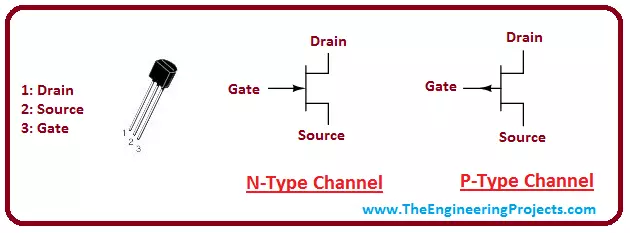
Hello Guys! I hope you are doing great and having fun. I am back to give you a daily dose of knowledge that will enhance your learning skills and put you ahead of others. Today, I am going to give you details on the Introduction to JFET. It is a Junction Field Effect Transistor that consists of three terminals named drain, source and gate. It comes in two configurations called the P-Type channel and the N-Type channel. I'll give you brief details on JFET and try to cover as many aspects as possible. Let's get started:
Introduction to JFET
JFET (Junction Field Effect Transistor) is a uni-polar voltage-controlled device that consists of three terminals called drain, source and gate.
Unlike bipolar junction transistors which are bipolar current-controlled devices in which a small amo ...
I hope you all are doing great. In today's tutorial, we are gonna have a look at detailed Introduction to ESP-01. ESP-01 is an inexpensive, small-sized WiFi module, which consists of TCP/IP stack along with a built-in microcontroller. So, we can directly program this small chip and can bring WiFi capability in our Embedded projects. When first time this ship came into the market in August 2014, it got a lot of attention by users. The main reason for it to seek attention is that this module allows the microcontroller to connect with a WiFi available (and programmed to connect) and it follows Hayes Style Commands and develops a TCP/IP network.
ESP-01 chip integrates an antenna, RF balun, power amplifier, filters, and power arrangement module. ESP-01 is used in industry and many projects a ...
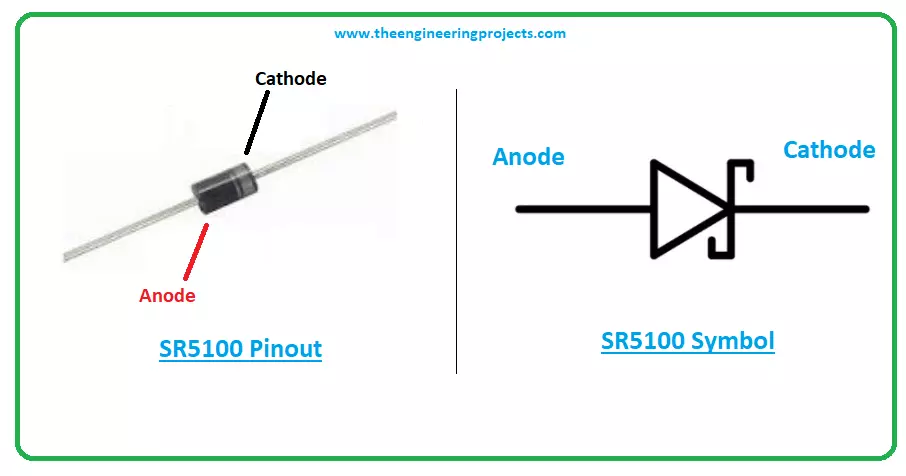
Hi Friends! Hope you’re well today. I welcome you on board. Happy to see you around. In this post today, I’ll walk you through the Introduction to SR5100.
The SR5100 is a Schottky diode used to generate extremely fast switching. It is also called a hot-carrier diode and is protected against overvoltage. It comes with a high surge current capability and low forward drop voltage. It contains a forward rectified current around 5 A and terminal resistance around 28 C/W. It is available in epitaxial construction with a peak reverse voltage of around 100 V.
You are most welcome to see the Introduction to 1n4744 and Introduction to 1n4742 that I have uploaded recently.
Read this post all the way through as I’ll detail the datasheet, pinout, features, ...
Hello everyone! I hope you all will be absolutely fine and having fun. Today, I am going to provide a detailed discussion on Flame Sensor Arduino Interfacing. Flame sensor is an electronic device which is capable of sensing/detection of fire or a high temperature zone. It gives an indication through an LED attached at its top, just after sensing the fire. These type of sensors are usually used for short ranges. They are able to detect the fire up to 3 feet. Flame sensors is the most common device available in the market these days due to its good results and cost efficiency. You should also have a look at Flame Sensor Library for Proteus.
Flame sensors are available in the market in two types one having three pins and the other having four pins ...