Hello friends, hope you all are fine and having fun with your lives. Today I am going to share a problem and also its solution with you guys. A few days ago, I bought new NRF24L01 modules as they were needed for a project. So, today when I started working on them, I encountered a very strange problem. When I interfaced my NRF24L01 with Arduino and uploaded the transmitting and receving codes in them, I couldn't get anything on my serial terminal as I explained in my previous post Interfacing of NRF24L01 with Arduino. That was quite strange for me as I have worked on this module many times and it never troubled me before. So I keep on working on it but no luck. I even changed my RF modules as I thought may be they are faulty modules but still no lu ...
Hello friends, I hope you all are fine and having fun with your lives. Today, I am going to share a very basic and introductory tutorial named How to use Arduino Serial Read. I am sharing this tutorial because I am getting a lot of emails in which users normally ask about basic Arduino tutorials as they are very new to them. So, I thought of sharing this very basic Arduino tutorial in which we are going to have a look at how we can use the Arduino Serial Read command.
I selected this tutorial as my first tutorial in this list of Arduino basic tutorials because learning to use Serial port is very necessary as it's one of the best troubleshooting tools for your code. I have also given a Proteus Simulation in which I have received the incoming data f ...
Hello Everyone! Hope you’re well today. In today's tutorial, we will have a look at D13005K NPN Transistor. We will also study D13005K Datasheet, Pinout, Power Ratings, Equivalents & Applications. As its an NPN transistor, so major charge carriers are electrons. D13005K is mainly employed for switching and amplification purpose.
Let's first recall NPN transistors: NPN transistor consists of 3 terminal, named as:
Emitter.
Collector.
Base.
If we provide voltage > 0.7V at base terminal, NPN transistor gets forward biased & starts conducting. If Base voltage D13005K NPN Transistor:
D13005K NPN Transistor
D13005K is a bipolar NPN transistor, mainly used for amplification and switching purposes.
It contains three layers where two n-doped layers surround one p-doped la ...
Hello everyone! I hope you all will be absolutely fine and having fun. Today, I am going to give you a detailed Introduction to ATmega328. ATmega328 is an Advanced Virtual RISC (AVR) microcontroller. It supports 8-bit data processing. ATmega-328 has 32KB internal flash memory.
ATmega328 has 1KB Electrically Erasable Programmable Read-Only Memory (EEPROM). This property shows if the electric supply supplied to the micro-controller is removed, even then it can store the data and can provide results after providing it with the electric supply. Moreover, ATmega-328 has 2KB Static Random Access Memory (SRAM). Other characteristics will be explained later. ATmega 328 has several different features which make it the most popular device in today's market. ...
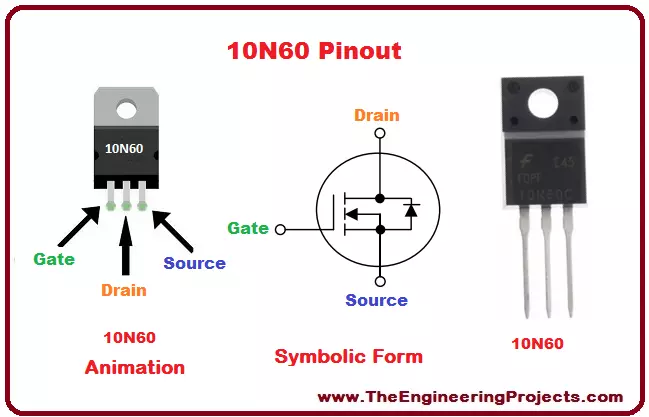
Hello everyone! I hope you all will be absolutely fine and having fun. Today, I am going to provide you a detailed discussion on Introduction to 10N60. Before going into the details of this article you should also have a look at Introduction to 4N60, 78M05, 2N3772, 2SC3320, 20N60. It is basically a high voltage Metal Oxide Semiconductor Field Effect Transistor (MOSFET). It is a power MOSFET and is able to control the certain level of the power. 10-N-60 is also a high current power MOSFET. This device has three terminals and is made up of silicon. It has around 10 ampere of current conduction capability i.e. this device is able to conduct 10A of current through it. 10-N-60 has a lot of amazing features.
It features include low on-state resistance ...
Hello friends, today I am posting a very basic tutorial on what is Arduino ??? In this tutorial I am gonna explain the basics of Arduino for the beginners. I am writing this tutorial because I got a lot of requests from the engineers in which they ask questions like what is Arduino ? What's the difference between Arduino and PIC? How to use Arduino? etc etc. So I thought of writing this topic. It's a very basic tutorial so if you are already familiar with this board and know the answer of this simple question What is Arduino ??? then you can skip this tutorial but again you must read it once, may be you get something out of it. :)
I have posted a tutorial on Arduino Projects, in which I gave all the links of Arduino projects and tutorials posted o ...
Hey Everyone! I hope you are doing great and having fun with your lives. I am back to give you a daily dose of information so you can grow and progress in your relevant field. Today, I am going to uncover the details on the Introduction to 2n4401. It is an NPN (negative-positive-negative) bipolar junction transistor (BJT) which is used for general purpose amplification and switching purpose. It consists of P doped semiconductor that exists between the two layers of N doped material.
I'll give you a brief detail about this transistor so you don't have to go anywhere for finding the information regarding this transistor. You can also check the Introduction to 2n4402 which is a complementary PNP transistor of this NPN transistor. Let's get started.
...
Hello friends! I hope you all will be absolutely fine and having fun. Today, I am going to give you an elaboration on Introduction to 2N3772. I have already shared basic knowledge about different IC's and transistors in my previous tutorials e.g. Introduction to IRF540, BC547, MMBD914, LM339, LM224 and LM386. You must have alook at these tutorials before going into the details of this tutorials. It will be quite helpful in the better understanding of this article. 2N-3772 is basically a type of central semiconductor. It is basically a Negative Positive Negative (NPN) semiconductor. This semiconductor is designed by the process named as epitiaxial process. The main purpose behind its designing is to provide the high power based amplification proce ...
Hello everyone! I hope you all will be absolutely fine and having fun. Today, I am going to give you an elaboration about Introduction to Pixy Camera. It is basically is an electronic device or sensor having fast vision. It is also known as fast vision sensor most of the time. Using this device we can teach to find objects in a very less time duration. It is an image sensor having a very powerful processor. Pixy is easy to interface with the micro-controllers e.g. Arduino. We can make different programs only to send the desired data from the device to micro-controller. In this way micro-controller can not overwhelm.
Pixy camera is able to communicate with the micro-controller in several different ways e.g. serial communication, I2C protocol, dig ...
Hello friends! I hope you will be absolutely fine and having fun. Today, I will give you an elaboration on Introduction to SG3524. I have already shared articles on Introduction to 74HC245, 74HC595, CD4051, L293D, L298, LF351 and LF411. You should also go through all of these tutorials in order to have a better understanding. SG 3524 consists of all the important functions necessary to design inverters.
Moreover, using SG-3524 we can also design regulation power supplies as well as switching regulators. This all design is based on a single chip. High power applications can also be controlled through this device. SG-3524 is especially designed for voltage doublers without transformers, transformer coupled DC to DC converters. Their design was als ...