Hello friends, I hope you all are doing great. Today, I am going to share the new MCP3008 8-Channel ADC Library for Proteus , the second of the lab ICs in our University Lab series. An ADC, an analog-to-digital converter, turns a voltage into a number. The MCP3008 does it for eight inputs at once, with 10 bits, over a four-wire SPI bus, and it is the standard way to give a board without analog inputs, such as the Raspberry Pi, its analog pins, or to give an Arduino more of them. Students meet it in sensor labs, data loggers, joystick and potentiometer projects, and in every course that teaches how SPI works. Updates MCP3008 8-Channel ADC Library for Proteus Latest version: V1.0 (November 2026, this tutorial) Other component libraries: C945 Transistor · PC817 Optocoupler · Relay Module · Re ...
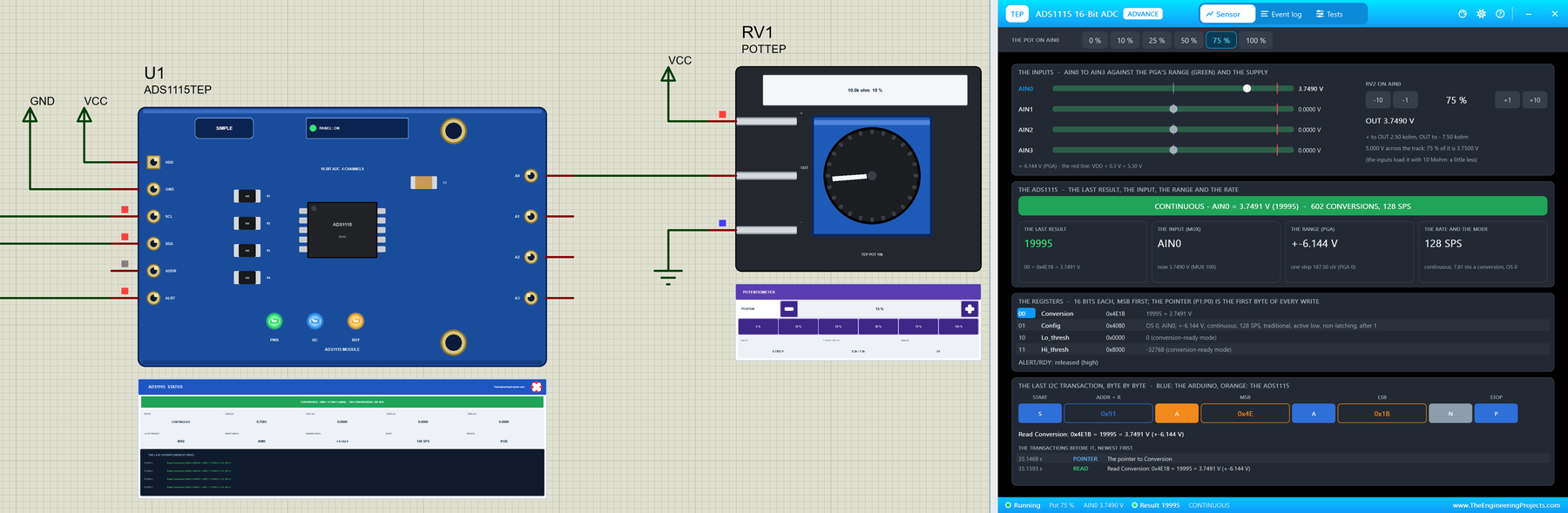
Hello friends, I hope you all are doing great. Today, I am going to share the new ADS1115 ADC Library for Proteus V1.0 . The ADS1115 is the 16-bit analog-to-digital converter that Arduino makers add when the UNO's own 10-bit ADC is not enough: four inputs, a programmable gain amplifier that can read a few millivolts, and an I2C bus. It sits in weighing scales, battery testers, soil and gas sensor boards, heart-rate monitors and data loggers. Now you can build and test those projects in Proteus, with the blue ADS1115 module and a 10 kohm potentiometer to turn. Updates ADS1115 ADC Library for Proteus Latest version: V1.0 (October 2026, this tutorial) Other measurement modules: INA219 · Current Sensor WCS1600 · HX711 Load Cell Helping Tools Serial Monitor Advance : a serial terminal window fo ...
An A nalog to D igital C onverter ( ADC ) converts a continuous signal (usually a voltage) into a series of discrete values ??(sequences of bits). The main features are: Resolution (in analog terms): It is the minimum variation of the analog input voltage that can determine the variation of the LSB, that is of the least significant bit of the output code. Since the quantization step Q corresponds to the LSB, it can be said that the resolution coincides with the quantization step Q (and therefore is measured in Volts). We can say that the quantization step Q corresponds to the LSB because two contiguous quantization bands, each of amplitude Q, are identified by codes that differ only for the least significant bit. Resolution (in digital terms): It is the number n of bits present at the conv ...