Hey Learners! I welcome you on the behalf of The Engineering Projects. I hope you are doing Great. If you are seeking for the best information about the T Flip Flop along with some small concepts and the Practical Performance, then you are at the right article. In this session you will get the following topics: What are T Flip Flops? What are the Functions of Preset and Clear Input in T Flip Flop? How can we Design the Truth Table of T Flip Flop? How can you perform the T Flip Flop simulation in very simple and useful way? Moreover, you will also get some pieces of information in DID YOU KNOW sections. so without wasting time, lets Jump into the answer of 1st Question. T Flip Flop T Flip Flop belongs to the family of Flip Flops and Latches and we define the T Flip Flop as: " T Flip Flops a ...
Hey Mentees! Welcome from the team of The Engineering Projects. We hope You are having a reproductive day. To add more reproduction, let's learn another Logical Circuit from scratch. In this Tutorial, we'll grasp the following topics: What are D-Type Flip Flop? Which is the IC of D Flip Flop in Proteus ISIS? How is the working of D Flip Flop? How can we design the Truth Table of D Flip Flop? How can we Perform the formation of D Flip Flops in Proteus ISIS? Moreover, we'll have small chunks of information in DID YOU KNOW Sections. At this instance, Let's start the learning. D-Type Flip Flops D-Type Flip Flops are important Logical Circuits and we Introduce it as: "The D-Type Flip Flop is a type of Flip Flop that captures the value of D input for a specific time of the Clock edge and show th ...
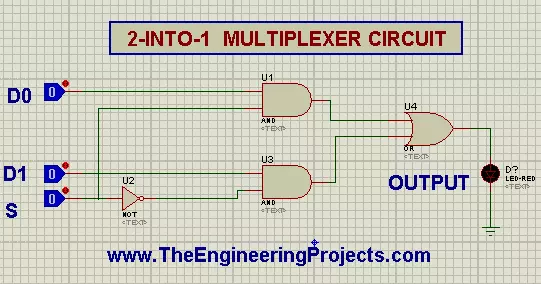
Hi Mentees! I welcome you on behalf of The Engineering Projects . In this section of this DLD Logic gates series, we are discussing different applications of logic gates. We have discussed DLD Adders and Subtractors in our previous lectures and now it's time to have a look at DLD Multiplexers. What are Multiplexers? What are the types of Multiplexers? What are the two input Multiplexers? How can we simulate the Circuit of 2 to 2 MUX in Proteus ISIS? How can we use the 2 to 1 MUX as OR, AND and NOT gates? What are Multiplexers? When I heard the word Multiplexer, I thought that as Adder adds numbers, Subtractor subtracts numbers, similarly, the Multiplexer will multiply binary numbers but that's not the case. Multiplexer is defined as: A Multiplexer(also called MUX or MPX) is a simple digita ...
Hey pals! I wish you are doing great. Welcome to a new lesson about the Digital Logic Circuits in The Engineering Projects. In the past tutorials, we Designed the Basic JK Flip Flop. Today, we'll talk about the following Points: What are JK Flip Flops? What are the Master Slave Flip Flops? How does the Circuit of Master Slave Flip Flop looks? How types of JK Flip Flop different from each other? How does the simulation of Master JK Flip Flip take place in Proteus ISIS? Moreover, we'll also learn some key concepts in DID YOU KNOW portions. Yet Let's recall some points about the topic. Flip Flops are the building block of a huge number of electronic systems and devices. A Flip Flop is a Digital circuit that can take the bits as input, work with the bits, Store the bits and can output the bits ...
Hello Learner! I hope you are doing great. Welcome to another tutorial at The Engineering Projects. This blog is the part of series we have stated about the Digital Logic Circuits. Previous to this, we learned Implementation of SK Flip Flops in Proteus. at the present day, we'll seek the knowledge about the following points: What are Flip Flops? What are JK Flip Flops? How can we record the Truth Table of JK Flip Flops? What is the Procedure to Construct the circuit of JK Flip Flop through Logic Gates and IC circuit? Moreover, we'll also have some useful bits of Information in Did you know Sections. Let' see the explanation of the concepts given above. Flip Flops The Flip Flops are the building blocks of many of the Electronic Circuits. We define the Flip Flops as: "The Flip Flops are the ...
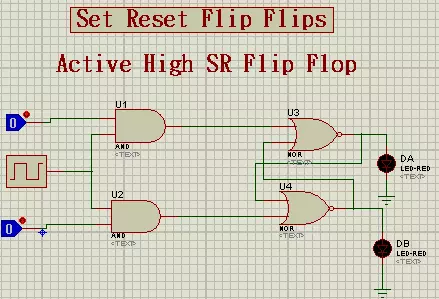
Hello Learners! welcome from the team of The Engineering Projects. We hope you are having a productive day. We are working on a series of Blogs based upon the core knowledge about Digital Logic Gates and Circuits. In this tutorial, we'll know about the SR Flip Flops and after brief introduction we will simulate SR Flip Flops in Proteus. Let's have a glimpse on the topics of today: What are Flip Flops? What are the types of Flip Flop? How does we design the Truth Table of SR Flip Flops? What are further classes of SR Flip Flips? Implementation of SR Flip Flops in Proteus. Flip Flops Flip Flops are extremely important Circuits of Digital Logic Design. We Introduce the Flip Flops as: " Flip Flops are type of sequential Logic Circuit that contain two stable states " Zero " and " One " (because ...
Hello Learners, hope you are doing well. I am here with a new tutorial. We'll discuss about Junction Field Effect transistors . In this tutorial, we will learn the basic Introduction to JFET nad will also have a look at its practical Implementation and simulation in Proteus. Basically, Junction Field Effect is a type of transistor, similar to Bipolar Junction Transistors but they have different characteristics due to some reasons as discussed below: Introduction to JFET We Define the JFET as: "Junction Field Effect transistors or simply JFET is the semiconductor ,Voltage Control, three terminal device that is present in both configurations either N channel or P channel." JFET are named so because the the operation of JFET relies on the Field of the input gate voltage thus they are voltage ...
Hello Pupils! I welcome you to The Engineering Projects . I hope you are having a good day. In our previous lectures, we simulated almost all the DLD Logic Gates i.e. AND, OR, NOT, NOR, NAND, XOR and XNOR. I hope now you must have a complete understanding of the logic gates and their working. Now, it's time to have a look at the reason for inventing these logic gates. These DLD logic gates are used to design different numerical modules i.e. adder, subtracter, multiplexer, de-multiplexer, encoder, decoder etc. These arithmetic modules are normally used in electronic products i.e. a simple microcontroller has numerous adders/subtractors for properly calling the registers' addresses. So, from today onward, we are going to discuss these applications of logic gates one by one. Today, we will fo ...
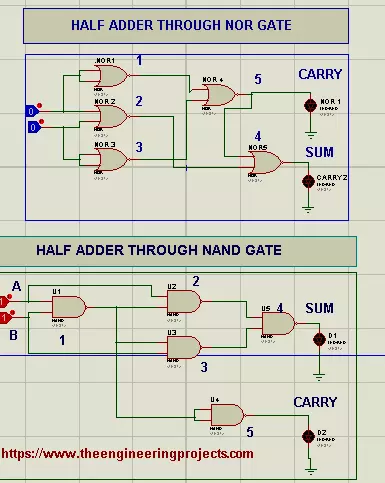
Hello Pupils! I welcome you to The Engineering Projects. I hope you are having a good day. In our previous lecture, we discussed Half-Adder Circuit Designing with XOR and AND logic gates. Today, we are going to design the same circuit using universal logic gates i.e. NOR and NAND gates. We are going to learn the following topics, in today's lecture: What is Adder? What is Half Adder? How can We make Half Adder Circuit through NAND Gate? How can We make Half Adder through just NOR Gate? Hence without wasting time, Let's find all the Answers. What is Adder? As we discussed in the last lecture, the DLD Adder is a simple electronic circuit, used to add binary numbers in bit form. There are two types of DLD Adders, named: Half Adder Full Adder In this article, we'll focus on the Half Adder only ...
Hello Learners! Welcome to The Engineering Projects. In the previous tutorial, we discussed the first universal gate i.e. NOR Gate and simulated it in Proteus. Today, we are going to focus on the second universal gate i.e. NAND Gate. We will also derive basic logic gates from the NAND gate, to prove its universality. Today, we'll seek the answers to the following questions: What is a NAND Gate? What is a Universal Gate? NAND as a Universal Gate. NAND Gate as Universal Gate in Proteus ISIS. Let's get started: What is a NAND Gate? A NAND Gate is designed by inverting the output of AND Gate and thus it gives a LOW output when all of its inputs are HIGH, otherwise, it's HGIH. In order to design a NAND gate, simply place a NOT gate in front of the AND gate. A and B are two inputs of the NAND Ga ...